
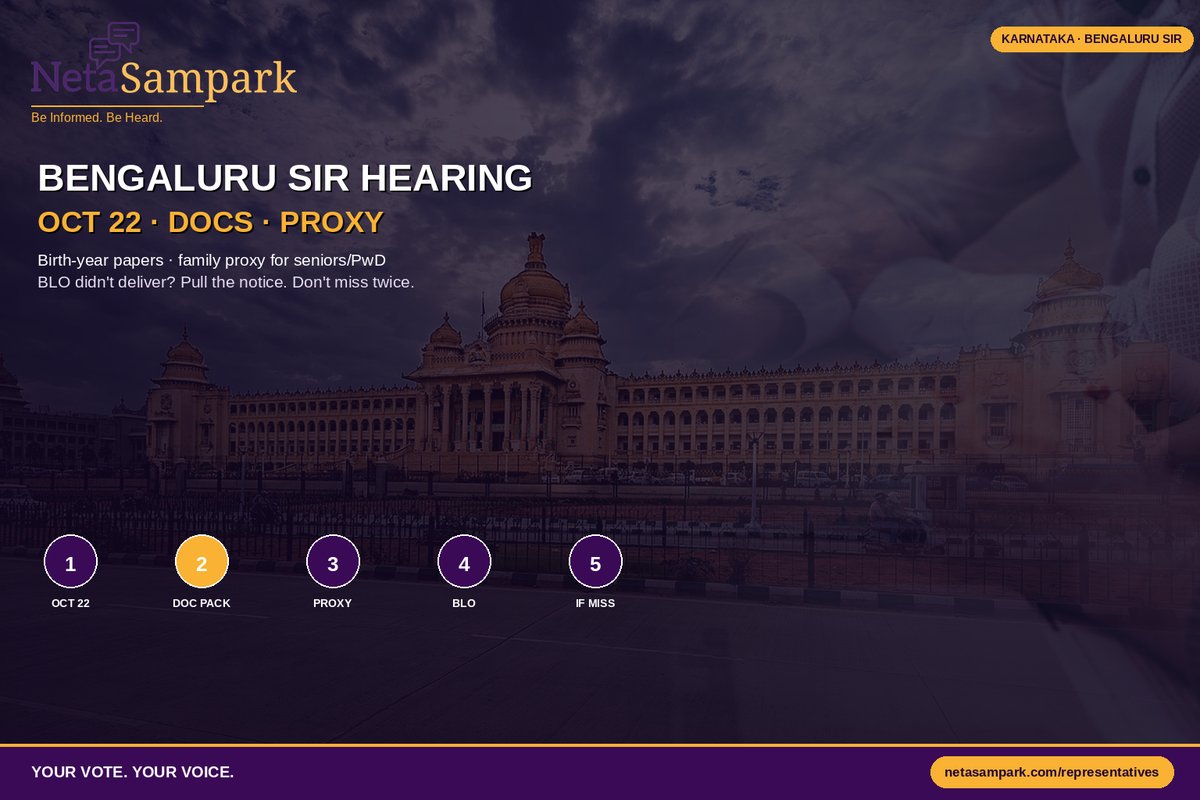
Quick take: A Karnataka SIR hearing notice is a document-checking exercise, not something to ignore because “my name is already on the voter list.” If you're in Bengaluru and have received a No Mapping or Anomaly/Logical Discrepancy notice, prepare the hearing file now, note the 22 October 2026 end of the claims/objections window, and—if the voter is elderly, sick, a person with disability, or otherwise unable to attend—use the newly clarified option for an adult family member to appear on their behalf. (The Indian Express)
This is a Bengaluru-focused citizen guide to the hearing. It is not a Form 6/7/8 tutorial, an appeal guide after deletion, or a general voter-registration explainer.
First: what kind of SIR notice did you receive?
The distinction matters.
No Mapping
Your current voter record could not be linked to the relevant previous SIR electoral roll.
In Bengaluru, officials have reported around 17.81 lakh No Mapping notices alongside about 6.24 lakh anomaly notices. (The New Indian Express)
For a No Mapping case, take the hearing seriously. Your task is to establish your identity and eligibility with the documents requested by the election authorities.
Logical discrepancy / anomaly
Officials found a possible inconsistency in the mapped records—for example, a name mismatch, unusual age relationship, or other data inconsistency.
These cases are generally about verification rather than an automatic deletion decision. (The Times of India)
Don't assume the two categories require exactly the same paperwork. Read the reason printed on your notice.
The 22 October clockFor Karnataka's SIR, the notice/disposal phase and claims-and-objections process runs through 22 October 2026. (The Indian Express)
That doesn't mean you should wait until 22 October to attend a hearing.
Your individual notice date is what matters for the hearing itself.
Think of the dates as two different clocks:
Your notice → hearing appointment
22 October → wider claims/objections deadline
If your hearing is next week, don't wait for October 22.
If you have missed your hearing, contact the election officials immediately rather than assuming the final deadline gives you another automatic appointment.
Your SIR hearing packDon't arrive with a single Aadhaar photocopy and hope for the best.
Create one physical folder for the voter.
Keep the notice on top
Carry:
- Original SIR notice
- Two photocopies
- EPIC/voter ID
- Two photocopies of the EPIC
- Aadhaar, if you use it as an additional identity document
- Other government documents relevant to the case
- Documents connecting the voter to the earlier electoral record, where available
- Current residence/address documents where relevant
- Any previous voter records, slips or EPIC details you can locate
The exact document requirement should follow the notice and the instructions of the Karnataka election authorities.
Build a "then → now" fileThis is particularly useful for older voters.
Instead of handing an officer a pile of unrelated documents, make the story easy to understand.
For example:
2002 / earlier roll:
Voter/parent lived at ______
2008:
Moved to ______
Current address:
Current EPIC:
Relationship to earlier elector:
Then place supporting documents behind each point.
A one-page timeline can save an officer from having to reconstruct 20 years of family history from ten photocopies.
Search the old SIR roll before the hearingThe ECI has an official SIR 2026 "Search your name in last SIR E-Roll" facility. It allows searches using EPIC details or elector details and can search the previous SIR roll by district, Assembly Constituency, polling station/part, serial number and related information. (Voter Information)
This is worth doing before your appointment.
Try:
- Exact spelling
- Alternate spelling
- Parent's name
- Spouse's name
- Previous address
- Old polling station
- Old part/serial number, if known
The ECI itself notes that spelling can vary between older and current records, so an unsuccessful exact-name search doesn't necessarily prove that the older record doesn't exist. (Voter Information)
Screenshot anything useful you find.
What should a senior citizen carry?For an elderly voter, make the folder slightly more comprehensive.
Identity
- EPIC
- Aadhaar
- Passport, if available
- PAN or another government ID, where relevant
Old electoral connection
- Old voter ID
- Old voter slip
- Parent's/spouse's old voter details
- Previous electoral-roll information
- Documents showing the family relationship
Age / family records
- Birth certificate, if available
- SSLC/matriculation certificate
- Marriage certificate where relevant
- Pension/government records that establish identity or family relationship
Address
- Current address document
- Previous address document, where relevant
- Utility bill
- Property/society document
- Other accepted residence evidence
Don't manufacture a "perfect" document set. Take documents you genuinely have and that actually explain the voter's history.
Can your son, daughter or another adult family member go instead?Yes—Karnataka's CEO office has now clarified an important arrangement.
Adult family members can appear before the ERO/AERO on behalf of senior citizens, persons with disabilities, sick persons and overseas electors who cannot conveniently appear themselves. (The Times of India)
That is especially important for Bengaluru's elderly voters.
The family member should carry:
- The voter's SIR notice
- The voter's supporting documents
- Their own identification
- Evidence/authority establishing the relationship where appropriate
- Any documents requested by the ERO/AERO
Don't assume "family member" means anyone can simply walk in.
The representative still needs to go through the election officer's verification process.
Before the hearing, contact the BLO/ERO/AERO mentioned in the notice and confirm exactly what they want the representative to bring.
What if the senior can barely travel?Don't wait until hearing morning.
Officials in Bengaluru have said arrangements can be made for people who are senior citizens, bedridden, injured or otherwise unable to attend in person. Options reported include deputing a family member or having officials visit the person's home. (The New Indian Express)
So the practical sequence is:
Notice received → call BLO/ERO → explain the limitation → request the appropriate arrangement → get the arrangement/date confirmed.
Keep a screenshot or written record of the request.
VIP treatment isn't the pointThere have been reports of officials conducting verification at the homes of certain VIPs, including senior politicians and other prominent individuals. (The Times of India)
But ordinary elderly voters shouldn't conclude that doorstep verification is reserved for famous people.
The important development is the broader clarification that adult family members can represent eligible elderly, sick, PwD and overseas voters.
Ask for the same accessibility arrangement based on the voter's circumstances—not their status.
What happens inside the hearing?Bengaluru officials have described hearings being conducted between approximately 10 a.m. and 5 p.m., with EROs/AEROs examining the notices and documents. (The New Indian Express)
Your practical job is simple:
1. Show the notice
Make sure you're at the correct venue.
2. Give the documents requested
Don't dump originals on the desk.
Give copies and show originals for verification.
3. Explain the linkage
If this is a No Mapping case, explain the family/address trail clearly.
4. Ask what happens next
Before leaving, ask:
"Has my appearance been recorded?"
"Is any further document required?"
"How will I know the decision?"
Write down the answer.
Don't surrender your originals casuallyThis deserves its own rule:
Show originals. Submit copies unless the officer specifically requires otherwise.
If an original must be retained, ask for an acknowledgement describing what was taken.
Your passport, birth certificate or property document may be difficult to replace.
A hearing should not turn into an accidental document-loss exercise.
What if you miss the hearing?Don't panic—but don't disappear either.
Call the number on the notice or contact the relevant BLO/ERO/AERO immediately.
Explain:
- Why you missed it
- Whether you received the notice late
- Whether the voter is elderly/sick/PwD
- Whether a family member can appear
- Whether you need another date or home verification
Get the next step in writing if possible.
Do not assume that 22 October automatically gives you a fresh hearing date.
The 22 October deadline and your individual hearing appointment are separate things.
The "senior citizen envelope"If you're helping an elderly parent or grandparent, prepare this before the hearing:
Envelope 1 — Notice
☐ Original notice
☐ 2 copies
Envelope 2 — Identity
☐ EPIC
☐ Aadhaar
☐ Other government ID
Envelope 3 — Old record
☐ Old EPIC/slip
☐ Previous roll information
☐ Parent/spouse details
Envelope 4 — Address
☐ Current address proof
☐ Previous address evidence, if useful
Envelope 5 — Family representative
☐ Representative's ID
☐ Relationship evidence
☐ Any written request/authority document
Put the originals in a separate transparent folder.
One-page hearing sheetPut this at the front of the file:
Voter: __________________
EPIC: __________________
Part/Serial: __________________
Notice category: No Mapping / Anomaly
Hearing date: __________________
Venue: __________________
ERO/AERO: __________________
BLO: __________________
Current address: __________________
Old address/roll connection: __________________
Representative, if any: __________________
Documents submitted:
Next action: __________________
Next date: __________________
This sounds excessively organised until you're sitting in a crowded verification centre trying to remember which document your father used in 2002.
If you discover the old record onlineSave three things:
Screenshot 1: Search parameters
Screenshot 2: Matching old elector record
Screenshot 3: Current voter record/EPIC information
Don't rely on the officer having to reproduce your search at the counter.
The ECI's SIR search portal itself warns that older data may contain spelling variations and advises trying different variations where an exact search doesn't work. (Voter Information)
Don't let WhatsApp become your election officeBe particularly suspicious of messages saying:
- "Everyone must submit this document."
- "Aadhaar is the only document accepted."
- "You can send your son without informing anyone."
- "No hearing is required."
- "The deadline has already passed."
- "Your name is definitely deleted."
The actual notice and election authorities should settle those questions.
The ECI's official voter/SIR infrastructure currently provides SIR information and the facility to search previous SIR rolls. (Voter Information)
For help, the ECI also lists 1950 as its toll-free voter helpline. (Election Commission of India)
What if the officer says your documents aren't enough?Don't argue that the officer is "wrong" immediately.
Ask:
"Which additional document would establish the missing link?"
Then write down the answer.
If they ask for something you don't possess, ask what alternative accepted document can establish the same fact.
The goal is to close the evidentiary gap—not win an argument at the counter.
Hearing-day checklistTaskDone?Read the exact notice category☐Confirmed venue/date/time☐Searched previous SIR roll☐Saved useful old-roll evidence☐Organised identity documents☐Organised linkage/family documents☐Organised address documents☐Made two copy sets☐Prepared one-page timeline☐Confirmed BLO/ERO contact☐Arranged family representative if needed☐Asked about home verification if required☐Recorded appearance/acknowledgement☐Noted next step/date☐Marked 22 October on calendar☐For families with an elderly voter: do this this weekDon't wait until the hearing morning.
Day 1: Find the notice.
Day 2: Search the previous SIR roll.
Day 3: Collect old voter/family/address documents.
Day 4: Make copies and prepare the timeline.
Day 5: Call the BLO/ERO if the voter cannot attend personally.
Before the hearing: Put everything into one labelled folder.
Five small steps beat one giant panic trip to the election office.
And after the hearing?
Keep watching the electoral-roll status.
If an adverse decision is made, the next legal/administrative remedy is a separate question from preparing for the hearing. Don't mix the two processes.
For now, your objective is narrower:
Show up—or arrange an authorised family representative/home process.
Bring evidence.
Get your appearance recorded.
Know the next date.
Don't miss the wider 22 October deadline.
Where NetaSampark fits
SIR verification itself belongs with the Election Commission/CEO/ERO machinery.
NetaSampark's role is different: helping citizens identify the relevant elected representatives when a broader implementation problem needs civic attention.
For example, if an entire apartment complex of elderly voters is unable to obtain accessible hearing arrangements, document the pattern first—names need not be public—and then take the factual issue to the appropriate representative.
Keep the individual electoral case with the election authorities.
Don't ask a representative to "fix" someone's voter eligibility. Ask them to help surface a genuine access or implementation problem.
Soft close
For Bengaluru families, a SIR notice is not the moment to start searching for documents.
Build the hearing pack now. Search the old roll. Mark 22 October. And if an elderly or sick voter cannot travel, don't assume they have to. Ask about the family-representative or home-verification route.
A voter should not lose their voice because a 90-year-old had trouble standing in a queue.
Be informed. Be heard.
Non-partisan civic explainer. SIR procedures, deadlines, document requirements and accessibility arrangements can change; confirm the current position from the notice, Karnataka CEO/ECI channels or the relevant ERO/AERO. Current editorial check: 12 September 2026.