
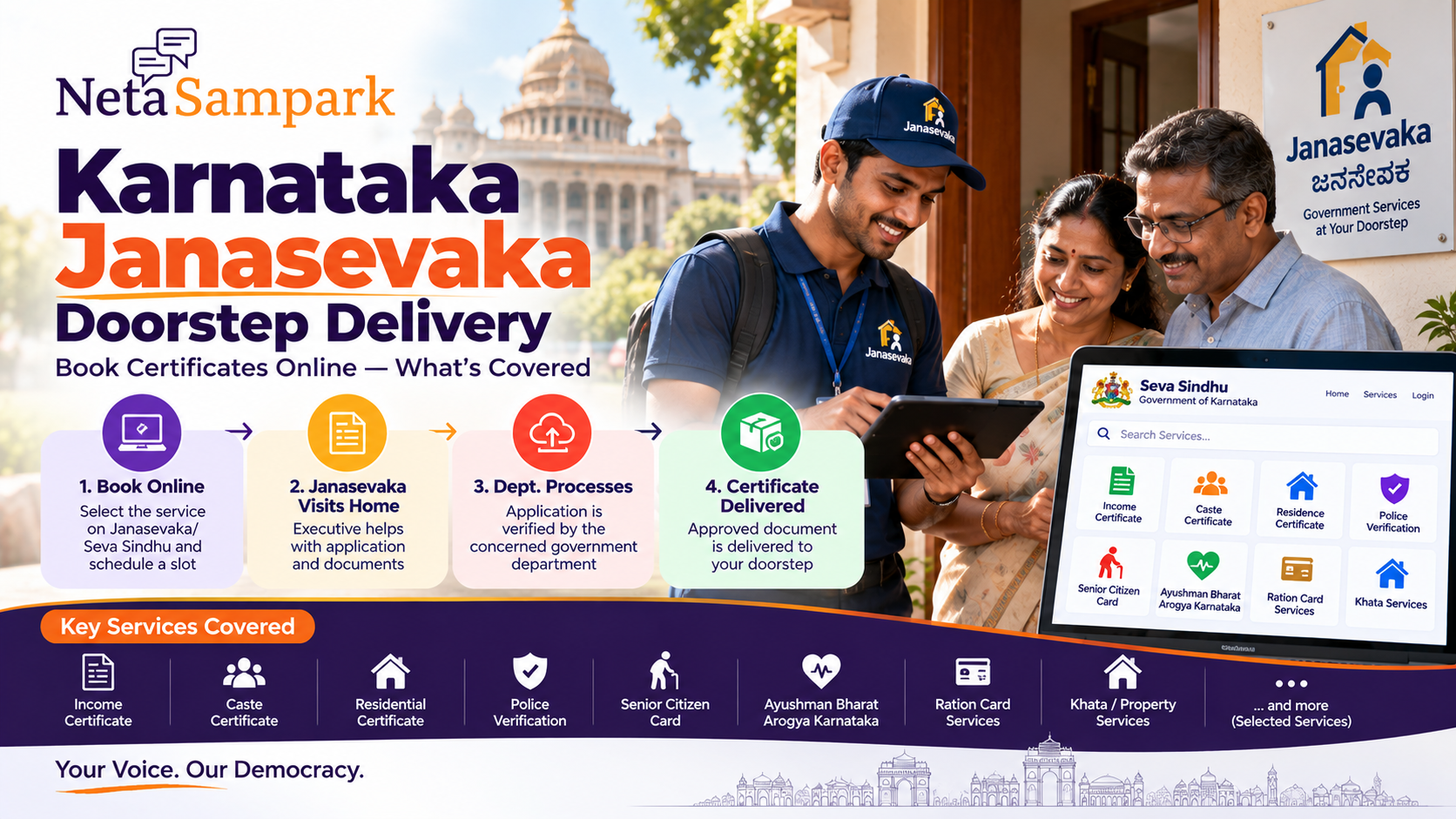
Quick take: Janasevaka is Karnataka’s doorstep-assisted channel for selected government services available through the broader Seva Sindhu ecosystem. Instead of travelling to a government office or service centre, an assigned Janasevaka can visit your home, help with the application and document submission, and the department processes the request. Once approved, the relevant certificate, card, licence, NOC or other output can be delivered through the service. (DARPG)
The important catch: Janasevaka does not cover every Seva Sindhu service. The available service list and geographic availability can change, so check the current Janasevaka list before booking.
What Janasevaka actually does
Think of it as:
Government service
→ Seva Sindhu
→ Janasevaka doorstep assistance
→ Department processes application
→ Certificate / document delivered
It is a delivery channel, not a separate certificate-issuing authority.
The underlying department still decides whether your application is approved.
Which certificate services are covered?
Historically, Janasevaka has included several high-demand citizen services.
Government/public-administration material records services including:
- Income Certificate
- Caste Certificate
- Residential Certificate
- Senior Citizen Card
- Police Verification Certificates
- Ayushman Bharat–Arogya Karnataka Health Card
- Labour-related cards/services
- Selected pension-related services
- Selected Khata/property services
- Aadhaar-related services
- APL ration-card service
The original Janasevaka rollout covered services from multiple departments; government material described 58 services across 8 departments in the programme at that stage. (India Today)
Do not treat the old 58-service figure as today's guaranteed list. Seva Sindhu and Janasevaka service menus have evolved, and the current service availability should be checked before booking.
The certificates people commonly look for
Income Certificate
Useful for applications where income eligibility needs to be established, such as certain scholarships, concessions and welfare services.
Janasevaka can provide the assisted application route where the service is currently listed for your location.
Caste Certificate
For eligible applicants requiring official caste documentation for education, employment, schemes or other purposes.
The Janasevaka executive assists with submission; the competent department remains responsible for verification and issuance.
Residential Certificate
A residential certificate can be required for state-specific education, recruitment or welfare purposes.
Don't confuse this with simply showing Aadhaar or a utility bill.
Police Verification / PCC-type services
Janasevaka has historically included several police verification services, including address/antecedent verification for specified purposes. (Status In)
The exact certificate type matters, so select the service that matches what your employer, institution or authority requested.
Other services beyond certificates
Janasevaka isn't only a certificate-delivery programme.
The service catalogue has included categories such as:
Revenue
→ Income/caste certificates and pension-related services
BBMP/property
→ Selected Khata services
Police
→ Selected verification certificates
Health
→ Ayushman Bharat–Arogya Karnataka health card
Labour
→ Construction-worker welfare-board services
UIDAI
→ Selected Aadhaar services
Food & Civil Supplies
→ Selected ration-card services
Senior citizens
→ Senior Citizen Card
These categories are based on published Janasevaka service descriptions; the current portal listing should be treated as the operational source of truth. (Status In)
Janasevaka vs Seva Sindhu
This distinction matters.
ServiceWhat it isSeva SindhuKarnataka's common online government-service platformJanasevakaDoorstep-assisted delivery channel for selected servicesGramaOneCitizen-service centre model at Gram Panchayat levelKarnatakaOne / BengaluruOnePhysical assisted-service centres
Seva Sindhu integrates multiple delivery channels, including Janasevaka, GramaOne, KarnatakaOne and BengaluruOne. (DARPG)
So if a service exists on Seva Sindhu, that does not automatically mean a Janasevaka can come to your home for it.
How to book Janasevaka
The service has historically been available through:
- Janasevaka's online booking interface
- Government mobile-service channels
- Call-centre assistance
Published Janasevaka information identifies the Bengaluru booking number as:
080-4455-4455. (Karnataka)
Before publishing this number in a live guide, verify it against the current official Janasevaka/Seva Sindhu page because government contact channels can change.
Step 1 — Find your service
Don't start by booking a doorstep visit.
First ask:
What exactly do I need?
For example:
College asks for income certificate
→ Select Income Certificate
not simply “Revenue Department service.”
Employer asks for police clearance
→ Identify the exact police verification/PCC service required.
State-quota admission asks for residence proof
→ Check whether it specifically requires a Residential/Domicile/Nativity Certificate.
The wrong certificate can still be perfectly genuine — and still be rejected.
Step 2 — Check the document list
The Janasevaka booking process is designed to tell you what documents are required for the selected service.
Prepare:
- Identity proof
- Address/residence evidence
- Existing certificates where applicable
- Supporting records
- Passport-size photograph, where required
- Application-specific declarations
- Any documents specified by the department
Don't upload or hand over every document you own.
Use the service-specific checklist.
Step 3 — Choose a slot
Janasevaka was designed around convenient doorstep scheduling. Government documentation describes doorstep slots between 8 AM and 8 PM, though current availability should be checked during booking. (DARPG)
Choose a slot when someone can actually be present at the address.
Step 4 — Keep your phone nearby
The workflow has historically used an OTP-based confirmation at the doorstep. (Yojana39)
Important
Don't tell an unknown caller your OTP.
Use it only in the intended Janasevaka transaction and only when the authorised service representative is actually handling your booked service.
Step 5 — Janasevaka visits your home
The executive can assist with:
- Checking documents
- Filling/submitting the application
- Scanning documents
- Uploading documents
- Collecting applicable fees
- Providing acknowledgement/reference information
The published programme description says the doorstep executive collects the required documents and assists with the application. (The Indian Express)
Step 6 — Department verification happens
This is an important distinction.
The Janasevaka representative does not decide whether your certificate should be issued.
The relevant government department processes the application.
If your documents don't establish eligibility, the application can still be rejected.
Doorstep service means:
easier submission
—not—
automatic approval.
Step 7 — Track the application
Save the:
- Application number
- Acknowledgement
- Transaction/receipt details
- Service name
- Date of submission
Seva Sindhu supports application-status tracking as part of its service workflow. (Informatics)
If someone tells you:
“Don't worry, we'll handle everything.”
still keep your own acknowledgement.
Step 8 — Receive the output
Depending on the service, the output can be a:
- Certificate
- Card
- NOC
- Permission
- Licence
- Other department-issued document
Published descriptions of Janasevaka explicitly describe doorstep delivery of certificates, NOCs, permissions and licences after departmental processing. (The Indian Express)
What does Janasevaka cost?
There can be two different components:
1. Government/department fee
This depends on the particular service.
2. Janasevaka facilitation/service charge
Historical programme documentation records a ₹115 facilitation charge, separate from the department fee. (Status In)
Because fees and service lists can change, check the amount shown during the current booking process before paying.
Ask for a receipt.
What Janasevaka does NOT mean
It doesn't mean every government service comes home
Only services enabled for Janasevaka can use the doorstep route.
It doesn't guarantee approval
The department still verifies your application.
It doesn't replace eligibility rules
A Janasevaka executive cannot make an applicant eligible for a certificate or scheme.
It doesn't mean you should hand over original documents permanently
Provide documents only as required by the official process and keep your originals with you unless the specific procedure explicitly requires otherwise.
It doesn't mean you need an agent
Janasevaka itself is designed as an assisted government-service channel.
Example: income certificate
Suppose a student needs an income certificate for a scholarship.
The workflow is:
Check scholarship requirement
↓
Select Income Certificate
↓
Check required documents
↓
Book Janasevaka slot
↓
Executive visits home
↓
Documents scanned/submitted
↓
Application acknowledged
↓
Revenue authority processes it
↓
Certificate issued
↓
Download/receive certificate
The Janasevaka representative helps with the application journey; the revenue authority decides the certificate.
Example: caste certificate
Before booking, check:
- Applicant's existing caste/community records
- Parent/family documentation where required
- Identity proof
- Address/residence evidence
- Any state-specific supporting documents
Then submit through the available Janasevaka route if the service is currently listed.
Don't assume the document list from a 2021 blog is still sufficient in 2026.
Example: residential certificate
This is particularly important for students.
If an admission portal asks for:
Karnataka domicile certificate
don't automatically apply for a generic address certificate.
First read the admission notification and identify the exact certificate required.
Senior citizens and people with mobility difficulties
Doorstep delivery has a practical advantage here.
Government documentation describes Janasevaka as an assisted delivery model intended to make services more accessible, including for citizens who may find travel to service centres difficult. (DARPG)
For an elderly parent:
Prepare documents → book slot → keep phone available → verify acknowledgement → track application.
You don't necessarily need to send them to a crowded service centre.
What if your service isn't listed?
Don't force a different service just because it sounds similar.
Use the broader Seva Sindhu service catalogue or the appropriate Karnataka citizen-service centre.
Depending on the service, alternatives can include:
- Seva Sindhu self-service
- GramaOne
- BengaluruOne
- KarnatakaOne
- Department portal
- CSC/authorised service centre
Seva Sindhu was designed to bring multiple government departments and delivery channels together. (DARPG)
If the Janasevaka doesn't arrive
Keep:
- Booking/reference number
- Slot date and time
- Registered mobile number
- Service name
Then use the official support/grievance channel.
Karnataka's Janaspandana/iPGRS system also provides grievance registration and currently lists 1902 as its grievance call number. (PGRS)
If you are asked for extra money
Ask:
“Is this an official department fee or service charge? Can I get a receipt?”
Don't confuse:
government fee
with
unofficial convenience payment.
If there is a problem, preserve the receipt/application details and use the official grievance route.
Five things to save
After your Janasevaka visit, keep:
1. Application number
2. Payment receipt
3. Service name
4. Submitted-document copy
5. Expected/status information
These five items make follow-up dramatically easier.
The citizen checklist
Before booking:
☐ Confirm exact certificate/service required
☐ Check current Janasevaka availability
☐ Read document list
☐ Prepare clear copies/scans
☐ Keep originals available for verification
☐ Check official fees
☐ Book a convenient slot
☐ Keep registered mobile nearby
☐ Get acknowledgement
☐ Track application
☐ Verify certificate after delivery
One important 2026 caveat
The Janasevaka programme has existed for several years and its service catalogue has changed over time. Older articles describe 53, 56 or 58 services, while later Seva Sindhu material describes a much broader overall service ecosystem. (India Today)
Therefore, don't publish a fixed “58 services” list as though it is the September 2026 live catalogue.
The current Janasevaka service-selection screen is the practical source of truth for what can be booked today.
How NetaSampark helps
Karnataka already has multiple government-service rails — Seva Sindhu, Janasevaka, GramaOne, BengaluruOne and KarnatakaOne. The difficult part for citizens is often knowing which service to select, which documents to prepare and whether doorstep delivery is actually available.
Use NetaSampark Explore Guides to understand the workflow before you book.
Be Informed. Be Heard.