
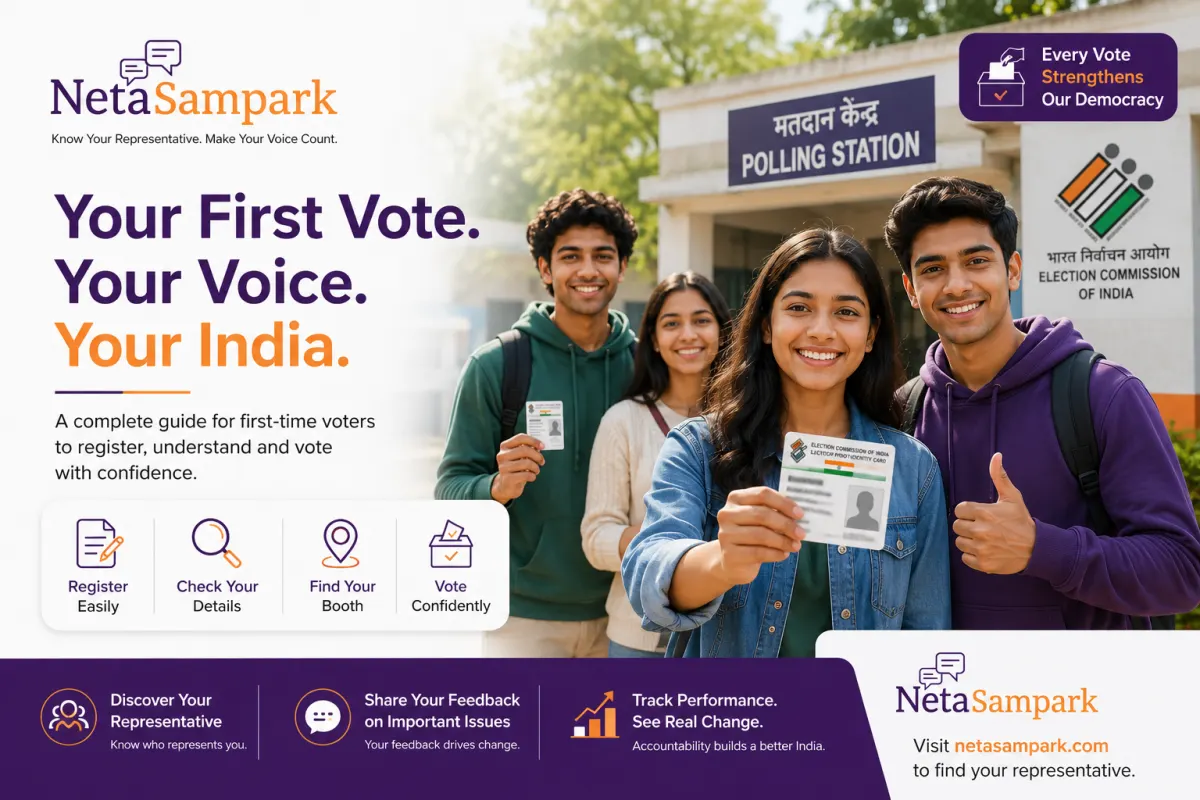
First-Time Voter Guide for India: How to Register, Get Your Voter ID & Vote
If you are voting for the first time in India, you may have questions about voter registration, Voter ID, documents, polling booths and what actually happens on election day.
The good news is that the process is straightforward once you know what to do.
This first-time voter guide explains the process step by step — from checking whether you are eligible to vote, to registering as a voter, finding your polling booth and understanding what to expect when you cast your first vote.
Who Can Become a Voter in India?
To register as a voter, you generally need to:
- Be an Indian citizen.
- Be at least 18 years old.
- Be ordinarily resident in the constituency where you are registering.
- Not be disqualified from voting under applicable law.
India provides multiple qualifying dates during the year for determining eligibility: 1 January, 1 April, 1 July and 1 October.
This means eligible young citizens do not necessarily have to wait until the next year to register if they become eligible during the year.
How to Register as a First-Time Voter
If you are registering for the first time, you need to submit Form 6.
You can apply through the Election Commission's voter services system or through the appropriate electoral registration authorities.
The process generally involves:
- Providing your personal details.
- Providing your address and constituency information.
- Providing the required age and residence documents.
- Uploading or submitting supporting documents where required.
- Submitting the application.
- Tracking the application and waiting for verification.
Make sure the information you provide is accurate, especially your name, date of birth and residential address.
What Is Form 6?
Form 6 is the application form used by eligible Indian citizens for inclusion of their name in the electoral roll as a new voter.
If you have never been registered as a voter before, Form 6 is generally the form you need.
Do not use Form 6 simply because you have lost your Voter ID or need to correct an existing voter record. Different forms are used for different voter-service requests.
What Documents Do First-Time Voters Need?
The exact supporting documents can depend on your circumstances and the current Election Commission requirements.
You may be asked to provide documents relating to:
- Your age or date of birth.
- Your ordinary residence.
- Your identity and other application details.
Keep clear copies of the relevant documents ready before beginning your application.
An important point for new voters: Aadhaar should not be treated as universally mandatory for voter registration. The current Form 6 provides for applicants who do not have an Aadhaar number.
Always check the latest Election Commission requirements before submitting your application.
Can I Register Online?
Yes. New voters can use the Election Commission's online voter-services system to submit an application.
The online process can make registration more convenient because you can enter your information, submit documents and track the status of your application digitally.
However, online submission does not necessarily mean that every part of the process happens automatically. Electoral authorities may carry out verification before your name is included in the electoral roll.
How Do I Check Whether I Am Registered?
After submitting your application, check your application status and verify that your name appears in the electoral roll.
This is important because simply submitting a voter-registration application does not mean you should assume that you are already registered.
Before an election, check your voter information early rather than waiting until election day.
Make sure your:
- Name is correct.
- Constituency is correct.
- Address information is correct.
- Electoral-roll entry is available.
How Do I Find My Polling Booth?
Once you are registered, you can find information about your polling station through the Election Commission's voter-services tools.
Your polling station is determined by your electoral-roll details.
Do not assume that your polling booth will be the same one used by your friends, neighbours or family members. Always check your own voter information.
What Should I Take on Election Day?
Before election day, check the latest instructions issued by the Election Commission for your election.
Carry the identification document permitted for voting and make sure your name is present in the electoral roll.
It is also a good idea to check your polling station in advance so you know where you need to go.
What Happens at the Polling Station?
For a first-time voter, the process may seem unfamiliar, but polling stations are designed to guide voters through the process.
Typically, officials verify your identity and electoral-roll information before you are allowed to cast your vote.
You then proceed through the voting process and cast your vote using the voting system provided at the polling station.
Follow the instructions of the polling officials and do not photograph or otherwise interfere with the secrecy of your vote.
How Should a First-Time Voter Choose a Candidate?
Getting registered is only the first step.
The more important question is: How should you decide whom to vote for?
Do not make your decision solely on the basis of social-media posts, forwarded messages or political advertisements.
Instead, consider questions such as:
1. What has the candidate done?
Look at the candidate's experience, public work and previous record where information is available.
2. What are the important issues in your constituency?
Think about the problems that directly affect your community.
For example:
- Roads
- Traffic
- Water
- Waste management
- Drainage
- Public transport
- Schools
- Healthcare
- Employment
- Safety
- Local infrastructure
3. What does the candidate promise?
Read or listen to the candidate's stated priorities.
More importantly, consider whether those promises relate to responsibilities that the candidate or elected office can actually influence.
4. Can you verify the information?
Before sharing or believing political claims online, try to verify them using reliable sources.
Your vote is your decision. Take the time to understand the choices available in your constituency.
What Is the Difference Between an MLA and an MP?
One of the most common questions for first-time voters is the difference between an MLA and an MP.
An MLA, or Member of the Legislative Assembly, represents an assembly constituency at the state level.
An MP, or Member of Parliament, represents a parliamentary constituency at the national level. MPs can be elected to the Lok Sabha or be members of the Rajya Sabha through the applicable constitutional and electoral processes.
Understanding this distinction is important because different levels of government have different responsibilities.
If you have a local problem, knowing whether it falls under your municipal body, state government, central government or elected representative can help you approach the right authority.
Your Vote Is Not the End of Civic Participation
Voting is an important part of democracy, but citizens do not have to wait until the next election to participate.
You can also:
- Learn about your elected representatives.
- Follow issues affecting your constituency.
- Give constructive feedback.
- Raise concerns about local problems.
- Participate in community discussions.
- Ask representatives to address issues.
- Track public commitments and work.
- Encourage others to participate responsibly.
Democracy works better when citizens stay engaged between elections as well as during elections.
Find Your Representative on NetaSampark
Once you know your constituency, the next step is understanding who represents you.
NetaSampark helps citizens discover and engage with their elected representatives in a more structured way.
You can use NetaSampark to explore representative information, understand who represents your area and participate in citizen feedback.
Find your representative.
Know who represents you. Understand their work. Make your voice count.
First-Time Voter Checklist
Before your first election, make sure you have:
- Checked that you are eligible to register.
- Submitted Form 6 if you are a new voter.
- Provided the required information and supporting documents.
- Checked your application status.
- Confirmed that your name appears in the electoral roll.
- Verified your constituency details.
- Found your polling station.
- Checked the latest election-day requirements.
- Learned about the candidates in your constituency.
- Researched the issues that matter to your community.
- Made an informed voting decision.
Frequently Asked Questions
Can I register to vote when I turn 18?
Yes, eligible Indian citizens can register when they meet the age requirement and other eligibility conditions. The Election Commission uses four qualifying dates during the year: 1 January, 1 April, 1 July and 1 October.
Which form is used for first-time voter registration?
Eligible Indian citizens applying for inclusion in the electoral roll as new voters generally use Form 6.
Is Aadhaar mandatory for voter registration?
Aadhaar should not be assumed to be mandatory for every voter-registration applicant. The current Form 6 provides an option for applicants who do not have an Aadhaar number.
Can I vote if I have a Voter ID but my name is not on the electoral roll?
You should verify your electoral-roll entry before election day. Having an identification document by itself should not be treated as a substitute for being properly registered in the electoral roll.
How can I find my polling booth?
Use the Election Commission's voter-services facilities to check your electoral-roll and polling-station information before election day.
What should I consider before voting for a candidate?
Consider the candidate's record, experience, priorities, public commitments and relevance to the responsibilities of the office. Also research the issues affecting your constituency and verify important claims.
Your First Vote Is the Beginning
Your first vote is more than a milestone.
It is your opportunity to participate in India's democracy and have a say in who represents your community.
But civic participation should not end after you leave the polling station.
Know your constituency. Know your representatives. Understand the issues. Ask questions. Give feedback. Stay involved.
Your voice matters between elections too.
Official sources
Confirm fees, dates and eligibility on the official page before you act.