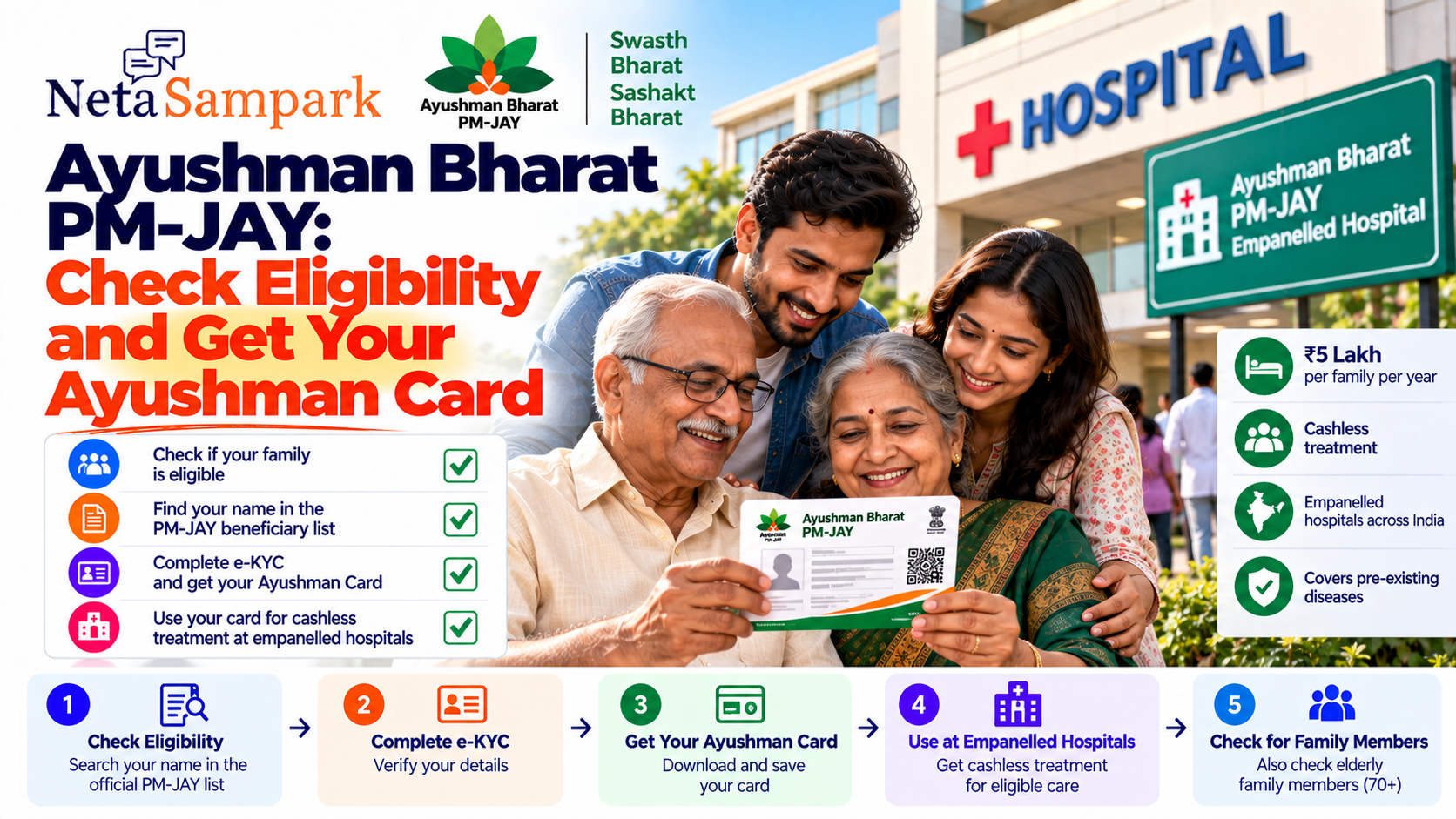
The Ayushman Bharat Pradhan Mantri Jan Arogya Yojana (AB PM-JAY) provides health coverage for eligible families for secondary and tertiary hospitalisation. The scheme provides coverage of up to ₹5 lakh per family per year for eligible hospitalisation expenses at empanelled public and private hospitals.
If you want to use PM-JAY, the first step is not simply to download a card. Check whether your family is eligible and whether your beneficiary record can be found in the official system.
What is Ayushman Bharat PM-JAY?
PM-JAY is a Government of India health-assurance scheme administered by the National Health Authority (NHA).
For eligible beneficiaries, the scheme provides:
- Up to ₹5 lakh coverage per family per year
- Cashless treatment at empanelled hospitals
- Coverage for listed secondary and tertiary hospitalisation
- Portability across India at participating hospitals
- No restriction based on family size, age or gender for eligible beneficiary families under the scheme.
The ₹5 lakh amount is a family-floater coverage, rather than ₹5 lakh separately for every member.
Who is eligible for PM-JAY?This is one of the most important points.
For the original PM-JAY beneficiary base, eligibility is determined primarily from government databases used to identify eligible households rather than simply allowing anybody to register for the scheme.
The original beneficiary identification was based largely on deprivation and occupational criteria from the Socio-Economic Caste Census (SECC) 2011.
States and Union Territories can also use their own beneficiary databases in accordance with the applicable scheme arrangements.
There is also an important expansion for senior citizens.
In 2024, the Government expanded AB PM-JAY to provide coverage to all citizens aged 70 years and above, irrespective of their socio-economic status, subject to the scheme's applicable conditions.
So if someone in your family is 70+, check their eligibility even if the family was not previously covered.
How to check your eligibilityUse the official PM-JAY beneficiary system rather than relying on third-party websites.
The beneficiary search process can generally use details such as:
- Mobile number
- Name
- State
- District
- Other identifying information available in the beneficiary database
The objective is to determine whether your household or individual record appears in the PM-JAY beneficiary database.
Basic process
Open the official PM-JAY beneficiary portal
↓
Select your state
↓
Search using the available identification details
↓
Find your family/member record
↓
Complete beneficiary verification if required
↓
Proceed with Ayushman Card creation
Don't assume that having Aadhaar automatically makes you eligibleThis is a common misunderstanding.
Aadhaar is an identity document. It is not, by itself, universal proof of PM-JAY eligibility.
For the original PM-JAY beneficiary population, eligibility comes from the applicable beneficiary database/criteria.
Aadhaar can be used as an identification/authentication document during beneficiary verification.
So the correct sequence is:
Eligibility → beneficiary verification → Ayushman Card
not:
Aadhaar → automatic PM-JAY eligibility
What is an Ayushman Card?The Ayushman Card is the beneficiary identification card used to access PM-JAY services.
It helps the hospital identify and verify an eligible beneficiary when treatment is sought.
Having a card is useful, but what matters is that the person is an eligible beneficiary and can be verified through the PM-JAY system.
How to get your Ayushman CardOnce your beneficiary record is found, the card-generation process can be completed through the authorised PM-JAY/Ayushman systems.
The process may involve:
- Finding your beneficiary record
- Selecting the family/member
- Completing identity verification
- Providing the required information
- Completing e-KYC where applicable
- Generating the Ayushman Card
- Downloading/saving the card
The exact steps can differ depending on the beneficiary category and the current portal/app workflow.
What documents should you keep ready?Before starting, keep commonly requested identification information available.
Useful documents/details
☐ Aadhaar card or other accepted identity document
☐ Mobile phone
☐ Mobile number linked to the relevant identity, where applicable
☐ Ration card/family details, if applicable
☐ Existing Ayushman Card, if you already have one
☐ Beneficiary/family identification details
The exact documentation required can depend on the beneficiary-verification process.
Don't upload documents to unofficial websites simply because they claim to generate an Ayushman Card.
What if your name is not found?Don't immediately conclude that you are not eligible.
Try the official search using the available alternatives.
For example:
- Check the spelling of your name
- Try the family member's details
- Check the state selected
- Check the district
- Try the available beneficiary identifiers
- Ask an authorised Ayushman/PM-JAY help desk to check the record
If your family is eligible but the record cannot be located, the authorised channel can explain the applicable process.
What about people aged 70 and above?This deserves separate attention.
The Union Cabinet approved the expansion of AB PM-JAY to cover all senior citizens aged 70 years and above, irrespective of their socio-economic status.
The government subsequently launched the Ayushman Vay Vandana Card for eligible senior citizens aged 70+.
So if your parent, grandparent or another family member is 70 or older:
Check their PM-JAY/Ayushman eligibility separately.
Don't assume they need to qualify through the older SECC-based beneficiary criteria.
Can an entire family use the ₹5 lakh?PM-JAY's standard benefit is up to ₹5 lakh per eligible family per year.
It is a family-floater arrangement.
For example, if one eligible family member uses ₹2 lakh for covered hospitalisation, the remaining available coverage is generally ₹3 lakh for that family during the relevant coverage period, subject to the scheme's rules.
The amount isn't automatically ₹5 lakh for each individual.
What treatments are covered?PM-JAY focuses on secondary and tertiary hospitalisation.
The scheme covers specified health benefit packages and associated hospitalisation expenses according to the applicable package rules.
Depending on the package, coverage can include components such as:
- Hospitalisation
- Treatment procedures
- Medicines during the covered hospitalisation
- Diagnostics associated with the covered treatment
- Pre- and post-hospitalisation expenses as specified under the package
The exact coverage depends on the applicable health-benefit package.
Is every hospital covered?No.
PM-JAY treatment is provided through empanelled hospitals.
The network includes both:
- Public hospitals
- Private hospitals
Before planned treatment, verify that the hospital is currently empanelled and that the required speciality/package is available there.
Can you use PM-JAY outside your state?Yes.
PM-JAY has national portability, allowing eligible beneficiaries to receive covered treatment at empanelled hospitals outside their home state.
For example:
Karnataka beneficiary → eligible treatment in Maharashtra
or
Bihar beneficiary → eligible treatment in Delhi
provided the hospital and treatment meet the applicable PM-JAY requirements.
This can be particularly useful for specialised treatment.
Is treatment cashless?For eligible treatment at an empanelled hospital, PM-JAY is designed to provide cashless access to covered services.
However, cashless does not mean that every service, medicine or expense imaginable is automatically covered.
The treatment must fall within the applicable PM-JAY package and scheme rules.
Before admission, ask the hospital's Ayushman help desk what is covered.
What if the hospital asks you to pay?Don't assume every payment request is legitimate or illegitimate.
First ask:
What exactly is this charge for?
Then determine whether it is:
- Outside the PM-JAY package
- An optional service
- A room upgrade
- A non-covered treatment
- A service requiring separate payment under the applicable rules
Ask the hospital's Ayushman/PM-JAY desk to explain the charge.
Keep receipts for anything you pay.
What if the hospital refuses your Ayushman Card?Ask the hospital for the reason.
Possible reasons can include:
- The hospital is not currently empanelled
- The required speciality isn't available
- The particular treatment isn't covered
- Beneficiary verification has not been completed
- Pre-authorisation is pending
- There is a technical problem
If you believe the issue is not being resolved, use the official PM-JAY grievance/support mechanism.
Keep a record of:
- Hospital name
- Date and time
- Patient name
- Beneficiary details
- Department
- Nature of the problem
- Any documents or receipts
If someone needs urgent medical attention, don't delay emergency care simply because you haven't completed the Ayushman Card process.
Go to the appropriate hospital/emergency facility and ask the PM-JAY/Ayushman desk to guide you through beneficiary identification and the applicable process.
For non-emergency planned treatment, complete the eligibility and hospital checks beforehand.
Does PM-JAY cover outpatient treatment?PM-JAY is primarily a hospitalisation-focused scheme, not a general outpatient health plan.
Routine consultations that don't result in covered hospitalisation are not automatically covered simply because you have an Ayushman Card.
Therefore, before visiting a hospital for a routine consultation, check whether the service you need falls within an applicable PM-JAY package.
What about pre-existing diseases?PM-JAY provides coverage for pre-existing conditions from the beginning of the policy/coverage period, subject to the applicable scheme rules.
This is different from many conventional health-insurance policies that may have waiting periods for pre-existing diseases.
Still, the particular treatment must be within the covered package.
Is there a limit on the number of family members?PM-JAY's original scheme design does not impose a family-size or age limit on eligible households.
That means eligible families should not assume that only a fixed number of members can receive the benefit.
The important issue is whether the person belongs to an eligible beneficiary household/category.
Ayushman Card checklistBefore you start:
☐ Check PM-JAY eligibility through an official source
☐ Keep Aadhaar/accepted ID available
☐ Keep your mobile phone available
☐ Check the beneficiary/family record
☐ Complete e-KYC if required
☐ Generate the Ayushman Card
☐ Save a digital copy
☐ Keep a copy accessible to family members
Hospital admission checklistIf treatment is planned:
☐ Verify hospital empanelment
☐ Check that the required speciality is available
☐ Confirm that the treatment is covered
☐ Carry your Ayushman Card
☐ Carry identity documents
☐ Carry medical reports/prescriptions
☐ Ask for the Ayushman help desk
☐ Ask before paying any additional charge
☐ Keep hospital documents and receipts
A simple family checkIf you're checking PM-JAY for your household, don't stop after finding one family member.
Make a list:
Family memberEligibility checkedCard availableActionMember 1YesYesKeep cardMember 2YesNoComplete card processMember 3Check requiredNoVerify beneficiary recordSenior 70+Check separatelyNoCheck Ayushman Vay Vandana eligibility
This is particularly useful for older family members.
Common mistakes to avoid❌ Assuming Aadhaar = PM-JAY eligibility
Aadhaar helps with identification; it doesn't automatically make everyone eligible.
❌ Going to any private hospital
Verify PM-JAY empanelment first.
❌ Assuming every treatment is covered
PM-JAY operates through defined health-benefit packages.
❌ Paying an agent to "activate" your card
Use official PM-JAY channels.
❌ Sharing your OTP
No legitimate support person should need your OTP for an unrelated transaction.
❌ Waiting until hospital admission to check everything
For planned treatment, verify eligibility and hospital coverage beforehand.
Where to get helpUse official PM-JAY/NHA channels for beneficiary and scheme-related assistance.
The PM-JAY beneficiary helpline is:
14555
You can also approach the Ayushman help desk/Arogya Mitra at an empanelled hospital.
If you are already at the hospital, ask specifically for the PM-JAY/Ayushman desk rather than relying on a general reception counter.
The 5-minute Ayushman checkIf you want to know whether your family can use PM-JAY:
1. Search the beneficiary record
↓
2. Verify eligibility
↓
3. Complete e-KYC if required
↓
4. Generate the Ayushman Card
↓
5. Save it
Then, before planned treatment:
Check the hospital + speciality + treatment package.
Official resources
National Health Authority — PM-JAY
Bottom line
First check eligibility. Then complete beneficiary verification and generate your Ayushman Card.
The card can be used for eligible treatment under PM-JAY at empanelled hospitals, including participating hospitals outside your home state through the scheme's portability arrangements.
For families, the most useful checklist is:
Check eligibility → complete e-KYC → get the card → verify the hospital → confirm the treatment package → keep your documents ready.
And if your family has someone aged 70 or above, check their eligibility separately under the expanded senior-citizen coverage.
Eligibility, beneficiary verification, hospital empanelment and package availability can change. Always confirm the current status through the official PM-JAY/NHA channels before planned treatment.