
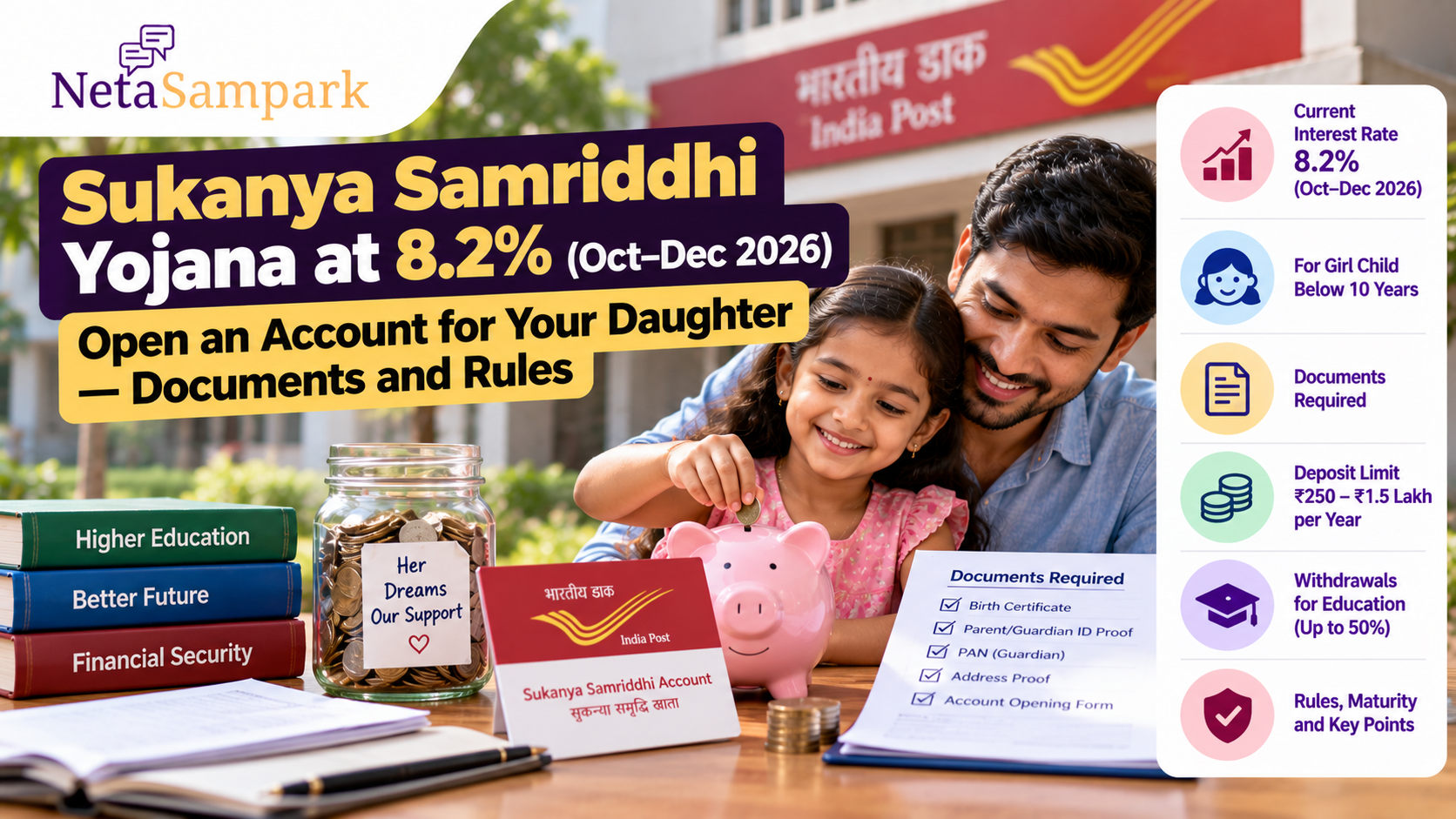
If you have a daughter below 10 years of age, Sukanya Samriddhi Account (SSA) is one of the Government of India's small-savings schemes specifically designed for girl children.
For the October–December 2026 quarter, the interest rate is 8.2% per year. The Department of Economic Affairs lists the Q3 FY 2026–27 small-savings rate notification dated 30 September 2026. DEA
The account can be opened by a parent or legal guardian, requires a minimum annual deposit of ₹250, and normally matures 21 years from the date of opening.
Here is what parents should know before opening one.
What is Sukanya Samriddhi Yojana?
Sukanya Samriddhi is a government-backed small-savings scheme for a girl child below 10 years of age.
The account is opened in the girl's name by her natural or legal guardian. India Post currently lists the interest rate at 8.2%, with rates reviewed every three months. India Post
The scheme is intended for long-term savings rather than short-term deposits.
Money can generally remain invested until the account matures, although the rules permit certain withdrawals and premature closure in specified circumstances.
Who can open a Sukanya Samriddhi Account?The basic eligibility rules are:
- The beneficiary must be a girl child below 10 years of age on the date of opening.
- The account is opened in the girl's name.
- A natural or legal guardian can open and operate the account while the child is a minor.
- Only one account can be opened in the name of a particular girl child.
- Normally, a family can open accounts for a maximum of two girl children, subject to the exceptions provided under the scheme rules. India Post
Example
If your daughter is:
- 3 years old → eligible
- 7 years old → eligible
- 9 years and 11 months old → generally eligible if the account is opened before she reaches 10
- 10 years old → generally not eligible for a new account
So parents should not unnecessarily wait until the child is older.
How much money do you need to start?You do not need a large amount to open the account.
The minimum deposit is:
₹250 per financial year
The maximum that can be deposited in a financial year is:
₹1.5 lakh
Deposits can be made in multiples of ₹50. Monthly deposits are not compulsory. India Post
This means a parent does not have to commit to a fixed monthly amount.
For example, you could structure your annual contribution as:
Monthly contributionApprox. annual deposit₹250₹3,000₹500₹6,000₹1,000₹12,000₹2,500₹30,000₹5,000₹60,000₹10,000₹1,20,000₹12,500₹1,50,000
The annual maximum is ₹1.5 lakh.
What documents are required?Parents should keep the following ready when opening the account.
For the girl child
1. Birth certificate
The girl's birth certificate is a key document and is mandatory for opening the Sukanya Samriddhi Account under the current India Post documentation requirements. India Post
It establishes the child's:
- Name
- Date of birth
- Eligibility by age
For the parent or legal guardian
The guardian needs the applicable KYC documents.
These can include:
- Aadhaar
- PAN
- Passport
- Driving licence
- Voter ID
- Other officially valid identity/address documents accepted under the account-opening rules
India Post's KYC instructions specify accepted identity and address documents and require KYC documents of the guardian when an account is opened on behalf of a minor. India Post
Keep these ready
A practical document folder should contain:
- Child's birth certificate
- Guardian's Aadhaar
- Guardian's PAN
- Address proof, if required
- Passport-size photographs, where required by the account office
- Account-opening form
- Any additional declaration or document requested by the post office/bank
Requirements can vary slightly according to the account-opening channel, so check the institution's current checklist before visiting.
Where can you open the account?Sukanya Samriddhi Accounts can be opened through post offices and authorised banks offering the scheme.
India Post states that the account can be opened at any post office and that transactions can be carried out at post offices under its core-banking system. India Post
When choosing a bank, use an authorised branch rather than an unofficial agent or website.
How to open the accountThe process is straightforward.
Step 1: Check your daughter's age
Make sure she is below 10 years old on the date of opening.
Step 2: Prepare the documents
Keep the birth certificate and guardian KYC documents ready.
Step 3: Obtain the account-opening form
You can obtain the Sukanya Samriddhi Account form from the post office or authorised bank.
Step 4: Fill in the child's details
The account is opened in the girl's name.
The guardian's details are also recorded because the guardian operates the account while the child is a minor.
Step 5: Submit KYC documents
Submit the required identity/address documents and the child's birth certificate.
Step 6: Make the initial deposit
The minimum opening deposit is ₹250. India Post
Step 7: Keep the account details safely
Keep the passbook/account details and deposit records in a secure place.
How long do you have to deposit money?The account has a 21-year maturity period from the date of opening, but contributions are not required for the entire 21 years.
The scheme requires the prescribed minimum annual deposit during the 15-year deposit period. After that, the account can continue earning interest until maturity according to the scheme rules. India Post
This distinction is important.
Deposit period ≠ maturity period.
You generally contribute for 15 years, while the account matures after 21 years from opening.
What happens if you don't deposit ₹250 in a financial year?The minimum annual contribution matters.
If the required minimum deposit is not made, the account can become a default account under the scheme rules.
The account can subsequently be regularised by paying the applicable minimum deposit and prescribed penalty for each default year, subject to the scheme rules.
So parents should set a reminder before 31 March each year.
A small annual deposit is better than accidentally allowing the account to remain in default.
What is the interest rate for October–December 2026?The Sukanya Samriddhi interest rate for the October–December 2026 quarter is 8.2% per annum.
The rate is not permanently fixed for the entire life of an account.
Small-savings interest rates are reviewed and notified by the Government for successive quarters. The Department of Economic Affairs' small-savings page lists the Q3 FY 2026–27 rate revision dated 30 September 2026. DEA
Therefore:
8.2% is the applicable rate for the October–December 2026 quarter, not a guaranteed 8.2% rate for the next 21 years.
Future quarterly notifications can change the applicable rate.
How is the interest calculated?Interest is calculated according to the scheme's prescribed method based on the balance in the account during the relevant month and is credited annually.
India Post's scheme material states that interest is calculated for the calendar month based on the lowest balance between the close of the fifth day and the end of that month, with interest credited at the end of the financial year. India Post
Practical tip
If you are planning your annual contribution, depositing money early in the financial year can give the money more time to earn interest during that year.
For monthly deposits, making the deposit before the fifth day of the month is generally relevant to the scheme's interest-calculation method.
Can you withdraw money before maturity?Yes, but only under specified conditions.
For education, withdrawal of up to 50% of the amount available at the end of the financial year preceding the year of application can be permitted.
The withdrawal becomes available after the girl has:
- Attained 18 years of age, or
- Passed Class 10, whichever is earlier. India Post
The withdrawal must be supported by documentation such as an admission offer or fee slip showing the educational requirement.
The rules also permit withdrawal in one lump sum or instalments, subject to the prescribed conditions.
Can the money be used for higher education?Yes.
Education is specifically recognised as a purpose for partial withdrawal.
For example, if the account holder is admitted to a college and needs money for tuition or other eligible education expenses, the prescribed withdrawal facility can be used.
However, it is not an unrestricted withdrawal facility.
The amount is subject to the 50% ceiling and the documentation and timing requirements under the scheme. India Post
What happens when the girl turns 18?Once the account holder reaches 18, she can operate the account herself after submitting the required documents.
Until then, the guardian operates the account under the scheme. India Post
This makes the account transition particularly important around the girl's 18th birthday.
Parents should ensure the account records, KYC details and required documents are updated as necessary.
Can the account be closed before 21 years?The normal maturity is 21 years from the date of opening.
However, the scheme permits certain premature closures.
For example, the account can be closed in the event of the account holder's death, subject to submission of the required death certificate and the applicable rules.
The rules also permit premature closure in specified compassionate circumstances, such as certain life-threatening medical situations or the death of the guardian, subject to the prescribed conditions. India Post
What about marriage?The scheme permits closure before completion of 21 years in connection with the account holder's intended marriage, subject to the conditions in the rules.
The account holder must be at least 18 years old on the date of marriage, and the prescribed application and timing requirements apply. India Post
Parents should therefore not assume that the account automatically closes simply because the girl turns 18.
Is Sukanya Samriddhi tax-free?Sukanya Samriddhi receives tax benefits under the applicable income-tax provisions.
India Post describes the scheme as eligible for tax benefits under Section 80C of the Income Tax Act. India Post
The scheme is commonly described as having an EEE-style tax treatment — subject to the tax law applicable at the relevant time — covering the eligible contribution, interest and maturity proceeds under the prescribed conditions.
Because tax rules can change, taxpayers should verify the current Income Tax Department provisions when claiming deductions.
Can grandparents open the account?The scheme permits the natural or legal guardian to open the account.
A grandparent cannot simply open an account in every situation merely because they are the child's grandparent.
If the grandparent is the legal guardian under the applicable circumstances, the position can be different.
The safest approach is to confirm the guardian status and documentation with the post office or authorised bank before submitting the application.
Can you open more than one account for the same daughter?No.
The rules allow only one Sukanya Samriddhi Account per girl child. India Post
Opening another account for the same child is not a way to increase the ₹1.5 lakh annual contribution limit.
The family-level limit is also generally two girl children, subject to the specific exceptions provided under the rules.
What if you have twins or triplets?The rules contain exceptions for multiple girl children born in the first or second order of birth in a family.
In qualifying circumstances, more than two accounts can be permitted, subject to the prescribed conditions and documentation from the competent medical authority. India Post
If your family situation involves twins, triplets or another multiple-birth situation, don't assume the ordinary two-child limit automatically applies.
Ask the account office about the required certificate before opening the accounts.
Can you transfer the account?The scheme provides for transfer of the account from one account office to another.
India Post's core-banking system also allows transactions at post offices under the applicable arrangements. India Post
This can be useful if the family moves to another city or State.
Keep the account details and passbook with your important financial documents whenever you relocate.
A ₹1.5 lakh annual deposit is not compulsoryThis is one of the most important points for parents.
The scheme allows deposits from ₹250 up to ₹1.5 lakh per financial year. India Post
You do not need to invest ₹1.5 lakh simply because the scheme permits it.
For example, a family that can comfortably save ₹2,000 per month can contribute about ₹24,000 a year.
Another family may choose to invest ₹50,000 or ₹1 lakh annually.
The appropriate amount depends on the family's finances and other financial goals.
Before opening the account, check these 8 things1. Your daughter's date of birth
Confirm that she is below 10 years of age.
2. Birth certificate
Keep the original and copies available as required.
3. Guardian KYC
Have Aadhaar, PAN and applicable address/identity documents ready.
4. Annual contribution
Remember the ₹250 minimum and ₹1.5 lakh maximum for each financial year.
5. Deposit period
Plan around the prescribed 15-year contribution period.
6. Maturity
The normal maturity is 21 years from the account-opening date.
7. Interest rate
The current October–December 2026 rate is 8.2%, but future rates can change.
8. Withdrawal rules
Don't treat the account like a normal savings account. Education withdrawals and other premature withdrawals are subject to specific conditions.
Sukanya Samriddhi quick checklistRuleCurrent positionWho is eligible?Girl child below 10 yearsWho opens it?Natural/legal guardianMinimum annual deposit₹250Maximum annual deposit₹1.5 lakhMonthly deposit compulsory?NoCurrent rate8.2% for Oct–Dec 2026Normal maturity21 years from openingDeposit period15 yearsEducation withdrawalUp to 50%, subject to rulesEducation withdrawal timingAfter age 18 or Class 10, whichever is earlierAccount after 18Girl can operate it herself after required formalitiesBirth certificateRequiredTax benefitEligible under applicable Section 80C provisions
What parents should do in October 2026If your daughter is eligible and you are considering Sukanya Samriddhi, prepare the documents now:
Birth certificate + guardian KYC + account-opening form + initial ₹250 or more.
Visit an authorised post office or bank offering the scheme and verify the current documentation requirements before submitting the application.
And remember one important distinction:
The 8.2% rate applies to the October–December 2026 quarter. It is not a promise that the account will earn 8.2% every year until maturity.
The scheme's interest rate can be revised by the Government for future quarters. DEA