
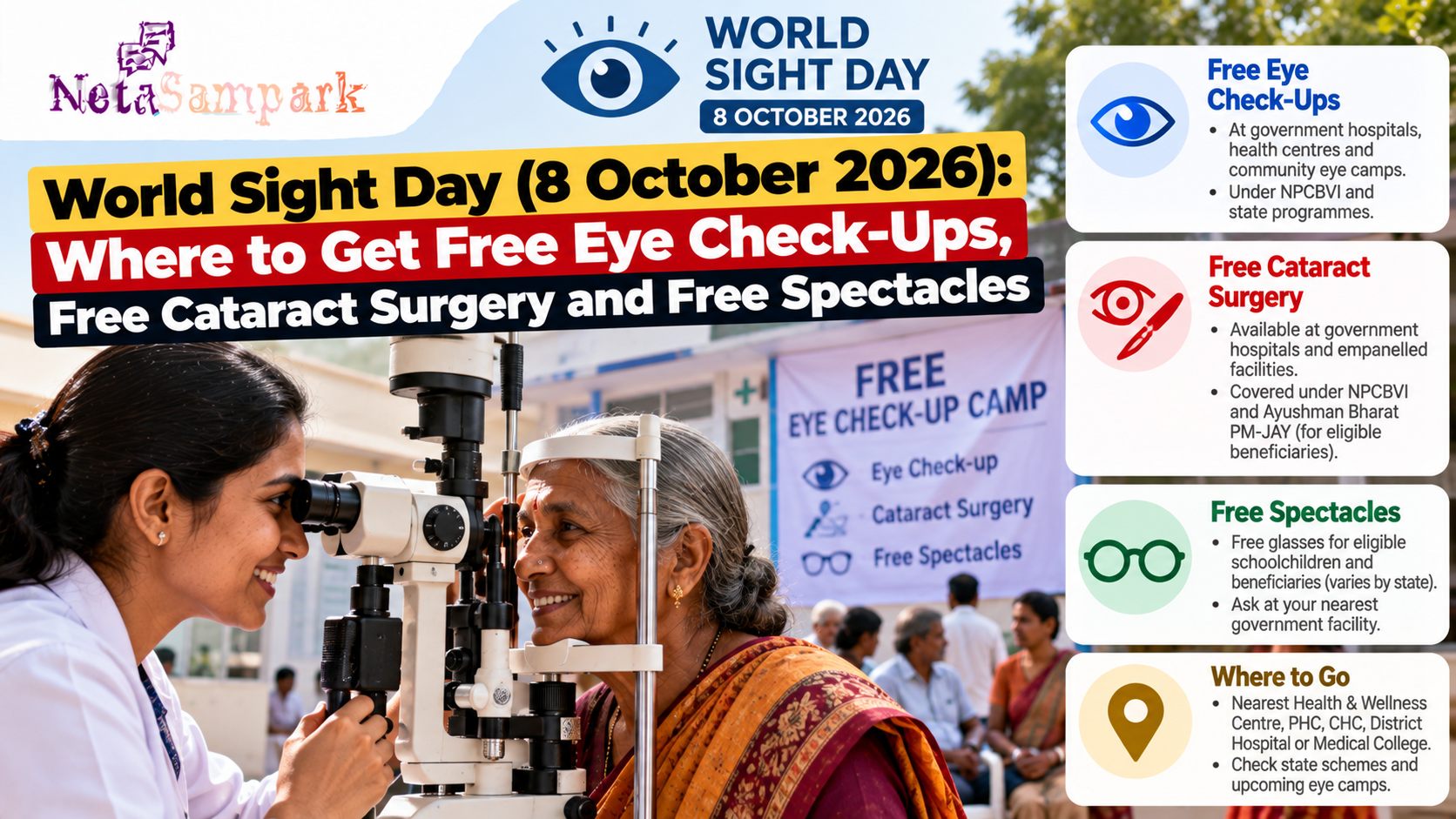
World Sight Day (8 October 2026): Where to Get Free Eye Check-Ups, Free Cataract Surgery and Free Spectacles
World Sight Day falls on 8 October 2026, the second Thursday of October. This year's global campaign continues the #LoveYourEyes message, with the International Agency for the Prevention of Blindness (IAPB) calling for accessible eye care and community action. IAPB
For Indian families, the day is also a useful reminder that an eye problem does not always mean paying for a private hospital.
Government health facilities and programmes provide eye screening, diagnosis, cataract surgery and spectacles in different circumstances, with availability depending on the State, facility, age group and eligibility.
The key is knowing where to start and what “free” actually covers.
Where can you get a free eye check-up?
The first place to try is your nearest government health facility.
Under India's National Programme for Control of Blindness and Visual Impairment (NPCBVI), the government supports comprehensive eye-care services covering conditions such as cataract, refractive errors, glaucoma, diabetic retinopathy and childhood blindness. The programme works through government hospitals, medical colleges and other public eye-care facilities. Directorate General of Health Services
Depending on your State's implementation, you may be directed through:
- a Health & Wellness Centre/primary-care facility;
- a Vision Centre;
- Community Health Centre (CHC);
- District Hospital;
- Government Medical College hospital;
- an outreach eye camp; or
- an NPCBVI-recognised/partner facility.
A 2025 National Health Mission review, for example, documented districts where government hospitals provided free eye diagnostics, CHCs provided refractive screening and free spectacles, and cataract patients were referred for surgery. National Health Mission
What happens at the first visit?
Depending on the facility, an eye-care worker or optometrist may check:
- visual acuity;
- refractive error;
- eye symptoms;
- need for spectacles;
- suspected cataract;
- other conditions requiring referral.
A basic vision screening is not the same as a complete ophthalmic examination.
If you have diabetes, glaucoma risk, sudden vision changes or other symptoms, ask whether you need a full examination by an ophthalmologist.
Where can you get free cataract surgery?
Cataract is one of the main conditions targeted under NPCBVI.
The programme continues to support cataract surgery through government eye-care facilities and other participating providers. The Union Health Ministry's latest annual report records millions of cataract operations under the programme and identifies cataract surgery as a key NPCBVI activity. Ministry of Health and Family Welfare
So if a government doctor diagnoses a cataract, ask:
“Is cataract surgery available free under NPCBVI at this hospital or through an authorised referral centre?”
The hospital can tell you:
- whether the surgery is available there;
- whether you qualify for free treatment;
- whether you need referral;
- what tests are required before surgery;
- what documents you need; and
- whether any particular implant or service has a separate charge.
Don't assume that every private eye hospital is automatically free simply because it advertises a cataract camp.
What if you have an Ayushman Bharat card?
AB PM-JAY also covers cataract surgery.
The National Health Authority's Health Benefit Package documentation specifically confirms that cataract remains covered under AB PM-JAY and lists cataract-surgery packages. National Housing Authority
PM-JAY provides eligible families with cashless cover of up to ₹5 lakh per family per year for listed secondary and tertiary hospitalisation at empanelled hospitals, subject to the applicable package and scheme rules. RMLH
That means an eligible beneficiary can ask an empanelled hospital whether the diagnosed cataract procedure is covered under the applicable PM-JAY package.
Before agreeing to pay, ask:
“Is this cataract operation being processed under PM-JAY?”
Also ask:
- What package is being used?
- Is the hospital empanelled for it?
- Is the prescribed IOL/implant covered?
- Are any additional services outside the package?
PM-JAY is not a promise that every eye-care service at every hospital is free.
Can you get free spectacles?
Yes, but eligibility varies by programme and State.
NPCBVI specifically supports the provision of free spectacles to children identified with refractive errors through school-eye screening. The Union Health Ministry's 2024–25 report records free spectacles being provided to schoolchildren under the programme. Ministry of Health and Family Welfare
Some State programmes go further.
For example, a National Health Mission 2026 best-practices compendium describes Karnataka's Ashakirana comprehensive eye-care model, which includes free spectacles for eligible beneficiaries and cataract surgery through government/recognised facilities. The documented programme has included schoolchildren and elderly people, with State support for certain adult age groups. National Health Mission
So if you need glasses, don't assume you have to buy them immediately.
Ask your government eye-care facility:
“Do I qualify for free spectacles under the State/NPCBVI programme?”
Who is most likely to qualify for free spectacles?
There is no single nationwide rule saying every adult gets free spectacles.
Free-spectacle programmes can be targeted at groups such as:
- schoolchildren with refractive errors;
- older adults;
- economically vulnerable patients;
- beneficiaries identified through government screening programmes;
- people covered under specific State schemes.
The exact eligibility and type of spectacle supplied depend on the programme.
This distinction is important because a government eye hospital may offer a free examination but not automatically provide free glasses to every adult patient.
What if your vision is getting blurry?
Don't automatically assume you need new glasses.
Blurred vision can result from:
- refractive error;
- cataract;
- diabetic retinopathy;
- glaucoma;
- corneal disease;
- retinal problems;
- other eye conditions.
WHO South-East Asia notes that cataract, uncorrected refractive error and diabetic retinopathy together account for more than 90% of blindness and visual impairment in the region. World Health Organization
That is why a proper eye examination matters.
You can even check your visual acuity at home—but it is not a substitute
WHO has developed WHOeyes, a free mobile app that allows people to conduct a visual-acuity self-assessment using a smartphone or tablet. World Health Organization
It can be useful as an initial check.
But WHO specifically warns that the app does not replace an examination by an eye-care professional.
So:
WHOeyes result → useful screening
Professional eye examination → proper clinical assessment
If your vision has changed, don't use a normal-looking app result as a reason to postpone medical care.
What documents should you take to a government eye hospital?
Requirements vary, but carrying the following can make the process easier:
- Aadhaar or another government ID;
- Ayushman Bharat/PM-JAY card, if applicable;
- State health-scheme card, if applicable;
- previous eye prescriptions;
- previous medical records;
- diabetes reports/medication details, if applicable;
- spectacles you currently use;
- mobile phone for SMS/OTP where required.
For a child, carry the parent's/guardian's ID and the child's relevant school or health records where available.
What if you cannot afford cataract surgery?
Don't delay simply because you assume surgery is unaffordable.
Start at a government hospital or government eye-care facility and tell the registration desk that you cannot afford private treatment.
Ask specifically about:
- NPCBVI-supported cataract surgery
- State government eye-care schemes
- Ayushman Bharat PM-JAY, if eligible
- Government medical college hospitals
- NPCBVI-recognised/partner facilities
NPCBVI's national programme is designed to strengthen eye-care infrastructure and service delivery through government medical colleges, district hospitals and other facilities. Directorate General of Health Services
What if the government hospital refers you to a private eye hospital?
That does not automatically mean you have to pay.
Government programmes can use recognised/empanelled or contracted facilities for particular services.
Before admission, ask:
“Is this referral under a government programme, and is the cataract surgery cashless/free under that programme?”
Get the answer from the hospital's official help desk rather than relying on a broker or informal agent.
What if an Ayushman hospital asks for money?
If you are an eligible PM-JAY beneficiary and the procedure is covered under the applicable package, ask the hospital to explain exactly what the requested payment is for.
A covered package and an unrelated additional service are not necessarily the same thing.
Ask for:
- package name/code;
- written estimate;
- explanation for every charge;
- receipt for anything you are actually required to pay.
If you believe a covered service is being wrongly denied or you are being charged improperly, PM-JAY has a grievance mechanism and helpline.
The National Health Authority lists 14555 / 1800-11-1565 as PM-JAY support numbers. PMJAY Quiz
Don't buy expensive glasses before checking eligibility
If you are diagnosed with a refractive error, ask the government facility whether free spectacles are available under the applicable programme.
This is particularly worth asking for:
- schoolchildren;
- elderly people;
- low-income families;
- people identified through government eye-screening programmes.
The Union government's NPCBVI programme explicitly tracks the provision of free spectacles to schoolchildren with refractive errors. Ministry of Health and Family Welfare
Warning signs that should not wait for a free camp
A routine eye camp is not the right place to wait if you have a potentially urgent eye problem.
Seek urgent medical attention if you experience:
- sudden loss of vision;
- sudden severe reduction in vision;
- severe eye pain;
- sudden flashes and a large increase in floaters;
- a curtain/shadow across your vision;
- significant eye injury;
- chemical exposure;
- sudden double vision;
- severe redness with vision loss.
A sudden change in vision can represent a time-sensitive eye emergency.
Do not wait for the next World Sight Day camp.
People with diabetes need regular eye care
Diabetes can damage the retina without causing obvious symptoms in the early stages.
Someone who says:
“I can see clearly, so my eyes must be fine”
may still need a diabetic-eye examination.
If you have diabetes, ask your doctor or eye specialist how often you need retinal screening.
NPCBVI includes diabetic retinopathy among the eye conditions addressed by the national programme. Directorate General of Health Services
Older adults should not assume blurry vision is “just age”
Cataract is common with ageing, but worsening vision can have several causes.
An older person with:
- increasing difficulty reading;
- difficulty recognising faces;
- glare around lights;
- difficulty seeing at night;
- frequent changes in spectacle power;
should get an eye examination rather than simply buying a stronger pair of glasses.
If cataract is diagnosed, ask about government-supported surgery.
Children need special attention
If a child is:
- sitting extremely close to the TV;
- holding books very close;
- squinting;
- complaining about headaches;
- struggling to read the classroom board;
- frequently rubbing the eyes;
- avoiding reading or schoolwork;
arrange a vision check.
Government school-eye screening programmes can identify refractive errors, and NPCBVI supports free spectacles for schoolchildren who need them. Ministry of Health and Family Welfare
Early correction can make a significant difference to a child's ability to learn.
A simple route to free eye care
If you're looking for low-cost or free treatment, follow this order:
Step 1 — Start at a government facility
Ask for an eye examination or referral to the nearest government Vision Centre/eye department.
Step 2 — Get the diagnosis
Find out whether you need:
- spectacles;
- cataract surgery;
- further testing;
- treatment for another eye condition.
Step 3 — Ask specifically about NPCBVI
Don't simply ask, “Is treatment free?”
Ask:
“Is this service available under NPCBVI or another government eye-care programme?”
Step 4 — Check PM-JAY if you are eligible
For cataract surgery, ask whether the hospital is PM-JAY empanelled and whether your procedure is covered.
Step 5 — Ask about State-specific benefits
States may have additional eye-care programmes.
Step 6 — Get the referral in writing
If you are sent to another facility, keep the referral and all investigation reports.
World Sight Day 2026: What you can do today
You don't have to wait for a special eye camp.
If you have never had an eye examination
Book one.
If your spectacles are several years old
Get your vision checked rather than automatically ordering the same prescription.
If you are over 50
Ask about cataract and other age-related eye conditions.
If you have diabetes
Ask about diabetic-retina screening.
If you have a child struggling at school
Arrange a vision check.
If you cannot afford treatment
Start with a government eye-care facility and ask specifically about NPCBVI, State schemes and PM-JAY eligibility.
Where to start in India
National Programme for Control of Blindness and Visual Impairment (NPCBVI)
The Directorate General of Health Services provides information on the national programme, its eye-care services and implementation through States/UTs. Directorate General of Health Services
Government District Hospital / Medical College Eye Department
Ask for the ophthalmology OPD and whether NPCBVI-supported services are available.
Ayushman Bharat PM-JAY
If you are an eligible beneficiary, check an empanelled hospital for covered cataract treatment. PM-JAY support: 14555 / 1800-11-1565. RMLH
State Health Department / NHM
Ask about your State's free eye-screening, spectacle and cataract programmes. Implementation can differ between States.
Quick checklist before leaving home
☐ Aadhaar/valid ID
☐ Ayushman card, if applicable
☐ Previous eye reports
☐ Current spectacles
☐ Diabetes/other relevant medical records
☐ Ask whether the examination is free
☐ Ask whether spectacles are free under the applicable programme
☐ Ask whether cataract surgery is free/cashless if diagnosed
☐ Get referral details in writing
☐ Keep all reports and receipts
The bottom line
Free eye care is available through government programmes, but “free” depends on the service, eligibility and facility.
NPCBVI supports comprehensive eye care across India, including cataract services and refractive-error care. Government reporting confirms large-scale cataract surgery and free spectacle distribution, particularly for schoolchildren. Directorate General of Health Services
For cataract patients who are eligible for AB PM-JAY, cataract surgery is included in the Health Benefit Packages, subject to the scheme's conditions and treatment at an appropriate empanelled facility. National Housing Authority
So on World Sight Day, 8 October 2026, don't just check your eyesight—you can also check whether you qualify for free or cashless eye care.
Start with the nearest government eye-care facility → get examined → ask about NPCBVI → check State benefits → check PM-JAY if eligible → don't delay urgent symptoms.