
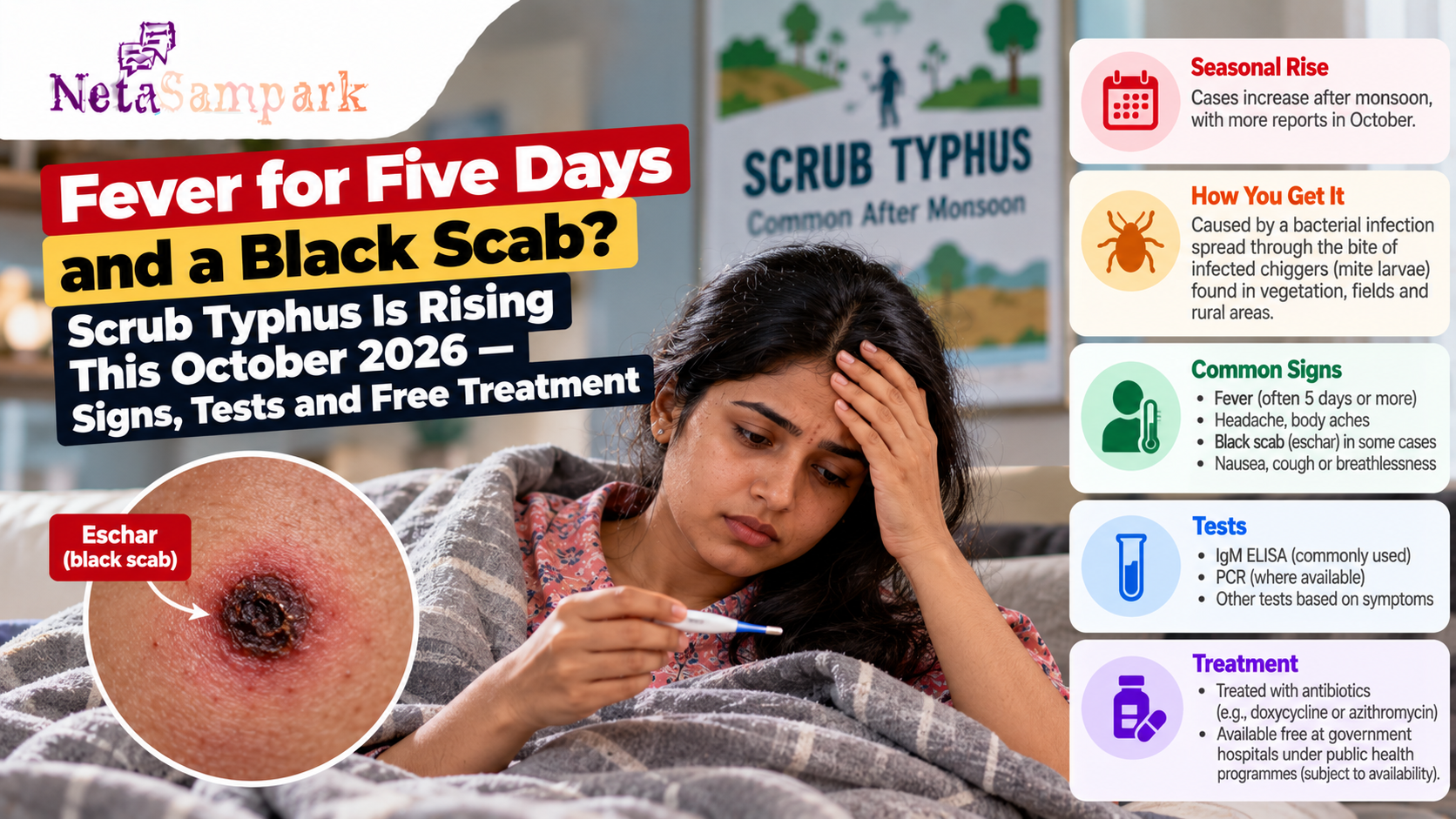
Fever for Five Days and a Black Scab? Scrub Typhus Is Rising This October 2026 — Signs, Tests and Free Treatment
A fever that lasts several days after the monsoon can have many causes — dengue, malaria, typhoid, leptospirosis and other infections among them. But in parts of India, scrub typhus is another important possibility, particularly when there has been exposure to vegetation, farms, scrubland or rural environments.
A black scab-like lesion, called an eschar, can be a useful clue. But it is important not to wait for a black scab before seeking care: many people with scrub typhus do not have a visible eschar. A 2026 Indian meta-analysis found the classic eschar in only about 29% of confirmed cases. PubMed
October also deserves attention because studies from India have found substantial seasonal activity around the monsoon and post-monsoon period, although the timing varies by region. OUP Academic
What is scrub typhus?
Scrub typhus is an infection caused by the bacterium Orientia tsutsugamushi.
It is transmitted to humans through the bite of infected larval trombiculid mites, commonly called chiggers. These mites can be found in vegetation, scrub, fields and other environments where people may come into contact with them. NCDC
It is not the same disease as typhoid fever, despite the similar name.
The infection can initially look like an ordinary viral fever. Without timely treatment, however, it can cause serious complications involving the lungs, liver, kidneys, brain and heart. IDSP
Why October matters
Scrub typhus is not restricted to one season or one part of India.
But research has repeatedly identified increased transmission during and after the monsoon in several regions.
A South India study found that more than two-thirds of cases occurred between September and January, with October showing the highest number of cases in that dataset. OUP Academic
A 2026 review of northern India similarly identified a seasonal peak from July through November. PubMed Central (PMC)
This does not mean every October fever is scrub typhus.
It means that if you have a persistent fever and a relevant exposure history, doctors may need to consider it alongside dengue, malaria, typhoid and other causes.
The classic warning sign: a black scab
The lesion associated with scrub typhus is called an eschar.
It can look like:
- a small ulcer;
- a dark or black central crust;
- a surrounding red area;
- a painless or relatively painless lesion.
It has sometimes been described as resembling a cigarette-burn mark. PubMed Central (PMC)
The important point is where you look.
An eschar may occur on:
- the trunk;
- groin;
- armpit;
- neck;
- chest;
- abdomen;
- other areas where a chigger may have bitten.
Some lesions in skin folds can be easy to miss and may not have the classic black appearance. ijmr.org.in
Don't wait for the scab
An eschar is helpful when present, but its absence does not rule out scrub typhus.
The 2026 meta-analysis found the classic eschar in only about 29% of confirmed cases. PubMed
So:
Five days of unexplained fever + exposure risk is enough reason to discuss scrub typhus with a doctor.
You do not need to find a black scab first.
What symptoms should you watch for?
Scrub typhus can begin with relatively non-specific symptoms.
Common features include:
- fever;
- headache;
- muscle aches;
- chills;
- weakness;
- nausea or vomiting;
- cough;
- breathlessness;
- rash in some patients;
- swollen lymph nodes in some cases.
The Indian clinical guidelines describe acute undifferentiated fever lasting five days or more, with or without an eschar, as a clinical situation in which rickettsial infection should be considered. PubMed Central (PMC)
This is particularly relevant when the patient has a history of outdoor or rural exposure.
Who should mention scrub typhus specifically to the doctor?
Tell the doctor if the patient has recently:
- worked in agricultural fields;
- walked through grass or scrub vegetation;
- worked in forest or rural areas;
- spent time outdoors during or after the monsoon;
- travelled to an area where scrub typhus is known to occur;
- had possible contact with mite-infested vegetation.
Occupational and environmental exposure can help the doctor distinguish scrub typhus from other causes of prolonged fever. PubMed Central (PMC)
Children, agricultural workers and people spending substantial time outdoors can also face greater exposure in affected areas.
What tests are used?
There is no single symptom that proves scrub typhus.
Doctors can use laboratory testing along with the clinical picture and exposure history.
1 IgM ELISA
IgM ELISA is one of the commonly used laboratory tests for scrub typhus in India.
A 2026 systematic review described IgM ELISA as one of the most widely used tests because it is relatively accessible and affordable in endemic settings. Wiley Online Library
However, timing matters.
A test performed very early in the illness may not give the same information as a test performed later. Your doctor may decide whether repeat testing or another test is appropriate.
2 PCR
PCR can detect Orientia tsutsugamushi DNA.
Indian guidelines recognise detection of rickettsial DNA in an eschar sample or whole blood as a confirmatory route. PubMed Central (PMC)
PCR availability varies between hospitals and laboratories.
3 Other antibody tests
Indirect immunofluorescence assays and other serological approaches can also be used, particularly in specialised laboratories. PubMed Central (PMC)
Why doctors may test for several diseases
A patient with five days of fever could have:
- dengue;
- malaria;
- typhoid;
- leptospirosis;
- scrub typhus;
- influenza or another respiratory infection;
- other bacterial or viral infections.
The symptoms can overlap considerably.
The Indian rickettsial-disease guidelines specifically recommend considering diseases such as dengue, malaria, pneumonia, leptospirosis and typhoid when evaluating suspected scrub typhus. PubMed Central (PMC)
So don't order one test at random and assume a negative result explains the fever.
Don't wait for the test if the doctor strongly suspects it
This is an important feature of the Indian clinical guidance.
The DHR-ICMR guidelines state that antibiotic treatment should be started when rickettsial disease is suspected rather than waiting for laboratory confirmation, particularly when clinical circumstances support the diagnosis. PubMed Central (PMC)
The NCDC's current scrub-typhus material likewise instructs healthcare providers to initiate appropriate treatment when scrub typhus is suspected. NCDC
That does not mean patients should buy antibiotics and start them themselves.
It means a doctor should not necessarily delay appropriate treatment while waiting for a laboratory report if the clinical suspicion is strong.
How is scrub typhus treated?
Scrub typhus is treated with antibiotics.
The NCDC/ICMR guidance lists doxycycline and azithromycin among the principal treatment options, with the choice depending on the patient and clinical circumstances. NCDC
For severe disease, hospital-based treatment may involve intravenous antibiotics and management of complications. NCDC
Important
Do not self-medicate with doxycycline or azithromycin.
The correct drug, dose and duration depend on factors such as:
- age;
- weight;
- pregnancy;
- severity;
- other medical conditions;
- complications;
- other medicines being taken.
Pregnancy and childhood require particular care in antibiotic selection. The NCDC guidance specifically identifies azithromycin as the preferred option for pregnant women. NCDC
What complications can occur?
Untreated or delayed scrub typhus can progress beyond fever.
Potential complications include:
- pneumonia;
- acute respiratory distress syndrome (ARDS);
- hepatitis/liver dysfunction;
- acute kidney injury;
- myocarditis;
- meningoencephalitis;
- septic shock;
- multi-organ dysfunction.
The NCDC/ICMR guidance identifies these as recognised severe complications. IDSP
The risk is one reason prolonged unexplained fever should not simply be treated as a routine viral infection indefinitely.
When should you go to hospital urgently?
Seek urgent medical care if fever is accompanied by:
- difficulty breathing;
- confusion or unusual drowsiness;
- seizures;
- severe weakness;
- persistent vomiting;
- very low urine output;
- jaundice;
- fainting;
- severe abdominal symptoms;
- bleeding;
- rapidly worsening illness.
These can indicate complications requiring hospital assessment. IDSP
A patient who has had several days of fever and suddenly becomes breathless or confused should not wait for a routine laboratory appointment.
Can treatment be free at a government hospital?
There is government support for free medicines and diagnostics through the National Health Mission's Free Drugs Service Initiative (FDSI) and Free Diagnostics Service Initiative.
The Union Health Ministry reported in 2026 that these programmes support States/UTs in providing essential medicines and diagnostic services free of cost at public health facilities, with the number of supported medicines and tests varying by level of facility. Press Information Bureau
This means a patient with suspected scrub typhus can ask at a government health facility about the available free diagnostic and treatment services.
However, don't interpret "free treatment" as a guarantee that every test, medicine or private-lab service is free everywhere.
Availability can vary by:
- State/UT;
- hospital;
- level of facility;
- local programme;
- test availability;
- whether referral to another centre is required.
Before paying privately, ask
"Is this test available under the government free diagnostics programme at this facility?"
And:
"Is the prescribed medicine available through the government hospital pharmacy?"
If you are being referred, ask where the relevant test or treatment is available under the public-health system.
What should a patient tell the doctor?
Instead of simply saying:
"I have fever."
Give the doctor a short timeline.
For example:
Day 1: Fever began
Day 3: Headache and body aches
Day 5: Fever continues
Exposure: Worked in a field 10 days earlier
Skin finding: Small painless black-centred lesion near the waist
This information can help the clinician decide which infections to investigate.
Check hidden areas for an eschar — but don't obsess over it
Because eschars can occur in areas such as the groin and armpits, a clinician may need to perform a careful skin examination.
But patients should not injure, scrape or squeeze a suspected lesion.
If you notice a suspicious black-centred ulcer, simply show it to the doctor.
A photograph can also help document how it looked initially, but it cannot replace examination and testing.
Can scrub typhus spread from one person to another?
Scrub typhus is acquired through the bite of infected mite larvae.
It is not generally transmitted through ordinary person-to-person contact.
The prevention focus is therefore on reducing exposure to infected mite habitats rather than isolating a patient in the same way as someone with a directly contagious respiratory infection.
How can you reduce your risk?
If you are working or travelling in vegetation-heavy areas:
- wear full-length trousers;
- wear long sleeves;
- use appropriate insect/mite repellent;
- avoid unnecessary contact with dense scrub;
- wash exposed skin after outdoor activity;
- wash outdoor clothing after potential exposure;
- keep living areas free from heavy vegetation and rodent infestation where possible.
The NCDC specifically recommends protective clothing, washing after exposure and appropriate repellents for people who cannot avoid infested terrain. NCDC
There is currently no widely available human vaccine that provides routine protection against scrub typhus. NCDC
Scrub Typhus vs Dengue: Why the distinction matters
Both can produce:
- high fever;
- headache;
- body aches;
- weakness;
- nausea;
- abnormal blood counts.
But the treatments are different.
Scrub typhus requires appropriate antibiotic treatment, while dengue does not respond to antibiotics.
This is why self-treating every post-monsoon fever as dengue is risky.
Similarly, a black scab does not prove scrub typhus — it is a clinical clue that needs medical assessment.
Five-Day Fever Checklist
If you or a family member has had fever for around five days:
- Record the fever duration and temperature.
- Tell the doctor about outdoor/field/forest exposure.
- Check the skin for an unusual painless ulcer or black-centred scab.
- Ask whether scrub typhus should be considered.
- Ask which tests are appropriate and whether timing affects the result.
- Ask about dengue, malaria and other relevant causes.
- Do not start antibiotics without medical advice.
- Ask a government hospital about free diagnostic and medicine availability.
- Seek urgent care for breathing difficulty, confusion, low urine output, jaundice or other severe symptoms.
Bottom line
Five days of unexplained fever after the monsoon deserves a proper medical evaluation. Scrub typhus is an important cause of acute febrile illness in India, and October can be a period of increased activity in several regions. OUP Academic
A black scab or eschar is a useful clue, but its absence does not rule out the infection. Testing may include IgM ELISA and, where available and appropriate, PCR or other confirmatory methods. PubMed
Most importantly, don't wait for a test result if a doctor strongly suspects scrub typhus. Indian clinical guidance supports starting appropriate treatment when rickettsial disease is suspected, because delayed treatment can allow serious complications to develop. NCDC
If you use the public healthcare system, ask about the NHM Free Drugs and Free Diagnostics programmes; the availability of specific tests and medicines depends on the State and facility. Press Information Bureau