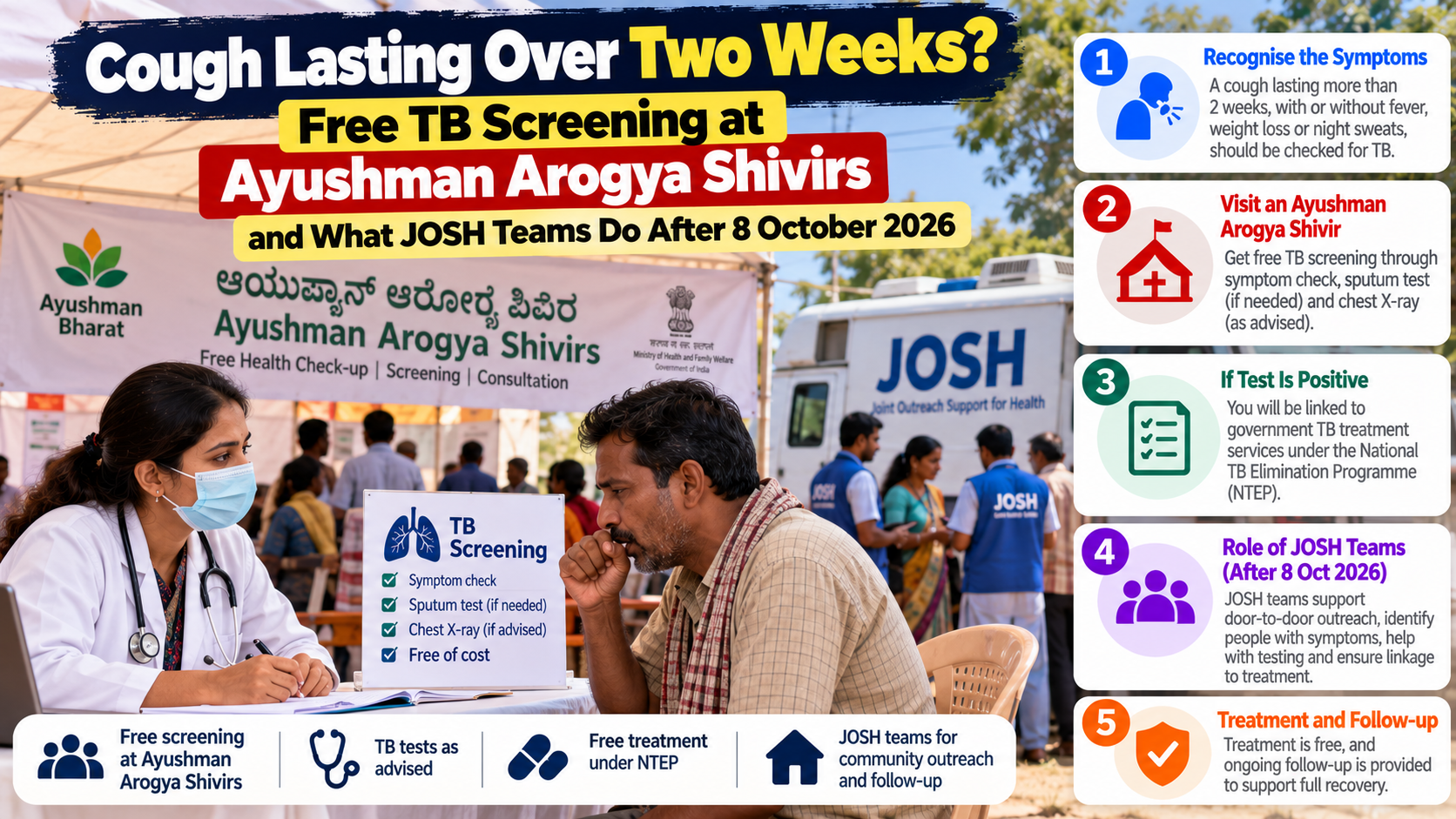
Cough Lasting Over Two Weeks? Free TB Screening at Ayushman Arogya Shivirs — and What JOSH Teams Do After 8 October 2026
A cough that lasts for two weeks or longer should not be ignored. It may have several causes, but persistent cough is one of the important symptoms of tuberculosis (TB) and should prompt a medical assessment.
India's National Tuberculosis Elimination Programme (NTEP) provides free TB diagnosis and treatment services through government health facilities and identified treatment centres. Ayushman Arogya Shivirs can bring screening and diagnostic services closer to communities, while the newly launched JOSH Teams aim to strengthen awareness and community participation in the fight against TB.
Here is what citizens should know about screening, testing, treatment and the role of JOSH Teams following their launch on 8 October 2026.
Why a Cough Lasting Two Weeks Needs Attention
TB is an infectious disease caused by Mycobacterium tuberculosis. It most commonly affects the lungs, although it can also affect other parts of the body.
According to the Central Tuberculosis Division, symptoms that may indicate pulmonary TB include:
- Persistent cough for two weeks or more
- Chest pain
- Shortness of breath
- Blood in sputum
- Unexplained weight loss
- Fatigue
- Fever, including a rise in temperature in the evening
Not everyone with TB has every symptom. A persistent cough can also result from other respiratory conditions, so symptoms alone cannot confirm TB.
If you have had a cough for two weeks or longer, visit a health facility and ask for an assessment. Do not wait for a camp or outreach event if you need medical attention. Seek urgent care for severe breathing difficulty, significant coughing of blood or other serious symptoms.
Source: Central Tuberculosis Division — TB FAQs.
What Are Ayushman Arogya Shivirs?
Ayushman Arogya Shivirs are outreach health camps intended to bring health services closer to communities, including people who may face difficulties travelling to a health facility.
Under the 2026 TB Mukt Bharat Abhiyaan campaign framework, mobile medical units and outreach activities can support TB screening and referral. Depending on the arrangements at a particular camp, services may include:
- Symptom assessment
- Chest X-ray, where available and indicated
- Sputum sample collection
- Referral for molecular testing, where indicated
- Medical consultation
- Screening for other health conditions included in the camp's service package
The Central Tuberculosis Division's 2026 campaign guidance describes the use of mobile medical units, handheld X-ray equipment, sample collection and molecular testing arrangements to strengthen outreach in identified high-risk villages and wards. The exact services available can vary by location and camp.
Source: TB Mukt Bharat Abhiyaan Campaign 2026 — official guidance.
Is TB screening free?
Government TB diagnosis and treatment services are available free of cost under the NTEP at government health facilities and identified private and NGO treatment centres.
However, the services available at a specific Ayushman Arogya Shivir depend on its local arrangements. A camp may provide symptom screening and sample collection, for example, while another may also have on-site or mobile diagnostic equipment.
Ask the staff which services are available and where you should go if additional tests are needed.
Do not assume that every camp offers every test on the spot.
What Happens During a TB Screening?
The process depends on your symptoms, medical history and the services available.
Step 1: Tell the health worker about your symptoms
Explain how long you have been coughing and whether you have fever, weight loss, night sweats, chest pain, breathlessness or blood in your sputum.
Mention any previous TB diagnosis or treatment, if applicable.
Step 2: Get assessed by a health professional
The health worker or clinician will decide which investigations are appropriate. Screening identifies people who may need further evaluation; it is not the same as confirming a diagnosis.
Step 3: Complete the recommended tests
Depending on the clinical assessment, testing may include sputum microscopy, a molecular test such as a nucleic acid amplification test (NAAT), and/or a chest X-ray.
A chest X-ray can help identify abnormalities, but an X-ray alone does not necessarily confirm TB. Laboratory testing and clinical assessment are important for establishing the diagnosis.
Step 4: Follow the referral instructions
If the camp cannot complete the required investigation, ask where the sample will be tested or which health facility you should visit.
Keep any referral slip and sample-collection information.
Step 5: Return for the result and follow-up
Do not assume that no further action is needed simply because you feel better or your initial screening was reassuring. Follow the instructions given by the treating clinician.
Source: Central Tuberculosis Division — diagnosis and symptoms.
What Is JOSH, Launched on 8 October 2026?
JOSH stands for Joint Squad for Health. The Ministry of Health and Family Welfare launched the initiative under the TB Mukt Bharat Abhiyaan on 8 October 2026 at Bharat Mandapam in New Delhi.
The initiative brings together the outreach networks of the health, youth and defence sectors to strengthen community participation in India's TB elimination efforts.
The first phase is planned across 55 districts in 11 states. It involves MY Bharat volunteers and National Cadet Corps (NCC) cadets, alongside the relevant government and community networks.
The aim is to take information about TB prevention, early diagnosis, timely treatment and stigma reduction beyond health facilities and into local communities.
Sources: Ministry of Health and Family Welfare — 8 October 2026 launch and pre-launch announcement.
What Will JOSH Teams Do After the Launch?
The launch establishes a framework for youth-led community mobilisation. The purpose is to support the TB response through organised local participation rather than relying exclusively on people visiting health facilities.
The initiative's stated objectives include:
1. Raise awareness about TB
Volunteers can help communicate information about symptoms, prevention, testing and the importance of completing treatment.
2. Encourage early diagnosis
Community outreach can help people who have persistent coughs or other symptoms understand why they should seek medical assessment instead of delaying care.
3. Reduce stigma
Misinformation and fear of discrimination can prevent people from seeking care. Community engagement is intended to encourage supportive, informed conversations about TB.
4. Connect people with health services
Outreach can help direct people to the appropriate health facility or diagnostic service. Clinical diagnosis and treatment decisions remain the responsibility of qualified health professionals.
5. Encourage treatment completion
People receiving TB treatment may need information, encouragement and appropriate follow-up. Community support can complement the services provided by healthcare teams.
These are the programme's stated aims. The precise activities, local deployment and availability of volunteers will depend on implementation in each participating district.
What If Your TB Test Is Positive?
A positive screening result does not always mean that TB has been definitively confirmed. The clinician will interpret the results and arrange any additional tests needed.
If TB is diagnosed, follow the treatment plan prescribed by the treating health professional.
Under the NTEP:
- TB diagnosis and treatment services are available free of cost at government facilities and identified treatment centres.
- The treatment regimen depends on the type of TB and the patient's clinical and drug-resistance results.
- Medicines should be taken as prescribed for the complete recommended duration.
- Follow-up appointments and additional tests should not be skipped.
- A patient who experiences side effects should contact the treating team rather than independently stopping or changing medicines.
TB is curable in many cases when the appropriate treatment is completed. Drug-resistant TB requires specialist assessment and a treatment regimen suited to the resistance pattern.
Source: Central Tuberculosis Division — FAQs and programme guidance.
Can You Get Help if You Cannot Travel Easily?
If you are elderly, have a disability, live far from a health facility or have difficulty arranging transport, ask your nearest government health facility whether a mobile medical unit, outreach camp or another local service is available.
The 2026 campaign framework includes mobile medical units and targeted outreach in identified high-risk villages and wards. It does not mean that a mobile unit will be available at every village or address on a particular date.
You can also call the national TB helpline to ask for guidance on locating services.
Where to Get Official TB Information
Use these official resources:
- National TB helpline (Nikshay Sampark): 1800-11-6666
- Central Tuberculosis Division: tbcindia.mohfw.gov.in
- TB symptoms and diagnosis FAQs: Official TB FAQs
- TB Mukt Bharat Abhiyaan 2026 guidance: Official campaign document
- JOSH launch announcement: Press Information Bureau
For camp dates, ask your local government health facility, Ayushman Arogya Mandir or district health authorities. Do not assume that a national launch announcement guarantees a camp in your locality on a specific day.
A Simple Checklist for Citizens
If you or a family member has a persistent cough:
- Arrange a medical assessment if the cough has lasted two weeks or longer.
- Mention other symptoms and any previous TB treatment.
- Ask whether TB testing is indicated.
- Check which diagnostic services are available locally.
- Keep referral slips and follow-up instructions.
- If diagnosed, follow the prescribed treatment and attend follow-up visits.
- Seek information from official health services rather than relying on rumours.
- Treat people affected by TB with dignity and without discrimination.
The Bottom Line
A cough lasting two weeks or longer deserves medical assessment. TB cannot be diagnosed from symptoms alone, but early evaluation can help identify people who need testing and treatment.
Ayushman Arogya Shivirs can bring screening and diagnostic services closer to communities, with the exact services depending on local arrangements. Under the National Tuberculosis Elimination Programme, diagnosis and treatment are available free of cost through government facilities and identified treatment centres.
The launch of JOSH Teams on 8 October 2026 adds a youth-led community mobilisation component to the TB Mukt Bharat Abhiyaan. The initiative is intended to improve awareness, encourage early diagnosis, reduce stigma and support treatment completion.
If you have a persistent cough, do not wait for a volunteer visit or a health camp. Contact a health facility, get assessed and follow the recommended testing and treatment process.