
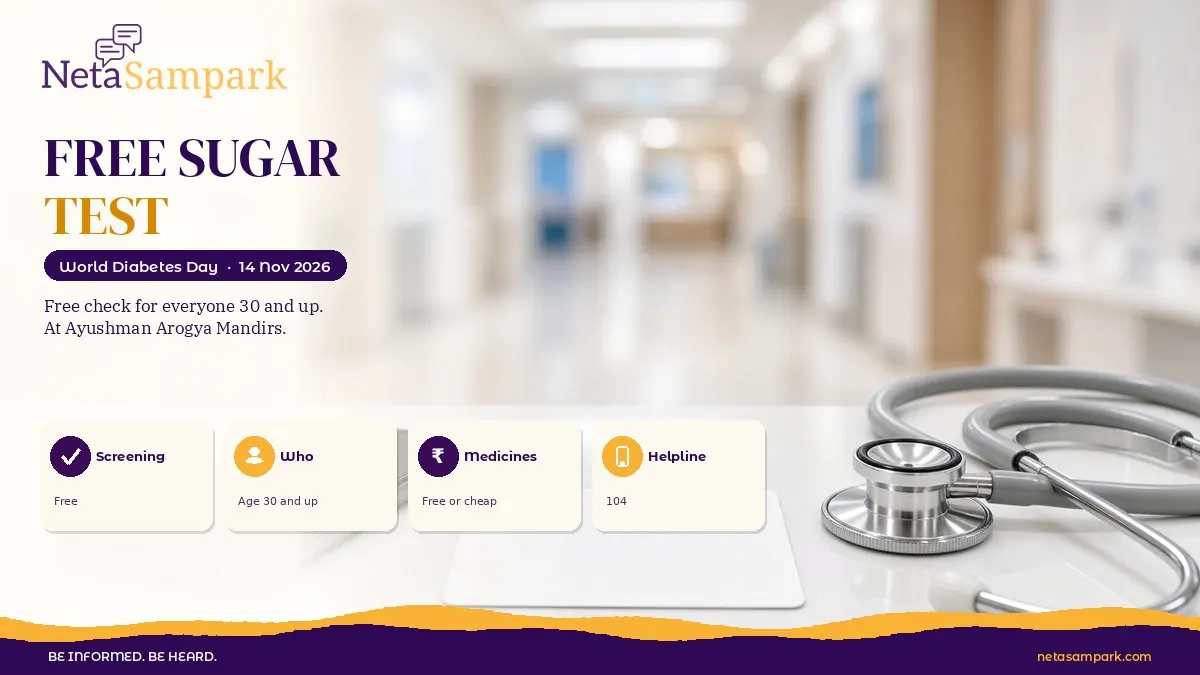
World Diabetes Day falls on 14 November 2026. If you're 30 or older, you can get a free blood sugar and BP check at your nearest Ayushman Arogya Mandir under the national NCD programme. Government health centres give diabetes medicines free, Jan Aushadhi Kendras sell them cheap, and children with type 1 diabetes can get free insulin at district hospitals.
Updated 3 November 2026
Quick facts
| Item | Details |
|---|---|
| Official portal | Ministry of Health and Family Welfare and the Ayushman Arogya Mandir portal |
| Helpline | 104 health helpline in most states; Jan Aushadhi Sugam app to find a kendra |
| Fee | Free screening and free medicines at government centres |
| Deadline | No deadline. Screening is available all year, with extra camps around 14 November 2026 |
| Documents | Aadhaar or any ID; ABHA number if you have one; old reports if you already have diabetes |
| Who should get checked | Everyone aged 30 and above, at least once a year |
| Where | Ayushman Arogya Mandirs, PHCs, CHCs and district hospitals |
Why should I get a sugar test now?
Many Indians with diabetes don't know they have it. High sugar often has no symptoms for years, while it quietly damages the eyes, kidneys, nerves and heart. The earlier you catch it, the cheaper and easier it is to control.
World Diabetes Day is marked every year on the birthday of Sir Frederick Banting, who co-discovered insulin. This year it falls on 14 November 2026. In 2026, many states hold extra screening camps in the days around 14 November 2026, but the free test is available on any working day.
Where can I get a free blood sugar test?
Under the National Programme for Prevention and Control of Non-Communicable Diseases (NP-NCD), everyone aged 30 and above is meant to be screened for diabetes, high BP and common cancers. This happens at:
• Ayushman Arogya Mandirs (AAMs): the upgraded sub-centres and PHCs, about 1.86 lakh across India as per the health ministry
• Primary Health Centres and Community Health Centres
• NCD clinics at district hospitals
• Screening camps run by ASHAs and health workers in your village or ward
As per a PIB release of 30 September 2026, more than 42 crore screenings each for hypertension and diabetes have been done so far.
How does the screening work?
1. Go to your nearest AAM or PHC with an ID. If you don't know where it is, ask your ASHA worker or call 104.
2. Registration. The health worker notes your details, sometimes linking to your ABHA number.
3. A short risk check. Questions on age, waist size, physical activity and family history.
4. Finger-prick test. A random blood sugar check with a glucometer. Takes a minute.
5. BP check.
6. If your reading is high, you're referred to the medical officer at the PHC or CHC for a confirmation test, usually fasting sugar or HbA1c.
7. If confirmed, you're put on treatment and follow-up, with medicines given at the centre.
What sugar levels should worry me?
These are general cut-offs doctors use. Your doctor decides the diagnosis.
| Test | Normal | Prediabetes | Diabetes |
|---|---|---|---|
| Fasting blood sugar | Below 100 mg/dL | 100 to 125 mg/dL | 126 mg/dL or more |
| HbA1c | Below 5.7% | 5.7% to 6.4% | 6.5% or more |
| Random blood sugar with symptoms | 200 mg/dL or more |
Prediabetes is the stage where you can still turn things around with diet, walking and weight loss.
Are diabetes medicines free at government hospitals?
Yes, at most government facilities. Under the Free Drugs Service Initiative of the National Health Mission, states keep essential medicines free at PHCs, CHCs and district hospitals. Common diabetes medicines like metformin and glimepiride, and insulin at higher centres, are usually on these lists. The exact list differs by state.
If the medicine is out of stock, you have a cheap backup:
• Jan Aushadhi Kendras sell generic medicines at a fraction of brand prices. The health minister said on 30 September 2026 that more than 20,149 kendras are running. Our guide on finding a Jan Aushadhi Kendra shows how to use the Jan Aushadhi Sugam app
What about children with type 1 diabetes?
Type 1 diabetes is different. It often starts in childhood, and the child needs insulin for life. For poor families, the cost of insulin, glucometers and strips is a huge burden.
Under the RBSK 2.0 framework for childhood diabetes announced in May 2026, children from birth to 18 are to be screened, and the "4Ts" warning signs are being taught to parents and teachers:
• Toilet: peeing a lot, or bedwetting again
• Thirsty: drinking far more water than usual
• Tired: unusual tiredness
• Thinner: losing weight without trying
Under this framework, children diagnosed with type 1 diabetes are to get free insulin, glucometers and test strips at district hospitals. Ask the paediatrics or NCD department at your district hospital how it works in your state.
What if I'm over 70?
If you're 70 or above, you can also get free hospital treatment up to ₹5 lakh a year under Ayushman Bharat, regardless of income. Diabetes complications like kidney problems often need hospital care. Our guide on the Ayushman Vay Vandana card explains how to enrol.
Diabetes also damages eyes over time. Get a yearly eye check. Our post on free eye check-ups and cataract surgery covers where to go.
How can I lower my risk if I'm prediabetic?
Small changes work better than crash diets. Walk for 30 minutes on most days, cut down sugar in tea and sweets, swap some white rice or maida for millets or whole wheat, and keep your waist in check. Sleep well and don't skip meals. Get your sugar tested again after 6 months. Many people bring prediabetes back to normal this way.
What should I carry to the health centre?
☐ Aadhaar card or any ID ☐ ABHA number (optional, helps keep your records) ☐ Old sugar reports or prescriptions, if any ☐ List of medicines you're already taking ☐ For a fasting test, come without eating for 8 to 10 hours (water is fine) ☐ Mobile number for follow-up reminders
What if the centre turns me away or there are no medicines?
• Ask for the medical officer in charge and note the date and time
• Call 104 or your state health helpline
• Complain on the state's grievance portal or CPGRAMS
• Tell your ward councillor, MLA or MP. Public health centres are their responsibility too. Find yours on NetaSampark
Does ABHA help with diabetes care?
It can. An ABHA (Ayushman Bharat Health Account) number lets health centres link your test reports and prescriptions digitally. If you move between a PHC, a district hospital and a private clinic, your records can follow you instead of getting lost in a plastic bag. It's optional and free.
Final reminder
One finger-prick could save you years of trouble. If you're 30 or older, walk into your nearest Ayushman Arogya Mandir around World Diabetes Day on 14 November 2026, or any day after, and get your sugar and BP checked. It's free. Take your parents along too.
Frequently asked questions
When is World Diabetes Day 2026?
World Diabetes Day 2026 falls on Saturday, 14 November 2026. The day is marked every year on the birthday of Frederick Banting, who co-discovered insulin.
Where can I get a free diabetes test in India?
At Ayushman Arogya Mandirs, PHCs and CHCs under the NP-NCD programme, for everyone aged 30 and above.
Are diabetes medicines free at government hospitals?
Yes, at most government facilities under the Free Drugs Service Initiative. The list varies by state.
Is insulin free for children with type 1 diabetes?
Under the RBSK 2.0 childhood diabetes framework, free insulin, glucometers and strips are to be given at district hospitals.
What fasting sugar level means diabetes?
A fasting sugar of 126 mg/dL or more usually means diabetes, and 100 to 125 mg/dL is prediabetes. A doctor will confirm with a repeat test or HbA1c before starting treatment.
Sources
• Ministry of Health and Family Welfare
• PIB: Union Health Minister on NCD screening and Ayushman Arogya Mandirs (30 September 2026)
• Ayushman Arogya Mandir portal