If you work in a factory, shop, hotel, office or other establishment covered by the Employees’ State Insurance (ESI) Scheme, your ESIC coverage is more than a deduction from your salary.
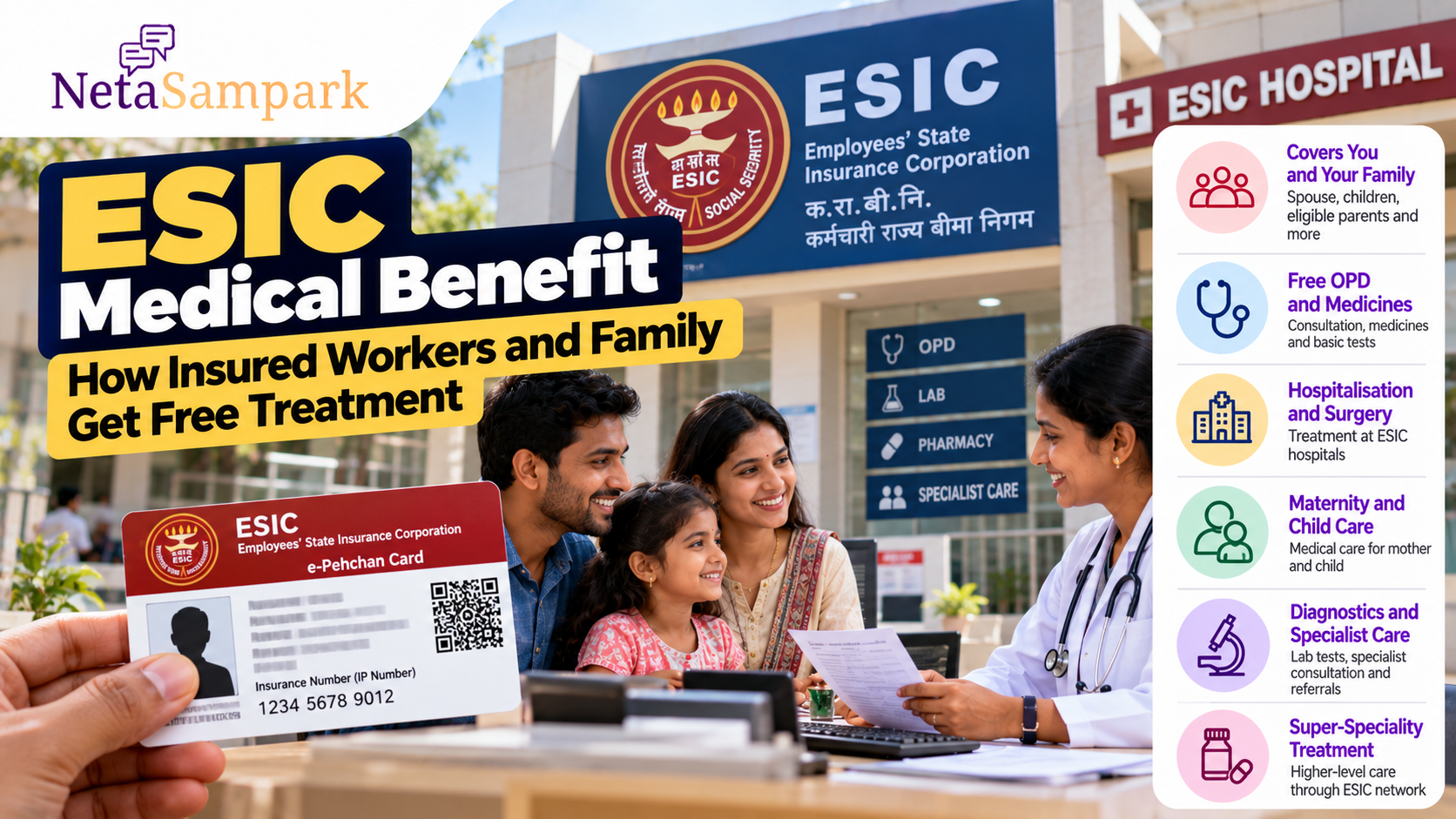
One of its most important benefits is medical care for the insured worker and eligible family members. ESIC describes the benefit as covering medical attendance and treatment, including primary, secondary and tertiary care, subject to the applicable ESI rules and medical system. ESIC
Here is how the benefit works, who can use it and what you need to do when you or a family member needs treatment.
What Is the ESIC Medical Benefit?
Medical Benefit is the healthcare component of the ESI Scheme.
For an eligible insured person, it can include:
- OPD consultation
- Medicines and injections
- Diagnostic and laboratory investigations
- Specialist consultation
- Hospitalisation
- Surgical treatment
- Obstetric and maternity-related medical care
- Super-speciality treatment
- Certain referral services
- Medical appliances and other prescribed services
ESIC's official material describes the medical benefit as covering primary, secondary and tertiary care for insured persons and their eligible family members. ESIC
Importantly, medical benefit is not a cash reimbursement scheme in which you normally pay a private hospital and then claim every bill from ESIC. The ESI Act provides medical treatment through the dispensary, hospital, clinic or other institution allotted under the scheme, subject to the applicable regulations. ESIC
Who Is Covered Under ESIC?
Coverage depends on both the establishment and the employee's wages.
ESIC's published scheme information states that employees of covered factories and establishments drawing wages up to ₹21,000 per month are covered, with a higher ceiling of ₹25,000 per month for persons with disability. Coverage also depends on whether the establishment and area fall under the ESI Scheme. ESIC
The scheme can cover different categories of employees, including:
- Regular employees
- Contract workers
- Casual employees
- Temporary employees
The specific coverage rules depend on the establishment and applicable notifications. ESIC
Important: Salary alone is not enough
A person earning below the wage ceiling is not automatically an ESIC beneficiary.
The employer and establishment must also fall within the scope of the ESI Act in the relevant area.
Does ESIC Cover Your Family?
Yes. Eligible family members of an insured person can receive medical benefits under the ESI Scheme.
The ESI Act's definition of family includes categories such as:
- Spouse
- Dependent minor children
- Certain dependent children receiving education up to the specified age
- Unmarried dependent daughters
- Children with qualifying physical or mental infirmity who remain dependent
- Dependent parents subject to the prescribed income conditions
- In certain circumstances, a minor brother or sister of an unmarried insured person whose parents are not alive ESIC
The exact eligibility of a particular family member should be checked against the current ESI rules and the family details recorded in the ESIC system.
When Does Medical Coverage Start?
One of the important features of ESI medical benefit is that medical care is available from the beginning of insurable employment, subject to the applicable rules.
ESIC's published scheme guide says medical benefit is admissible from day one of employment for the insured person and family. ESIC
The ESI Act also provides that an insured person or eligible family member requiring medical treatment is entitled to medical benefit, subject to the statutory conditions. ESIC
This is different from some insurance policies where a waiting period may apply before healthcare benefits begin.
How to Get Treatment Through ESICThe normal process is straightforward.
Step 1: Get your ESIC insurance number
Every insured person receives a unique Insurance Number.
ESIC says this number remains valid throughout the employee's life, including when the person changes jobs. ESIC
Keep this number safely recorded.
Step 2: Get your e-Pehchan Card
An insured person receives an e-Pehchan Card containing the insurance number and other details.
ESIC says the e-Pehchan Card can also be downloaded through the IP Portal or UMANG app. ESIC
Step 3: Add your family members
Your employer provides ESIC with details of the insured employee and eligible family members.
Make sure the following information is updated:
- Spouse
- Children
- Parents, where eligible
- Family address
- Family members' relevant identification details
This matters because a family member whose details have not been properly recorded may face difficulties when trying to use the medical facility.
Step 4: Go to the allotted dispensary
The insured person and family members are generally linked to an ESI dispensary or other authorised medical facility.
Start there for routine medical care.
What Treatment Can You Get?The medical benefit is much broader than simply visiting a doctor.
OPD treatment
You can receive consultation and treatment through the ESI medical network.
Depending on the facility, this can include:
- Doctor consultation
- Basic investigations
- Prescribed medicines
- Injections
- Follow-up treatment
ESIC's medical-care documentation describes outpatient services through service dispensaries, hospital OPDs and, in applicable areas, panel medical practitioners. ESIC
Specialist Treatment
If the doctor determines that specialist treatment is required, the patient can be referred through the ESI system.
Specialist services can include areas such as:
- Medicine
- Surgery
- Paediatrics
- Gynaecology
- ENT
- Ophthalmology
- Cardiology
- Neurology
- Nephrology
- Urology
The availability of individual specialties depends on the relevant ESI facility and referral arrangements. ESIC
Hospitalisation
ESIC provides inpatient treatment through its hospitals and other authorised arrangements.
The ESI Act specifically provides for medical treatment through hospitals and other institutions, including inpatient treatment. ESIC
If your condition requires hospitalisation, follow the referral and admission process applicable to your ESI facility.
What About Super-Speciality Treatment?
ESI beneficiaries can also receive tertiary and super-speciality care through the ESI medical system, including through referral arrangements where the required service is not available at the primary facility.
ESIC's scheme material describes primary, secondary and super-speciality treatment for insured persons and eligible family members. ESIC
The referral and eligibility requirements can vary according to the treatment and current ESIC rules.
Is ESIC Treatment Really Free?For eligible beneficiaries receiving treatment through the ESI system, medical care is provided as a scheme benefit rather than as an ordinary private-hospital bill.
ESIC describes the medical benefit as full medical care including treatment, medicines, specialist consultation and hospitalisation for insured persons and eligible family members. ESIC
However, don't interpret this as meaning that every medical expense anywhere is automatically free.
The ESI Act states that an insured person generally cannot claim reimbursement for treatment obtained outside the prescribed ESI system except where the regulations provide for it. ESIC
This distinction is important
ESIC facility/referral → covered treatment under the scheme
Any private hospital chosen independently → not automatically reimbursable
If you want to use a private hospital, first check whether it is an authorised or empanelled facility and whether the required referral/approval applies.
What If Your Family Lives Somewhere Else?Your family does not necessarily have to live at the same address as you.
ESIC's FAQ explains that when the family lives in another place, including another state, arrangements can be made for the family to receive medical benefit through an ESI dispensary in the area where they reside, subject to the required declaration and certification. ESIC
This can be particularly useful when:
- The worker lives in Bengaluru but parents live in another city
- The worker is posted away from the family
- Children stay with grandparents
- The spouse lives in another location
Make sure the family details and residence information are properly updated.
What Should You Carry to the ESI Dispensary?Keep these details accessible:
- ESIC Insurance Number
- e-Pehchan Card
- Aadhaar or other identification, where requested
- Family member's ESIC details
- Previous medical records
- Existing prescriptions
- Diagnostic reports
- Details of ongoing medicines
For children and other dependants, carrying proof of their relationship and their ESIC/family details can help avoid unnecessary delays.
What If You Change Jobs?Your ESIC Insurance Number is not supposed to change simply because you change employers.
ESIC states that the insurance number is unique and remains valid throughout the insured person's life. ESIC
When joining a new covered employer, provide your existing ESIC Insurance Number rather than creating a second number.
This allows your insurance record to continue with the new employment.
What If Your Salary Later Goes Above ₹21,000?Crossing the wage ceiling does not necessarily mean your coverage ends immediately.
ESIC's FAQ explains that when an employee crosses the prescribed wage ceiling after the beginning of a contribution period, the employee continues to be treated as covered until the end of that contribution period. ESIC
Also remember that overtime is treated differently when determining the wage ceiling for coverage. ESIC explains that overtime is excluded for determining coverage but is included for contribution purposes. ESIC
If your salary has changed recently, check your contribution period and coverage status with your employer or ESIC rather than assuming your medical benefit stopped on the day your salary increased.
What If You Leave Your Job?Medical coverage is connected to the applicable ESI contribution and benefit periods, so it does not simply continue indefinitely after employment ends.
There are also specific provisions for certain situations, including permanent disablement and medical benefits available to eligible retired insured persons and spouses subject to prescribed conditions. ESIC
If you are leaving an ESI-covered job, check your exact eligibility before assuming that your family has either lost or retained medical coverage.
Aadhaar: Is It Mandatory for ESIC Medical Treatment?ESIC has introduced Aadhaar authentication/seeding for insured persons and family members.
Its recent employer guide describes Aadhaar seeding as voluntary, with options including OTP, biometric authentication and facial recognition through ESIC systems. ESIC
So don't confuse having Aadhaar linked to your ESIC record with the basic eligibility for ESI medical benefit.
Your core eligibility comes from being an insured person or eligible family member under the ESI Scheme.
What If the ESIC Dispensary Does Not Have the Required Treatment?Not every ESI dispensary provides every specialist or hospital service.
The ESI medical system is structured across:
Dispensary → Specialist/Hospital → Referral/Tertiary Care
The ESI Act permits ESIC and state governments to establish hospitals, dispensaries and other medical services and to make arrangements with other institutions for treatment. ESIC
If your doctor says you need a service that is unavailable at your current facility, ask about the official referral process rather than independently paying a private hospital and assuming ESIC will reimburse you.
Common Mistakes ESIC Beneficiaries Make1. Not adding family members
Your family cannot simply walk into an ESI facility and assume that the system will automatically recognise them.
Keep family records updated.
2. Creating a new ESIC number after changing jobs
Your Insurance Number is designed to remain valid throughout your working life. ESIC
Give your existing number to the new employer.
3. Going directly to a private hospital
Private treatment is not automatically reimbursable under ESIC.
Check the referral and empanelment rules first. ESIC
4. Not checking the dispensary assigned to you
Medical services are organised around designated ESI facilities and the applicable registration arrangements.
5. Keeping your e-Pehchan details outdated
Update family and address information when circumstances change.
ESIC Medical Benefit: Quick ChecklistIf you are an insured worker, check these today:
- I know my ESIC Insurance Number
- I can access my e-Pehchan Card
- My spouse is correctly recorded, if eligible
- My children's details are updated
- My eligible parents are recorded where applicable
- I know my allotted ESI dispensary
- I know how to reach the nearest ESI hospital
- I have saved my ESIC records
- I know the referral process
- I have not assumed that private treatment will automatically be reimbursed
The ESIC medical benefit is a significant part of India's Employees' State Insurance Scheme. For eligible insured workers and their qualifying family members, it can provide OPD care, medicines, investigations, specialist treatment, hospitalisation and higher-level care through the ESI medical network, subject to the applicable rules and referral arrangements. ESIC
If you are covered by ESIC, the most useful step is not simply knowing that the benefit exists. Know your Insurance Number, keep your family details updated, identify your ESI dispensary and understand how referrals work.
And before paying a private hospital bill yourself, check whether the treatment can be provided through an ESI facility or authorised referral, because the ESI Act does not provide automatic reimbursement for every treatment obtained outside the prescribed system. ESIC