
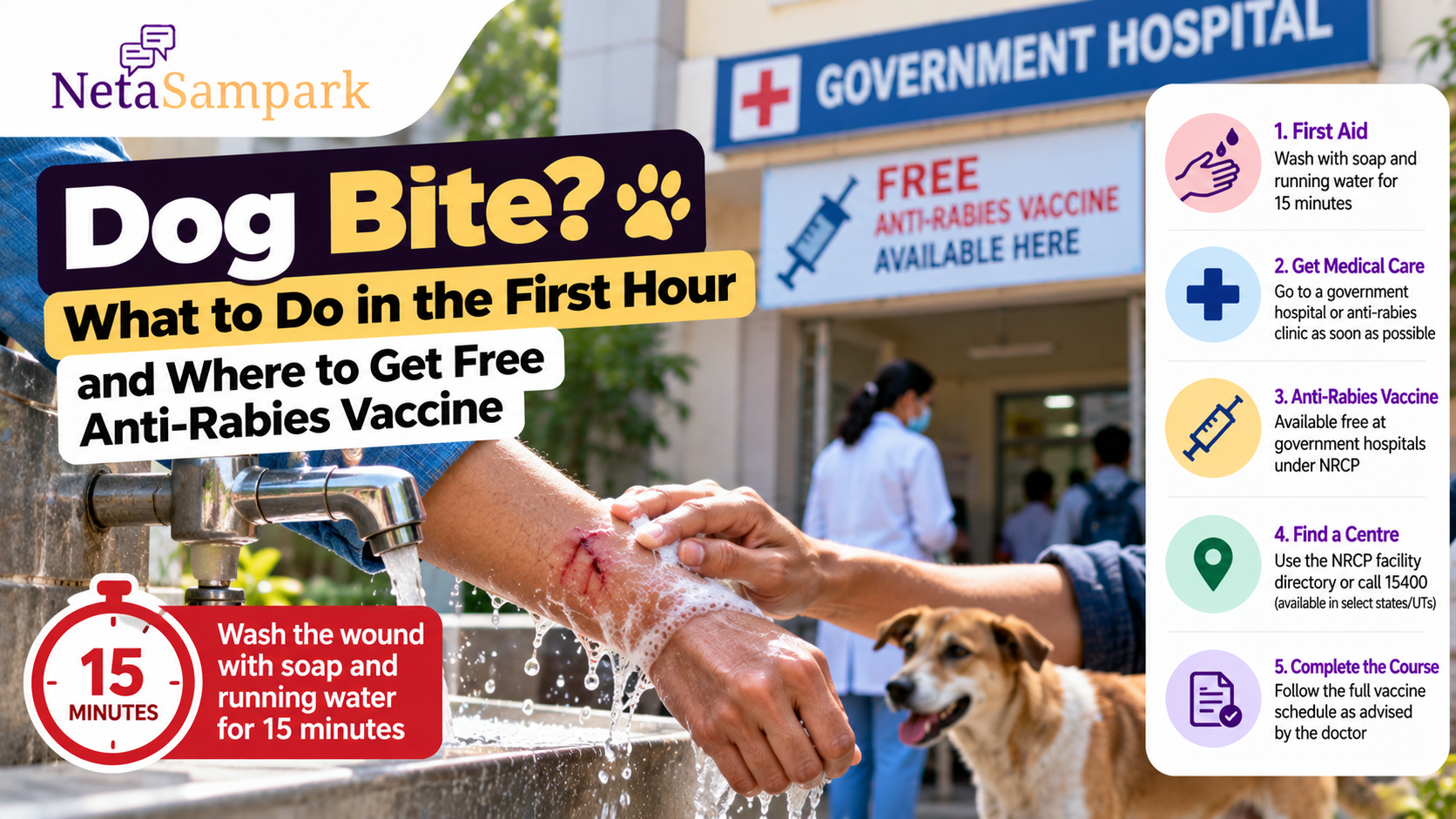
A dog bite can look like a small wound and still require urgent medical attention.
Rabies is preventable when post-exposure treatment is started promptly and correctly. The first step is not to wait for the dog to become sick or to decide whether the bite "looks serious." India's National Rabies Control Programme (NRCP) advises immediate wound washing followed by medical assessment for people exposed to an animal bite or scratch. Rabies Free India
If you or someone with you has just been bitten, start washing the wound now and seek medical care as soon as possible.
The first 15 minutes matter
The most important first-aid step is surprisingly simple:
Wash the wound continuously with soap and running water for 15 minutes.
The National Rabies Control Programme recommends:
- Immediately wash the wound with soap or detergent.
- Flush it thoroughly under running water for up to 15 minutes.
- If soap is unavailable, flush with plenty of water.
- After washing, apply an iodine-containing antiseptic or another appropriate virucidal preparation.
- Go to a healthcare facility for assessment and further treatment. Rabies Free India
Don't wait until you reach a hospital to wash the wound.
Start at the nearest tap.
What NOT to put on a dog biteAvoid home remedies such as:
- Chilli powder
- Turmeric paste
- Lime
- Kerosene
- Soil or mud
- Tobacco
- Ash
- Other irritants
Don't tightly seal the wound yourself.
Don't attempt to burn or cauterise the wound.
The priority is thorough washing, antiseptic treatment and professional medical assessment.
Does every dog bite require rabies vaccination?A healthcare professional should assess the exposure.
The National Guidelines for Rabies Prophylaxis classify exposures into categories. Category II and III exposures require rabies vaccination, while Category III exposures additionally require rabies immunoglobulin (RIG). Rabies Free India
Category I
Contact such as touching or feeding an animal, or a lick on intact skin, without an actual exposure of broken skin or mucous membranes.
The medical team determines whether rabies PEP is necessary based on the actual exposure.
Category II
Examples include:
- Minor scratches or abrasions without bleeding
- Nibbling of uncovered skin
- Other specified minor exposures
Rabies vaccination is indicated under the national guidelines. Rabies Free India
Category III
This includes more serious exposures such as:
- Bites that penetrate the skin
- Bleeding bites
- Scratches that break the skin
- Saliva contacting broken skin
- Saliva contacting mucous membranes
For Category III exposure, the national guidelines call for rabies vaccine plus infiltration of rabies immunoglobulin (RIG) into the wounds. Rabies Free India
The final classification should be made by the treating healthcare professional.
Don't wait to see whether the dog is healthyA common mistake after a dog bite is:
"The dog looks normal, so I'll wait."
That is not a safe way to decide whether medical care is necessary.
A person exposed to a potentially rabid animal should be assessed promptly. The NRCP advises people with animal bites or scratches to seek healthcare as soon as possible. Rabies Free India
If the dog is available, tell the medical team:
- Whether it is a pet or stray
- Whether it is vaccinated, if known
- Where the incident happened
- Whether the dog can be safely identified or observed
Do not put yourself at risk trying to catch or restrain the dog.
What happens at the hospital?The healthcare professional will assess:
- Type of animal exposure
- Location of the wound
- Whether the skin was broken
- Whether there was bleeding
- Whether saliva contacted broken skin or mucous membranes
- Whether the person has previously received rabies vaccination
- Whether rabies immunoglobulin is required
- Whether tetanus protection or other wound treatment is needed
Rabies post-exposure prophylaxis (PEP) has three components:
1. Wound management
2. Rabies immunoglobulin when indicated
3. Rabies vaccine
The NRCP describes these as the three components of PEP. Rabies Free India
When is rabies immunoglobulin needed?RIG is particularly important for Category III exposure in someone who has not previously been appropriately vaccinated against rabies.
It is infiltrated into and around the wound to provide immediate passive protection while the vaccine stimulates the body's immune response.
The NRCP advises that RIG should be given as soon as possible, preferably within 24 hours of exposure, and not later than seven days after the first vaccine dose. Rabies Free India
This is one reason not to delay medical treatment after a serious bite.
What is the rabies vaccine schedule?For someone who has never previously received rabies vaccination, the exact regimen depends on the route selected by the treating facility.
The national guidelines list:
Intradermal route
Vaccination at specified sites on:
Day 0 → Day 3 → Day 7 → Day 28
Intramuscular route
Vaccination on:
Day 0 → Day 3 → Day 7 → Day 14 → Day 28
The NRCP notes that the treating facility determines the appropriate route and schedule. Rabies Free India
Important
Day 0 means the day the first dose is given, not necessarily the calendar day after the bite.
Don't create your own schedule based on information from another patient. Follow the schedule written by your healthcare provider.
What if you've had rabies vaccination before?Tell the doctor.
A person who has previously completed an appropriate rabies vaccination course can have a different post-exposure regimen from someone who has never been vaccinated.
Do not assume that you need the same number of doses as someone receiving PEP for the first time.
Carry your previous vaccination records if you have them.
Where can you get free anti-rabies vaccine in India?This is one of the most useful things to know.
Under the National Rabies Control Programme, Anti-Rabies Vaccine (ARV) and Anti-Rabies Serum/Immunoglobulin are provided free of cost in public health facilities under the National Free Drug Initiative, subject to availability and the applicable public-health programme arrangements. NCDC
This means a person who has been bitten does not necessarily need to go to a private hospital and pay for the complete treatment.
Start by checking:
- Government hospitals
- District hospitals
- Government medical college hospitals
- Designated anti-rabies clinics
- Other public health facilities providing rabies PEP
Availability can vary between facilities, so confirm that the required vaccine and RIG are available before travelling long distances.
Use the official NRCP facility directoryThe National Rabies Control Programme maintains a directory of anti-rabies clinics.
Its downloads section currently lists a List of Anti Rabies Clinic, dated February 2026. Rabies Free India
The NRCP website also provides a facility-search function for finding locations where rabies vaccine is available. Rabies Free India
National Rabies Control Programme — Find vaccination facilities
Before visiting, call the facility where possible and ask:
"Do you currently have anti-rabies vaccine and rabies immunoglobulin for dog-bite PEP?"
That can save a potentially unnecessary trip.
Rabies helpline: 15400The National Rabies Control Programme currently lists 15400 as its toll-free rabies helpline.
The helpline's stated objectives include providing information about first aid after animal bites and identifying nearby health facilities with Anti-Rabies Vaccine and Anti-Rabies Serum availability. Rabies Free India
However, there is an important limitation:
The NRCP currently says the 15400 helpline is being implemented in five states/UTs: Andhra Pradesh, Madhya Pradesh, Assam, Puducherry and Delhi. Rabies Free India
Therefore, don't assume that 15400 is a nationwide facility-location helpline in every State.
If you are outside those areas, use the NRCP facility directory and your State/district health department's government hospital network.
What if you are in a city with no vaccine at the nearest hospital?Don't simply give up.
Ask the hospital:
"Which government facility in this district currently provides anti-rabies PEP?"
Government hospitals may refer patients to designated anti-rabies clinics or another facility.
If RIG is required, specifically ask about its availability.
A vaccine-only visit may not be sufficient for a Category III exposure where RIG is indicated.
What should you carry to the hospital?Take:
- Aadhaar or another ID if available
- Previous rabies vaccination records, if any
- Information about when and where the bite occurred
- Details of the animal, if known
- Any information about the dog's vaccination status
- Your regular medical information if relevant
But don't delay treatment because you don't have an Aadhaar card or paperwork with you.
The urgent priority after a bite is wound washing and medical assessment.
What if the bite happened several hours ago?Still seek medical care.
Do not assume that PEP is useless because you didn't receive the vaccine immediately.
The NRCP states that wound management should be performed even when a patient reports late, and PEP should be initiated promptly following a relevant exposure. Rabies Free India
If the bite happened earlier today:
Wash it now → seek medical care now.
If it happened yesterday or several days ago:
Still seek medical assessment as soon as possible.
Do not wait for symptoms.
What if the wound has already healed?A healed-looking wound does not tell you whether rabies exposure occurred.
If you had a potentially significant bite or scratch and did not receive appropriate PEP, tell a healthcare professional exactly:
- When it happened
- Where you were bitten
- Whether the skin broke
- Whether there was bleeding
- What treatment you received
- Whether you have previously been vaccinated
The clinician can determine what treatment is appropriate.
What if the dog is vaccinated?Tell the doctor if the dog is a known vaccinated pet and provide vaccination records if available.
But don't decide on your own that vaccination is unnecessary.
The healthcare professional will assess the exposure and the circumstances of the animal.
For a stray or unknown dog, don't wait for proof of vaccination before seeking medical care.
What if the dog runs away?You should still seek medical assessment.
You don't need to find the dog before starting the process.
If the animal can be safely identified later, provide that information to the healthcare team or local authorities.
Never attempt to capture a potentially aggressive animal yourself.
Can a small scratch transmit rabies?Potentially, yes.
A scratch that breaks the skin can constitute a rabies exposure, particularly if contamination with saliva is possible.
That's why the national guidelines specifically include scratches and abrasions among exposures that need assessment. Rabies Free India
A wound doesn't have to look dramatic to require PEP.
What about a lick?The risk depends on where the saliva contacted the body.
A lick on intact skin is different from saliva contacting:
- A fresh wound
- Broken skin
- The eyes
- The mouth
- Other mucous membranes
The latter situations require medical assessment.
The national guidelines classify exposures according to the nature of contact rather than simply whether the animal touched the person. Rabies Free India
What about tetanus?A dog bite is also a wound, so the healthcare professional may assess whether tetanus protection and other wound treatment are required.
Tell the doctor when you last received a tetanus-containing vaccine if you know.
Don't assume that rabies vaccination replaces ordinary wound care or tetanus assessment.
The first-hour checklistIf a dog has just bitten you, follow this order:
0–15 minutes
Wash the wound with soap and running water continuously for 15 minutes.
Immediately after washing
Apply an appropriate antiseptic.
As soon as possible
Go to a healthcare facility.
At the facility
Tell the doctor:
- When the bite happened
- Whether the skin broke
- Whether there was bleeding
- Where the bite occurred
- Whether the dog is known/vaccinated
- Whether you have previously received rabies vaccine
Before leaving
Confirm:
- Whether rabies vaccine is required
- Whether RIG is required
- Your next vaccine date
- Whether tetanus or other treatment is needed
Write the next vaccination date in your phone immediately.
Don't miss the next vaccine doseRabies vaccination is a course, not simply one injection in every case.
If your doctor starts PEP, follow the prescribed schedule.
For the standard schedules listed by the NRCP, subsequent doses may fall on Day 3, Day 7 and later dates depending on whether the intradermal or intramuscular regimen is used. Rabies Free India
Don't stop because:
- The wound looks better
- The dog appears healthy
- You feel completely normal
- The first injection was painless
- Someone tells you "one dose is enough"
If there is a problem with attending the next appointment, contact the treating facility rather than making your own changes.
A note for parents: children need the same urgencyChildren may not always tell parents that a dog has scratched or bitten them, particularly if the wound appears minor.
After children play with or are bitten/scratched by an unfamiliar animal, check for:
- Small punctures
- Scratches
- Bleeding
- Broken skin
- Saliva exposure
If an exposure occurred, wash the area and seek medical advice promptly.
The NRCP's first-aid guidance applies to animal bites and scratches, including those involving children. Rabies Free India
Dog Bite: Quick Do-and-Don't ListDoDon'tWash with soap and running water for 15 minutesDon't wait for symptomsApply appropriate antisepticDon't apply chilli, soil or other irritantsGet medical assessment promptlyDon't assume a small wound is harmlessTell the doctor about previous rabies vaccinationDon't decide your own vaccine scheduleAsk about ARV and RIG availabilityDon't delay because the dog looks healthyKeep your next-dose dates recordedDon't stop the course without medical adviceUse government facilities where availableDon't try to catch an aggressive dog
Where to start if you need free treatmentThe simplest route is:
1. Wash the wound for 15 minutes.
2. Go to the nearest government hospital or designated anti-rabies clinic.
3. Ask whether Anti-Rabies Vaccine and, if needed, RIG are available.
4. Use the National Rabies Control Programme's facility directory if you need another centre.
5. In the five areas currently covered by the NRCP helpline — Andhra Pradesh, Madhya Pradesh, Assam, Puducherry and Delhi — call 15400 for information about nearby facilities and vaccine/serum availability. Rabies Free India
NRCP official website and facility information
The one thing to remember
Dog bite → wash for 15 minutes → seek medical care promptly.
Don't wait for the dog to develop symptoms. Don't wait for the wound to become painful. And don't rely on home remedies.
Rabies is almost always fatal once clinical symptoms develop, but prompt and correct post-exposure treatment can prevent it. Rabies Free India
If this is about a bite that just happened, start washing the wound now and seek urgent medical assessment rather than waiting to read the rest of this article.