
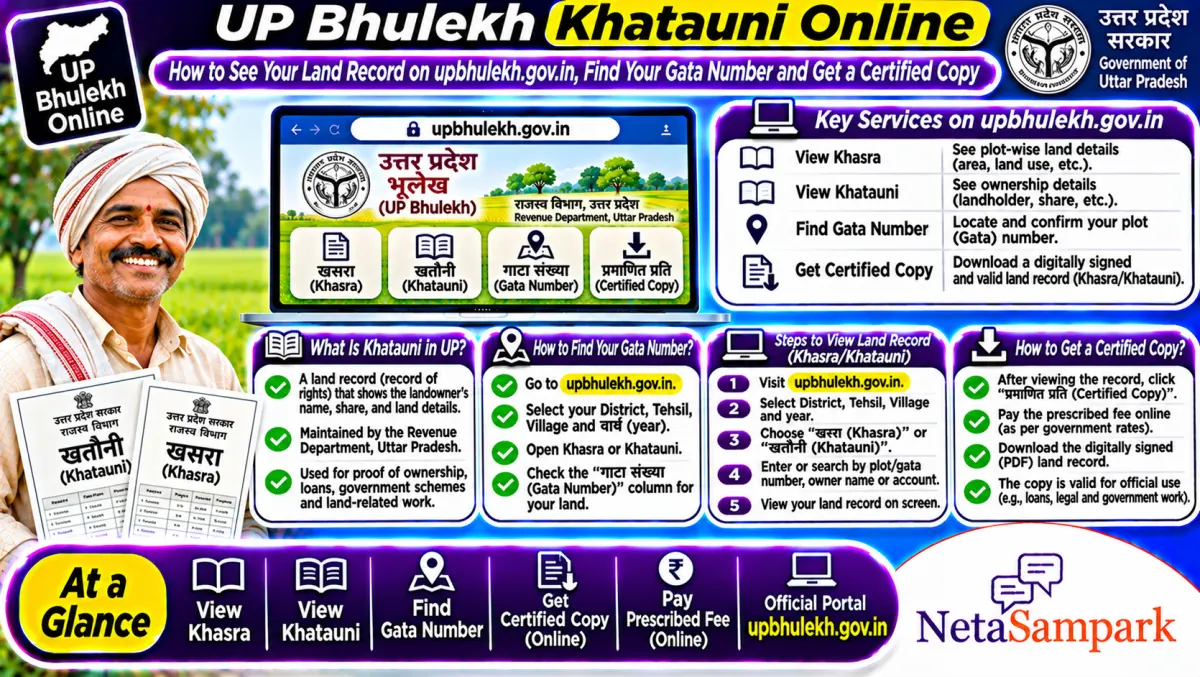
Want to check whose name is on a plot in Uttar Pradesh? Open upbhulekh.gov.in, pick your district, tehsil and village, then search by khasra or gata number, khata number or owner name. The khatauni copy you see online is free and for information only. For a bank loan or court, get a certified copy.
Updated 11 November 2026
If you're about to buy land, take a crop loan, apply for PM-Kisan or settle a family partition in UP, the first paper everyone asks for is the khatauni. Good news: you don't need to stand outside the tehsil for it anymore. The Board of Revenue's UP Bhulekh portal shows the record of rights for almost every village in the state, and it takes about two minutes if you know which number to type.
This guide walks you through it slowly, explains what each column means, and tells you what to do when the record is wrong or your name hasn't been updated after a sale or inheritance.
Quick facts: UP Bhulekh khatauni
| Item | Details |
|---|---|
| Official portal | upbhulekh.gov.in (Board of Revenue, Uttar Pradesh) |
| Map portal | upbhunaksha.gov.in for the village map (Bhu-Naksha) |
| Helpline | Tehsil office / Lekhpal for corrections; UP CM Helpline 1076 for complaints |
| Fee | Free to view online; certified copy at a Jan Seva Kendra or tehsil for a small fixed fee (confirm at the counter) |
| Deadline | None, the record is open all year |
| Documents | None to view; for a certified copy carry your Aadhaar and the khata or gata number |
| Search options | Khasra / gata number, khata number, khatedar name, or Unique Land Parcel ID |
| Mutation (dakhil kharij) | Apply on the Revenue Court portal vaad.up.nic.in or at the tehsil |
What is a khatauni, and how is it different from khasra?
Think of it this way. The khasra (also called gata) is the plot. It's the number given to one piece of land on the village map. The khatauni is the account. It lists every khatedar (owner or co-owner) of a khata and all the gata numbers that belong to that khata.
So one khata can have five gata numbers spread across the village, and one gata can be shared by three brothers. When a bank or the PM-Kisan office asks for your "land record", they mostly want the khatauni, because it shows the name, share, area and the class of land.
Who needs to check the khatauni?
• Buyers, before paying any advance for a plot or farmland
• Farmers applying for a Kisan Credit Card, crop insurance or PM-Kisan land seeding
• Families after a death, to see if varasat (inheritance) has been entered
• Anyone who got a court or tehsil order and wants to see if it's been recorded
How to see your khatauni on UP Bhulekh, step by step
1. Open upbhulekh.gov.in on your phone or laptop. The site is in Hindi first, which is fine, the options are simple.
2. Tap "खतौनी (अधिकार अभिलेख) की नकल देखें", which means "view a copy of the khatauni". You'll also see a "Real Time Khatauni" option on newer versions of the site. Use that if it's available, since it reflects the latest entries.
3. Type the captcha shown on the screen and continue.
4. Pick your district (जनपद), then tehsil, then village from the drop-downs. If your village has two similar names, check the pargana shown next to it.
5. Choose how you want to search: by khasra or gata number, by khata number, or by khatedar name. If you know the gata number, use it. Name searches throw up many results in big villages.
6. Select your record from the list and tap the button to view the khatauni.
7. Check the captcha again if asked, and the full khatauni will open. Take a screenshot or use the print option to save it as a PDF.
That's it. If the site is slow, try early morning or late evening. Around crop-loan season it gets heavy traffic.
How to read the khatauni once it opens
The page looks crowded, so here's what to look at first:
• Khata number: the account number at the top. Keep it, every future request needs it.
• Khatedar names: each owner with father's or husband's name and address. Check the spelling against your Aadhaar.
• Gata number and area: each plot with its area in hectares. A mismatch here causes loan trouble later.
• Share: if land is joint, the fraction each person holds.
• Order column (आदेश): any recent order, like varasat after a death, a sale entry or a court order, with the date.
• Land class (श्रेणी): whether it's bhumidhari land with transferable rights or another category. Banks look at this.
If the order column is blank for a sale you made years ago, the mutation was probably never done. That's the most common problem we hear about.
How to get a certified khatauni copy
The online copy says it's for information only. For a bank loan, registry, court case or a government scheme that needs a stamped copy, do this:
1. Go to any Jan Seva Kendra (CSC) or the tehsil counter.
2. Give the district, tehsil, village and khata or gata number.
3. Pay the fixed fee and take the receipt.
4. You'll get a printed khatauni with the signature or digital verification that offices accept.
Ask the operator to show you the screen before printing, so you can check the name and gata numbers are right.
Find your Unique Land Parcel ID (Bhu-Aadhaar)
Under the Centre's land records programme, plots are getting a 14-character Unique Land Parcel Identification Number, often called Bhu-Aadhaar. UP Bhulekh has an option to look it up. Once your plot has one, keep it with your khatauni. It makes future searches, loans and registries quicker because there's no confusion over similar gata numbers. You can read more in our explainer on DILRMP and Bhu-Aadhaar.
Name not updated after a sale or death? Here's what to do
This is where most people get stuck, so let's go slowly.
After a death (varasat): the legal heirs apply for varasat at the tehsil or through the Lekhpal. Carry the death certificate, Aadhaar of all heirs and a family tree (vanshavali) if asked. Once approved, the new names show in the order column of the khatauni.
After a sale or gift (dakhil kharij or namantaran): the buyer applies for mutation. You can file online on the UP Revenue Court Computerised Management System at vaad.up.nic.in, or at the tehsil. Attach the registered sale deed, ID proof and the old khatauni. You'll get a case number. Track it on the same portal.
A spelling mistake or wrong area: apply to the Tehsildar with the correct documents. Small spelling fixes are usually handled after the Lekhpal's report.
If nothing moves for weeks, file a complaint on the UP Jansunwai portal or call 1076. We've explained how that works in our UP Jansunwai 1076 guide.
Common errors on UP Bhulekh and quick fixes
| Problem | What it usually means | What to do |
|---|---|---|
| "No record found" | Wrong village or gata format | Recheck the village; try khata number instead |
| Captcha keeps failing | Session timed out | Refresh the page and try again |
| Old owner still showing | Mutation not done or pending | Check vaad.up.nic.in for the case; meet the Lekhpal |
| Area differs from sale deed | Survey or entry mismatch | Apply to the Tehsildar for correction |
| Page won't load | Server rush | Try at a quieter hour or use a CSC |
A real-life example
Ramesh from Barabanki bought 0.150 hectare from his neighbour in 2024. He checked UP Bhulekh before applying for a Kisan Credit Card in 2026 and found the seller's name still on the khatauni. He filed for dakhil kharij on vaad.up.nic.in with his sale deed, got a case number, and followed up with the Lekhpal for the report. Only after the order showed in the khatauni did the bank process his loan. The lesson: check the record well before you need it.
Documents checklist
☐ Khata number or gata number (from an old khatauni or sale deed)
☐ Aadhaar card of the khatedar
☐ Registered sale deed or gift deed, if you're applying for mutation
☐ Death certificate and family details, if you're applying for varasat
☐ Mobile number that works, for case updates
Why this matters for you as a citizen
Land disputes are one of the biggest reasons people end up visiting their MLA or pradhan. If your tehsil is sitting on a mutation for months, it's fair to raise it with your elected representative. You can find your MLA and MP on NetaSampark's Uttar Pradesh page.
Final reminder
Check your khatauni once now, even if you don't need it. Note the khata number, confirm every name and gata, and if anything's off, start the correction before a loan, sale or scheme forces you to rush.
Frequently asked questions
Is the khatauni on UP Bhulekh valid for a bank loan?
The online copy is for information. Most banks want a certified copy from a Jan Seva Kendra or the tehsil, so get that for loans and registries.
How do I find my gata number if I don't know it?
Search by khatedar name on UP Bhulekh, or look at your old khatauni or sale deed. The Lekhpal can also tell you.
How long does dakhil kharij take in UP?
It depends on whether anyone objects. Undisputed cases move faster. Track your case on vaad.up.nic.in and follow up with the tehsil if it stalls.
Can I see the village map too?
Yes. Use upbhunaksha.gov.in, pick your district, tehsil and village, and tap your plot number to see its shape and neighbours.
Is there any fee to view the khatauni online?
No. Viewing on upbhulekh.gov.in is free. You only pay for a certified copy.
Sources
• UP Bhulekh, Board of Revenue Uttar Pradesh