
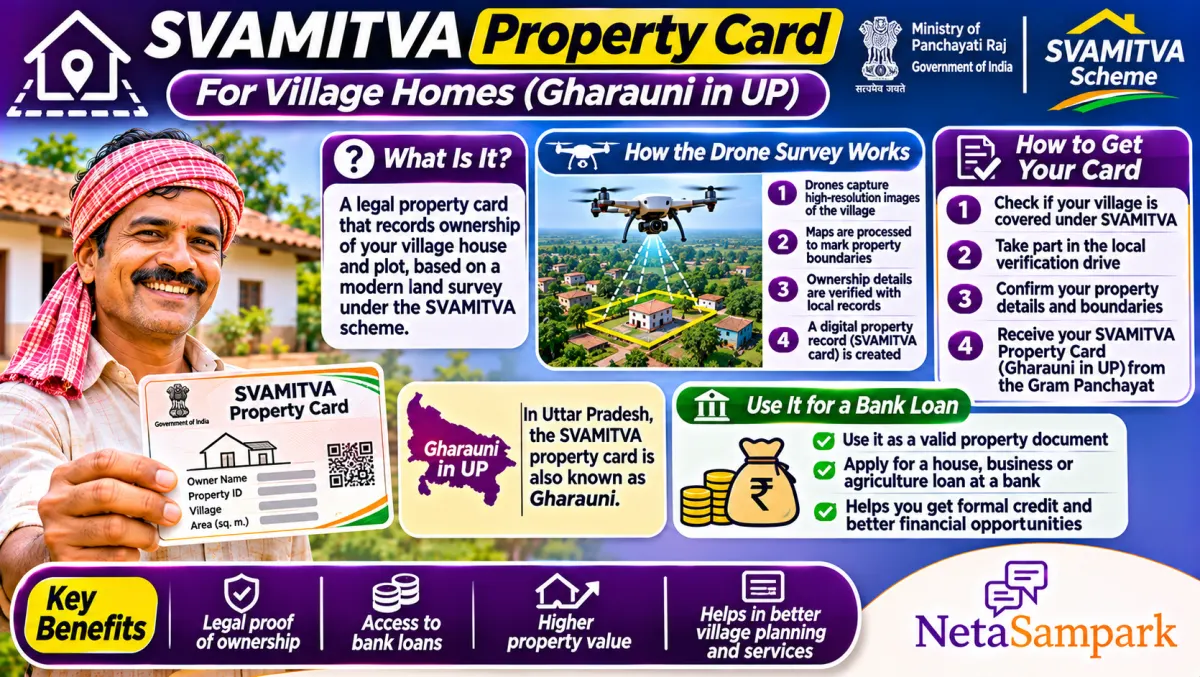
The SVAMITVA scheme gives village families a legal property card for their house and land in the abadi (inhabited) area, after a drone survey maps every plot. In UP it's called Gharauni. Ask your gram panchayat if your village is surveyed, review the draft map, raise objections if any, and collect or download the card once issued.
Updated 11 November 2026
For generations, village houses in India had no proper ownership papers. The land under the house sat in the "abadi" area, which old revenue records didn't map plot by plot. That meant no bank loan against the house, endless boundary fights, and nothing to show in court. The Ministry of Panchayati Raj's SVAMITVA scheme, launched in April 2020, is changing that with drone surveys and property cards.
Here's how it works, what you need to do when the survey reaches your village, and how the card helps you.
Quick facts: SVAMITVA property card
| Item | Details |
|---|---|
| Official portal | svamitva.nic.in and panchayat.gov.in (Ministry of Panchayati Raj) |
| Helpline | Gram panchayat secretary, Lekhpal or Patwari, and the tehsil office |
| Fee | No fee for the survey; states may charge for printed copies as per rules |
| Deadline | Objection window after the draft map, as notified in your village |
| Documents | ID proof, any old papers or tax receipts for the house, family details |
| Who runs it | Ministry of Panchayati Raj with state revenue departments and Survey of India |
| State names | Gharauni (UP), Adhikar Abhilekh and others in different states |
| Covers | Residential properties in the rural abadi area |
Who benefits?
Families who own a house or plot inside the village abadi area. The scheme doesn't cover agricultural fields, which are already in the revenue record (khatauni, 7/12, jamabandi and so on). It's about the house plots that were never mapped.
How the drone survey works
1. Notification: the state announces the survey for your village.
2. Chuna marking: villagers and the survey team mark property boundaries with lime powder, with neighbours present.
3. Drone flight: Survey of India drones photograph the village at high resolution.
4. Map preparation: a detailed map of every plot is made.
5. Ground check: the team verifies plots and owners on the ground.
6. Draft list and objections: the draft is displayed, and families can object.
7. Final property cards: after objections are settled, cards are issued.
What you should do when the survey reaches your village
• Be present when the chuna marking happens. If you're away for work, ask a family member to stand in.
• Agree boundaries with neighbours on the spot. Most disputes start here.
• Check the draft list and map when displayed at the panchayat. Look at your name, the plot shape and the area.
• File an objection within the window if anything's wrong. Carry proof like old sale papers, house tax receipts or electricity bills.
• Collect the card when issued, or download it if your state offers that.
How to get or download the card
The process depends on the state. In many states, cards are distributed at village camps and also made available through the state's revenue or panchayat portal, or DigiLocker in some states. In UP, Gharauni cards are distributed through the revenue department, and the tehsil can tell you about copies. Ask the gram panchayat secretary or Lekhpal for the exact route in your village.
Using your property card
• Bank loans: banks can accept the card as proof of ownership for a home loan or a loan against property, subject to their rules.
• Fewer disputes: a mapped boundary and an official card make fights with neighbours easier to settle.
• Property tax for panchayats: panchayats can assess property tax better, which funds village works.
• Sale and inheritance: a clear record makes transfers smoother.
Common problems and fixes
| Problem | Likely reason | What to do |
|---|---|---|
| Name missing in draft | Not recorded during the survey | Object within the window with proof |
| Wrong area or boundary | Chuna marking error | Object; ask for a re-check with neighbours |
| Family dispute over the plot | Heirs not agreed | Settle inside the family or seek mediation before objecting |
| Card not received | Distribution pending | Ask the gram panchayat or tehsil |
| Village not yet surveyed | Phase not reached | Ask the tehsil for the schedule |
A real-life example
Ramvati's family in Mirzapur had lived in the same house for three generations with no papers. When the survey team came, her son stood with the neighbours during chuna marking, and they agreed the boundary wall line. In the draft, the area was a little short. They objected with an old house tax receipt, the team rechecked, and the corrected Gharauni came through. The family later used it to apply for a small business loan.
Documents checklist
☐ Aadhaar of the owner or owners
☐ Old sale papers, gift deed or family partition papers, if any
☐ House tax or electricity receipts showing the address
☐ Family details for inherited homes
☐ Mobile number for updates
How SVAMITVA links to other land records
The Centre's land records push, including the unique land parcel number, aims to bring rural house plots and farmland into one clean system. Read our DILRMP and Bhu-Aadhaar explainer and our guide to downloading your ROR land record.
Who to approach
Your gram panchayat, Lekhpal or Patwari, and the tehsil handle the survey. If your objection isn't heard, write to the SDM. Your MLA and MP review SVAMITVA progress too, so it's fair to raise a stuck village with them. Find them on NetaSampark.
Joint families and inherited houses
Many village houses belong to brothers or cousins jointly, often without any written partition. During the survey, the team records owners as per what the family and village agree on the ground. If the family wants separate cards for separate portions, settle it before the chuna marking and mark the internal boundary. If it's not agreed, the card may show joint ownership, which you can change later only through a proper partition. Women heirs are owners too, and their names should be recorded where they have a share.
Is it a title guarantee?
The property card is a record of rights prepared through a legal process in your state, and it's strong proof of ownership. Still, if there's a court case pending over the property, the card doesn't override the court. If you know of a dispute, tell the survey team so it's noted, rather than hiding it.
Getting a copy later
If you lose your card, ask the tehsil or gram panchayat for a copy. Some states let you download the card online, so check with your Lekhpal or Patwari about the portal for your state.
Keep the card safe
Keep the property card with your other papers, and give a copy to every family member who has a share. That way nobody is surprised when the house is divided, sold or used for a loan, and any mistake gets spotted early while the survey team and gram panchayat records are still fresh.
Final reminder
When the drone survey is announced in your village, be there for the chuna marking, check the draft map carefully, and object on time if anything's wrong. Once the card comes, keep it safe; it's the first legal paper many village homes have ever had.
Frequently asked questions
What is the SVAMITVA scheme?
A Ministry of Panchayati Raj scheme that maps rural house plots with drones and gives owners a legal property card.
What is Gharauni?
It's the name of the SVAMITVA property card in Uttar Pradesh.
Does SVAMITVA cover farmland?
No. It covers residential properties in the village abadi area. Farmland is in the regular revenue records.
Can I get a bank loan with a property card?
Banks can accept it as proof of ownership, subject to their own lending rules.
What if my name is wrong in the draft?
File an objection within the notified window with proof, and ask for a re-check.