
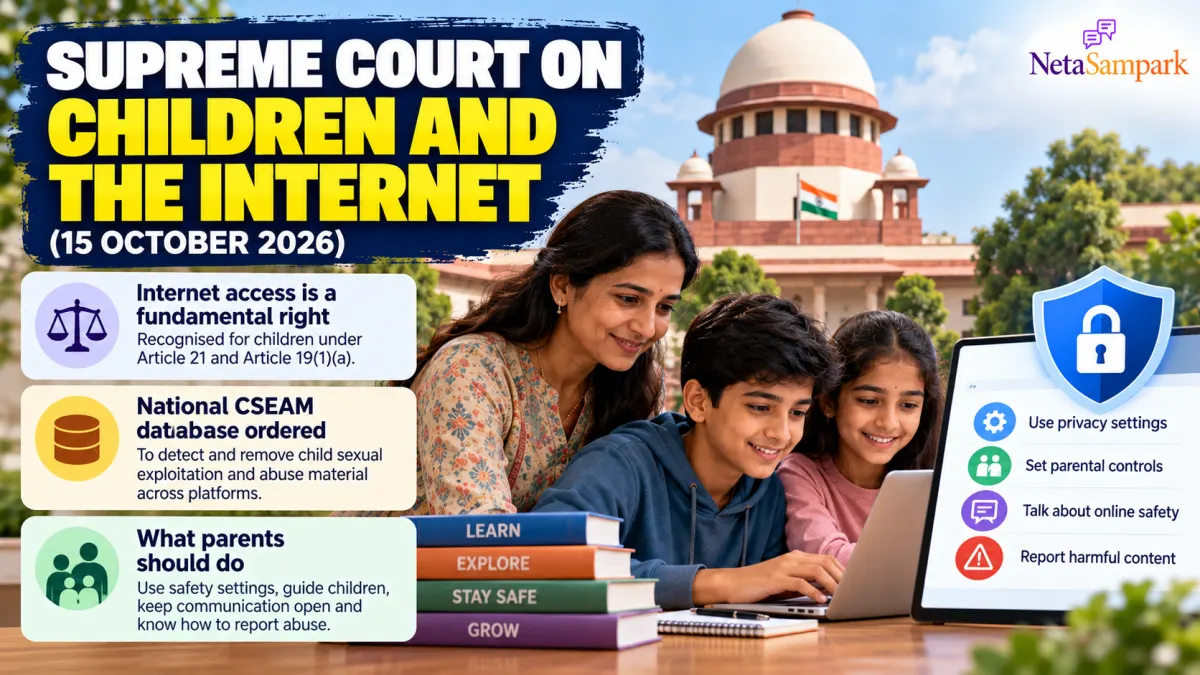
Supreme Court on Children and the Internet (15 October 2026): Fundamental Right, National CSEAM Database and What Parents Should Do
The Supreme Court of India has recognised that children have a fundamental right to access and use the internet, while directing stronger measures to detect and remove child sexual exploitation and abuse material (CSEAM) from online platforms.
In its order dated 15 October 2026, in Just Rights for Children Alliance & Anr. v. S. Harish & Ors., the Court rejected blanket restrictions on children's internet access as a proportionate solution to online harm. Instead, it emphasised age-appropriate safeguards, parental guidance, platform accountability and coordinated action against abusive content.
The Court also directed the Union Government to establish a National Hash & URL List Database to help identify and remove confirmed CSEAM across digital platforms.
For parents, the message is practical: children need access to education, information and communication, but that access must be supported by age-appropriate safety settings, open conversations and clear reporting options when something goes wrong.
Official case reference: Supreme Court order — 15 October 2026, 2026 INSC 1149
Supreme Court Order: Key Details at a Glance
| Particular | Details |
|---|---|
| Court | Supreme Court of India |
| Order date | 15 October 2026 |
| Case | Just Rights for Children Alliance & Anr. v. S. Harish & Ors. |
| Case citation | 2026 INSC 1149 |
| Bench | Justice J.B. Pardiwala and Justice K. Vinod Chandran |
| Constitutional provisions | Article 21 and Article 19(1)(a) |
| Key ruling | Internet access and use is a fundamental right, including for children |
| National measure | National Hash & URL List Database for confirmed CSEAM |
| Approach to child safety | Proportionate safeguards rather than blanket internet bans |
| Next listed hearing | 10 December 2026, as recorded in the published order |
The order arose from concerns about the circulation of child sexual exploitation and abuse material through social media, including indirect links and promotional mechanisms. The Court examined the responsibilities of online intermediaries, government authorities and other stakeholders in detecting, reporting and removing such material.
1 What Did the Supreme Court Say About Children's Internet Rights?
The Court held that the right to access and use the internet is a fundamental right under Article 21, read with Article 19(1)(a), of the Constitution. The judgment expressly includes children, regardless of age.
This matters because the internet is no longer simply a place for entertainment. Children use it for:
- Online classes, educational resources and homework.
- Access to information and public services.
- Communication with family, teachers and friends.
- Creative expression and participation in digital communities.
- Accessibility tools and support networks, particularly for children with disabilities.
The Court's reasoning recognises that a blanket ban can deny children legitimate opportunities and may make some children less willing to report online threats if they fear punishment for using the internet.
Does this mean parents cannot restrict screen time?
No. The judgment does not mean children have unrestricted access to every website, application or type of content.
Parents can still establish reasonable, age-appropriate household rules, supervise younger children and use safety settings. The Court also recognised that restrictions may be appropriate for specific categories of content or services that are inherently harmful to children.
The distinction is between responsible, proportionate safeguards and a blanket denial of internet access simply because online risks exist.
2 What Is the National CSEAM Database?
CSEAM stands for Child Sexual Exploitation and Abuse Material. It refers to material depicting or documenting the sexual exploitation or abuse of children.
The Court directed the Union Government to create a National Hash & URL List Database, which may be established through the existing Sahyog Portal or as a separate repository.
The objective is to help platforms and law enforcement agencies detect known abusive material and links to it, rather than depending entirely on individual users to report every instance.
How is hash matching supposed to work?
A digital hash is an identifier generated from digital content. Platforms can compare identifiers against a verified list to identify matching material.
The Court also discussed perceptual hashing, which can help detect content that has been altered, resized or reformatted. URL listing can help identify links directing users to locations where confirmed abusive material is hosted.
Under the directions, the proposed national database must include safeguards:
- Entries must undergo multiple levels of verification.
- At least three trained human analysts must independently determine whether the material constitutes CSEAM before an entry is made.
- The database must be limited to identifiers and URLs of material confirmed to be CSEAM.
- Entries must be transmitted through encrypted channels.
- Platforms and law enforcement agencies must use matching mechanisms to help detect and remove material corresponding to verified entries.
These measures are intended to improve cross-platform detection, including when abusive material reappears elsewhere on the internet.
Important: The order directs the government to establish and operationalise the framework. It should not be assumed that every part of the national database is already fully implemented.
3 What Other Changes Did the Court Seek?
The judgment addresses more than the national database. It examines the responsibilities of online intermediaries, reporting procedures, grievance redressal and penalties for persistent failures to comply with applicable law.
Key areas include:
Better detection and removal
Platforms are expected to use effective technological and human-review mechanisms to detect and remove confirmed abusive material. The Court emphasised the limitations of relying only on individual complaints or content previously removed by the same platform.
Clearer reporting procedures
The order addresses the need for standardised reporting mechanisms, appropriate authorities and timelines for handling CSEAM reports. It also discusses dedicated grievance officers and safeguards for complaint handling.
Greater accountability for platforms
The Court considered stronger enforcement measures for persistent failures to comply with legal obligations. These include questions concerning monetary penalties and revenue associated with abusive material.
Government implementation
The Union Government was directed to develop guidelines and standard operating procedures, consider necessary amendments to the Information Technology Rules and report on implementation.
The order therefore establishes a framework for stronger action; individual technical and regulatory measures may still require implementation by the relevant authorities.
4 What Should Parents Do Right Now?
Parents do not need to wait for a new government application or a special Supreme Court form to start protecting children online. These steps can be taken using existing device and platform settings.
Step 1: Review privacy settings on social media
For children who use social platforms, review the available settings together.
- Set the account to private where appropriate.
- Limit who can send direct messages.
- Restrict contact from unknown adults.
- Review who can comment, tag, mention or share content.
- Disable unnecessary location sharing.
- Review friend and follower lists periodically.
Settings differ by platform and age. Check the platform's current help centre rather than assuming that every application offers identical controls.
Step 2: Enable age-appropriate parental controls
Use the built-in controls available on the child's device and relevant applications.
For example:
- Google Family Link for supported Android and Google account supervision.
- Apple Screen Time for screen-time limits, communication restrictions and content controls on supported Apple devices.
- The platform's own family or teen safety settings for social media accounts.
Choose controls according to the child's age and needs. Explain what the settings do instead of using them as a substitute for conversation.
The Supreme Court discussed the possibility of a dedicated child mode for social media accounts, alongside parental consent, guidance and oversight. This should not be confused with a claim that a single, universal child-mode feature is already available across all platforms.
Step 3: Talk about grooming and manipulation
Children should know that an online contact can pretend to be a friend, classmate, recruiter, gaming partner or trusted adult.
Explain warning signs such as someone who:
- Requests intimate images or private videos.
- Asks the child to keep a relationship secret from parents.
- Offers money, gifts, game credits or special privileges in exchange for images.
- Pressures the child to move to a private messaging application.
- Threatens to publish private information or images.
- Tries to arrange a secret meeting.
Make it clear that a child can tell a trusted adult about an uncomfortable interaction without being blamed for what happened.
Step 4: Create a no-blame reporting rule
Tell your child that if someone threatens, blackmails, manipulates or harasses them online, they should seek help immediately.
A useful family rule is:
“If something online makes you uncomfortable or frightened, tell me or another trusted adult. You will not be blamed for asking for help.”
This matters because fear of losing device access can discourage children from reporting dangerous situations.
Step 5: Review downloads, permissions and location access
Periodically check which applications have access to the camera, microphone, contacts, photos and location.
Remove unnecessary permissions and uninstall applications the child no longer uses. Explain why personal details, school information, live location and photographs should not be shared publicly without careful consideration.
Step 6: Keep devices and accounts secure
Use strong, unique passwords and enable two-factor authentication where available. Teach children never to share OTPs, verification codes or account passwords with people they meet online.
Review recovery email addresses and phone numbers, particularly when the child uses a supervised account.
5 What Should a Child Do If Someone Threatens or Blackmails Them Online?
Act promptly, prioritise the child's safety and avoid escalating the situation.
- Listen calmly. Reassure the child that the person responsible for the abuse or threat is accountable for their conduct.
- Stop engaging with the suspected offender. Do not negotiate, pay money or send additional images.
- Preserve safe evidence. Keep relevant messages, usernames, profile links, timestamps and transaction details where applicable. Do not forward or circulate abusive imagery.
- Report the account or content to the platform. Use the available child-safety, harassment or abuse-reporting mechanism.
- Report suspected child sexual exploitation or abuse. Contact the local police or Special Juvenile Police Unit (SJPU). Under the POCSO framework, suspected sexual offences against children must be reported through the prescribed channels.
- Use official cybercrime reporting channels. Visit the National Cyber Crime Reporting Portal. For immediate danger, contact the police or emergency services.
- Seek child-protection support. Child Helpline 1098 is an established child-protection helpline in India. If the child is in immediate danger, do not delay contacting the police or emergency services while making an online complaint.
Do not download, repost or circulate suspected CSEAM to prove that it exists. Avoid confronting the suspected offender if doing so could increase the risk to the child.
6 How Can Parents Report Harmful Online Content in India?
Use the appropriate reporting channel for the situation.
| Situation | What to do |
|---|---|
| Suspected child sexual abuse or exploitation | Report to local police or the SJPU; use the applicable POCSO reporting process |
| Cybercrime, online threats or blackmail | National Cyber Crime Reporting Portal |
| Child in need of protection or support | Child Helpline 1098 |
| Immediate physical danger | Contact local police or emergency services |
| Harmful content on a social platform | Report through the platform's official safety mechanism, in addition to contacting the authorities where required |
| Platform fails to respond | Use the platform's grievance mechanism and consider the appropriate legal or regulatory escalation route |
The Supreme Court stressed that platform reporting cannot replace the legal obligation to report suspected offences to the appropriate authorities under the POCSO framework.
7 Does This Judgment Ban Social Media for Children Below a Certain Age?
The Court did not endorse a blanket internet ban for children as a general solution to online abuse.
It discussed safeguards such as parental guidance, parental consent, child-mode accounts, safer privacy defaults and restrictions on unwanted contact. It also clarified that the ruling does not prevent the government from restricting access to specific categories of content or services that are inherently harmful to children.
This means the decision should not be read as a declaration that every child can access every social media platform regardless of that platform's age requirements or applicable law.
Parents should continue to follow the platform's published age rules and the laws in force.
8 Does the Ruling Mean Children Have an Absolute Right to Everything Online?
No. A fundamental right does not mean every form of online access must be unrestricted.
The judgment recognises the importance of digital access while allowing proportionate safeguards to protect children. It distinguishes between protecting children from harmful content and excluding them altogether from a medium that supports learning, communication and expression.
The Court's approach is to focus more directly on harmful material, exploitative conduct and the responsibilities of platforms and authorities, rather than treating every child as someone who must be denied internet access.
9 What Does the Judgment Mean for Schools and Digital Platforms?
For schools
Schools can review digital-safety education, reporting procedures and the support available to students who experience cyberbullying, grooming or online exploitation.
Students should know how to report incidents confidentially and where to obtain help without fear of humiliation.
For social media and technology platforms
The directions place renewed emphasis on detection tools, verified hash and URL matching, reporting mechanisms, grievance redressal and compliance with child-protection law.
Platforms will need to follow the applicable directions and any further guidelines or rule amendments issued by the government.
For parents
The ruling reinforces that child safety is a shared responsibility. Families, schools, online services, law enforcement agencies and the government each have a role.
Parental supervision remains important, but it should support a child's safe use of the internet rather than rely exclusively on surveillance or blanket bans.
Frequently Asked Questions
When did the Supreme Court issue the order?
The order was issued on 15 October 2026 in Just Rights for Children Alliance & Anr. v. S. Harish & Ors., cited as 2026 INSC 1149.
Is internet access a fundamental right for children in India?
Yes. The Supreme Court recognised the right to access and use the internet as a fundamental right under Article 21 read with Article 19(1)(a) of the Constitution, including for children.
What is the National Hash & URL List Database?
It is a proposed national framework for recording verified digital identifiers and URLs associated with confirmed CSEAM, enabling platforms and law enforcement agencies to identify and remove matching material more effectively.
Does the database mean the government will store every child's photographs?
The direction concerns identifiers and URLs for material confirmed to be CSEAM, subject to verification and safeguards. It is not described as a general database of every child's photographs.
Should parents stop children from using the internet?
The judgment does not support blanket denial of internet access as a general child-safety measure. Parents should instead use age-appropriate supervision, privacy settings, content restrictions and open communication.
What is the child helpline number in India?
Child Helpline 1098 is an established child-protection helpline. For immediate danger, contact the local police or emergency services.
Has the national database already been fully implemented?
The Court directed the Union Government to establish the database and develop the necessary implementation framework. The order should not be treated as proof that every part of the system is already operational.
Where can I read the order?
Read the published judgment here: Just Rights for Children Alliance v. S. Harish, 15 October 2026.
Final Takeaway
The Supreme Court's 15 October 2026 order marks an important development in India's approach to children's digital rights. It recognises that children should not automatically be excluded from the internet because online risks exist, while calling for stronger measures against child sexual exploitation and abuse material.
For parents, the next steps are straightforward: review privacy and parental-control settings, teach children how to recognise manipulation, keep communication open and know where to report abuse. For government and technology platforms, the challenge is to implement effective, verified and accountable safeguards without undermining children's legitimate access to information and expression.
Protect children by making the internet safer—not by making them afraid to ask for help.