
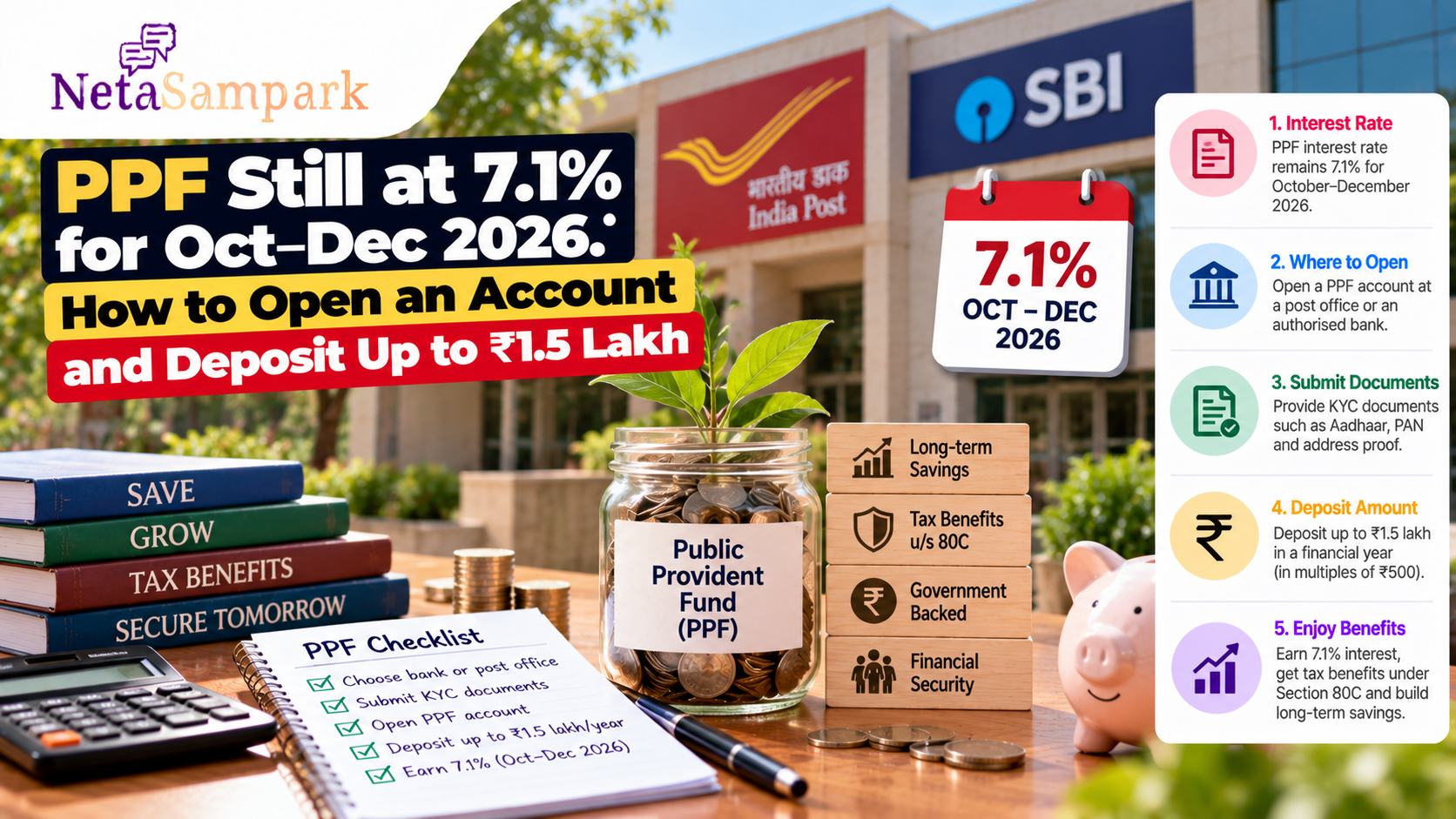
PPF Still at 7.1% for Oct–Dec 2026: How to Open an Account and Deposit Up to ₹1.5 Lakh
The Public Provident Fund (PPF) interest rate remains at 7.1% per annum for October–December 2026.
The Department of Economic Affairs has published the small-savings rate revision for the third quarter of 2026–27, covering 1 October to 31 December 2026. The PPF rate remains unchanged at 7.1%. Drug Enforcement Administration
For someone looking for a government-backed, long-term savings option, PPF combines a fixed government-notified interest rate for each quarter with a long maturity period and tax benefits under the applicable rules.
You can open a PPF account at an authorised bank or a post office.
What is PPF?
The Public Provident Fund is a long-term government savings scheme.
A PPF account can be opened by an individual at an authorised bank or post office. One person can generally have only one PPF account in their own name, and joint PPF accounts are not permitted. An account can also be opened by a guardian on behalf of an eligible minor. India Post
PPF is designed as a long-term savings product rather than a regular savings account. Its maturity period is 15 years, subject to the rules governing extensions and withdrawals.
PPF interest rate for October–December 2026
For the quarter:
1 October 2026 to 31 December 2026
the PPF interest rate is:
7.1% per annum
The rate is notified by the Government as part of the quarterly review of small-savings schemes. The Department of Economic Affairs' current small-savings page lists the Q3 2026–27 rate revision dated 30 September 2026. Drug Enforcement Administration
The important point is that 7.1% is the rate for the current quarter. It should not be treated as a guaranteed 7.1% rate for the entire 15-year period. Small-savings interest rates are periodically notified by the Government.
How much can you deposit in PPF?
The annual contribution limit is:
Minimum: ₹500
Maximum: ₹1,50,000 per financial year
Deposits can be made in permitted multiples, subject to the scheme rules. India Post's PPF information confirms the ₹500 minimum and ₹1.5 lakh annual maximum. India Post
The ₹1.5 lakh limit applies to the total deposits in the PPF account during a financial year.
So you could, for example:
- Deposit ₹1,500 every month.
- Deposit ₹12,500 every month.
- Make a few larger deposits during the year.
- Make a single deposit, subject to the applicable rules.
The contribution pattern can therefore be planned around your cash flow.
Can you deposit ₹1.5 lakh at once?
Yes, provided the deposit complies with the applicable PPF rules and your total contribution for that financial year does not exceed ₹1.5 lakh.
However, there is an important timing point.
PPF interest calculation is linked to the balance in the account during the month. Therefore, people making large annual contributions should pay attention to when during the month they deposit the money, rather than waiting until the end of the month.
If you are planning to make a large contribution, check the applicable deposit and interest-crediting rules at your bank or post office.
How to open a PPF account
1. Choose a bank or post office
PPF accounts can be opened through:
- India Post
- Authorised banks
India Post confirms that PPF accounts can be opened at post offices, including eligible branch post offices, as well as authorised banks. India Post
If you already have a relationship with a bank offering PPF services, you can check whether it provides online account opening or contribution facilities.
2. Keep your KYC documents ready
The exact documents and process can vary depending on the institution.
Typically, you should be prepared with:
- Identity proof
- Address proof
- PAN
- Photograph
- Bank/post-office account details
- Minor's details and guardian documents, where applicable
The institution may request additional documents or information under its current KYC requirements.
3. Complete the PPF account-opening form
Submit the applicable PPF account-opening form through your selected bank or post office.
Provide your personal details carefully and nominate a person if you want to make a nomination.
4. Make the initial deposit
A PPF account requires an initial contribution of at least ₹500. India Post
Once the account is opened, keep the account number and deposit confirmation safely.
5. Start making annual contributions
To keep the account active, you need to meet the applicable minimum annual contribution requirement.
India Post's PPF information states that at least ₹500 must be deposited in a financial year. India Post
PPF tax benefits
PPF is also known for its tax treatment.
India Post's published information states that contributions can qualify for deduction under Section 80C of the Income Tax Act, subject to the applicable tax rules and limits. It also states that interest earned on PPF is not taxable. India Post
This means PPF can have three important tax-related features:
Investment: Eligible contribution can qualify for Section 80C deduction under the applicable tax regime/rules.
Interest: PPF interest is exempt from tax under the applicable provisions.
Maturity: The PPF maturity amount is generally tax-exempt under the applicable provisions.
Tax treatment can depend on the tax regime and prevailing law, so taxpayers should check the rules applicable to their circumstances.
How long does a PPF account run?
The standard maturity period is:
15 years
The period is calculated according to the PPF rules from the relevant date of account opening.
After the initial maturity period, the account can be continued under the permitted extension options, including with or without further contributions, subject to the applicable rules. India Post describes extension after maturity as one of the features of PPF. India Post
This makes PPF different from a short-term fixed deposit.
Can you withdraw money from PPF before maturity?
PPF is a long-term product, but the rules permit certain forms of access before maturity.
India Post's published information states that:
- Loans can be taken against the account from the third financial year.
- Partial withdrawals are permitted from the seventh year, subject to the applicable rules. India Post
These are not equivalent to being able to withdraw the entire balance whenever you want.
If you expect to need the money in the near future, take the PPF lock-in and withdrawal rules into account before depositing the full ₹1.5 lakh.
What happens if you deposit less than ₹500 in a year?
The account can become inactive if the required minimum annual subscription is not made.
India Post's published material states that a defaulted account can be regularised by paying the required arrears along with the prescribed default fee. India Post
Therefore, even if you do not plan to make a large contribution in a particular year, remember the minimum annual contribution requirement.
Can you have two PPF accounts?
Generally, no.
India Post states that an individual can hold only one PPF account in their own name, whether at a post office or an authorised bank. India Post
If you already have a PPF account with one institution, opening another account in your own name elsewhere can create a compliance issue.
A guardian can, however, open an account for an eligible minor subject to the scheme rules. India Post
Can a minor have a PPF account?
Yes.
A guardian can open a PPF account on behalf of a minor, subject to the applicable conditions. India Post's PPF manual states that only one account may be opened in the name of a minor by a guardian. India Post
The overall contribution limits have to be considered in accordance with the PPF rules, including the applicable limits where accounts are held by the same guardian.
PPF vs keeping the money in a savings account
PPF serves a very different purpose from an ordinary savings account.
| Feature | PPF | Savings account |
|---|---|---|
| Purpose | Long-term savings | Day-to-day banking |
| Current PPF rate | 7.1% for Oct–Dec 2026 | Depends on bank |
| Maximum annual PPF contribution | ₹1.5 lakh | Generally no PPF-style annual limit |
| Minimum annual PPF contribution | ₹500 | Depends on bank/account |
| Standard maturity | 15 years | No fixed maturity |
| Partial access | Subject to PPF rules | Generally readily accessible |
| Tax treatment | Preferential treatment under applicable tax rules | Interest generally taxable as applicable |
The comparison is not about choosing one universally; the two products serve different financial purposes.
What if you want to invest the full ₹1.5 lakh?
If you have ₹1.5 lakh available for PPF, you could contribute the full amount during the financial year, provided you comply with the deposit rules.
Before doing so, consider:
- Whether you have an emergency fund.
- Whether you have expensive short-term debt.
- Whether you may need the money before PPF permits withdrawal.
- Whether you have already used your applicable tax deductions elsewhere.
- Whether PPF fits your overall long-term savings plan.
The maximum contribution is an upper limit, not an amount that every account holder needs to deposit.
A simple monthly PPF plan
If ₹1.5 lakh a year is too large to deposit at once, you can spread contributions across the year.
For example:
₹12,500 × 12 months = ₹1,50,000
Or:
₹10,000 × 12 months = ₹1,20,000
Or:
₹5,000 × 12 months = ₹60,000
The important requirement is that the total contribution stays within the annual limit and meets the applicable minimum.
Don't treat 7.1% as a 15-year guarantee
This is one of the most important points when discussing PPF.
The 7.1% rate applies to the October–December 2026 quarter.
The Government periodically reviews and notifies small-savings interest rates. The Department of Economic Affairs' small-savings page records these quarterly rate revisions. Drug Enforcement Administration
Therefore, a calculation that assumes 7.1% every year for the next 15 years is only an illustration, not a guaranteed maturity outcome.
PPF checklist before opening an account
- Confirm that PPF suits your long-term savings needs
- Choose an authorised bank or post office
- Keep KYC documents ready
- Check whether you already have a PPF account
- Complete the account-opening form
- Make at least the required initial deposit
- Add a nominee where applicable
- Record your PPF account number
- Plan at least ₹500 contribution each financial year
- Keep total annual deposits within ₹1.5 lakh
- Track deposits and interest credited to the account
Key PPF numbers for October–December 2026
| Item | PPF rule |
|---|---|
| Interest rate for Oct–Dec 2026 | 7.1% p.a. |
| Minimum annual contribution | ₹500 |
| Maximum annual contribution | ₹1,50,000 |
| Standard maturity | 15 years |
| Loan facility | From 3rd financial year, subject to rules |
| Partial withdrawal | From 7th year, subject to rules |
| Account type | Individual; joint account not permitted |
The rate for October–December 2026 is based on the Government's latest small-savings notification, while the account limits and features are reflected in India Post's PPF materials. Drug Enforcement Administration
Where to open a PPF account
You can approach an India Post office or an authorised bank offering PPF services. India Post confirms both channels for opening PPF accounts. India Post
India Post — PPF and Post Office Savings Schemes
Bottom line
For October–December 2026, the PPF interest rate remains 7.1% per annum. The account allows deposits from ₹500 up to ₹1.5 lakh in a financial year, subject to the scheme rules. Drug Enforcement Administration
If you want to open one, start with an authorised bank or post office, complete KYC and the PPF account-opening process, make the initial contribution and then plan your annual deposits.
The key thing to remember is that ₹1.5 lakh is the annual maximum, not a mandatory investment, and 7.1% is the rate notified for the current quarter, not a guaranteed rate for the entire 15-year period.