
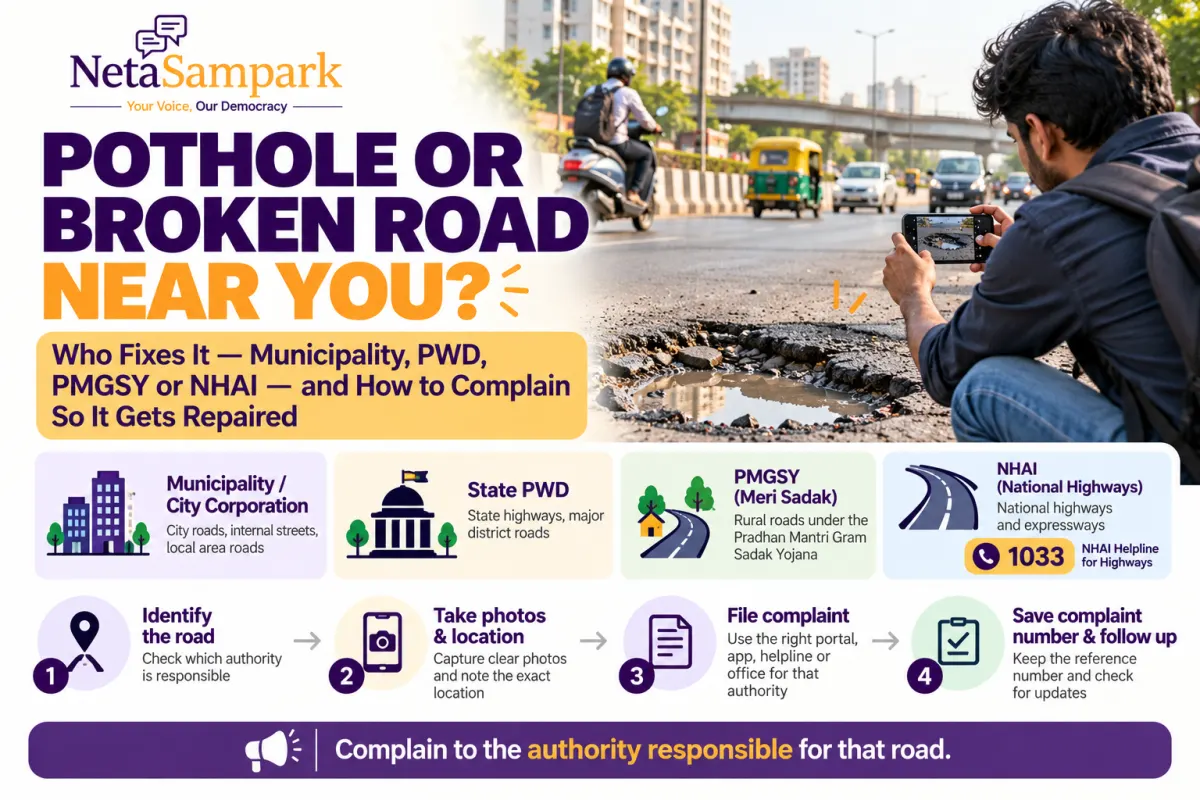
A deep pothole. A broken stretch of road. Loose gravel, an uncovered drain or a crater that fills with water every time it rains.
These are more than inconveniences. Damaged roads can cause accidents, damage vehicles and make everyday travel dangerous for pedestrians, cyclists and two-wheeler riders.
But when you want the road repaired, one question often gets in the way: Whom should you complain to?
The answer depends on who owns or maintains the road. It could be your municipal corporation, a State Public Works Department (PWD), a rural-road agency implementing the Pradhan Mantri Gram Sadak Yojana (PMGSY), or the National Highways Authority of India (NHAI).
This NetaSampark guide explains how to identify the responsible authority, report a pothole, submit useful evidence and follow up until you receive a meaningful response.
1 Who is responsible for repairing your road?
Start by identifying the type of road and the agency responsible for maintaining it. The name of the road alone does not always reveal which department handles repairs.
| Type of road | Authority to approach | How to report the problem |
|---|---|---|
| Internal city streets and many local roads | Municipal corporation, municipality or local urban body | Municipal grievance portal, civic app, helpline or ward office |
| State highways and certain major district roads | State PWD or the designated state road agency | State PWD grievance system, divisional office or road-maintenance office |
| Rural roads constructed under PMGSY | State Rural Roads Development Agency or the responsible programme unit | Meri Sadak app, PMGSY feedback system or designated programme office |
| National Highways maintained by NHAI | NHAI or the agency responsible for that highway stretch | Rajmargyatra app or portal; call 1033 for highway assistance |
| Roads maintained by a development authority, industrial authority or private concessionaire | The relevant authority or concessionaire | Its official complaint channel |
These are starting points, not absolute rules. Some roads within city limits belong to state agencies or development authorities. Some National Highway stretches are maintained by agencies other than NHAI.
The practical rule: Identify the road, find its maintaining agency and direct the complaint to that agency.
2 How to identify the authority responsible for a damaged road
If you are unsure who maintains the road, use the following checks before filing a complaint.
Check for a roadwork information board
If construction or resurfacing is underway, look for a project board displaying the department, contractor, project details or responsible engineering office.
For PMGSY works, the National Rural Infrastructure Development Agency (NRIDA) says citizens can direct complaints to the head of the Programme Implementation Unit (PIU), whose details are available on the information board at the worksite. <Cite refs={["turn985685search1"]}/>
Check the road’s classification
Look for a National Highway number, state-highway marker or other road identification sign. This can help narrow down the responsible agency.
However, do not rely on road signs alone. Verify the maintaining authority if the road passes through a municipal area or has recently been transferred between agencies.
Ask the local engineering office
If the responsible agency is unclear, contact the municipal ward office, local engineering department, PWD division or district road agency. Provide the exact location and ask which office maintains that stretch.
If the first office says the road belongs to another agency, request the correct office or official complaint channel rather than abandoning the complaint.
3 How to complain about a pothole or broken municipal road
For a typical internal city road, start with your municipal corporation or municipality.
The complaint process differs by city, but the following approach works across many local-body systems.
Step 1: Open the official civic website or app.
Find the complaint, grievance, citizen services or road-maintenance section. If the website lists a dedicated pothole or road-damage category, select it.
Step 2: Enter the precise location.
Include the road name, locality, nearest landmark, ward number if known and a map location or coordinates if the form permits.
Avoid descriptions such as “road near my house.” A complaint that pinpoints the damaged stretch is easier to route to the right team.
Step 3: Upload photographs.
Take a clear photograph showing the pothole and enough of the surrounding road to identify it. Where safe, include a wider view and a closer image.
Step 4: Describe the risk.
Mention whether the pothole is deep, waterlogged, difficult to see at night, near a school or junction, or forcing vehicles into oncoming traffic.
Step 5: Submit and save the complaint number.
Keep the acknowledgement, ticket number or screenshot. Use it to track progress and follow up if the issue remains unresolved.
If the portal does not work, contact the ward office or civic helpline and request that the complaint be registered. Keep a record of the interaction.
4 How to complain about a State PWD road
State Public Works Departments and designated state road agencies maintain many state highways, major district roads and other roads assigned to them.
To report a damaged stretch:
- Check the relevant state PWD’s official website.
- Look for a grievance, complaint, road maintenance or contact section.
- Identify the relevant district, division or subdivision.
- Provide the exact location, photographs and a description of the damage.
- Save the acknowledgement and follow up with the responsible engineering office.
If the road is under another state agency, such as a development authority, ask the PWD office to identify the responsible department.
What if the road was recently repaired?
Mention the approximate date of the earlier repair, if known, and explain what has failed. Attach photographs showing the current condition.
You can ask the department to inspect the work and determine whether any applicable maintenance or defect-liability obligations remain in force. Avoid assuming that every road repair carries the same warranty period; the relevant contract and maintenance arrangement determine that.
5 How to complain about a PMGSY rural road
The Pradhan Mantri Gram Sadak Yojana is a rural-road programme. If a damaged road was built under PMGSY, a dedicated complaint route is available.
Option A: Use the Meri Sadak app
The government’s National Government Services Portal describes Meri Sadak as a citizen-feedback service for PMGSY roads and other roads. It allows citizens to report road-related concerns, including quality issues, with photographs.
You can start by visiting the National Government Services Portal and searching for “Meri Sadak.”
Use the current official app listing or linked government service, then follow the instructions to submit the road details and feedback.
Option B: Complain to the Programme Implementation Unit
NRIDA’s official FAQ says citizens can complain to the head of the district or group-of-districts Programme Implementation Unit (PIU), or to the State Quality Coordinator (SQC) of the State Rural Roads Development Agency.
The guidance states that complaints should be acknowledged and registered, an enquiry arranged where required, and the complainant informed of action taken within 30 days.
You can also explore the PMGSY official website and its feedback facilities.
What should you include?
Mention the village, block, district, road name or package number if known, the damaged section and the nearest landmark. Attach photographs and identify whether the problem concerns potholes, poor construction, drainage or deterioration after repairs.
Do not worry if you do not know the technical package number. Give enough location information for the responsible office to identify the road.
6 How to report a damaged National Highway to NHAI
If the pothole is on a National Highway stretch maintained by NHAI, use its official highway complaint services.
Option A: Call 1033
NHAI’s Rajmargyatra service lists 1033 as a 24×7 toll-free National Highway helpline for highway assistance. <Cite refs={["turn985685search2","turn985685search3"]}/>
When reporting a pothole, provide:
- The National Highway number, if known.
- The direction of travel.
- The nearest town, junction, toll plaza or landmark.
- The approximate location or map coordinates.
- The nature of the damage and any immediate safety risk.
Ask for a complaint or reference number if one is issued.
Option B: Use Rajmargyatra
Visit the official Rajmargyatra portal. It provides highway-user services and a complaint facility for reporting road issues and other concerns. The Rajmargyatra app also supports highway assistance and complaint-related services. <Cite refs={["turn985685search2","turn985685search9"]}/>
Select the appropriate complaint or assistance option and follow the current instructions.
What if it is a National Highway but not maintained by NHAI?
Not every highway stretch is necessarily maintained by NHAI. If the road is managed by a state PWD or another designated agency, submit the complaint there instead.
If you are unsure, provide the road number and location to the relevant highway authority and ask which agency is responsible for that stretch.
7 What makes a pothole complaint more effective?
A vague complaint can be difficult to act on. A specific, documented report gives the responsible authority a clearer starting point.
Include as many of the following as possible:
- Exact location: Road name, locality, ward or village, landmark and map pin.
- Photographs: A close-up and a wider image that establishes where the pothole is.
- Description: Approximate size or depth, waterlogging, broken edges or loose debris.
- Safety impact: Whether vehicles are swerving, pedestrians are at risk or the damage is difficult to see at night.
- Duration: When you first noticed it, or how long it has remained unrepaired.
- Previous complaints: Earlier reference numbers and dates, if any.
Photograph the road from a safe place. Do not stand in moving traffic, stop in a dangerous lane or put yourself at risk to collect evidence.
You can also ask neighbours or other road users to submit separate, factual reports if they have witnessed the same problem. Do not fabricate details or submit misleading images.
8 Copy-and-use pothole complaint template
You can adapt the following message for a municipal portal, PWD office or road-maintenance authority.
Subject: Request for Urgent Inspection and Repair of Pothole at [Location]
To the Concerned Road Maintenance Authority,
I wish to report a pothole/damaged road at [exact road name, locality, nearest landmark, ward/village and district].
The damaged stretch is creating a safety risk for motorists, two-wheeler riders, cyclists and pedestrians. The issue is particularly concerning because [briefly describe the risk, such as waterlogging, poor visibility at night or vehicles swerving to avoid the pothole].
The damage was noticed on or around [date, if known]. I have attached photographs and the location details to help your team identify the affected stretch.
I request that the responsible authority inspect the location, arrange appropriate repairs and take any necessary steps to prevent further deterioration.
Please register this complaint and provide a reference number. I would also appreciate an update on the proposed action.
Thank you.
Name: [Your name]
Contact details: [Your contact details]
Location: [Road/locality/ward or village]
Previous complaint number, if any: [Reference]
9 What if the complaint is ignored?
If the road remains damaged, do not immediately start over with a new complaint. First, follow up using the original reference number.
Step 1: Check the complaint status
Log in to the same portal or contact the office where you submitted the complaint. Ask whether it has been assigned to an engineer or maintenance team and whether an inspection has taken place.
Step 2: Send a follow-up with updated evidence
If the pothole has worsened, submit new photographs and refer to your original complaint number. Explain the continuing safety concern.
Step 3: Escalate to the next responsible officer
Depending on the authority, this may be a ward engineering officer, Assistant Engineer, Executive Engineer, PWD division head, State Quality Coordinator or the designated grievance officer.
Use the department’s published escalation procedure rather than assuming every authority follows the same chain of command.
Step 4: Use a public grievance channel where appropriate
For unresolved complaints involving a central government organisation, you can explore the Centralised Public Grievance Redress and Monitoring System (CPGRAMS). It allows citizens to register and track grievances and provides an appeal facility in applicable cases. <Cite refs={["turn985685search11"]}/>
For a state or municipal road, first identify the state’s or local body’s grievance system. The correct escalation route depends on which authority is responsible.
Step 5: Keep the record until the repair is verified
Save the original complaint, follow-ups, responses and updated photographs. If the complaint is marked resolved but the pothole remains, report the discrepancy through the available process and refer to the earlier reference number.
A complaint marked “closed” is not the same as independently confirming that the road has been repaired properly.
10 Frequently asked questions
Can I complain about a pothole without knowing which department owns the road?
Yes. Start with the local civic body or the relevant road authority and provide the exact location. If the road belongs to another agency, ask for the correct department or complaint channel.
Is 1033 the number for every pothole complaint in India?
No. NHAI’s 1033 helpline is for National Highway assistance. For municipal roads, state roads and rural roads, use the complaint route of the responsible authority.
Can I report a pothole on a PMGSY road?
Yes. You can use the Meri Sadak citizen-feedback service or complain to the relevant Programme Implementation Unit or State Quality Coordinator. NRIDA publishes the applicable complaint guidance on its official website.
What if the municipality says the road belongs to PWD?
Ask the municipality to identify the responsible PWD division or office. You can then submit the complaint with the location and photographs. Keep a note of any earlier complaint number so the history is not lost.
How long should it take for a pothole to be repaired?
There is no single nationwide repair deadline that applies to every road and authority. Emergency risks may require quicker attention, while other complaints follow the relevant department’s service standards, maintenance arrangements and procedures. Ask for the applicable timeline when registering the complaint.
Should I complain if the pothole is small?
If it poses a safety risk, reporting it can help the authority inspect and prioritise the problem before it worsens. Provide a factual description and avoid exaggerating the damage.
Conclusion: Report the pothole to the right authority
A damaged road can remain unrepaired when the complaint reaches the wrong department or lacks enough information to identify the location.
Before submitting your complaint, determine whether the stretch is maintained by your municipality, State PWD, PMGSY programme unit, NHAI or another designated agency. Then provide clear location details, photographs and a description of the safety risk.
Save the complaint number, follow up through the official channel and check whether the repair has actually been completed.
A useful complaint is more than a photograph of a pothole. It identifies the location, reaches the responsible authority and creates a record for follow-up.
About NetaSampark
NetaSampark helps citizens understand public services, government responsibilities and practical ways to raise civic issues.
Explore more guides and resources at NetaSampark.com.