
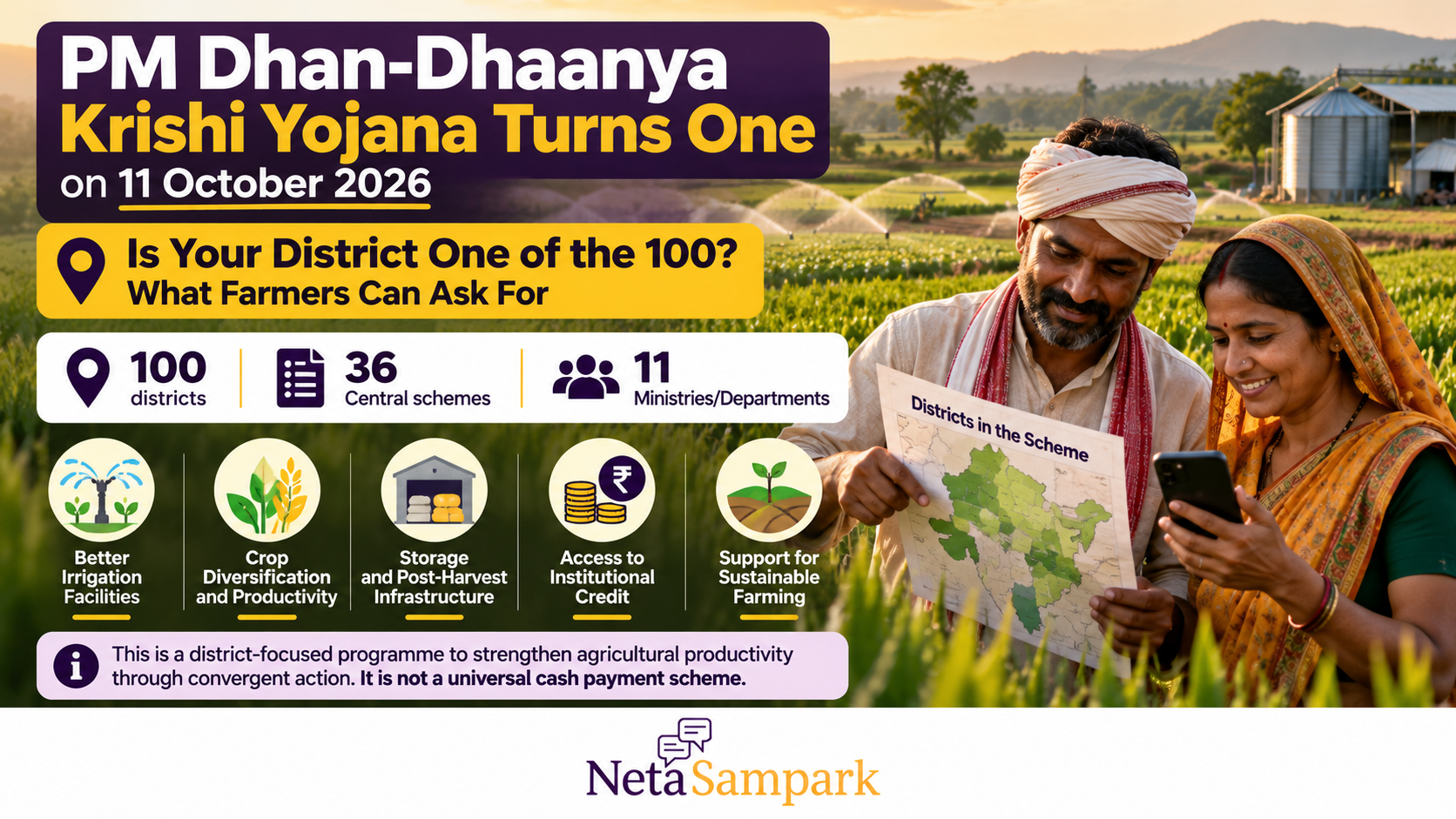
PM Dhan-Dhaanya Krishi Yojana Turns One on 11 October 2026: Is Your District One of the 100 — and What Farmers Can Ask For
The Prime Minister Dhan-Dhaanya Krishi Yojana (PM-DDKY) completed its first year on 11 October 2026. Launched in 2025, the programme aims to improve agricultural productivity, irrigation, crop diversification, post-harvest infrastructure and access to agricultural credit in 100 selected districts across India.
For farmers, the important question is not simply whether their district appears on the list. It is whether the district's agricultural action plan addresses the problems they face locally—and how farmers can ask officials to explain what is planned, which schemes can be used and what progress has been made.
The Union government's first-anniversary update says that all 100 selected districts have prepared District Action Plans and that implementation is underway. Farmers can use the official dashboard and their district agriculture offices to understand the priorities for their area.
This guide explains how to check whether your district is included, what the scheme is intended to support, and what farmers, farmer groups and Farmer Producer Organisations (FPOs) can ask for.
What Is the PM Dhan-Dhaanya Krishi Yojana?
The Union Cabinet approved PM-DDKY on 16 July 2025 for six years, beginning with the 2025–26 financial year. The Prime Minister formally launched it on 11 October 2025.
The programme has an announced outlay of ₹24,000 crore over six years and focuses on 100 Aspirational Agricultural Districts.
The districts were selected using three principal indicators:
- Low agricultural productivity.
- Low cropping intensity.
- Lower agricultural credit disbursement.
The selection process also considered each state's or Union Territory's share of net cropped area and operational holdings. At least one district was selected from every state.
Rather than functioning as a single cash-transfer scheme, PM-DDKY brings together existing Central schemes, State schemes and local partnerships to address district-specific agricultural needs.
According to the official scheme information from NITI Aayog, the programme brings together 36 Central schemes across 11 ministries and departments.
Is Your District One of the 100?
The quickest way to check is through the official PM-DDKY website and its district dashboard.
Official links:
- Scheme website: https://pmddky.niti.gov.in/
- District performance dashboard: https://pmddky.niti.gov.in/dashboard
- Scheme guidelines and objectives: https://pmddky.niti.gov.in/aboutTheScheme
How to check your district
Step 1: Open the official dashboard.
Visit the PM-DDKY dashboard and look for the district performance or district-selection information.
Step 2: Search for your district.
Use the district list or the dashboard's available filters. Check the state and district name carefully, particularly if your district has been renamed or its name appears in a different spelling.
Step 3: Check the district's performance information.
The dashboard provides information on district performance and progress against agricultural objectives. The available data may depend on the selected year, month and indicator type.
Step 4: Confirm with the district agriculture office.
If you cannot find your district or need to know which interventions are planned, contact the District Agriculture Officer or the relevant district administration office. Ask for the District Dhan-Dhaanya Krishi Yojana Samiti and the current District Action Plan.
Do not assume that every village in a selected district automatically receives the same benefit. Projects, activities and eligibility depend on the district plan and the relevant scheme's rules.
Karnataka districts included in PM-DDKY
The official district list includes these six Karnataka districts:
- Tumakuru
- Chitradurga
- Koppal
- Gadag
- Haveri
- Chikkaballapura
Farmers in these districts can ask their district agriculture offices about the local action plan, ongoing interventions and the schemes being coordinated under PM-DDKY.
Farmers in other Karnataka districts should not assume that their district is included simply because the programme operates in the state. Check the official list before making a claim or application.
What Can Farmers Ask For Under the Scheme?
PM-DDKY has six broad objectives: improving productivity, encouraging crop diversification and sustainable farming, increasing post-harvest storage, improving irrigation, expanding access to agricultural credit, and strengthening governance and service delivery.
These objectives provide a practical framework for questions farmers can raise with district officials.
1. Better irrigation facilities
If your village faces water shortages or depends heavily on rainfall, ask whether irrigation improvement is included in the district's agricultural priorities.
Farmers can ask officials:
- Is irrigation infrastructure planned for our area?
- Are micro-irrigation or water-efficiency interventions being considered?
- Which existing government schemes can support eligible farmers?
- What are the eligibility conditions, application dates and contribution requirements, if any?
- Who is responsible for approving and implementing the proposed work?
PM-DDKY's objective is to improve irrigation infrastructure. That does not mean every farmer is automatically entitled to a free pump, borewell, sprinkler or drip-irrigation system.
2. Support for crop diversification
Farmers who depend on a single crop may face risks from changing rainfall, pests, market prices or rising input costs.
Ask the agriculture department whether the district plan supports suitable alternative crops, crop diversification or sustainable farming practices.
Useful questions include:
- Which crops are being prioritised for our block or local area?
- Is technical guidance or farmer training available?
- Are suitable seed or input-support schemes operating in our district?
- Can farmers access demonstrations, soil testing or agricultural extension services?
- What market or procurement arrangements exist for the proposed crops?
Crop choices should be based on local soil, water availability, climate, production costs and market demand. A crop promoted in one district may not be suitable for another.
3. Storage and post-harvest infrastructure
Farmers can lose value when produce spoils, storage is inadequate or they have to sell immediately after harvest.
PM-DDKY aims to improve post-harvest storage at the panchayat and block levels.
Farmers, cooperatives and FPOs can ask:
- Is a warehouse, storage facility, processing unit or other post-harvest project included in our district plan?
- Which existing schemes can support eligible infrastructure?
- Can an FPO or cooperative submit a proposal?
- What land, technical approvals, financing and operating arrangements are required?
- How will farmers access the facility and what charges will apply?
Storage and processing projects generally require planning, approvals and a viable operating model. Their inclusion in a district plan does not mean construction or access is guaranteed immediately.
4. Better access to agricultural credit
Access to timely and affordable institutional credit is another objective.
Farmers can ask their bank, cooperative institution or agriculture office about available short-term and long-term agricultural credit options.
Questions worth raising include:
- Which agricultural credit facilities are available for my farming activity?
- What documents are required?
- Are there existing credit-linked schemes relevant to irrigation, equipment, storage or allied activities?
- How can I check the status of a pending application?
- If my application was rejected, can the bank explain the reason and the options for reconsideration?
PM-DDKY seeks to facilitate agricultural credit, but it is not an automatic loan approval programme. Banks and other lending institutions apply their own eligibility and lending requirements.
5. Sustainable farming and better productivity
Farmers can also ask whether the district plan includes soil-health support, efficient input use, improved agricultural practices, natural farming or other suitable productivity measures.
Ask for the relevant programme name, implementing department, eligibility criteria and local contact person.
Do not purchase expensive equipment or inputs based solely on an informal claim that a subsidy is available. Verify the applicable scheme and approval process first.
6. Support for Farmer Producer Organisations
FPOs can help farmers aggregate produce, improve bargaining power, access markets and explore processing or storage opportunities.
Under PM-DDKY, farmers and FPOs can ask district officials about local priorities involving:
- Produce aggregation and market access.
- Storage and processing infrastructure.
- Suitable crop-diversification initiatives.
- Training and technical support.
- Institutional finance for eligible activities.
- Partnerships that connect farmers with buyers.
The scheme does not automatically grant every FPO funding or a guaranteed buyer. Any proposed support depends on the relevant programme, project approvals and eligibility requirements.
What Has Happened During the First Year?
The government published a first-anniversary update on 10 October 2026 outlining the programme's implementation progress.
According to the Press Information Bureau's PM-DDKY first-year review:
- All 100 selected districts have prepared District Action Plans, which are under implementation.
- State, district and national committees have been constituted for monitoring and review.
- All 100 districts submitted output-indicator data up to August 2026 and outcome-indicator data for the 2025–26 financial year.
- The programme's dashboard tracks progress across 121 indicators: 74 output indicators and 47 outcome indicators.
- The average score across the six objectives for the 100 districts increased from 18.85 in April 2026 to 46.89 in August 2026.
These figures are programme-monitoring indicators. They should not be interpreted as a 46.89% increase in farmers' income or as proof that every farmer has received a benefit. To understand local impact, farmers should ask about completed projects, actual access to services, and measurable outcomes in their own district.
Examples of district-level activity
The government has highlighted examples of agricultural and market-related initiatives in selected districts.
Tumakuru, Karnataka: The first-year review describes Tiptur Farmer Producer Co. Ltd., an FPO with 750 farmer members, supplying ball copra to a buyer and reporting improved market access. The review reports a turnover of ₹1.60 crore for FY 2025–26.
Gadchiroli, Maharashtra: The government highlights an FPO with a rice-processing unit and a 900-metric-tonne warehouse, intended to support local processing and better value realisation.
Jaisalmer, Rajasthan: The review describes Integrated Pest Management-based cumin cultivation and solar-powered sprinkler irrigation used across part of the cultivated area.
These are examples cited in the government's review, not a promise that every district will receive identical facilities or that every farmer will achieve the same results.
How Does PM-DDKY Work With Existing Government Schemes?
One important feature of the programme is convergence. Instead of operating as a completely separate benefit for every farmer, it coordinates relevant existing Central and State schemes with district-level priorities.
This means the same district may have different interventions for irrigation, crop diversification, credit, storage or agricultural services, depending on local needs.
A farmer should therefore ask two separate questions:
- Is the proposed activity included in the district's PM-DDKY action plan?
- Which existing scheme, department or implementing agency will deliver the activity, and what are its eligibility conditions?
The second question matters because the application, subsidy, financing or approval process may be governed by the underlying scheme rather than by PM-DDKY alone.
For example, an irrigation subsidy may have a separate application window, while a warehouse proposal may need to be submitted through an eligible cooperative, FPO or other implementing body.
How to Raise a Request With Your District Administration
Farmers do not need to begin with a complicated proposal. A specific, evidence-based request is more useful than a general demand for benefits.
Step 1: Identify the local problem
Describe the issue clearly: insufficient irrigation, lack of storage, crop losses, limited market access or difficulty obtaining institutional credit.
Include the village, gram panchayat and block wherever relevant.
Step 2: Ask for the District Action Plan
Approach the District Agriculture Officer or district administration and ask which relevant interventions appear in the current PM-DDKY plan.
You can also ask which department is responsible for each activity.
Step 3: Submit a written request
State the problem, explain who is affected and ask what action is planned. For a group proposal, include supporting information such as the number of farmers affected, the type of crop or infrastructure required and any existing facilities.
Step 4: Request a reference number
If the office accepts a written request, ask for an acknowledgement or inward number. Keep a copy for follow-up.
Step 5: Follow up with the responsible department
Ask whether the proposal has been considered, whether further information is required and what the next step is.
A district plan does not automatically approve every individual request. Officials may need to assess feasibility, eligibility, funding and the priorities of the relevant scheme.
A Sample Request Farmers Can Submit
Subject: Request for Information on PM-DDKY District Action Plan and Local Agricultural Needs
To
The District Agriculture Officer / District Administration
[District name, State]
I am writing on behalf of farmers from [village/block] to request information about the interventions planned under the Prime Minister Dhan-Dhaanya Krishi Yojana.
The main agricultural issue affecting our area is [describe the issue, such as inadequate irrigation, lack of post-harvest storage, crop losses or limited access to institutional credit].
We request the following information:
- Whether this issue is addressed in the current District Action Plan.
- Which department or implementing agency is responsible.
- Which existing government scheme may be relevant and what its eligibility requirements are.
- Whether farmers, cooperatives or an FPO can submit a proposal or application.
- The process for submitting supporting documents and following up on the request.
We request an acknowledgement of this representation and guidance on the appropriate next step.
Name: [Name]
Village/Block: [Details]
District: [District]
Contact details: [Contact information]
Thank you.
Common Misunderstandings About PM-DDKY
Is PM-DDKY a direct cash-benefit scheme?
No. Its main purpose is district-level agricultural development through coordinated interventions. It should not be confused with a scheme that guarantees a fixed cash payment to every farmer.
Does every farmer in a selected district automatically qualify for assistance?
No. District inclusion means the district is part of the programme. Individual support depends on the relevant intervention, scheme rules, eligibility and approvals.
Can farmers in a district outside the list apply for PM-DDKY directly?
The programme covers 100 selected districts. Farmers elsewhere can continue to check other Central and State agricultural schemes for which they may qualify, but should not assume that their district is covered by PM-DDKY.
Does a higher dashboard score mean every farmer is better off?
Not necessarily. The dashboard tracks defined indicators. Farmers should also examine whether a project has been completed, whether the intended beneficiaries can use it and whether local outcomes have improved.
Is the ₹24,000 crore outlay a subsidy fund that farmers can claim individually?
No. The announced outlay covers the programme over six years. It is not a personal entitlement or an amount that individual farmers can claim directly.
Final Checklist for Farmers
If your district is included in PM-DDKY, take these steps:
- Check the official district list and performance dashboard.
- Ask your District Agriculture Officer for the current District Action Plan.
- Identify the local issue you want addressed.
- Ask which existing scheme or department can deliver the intervention.
- Verify eligibility, application dates and required documents.
- Submit a written request when appropriate and keep its acknowledgement.
- Follow up with the responsible office and ask for a clear status update.
The first anniversary of PM-DDKY is an opportunity to look beyond the announcement and ask what the district plan means on the ground. Farmers can play a practical role by identifying local gaps, asking for the relevant scheme details and following up on specific proposals.
Official resources
- PM Dhan-Dhaanya Krishi Yojana: https://pmddky.niti.gov.in/
- District performance dashboard: https://pmddky.niti.gov.in/dashboard
- Scheme objectives and guidelines: https://pmddky.niti.gov.in/aboutTheScheme
- Government's first-anniversary review: https://www.pib.gov.in/PressReleasePage.aspx?PRID=2321731&lang=1®=3
- Cabinet approval and programme objectives: https://www.pib.gov.in/Pressreleaseshare.aspx?PRID=2145147&lang=2®=48