
RBI’s 7 October 2026 Changes: Your Demat CAS Can Show Bank Deposits and Any Account Aggregator Will Work — What It Means for You
Do you track your shares through a demat account, mutual funds through investment statements, and fixed deposits through separate bank apps? That may become easier.
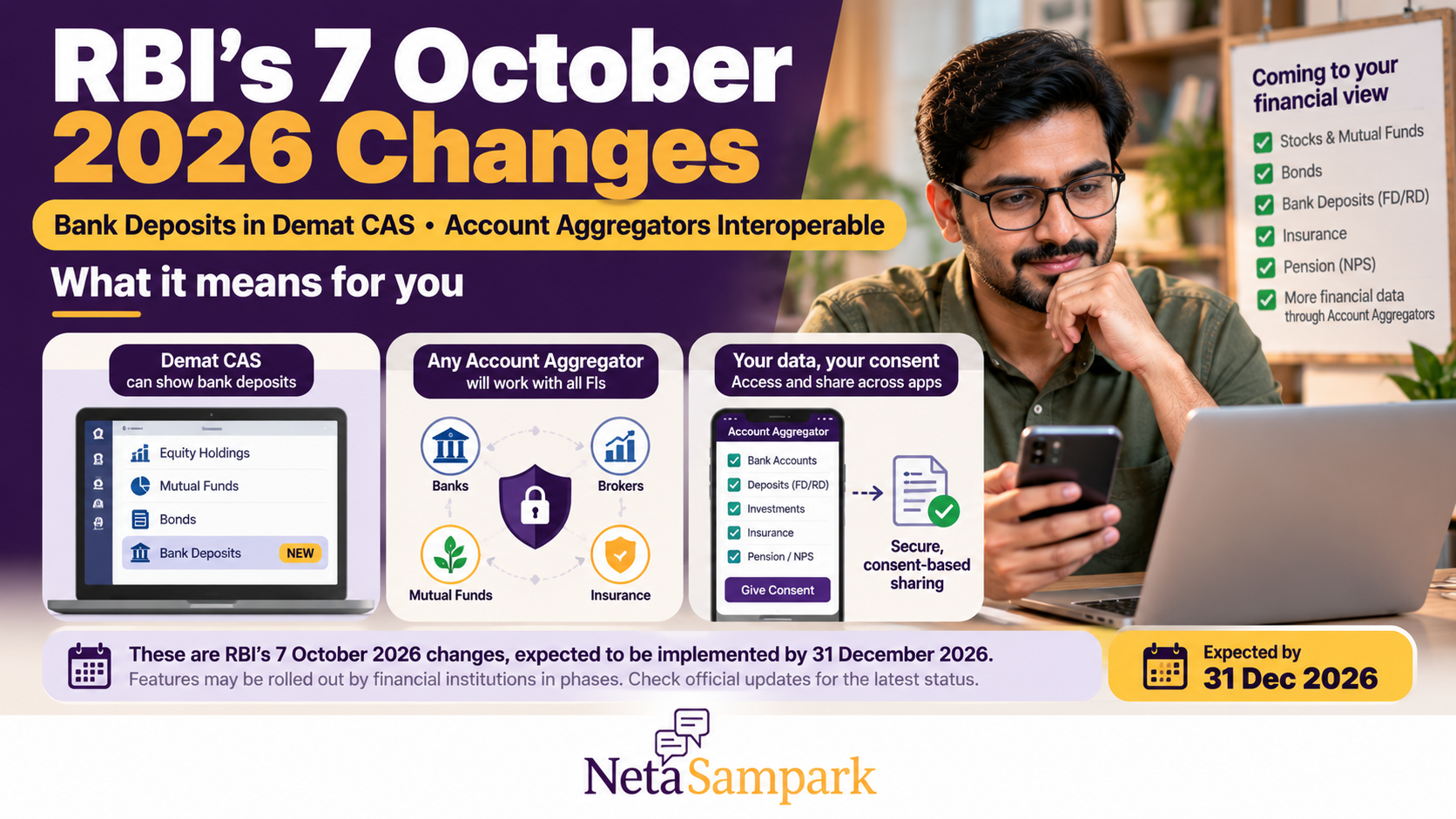
On 7 October 2026, the Reserve Bank of India (RBI) announced two changes designed to make financial information easier to access and consolidate:
- Bank deposit information can be included in the Consolidated Account Statement (CAS) issued through SEBI-regulated depositories, using the Account Aggregator framework.
- Account Aggregators (AAs) will become interoperable, allowing customers to access and share financial information across participating institutions through an Account Aggregator of their choice.
Both measures are expected to be implemented by 31 December 2026. The changes are not necessarily available to every customer immediately, and the exact rollout may depend on the institutions involved.
For ordinary investors, the practical benefit is a more consolidated view of financial holdings and greater flexibility in choosing a service to share financial data—with consent.
What Did the RBI Announce on 7 October 2026?
The announcement formed part of the RBI's developmental and regulatory measures for customer convenience.
According to News On AIR's report on the RBI announcement, the two relevant measures are:
- Interoperability among non-banking financial company Account Aggregators.
- Enabling SEBI-regulated depositories to include bank deposit account information in the CAS through the Account Aggregator framework.
The RBI expects both measures to be implemented by 31 December 2026.
These changes are intended to improve access to financial information. They do not mean that every bank balance, investment or deposit will automatically appear in one statement from the date of the announcement.
What Is a Consolidated Account Statement (CAS)?
A Consolidated Account Statement is a combined statement that helps investors view eligible investment information in one place.
Traditionally, a CAS can consolidate mutual fund transactions and securities held in demat accounts, subject to the applicable reporting and account-linking rules.
The statement is particularly useful for people who invest through multiple mutual fund schemes or hold securities through demat accounts.
SEBI explains the existing CAS facility in its investor education resource: Consolidated Account Statement — SEBI Investor.
What changes with bank deposit information?
Under the RBI's new measure, SEBI-regulated depositories will be facilitated to include bank deposit account information in the CAS through the Account Aggregator framework.
This could give eligible demat account holders a more consolidated view of investments and deposits in one statement.
For example, someone who holds shares and mutual funds while also maintaining fixed deposits at different banks may find it easier to review those financial holdings together.
However, the precise information shown, the institutions covered and the statement format will depend on the implementation arrangements. A CAS should not be assumed to replace official bank statements or deposit certificates.
What Could Your Financial View Include?
<text> </text>
The expanded CAS and the Account Aggregator framework serve related but different purposes.
| Financial information | What the changes mean |
|---|---|
| Shares and other eligible securities | Continue to be reflected through applicable demat reporting. |
| Mutual funds | Continue to be covered by CAS under existing reporting arrangements. |
| Bank deposits, including eligible fixed deposits | Information may be included in CAS through the Account Aggregator framework as the new measure is implemented. |
| Information held at different financial institutions | Interoperability is intended to make consent-based access and sharing easier through a chosen Account Aggregator. |
| Other financial information | Availability depends on the participating institution, the type of information and the relevant framework. |
Important: The RBI announcement does not mean that every financial product will appear in every CAS. The exact scope of the new facility must be confirmed through official implementation guidance.
What Is an Account Aggregator?
An Account Aggregator is a regulated entity that enables customers to share their financial information between participating financial institutions through a consent-based process.
Think of it as a secure bridge for financial data—not as a bank account, investment platform or payment service.
For example, suppose you want a financial service to review information from your bank accounts to assess a loan application. Instead of collecting and uploading every document manually, you may be able to authorise data sharing through an Account Aggregator, provided the relevant institutions and information are supported.
The RBI's framework requires customer consent for financial information to be retrieved, shared or transferred through the system.
You can read the government's overview of the framework here: Department of Financial Services — Account Aggregator Framework.
How does consent-based sharing work?
The process generally involves these steps:
- You choose a service that supports the Account Aggregator framework.
- You identify the financial information you want to share.
- The service presents a consent request describing the relevant information and purpose.
- You review and approve the request if you agree.
- The requested information is shared through the framework according to the approved consent.
An Account Aggregator does not get unrestricted permission to use all your financial data simply because you register with it. The information and sharing must follow the applicable consent arrangements.
Always review the institution requesting access, the information requested, the purpose and the duration of consent before approving a request.
What Does Account Aggregator Interoperability Mean?
Before interoperability, customers could encounter friction when trying to use different Account Aggregators to access information held by participating financial institutions.
The RBI's announcement is intended to make the framework interoperable so that customers can access and share their financial information across participating institutions through an Account Aggregator of their choice.
A simple example
Imagine that you use one Account Aggregator for a financial service but later prefer another supported provider.
Under the intended interoperable framework, you should have greater flexibility in choosing an Account Aggregator rather than being restricted by the lack of interoperability between providers.
This is intended to improve convenience and competition. It does not mean that every provider will immediately support every bank, insurer, investment platform or type of financial data.
The institutions involved must participate in the framework and support the relevant data-sharing process.
What Does This Mean for You?
The practical impact depends on how you manage your finances.
If you have a demat account and fixed deposits
You may find it easier to review your eligible bank deposit information alongside your investment holdings once the facility is implemented and supported by the relevant institutions.
This can help you prepare a more complete overview of your financial assets.
If you have accounts at multiple banks
Interoperability could make consent-based financial data sharing more flexible. You may not need to choose a particular Account Aggregator solely because it supports a specific institution, provided the institutions and services you need are available through the interoperable framework.
If you are applying for a loan
Account Aggregators can already facilitate consent-based financial data sharing for participating institutions and use cases. Interoperability is intended to improve the customer experience across providers.
It does not guarantee loan approval, a lower interest rate or faster processing in every case.
If you manage family finances
A consolidated view may help you review financial holdings and identify information that needs follow-up.
However, access to another person's financial information is not automatic. Each person's information must be handled according to the applicable consent, identity and authorisation requirements.
If you do not have a demat account
The RBI's announcement specifically notes that customers without demat accounts will continue to be able to obtain a consolidated view of their financial information and share it through Account Aggregators.
The new CAS facility is therefore not the only route to consent-based financial data sharing.
Could This Help Families Find Unclaimed Deposits?
A more consolidated view of financial information may help people understand where they hold assets and identify accounts or deposits that require attention.
This can be especially useful when someone has accounts at several institutions or when family members are trying to organise financial records.
However, the CAS changes should not be treated as a guarantee that every dormant or unclaimed deposit will automatically be discovered.
If you are trying to locate an old bank deposit, use the bank's official channels and the RBI's UDGAM portal, which helps users search for unclaimed deposits across participating banks.
The applicable claim and verification process still needs to be followed.
Is Your Financial Data Safe?
The Account Aggregator framework is designed around consent-based financial information sharing, but customers still need to review requests carefully.
The Department of Financial Services explains that an Account Aggregator transfers information based on the customer's instruction and consent. Under the RBI framework, an Account Aggregator is not supposed to use customer financial information for unrelated purposes.
Before approving any data-sharing request:
- Verify the identity of the institution requesting your information.
- Check which accounts and information are included.
- Read the purpose and duration of the consent.
- Avoid approving requests you do not understand or did not initiate.
- Never share your banking password, UPI PIN or OTP with someone claiming to be an Account Aggregator representative.
- Use official apps and websites, and report suspicious requests to the relevant institution.
Interoperability does not mean that all providers can access your information without permission. The intended system remains consent-based.
When Will the New Features Be Available?
The RBI expects both interoperability among NBFC-Account Aggregators and the CAS bank-deposit facility to be implemented by 31 December 2026.
As of 12 October 2026, this is an announced implementation target—not confirmation that every institution has already activated the features.
The practical availability may vary according to the participating banks, depositories and Account Aggregators.
If you do not see bank deposit details in your CAS immediately, that alone does not indicate a problem with your demat account or bank account.
Check for updates from your depository, broker, bank or Account Aggregator before taking action.
What Should You Do Now?
There is no need to open a new account or switch providers solely because of the announcement.
Instead, take these steps:
- Review your current CAS. Understand which investment accounts and transactions it already covers.
- Keep your bank records updated. Check that your contact details and account information are correct.
- Review your Account Aggregator options. Use regulated providers and check which financial institutions they support.
- Read consent requests carefully. Share only the information needed for the stated purpose.
- Watch for official implementation updates. Confirm availability with your bank, depository or Account Aggregator.
- Keep official statements. Use bank statements and deposit certificates when you need definitive records for taxes, claims or financial transactions.
Frequently Asked Questions
Will my fixed deposits automatically appear in my demat CAS?
Not necessarily immediately. The RBI has enabled a framework for bank deposit information to be included through Account Aggregators. Availability will depend on implementation and participation by the relevant institutions.
Do I need to open a demat account to use an Account Aggregator?
No. The Account Aggregator framework is separate from having a demat account. Customers without demat accounts can continue to use Account Aggregators for supported consent-based financial information sharing.
Can I choose any Account Aggregator after interoperability begins?
The RBI's measure is intended to allow customers to use an Account Aggregator of their choice across participating institutions. In practice, the relevant provider and institutions must support the requested information and service.
Will my bank share my data without permission?
The Account Aggregator framework requires explicit customer consent for financial information to be retrieved, shared or transferred. Review the consent details before approving a request.
Will a CAS replace my bank statement?
No. CAS is a consolidated reporting tool. Continue to use official bank statements, deposit receipts and other records when you need authoritative details about a specific account or transaction.
Does this mean all financial assets will be visible in one place?
Not necessarily. The changes expand the potential for consolidation and data sharing, but the information available will depend on the framework, participating institutions and supported data types.
Final Takeaway
The RBI's 7 October 2026 announcement is aimed at making it easier for customers to see and share their financial information.
For demat account holders, the key development is the planned inclusion of bank deposit information in the Consolidated Account Statement through the Account Aggregator framework. For other customers, interoperability is intended to make consent-based data sharing more flexible across participating financial institutions.
Both measures are expected to be implemented by 31 December 2026. Until the rollout is confirmed by the institutions you use, continue relying on official bank and investment records and approve financial-data sharing requests only after checking the details.
Official resources
- RBI announcement report: https://newsonair.gov.in/rbi-announces-series-of-developmental-and-regulatory-measures-for-customer-convenience/
- Department of Financial Services — Account Aggregator Framework: https://www.financialservices.gov.in/account-aggregator-framework
- SEBI Investor — Consolidated Account Statement: https://investor.sebi.gov.in/consolidated_account_statement.html
- RBI Account Aggregator information: https://rbikehtahai.rbi.org.in/AccountAggregatorFacility.html
- RBI UDGAM portal for unclaimed deposits: https://udgam.rbi.org.in/