
Quick take
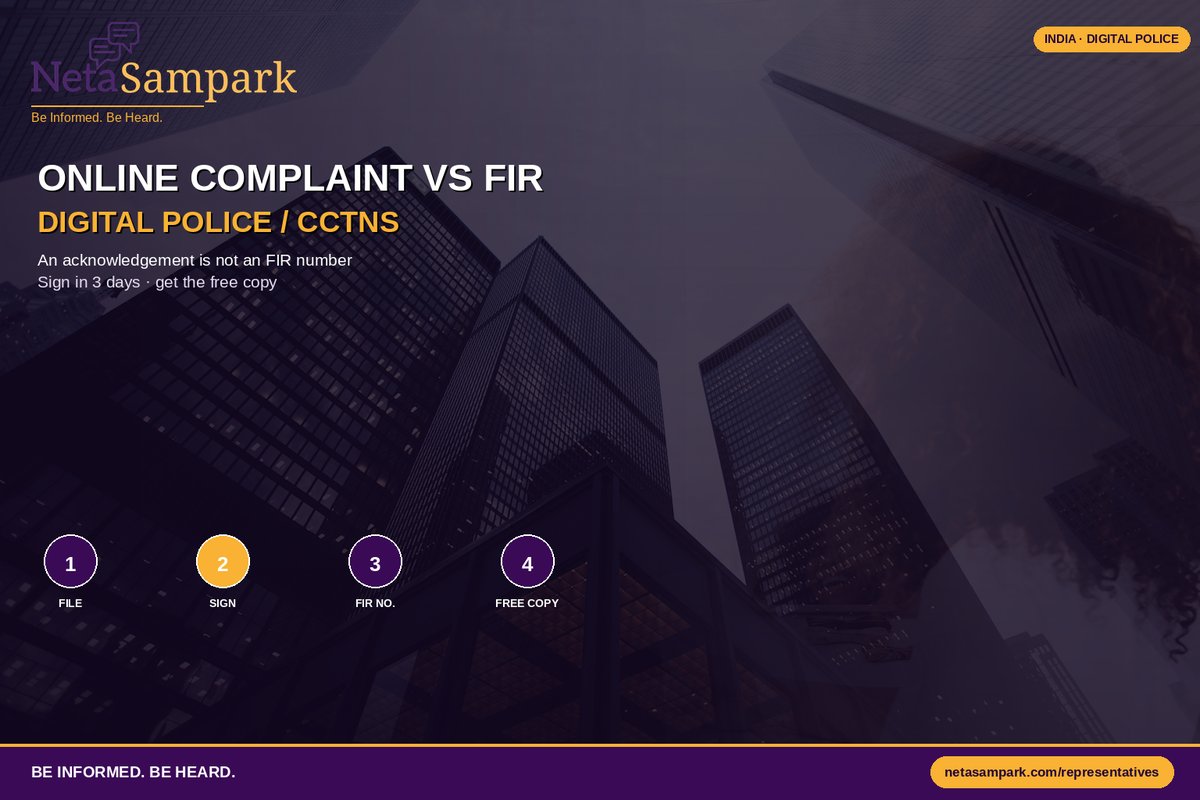
Clicking “Submit” on a police portal does not always mean an FIR has been registered.
Depending on the service and the nature of the incident, your submission may become an online complaint, a lost-article report, an NCR, or an FIR. Knowing the difference can save you days of confusion.
For electronic information relating to a cognizable offence, the Bharatiya Nagarik Suraksha Sanhita (BNSS) provides for electronic communication, with authentication requirements that you should not ignore.
This guide explains what happens after you file online, how to identify an FIR, and what to do if registration or the FIR copy is delayed.
Complaint, NCR and FIR are not the same thing
Online complaint
An online complaint is information you submit through a police citizen portal.
You normally receive a reference or acknowledgement number. An officer may then contact you, ask for additional information, investigate the matter, or decide whether an FIR or another report is appropriate.
An acknowledgement number is not necessarily an FIR number.
NCR or lost-article report
A non-cognizable report or lost-article report records a particular type of incident.
It can be useful for:
- Reporting lost documents
- Reporting a lost mobile phone
- Blocking or replacing certain documents
- Insurance or administrative follow-up
But it generally does not mean that a cognizable criminal case has been registered.
FIR
An FIR (First Information Report) is the formal registration of information relating to a cognizable offence.
The key thing to remember is simple:
Ask for the FIR number and year.
If the police have only given you a portal reference number or complaint number, ask whether an FIR has actually been registered.
What changed with the BNSS?
The Bharatiya Nagarik Suraksha Sanhita, 2023 (BNSS) replaced the Code of Criminal Procedure from 1 July 2024.
Section 173 provides for information relating to cognizable offences to be given by electronic communication.
However, electronic submission does not mean you should simply file online and forget about it.
Where the information is given electronically, the law provides for the information to be signed within the prescribed period. In particular circumstances, the electronic information must be authenticated by the informant through the process prescribed by the law and police system.
Practical rule: if the portal or police officer tells you to appear and sign, do it promptly and keep proof that you appeared.
What is a Zero FIR?
A Zero FIR helps address jurisdiction confusion.
If you approach a police station and the officer says:
“This happened outside our area. Go somewhere else.”
That does not necessarily end the matter.
A Zero FIR can allow information about a cognizable offence to be recorded even when the eventual investigation belongs to another police station. The case can then be transferred to the police station having the appropriate jurisdiction.
This is particularly useful when:
- The incident happened while travelling
- You are in another city
- The exact jurisdiction is disputed
- Immediate police action is necessary
Don't spend hours arguing about boundaries. If the matter requires an FIR, ask about the appropriate procedure for recording a Zero FIR.
How online police reporting generally works
The exact screens differ between states, but the process usually looks like this:
1. Use the official police portal
Start from your state police website or the official citizen services connected to CCTNS / Digital Police.
For cybercrime, use the official national cybercrime reporting system where appropriate.
Avoid links received through random WhatsApp groups or SMS messages.
2. Select the correct service
Depending on your state, you may see options such as:
- Online complaint
- e-FIR
- Lost article
- Vehicle theft
- Missing person
- Cybercrime
- Character verification
- Tenant verification
Choose the service that actually describes your situation.
3. Enter facts carefully
Write:
- Date and approximate time
- Location
- What happened
- What was lost or damaged
- Names or descriptions of people involved, if known
- Relevant transaction or vehicle details
- Supporting documents
Stick to facts.
Don't turn the complaint into a long emotional narrative. A clear chronology is easier for an officer to understand.
4. Submit and save everything
Immediately save:
- Complaint/reference number
- Date and time
- SMS acknowledgement
- Screenshots
- Uploaded documents
- Any email confirmation
Keep the original files separately.
5. Find out what happened to the complaint
This is the step many citizens skip.
A portal may say “submitted”, “under process”, or “forwarded to police station.”
None of those phrases necessarily means an FIR has been registered.
Ask:
“Has an FIR been registered? If yes, what is the FIR number and year?”
The three-number rule
When dealing with an online police complaint, keep these three numbers separate in your notes:
NumberMeaningComplaint / acknowledgement numberProof that you submitted informationDiary / GD / CSR numberPolice station's internal record, where applicableFIR number + yearIdentifies the registered FIR
States use different terminology and systems, so you may not receive all three.
But don't assume the first number you receive is an FIR number.
How to get your FIR copy
If an FIR has been registered, ask for a copy.
Under the BNSS, the informant or victim is entitled to receive a copy of the recorded information as provided by law.
Depending on the state, you may be able to:
- Collect it from the police station
- Download it from the state police portal
- Obtain a digitally generated copy
- Request it through the relevant police records process
Save the PDF if you receive one.
A digital copy is much easier to search, email and attach to an insurance or legal file than a photograph of a register page.
Why you may not find an FIR online
Don't immediately assume the police have refused to register it.
Some FIRs or sensitive information may not be publicly searchable because of the nature of the offence and applicable privacy or legal restrictions.
For example, sensitive cases involving victims of sexual offences or children may have additional restrictions.
If you are the informant or victim, ask the police station directly for the copy or appropriate access route.
What if the police don't register the FIR?
If you believe information about a cognizable offence has not been registered appropriately, keep the escalation written and sequential.
Step 1: Approach the SHO
Submit a written request.
Mention:
- Date of original complaint
- Complaint/reference number
- Police station
- Brief description
- Why you believe registration is required
- Your contact details
Keep a copy with acknowledgement.
Step 2: Escalate to the senior police officer
If the station does not act, use the applicable supervisory channel, such as the SP / DCP / ACP / SDPO, depending on your state and police structure.
Attach the original acknowledgement.
Step 3: Consider the Magistrate route
Where appropriate, the criminal procedure framework provides a judicial route when police registration or investigation is refused.
This is where legal advice can become valuable, particularly if the matter is serious or time-sensitive.
Don't rely solely on repeated visits to the same desk.
What evidence should you preserve?
Create one folder on your phone and one backup.
Digital folder
Keep:
- Online complaint acknowledgement
- FIR copy
- Police emails/SMS
- Photos and videos
- Screenshots
- Transaction records
- Relevant documents
- Names of officers you spoke to
- Dates and times of visits
One-page incident timeline
Write:
Date → Event → Police contact → Reference number → Action promised
For example:
10 Sept — Incident occurred
11 Sept — Online complaint submitted
11 Sept — Acknowledgement received
12 Sept — Called police station
13 Sept — Asked to appear and sign
13 Sept — FIR registered, No. ___/2026
That one page can become extremely useful if the matter later reaches a lawyer, insurer, senior police officer or court.
Common traps
“I submitted it online, so it is automatically an FIR.”
Not necessarily.
Check the status and ask for the FIR number.
“The police gave me a complaint number, so the case is registered.”
A complaint number and FIR number serve different purposes.
“The offence happened somewhere else, so police cannot take my complaint.”
Jurisdiction does not automatically prevent recording a cognizable offence. Ask whether a Zero FIR is appropriate.
“I need to pay someone to get the FIR copy.”
The informant should not be charged simply for receiving the copy they are entitled to under the law.
“I complained on social media, so the FIR is registered.”
A post, email or social-media message may alert authorities, but it is not automatically an FIR.
Always ask for the formal police record.
Cyber fraud: act quickly
Online financial fraud is different from an ordinary lost-item complaint.
If money has been transferred fraudulently:
- Contact your bank immediately.
- Report the transaction through the appropriate official cybercrime channel.
- Preserve transaction IDs, UTR numbers, screenshots and messages.
- Inform the police as required.
- Don't delete conversations with the suspected fraudster.
Speed matters. The sooner the banking and law-enforcement systems receive the transaction details, the more useful the intervention may be.
Before leaving the police station
Use this five-point check:
☐ Did I receive the complaint / diary acknowledgement?
☐ If an FIR was registered, did I note the FIR number and year?
☐ Did I receive or request my copy?
☐ Did I note the investigating officer's name/contact where appropriate?
☐ Did I write down the next action and date?
Don't depend on memory after an emotionally stressful incident.
If the portal itself is broken
Sometimes the problem isn't the police officer. It's the technology.
If:
- OTP isn't arriving
- Upload repeatedly fails
- The portal shows an error
- The complaint disappears after submission
- Status doesn't update
Take screenshots showing the date, time and error message.
Then use the official alternative route—police station, helpline or designated citizen service—rather than repeatedly clicking Submit for three hours.
Your screenshot is evidence that you attempted the digital route.
Where NetaSampark fits
NetaSampark is not a replacement for the police system.
Police portals and police stations handle the criminal-law process. Elected representatives have a different role.
If the problem becomes a broader civic implementation issue—for example:
- Police citizen portal repeatedly unavailable
- FIR copies routinely not being provided
- A police station's public-facing service is consistently failing
- A whole locality is experiencing the same administrative problem
you can document the pattern and identify the appropriate elected representative through NetaSampark.
Keep the distinction clear:
Don't ask a representative to interfere with the merits of an investigation.
Ask for attention to systemic service failures.
Your pocket checklist
Incident → Online complaint → Acknowledgement → Authentication/signature where required → FIR number → FIR copy → Investigation → Follow-up
Save every reference number along the way.
The goal isn't to create more paperwork. It's to make sure the paperwork already created by the system doesn't disappear when you walk out of the station.
Soft close
A police portal can start the process, but “submitted” is not the same as “FIR registered.”
Save the acknowledgement. Understand what document you actually received. If electronic filing requires authentication, complete it. If an FIR is registered, record the number and obtain your copy.
Be informed. Be heard.
Non-partisan civic explainer. Police portal procedures vary by state and service. For serious or urgent criminal matters, consult a qualified lawyer and confirm the current procedure with the relevant police authority.