
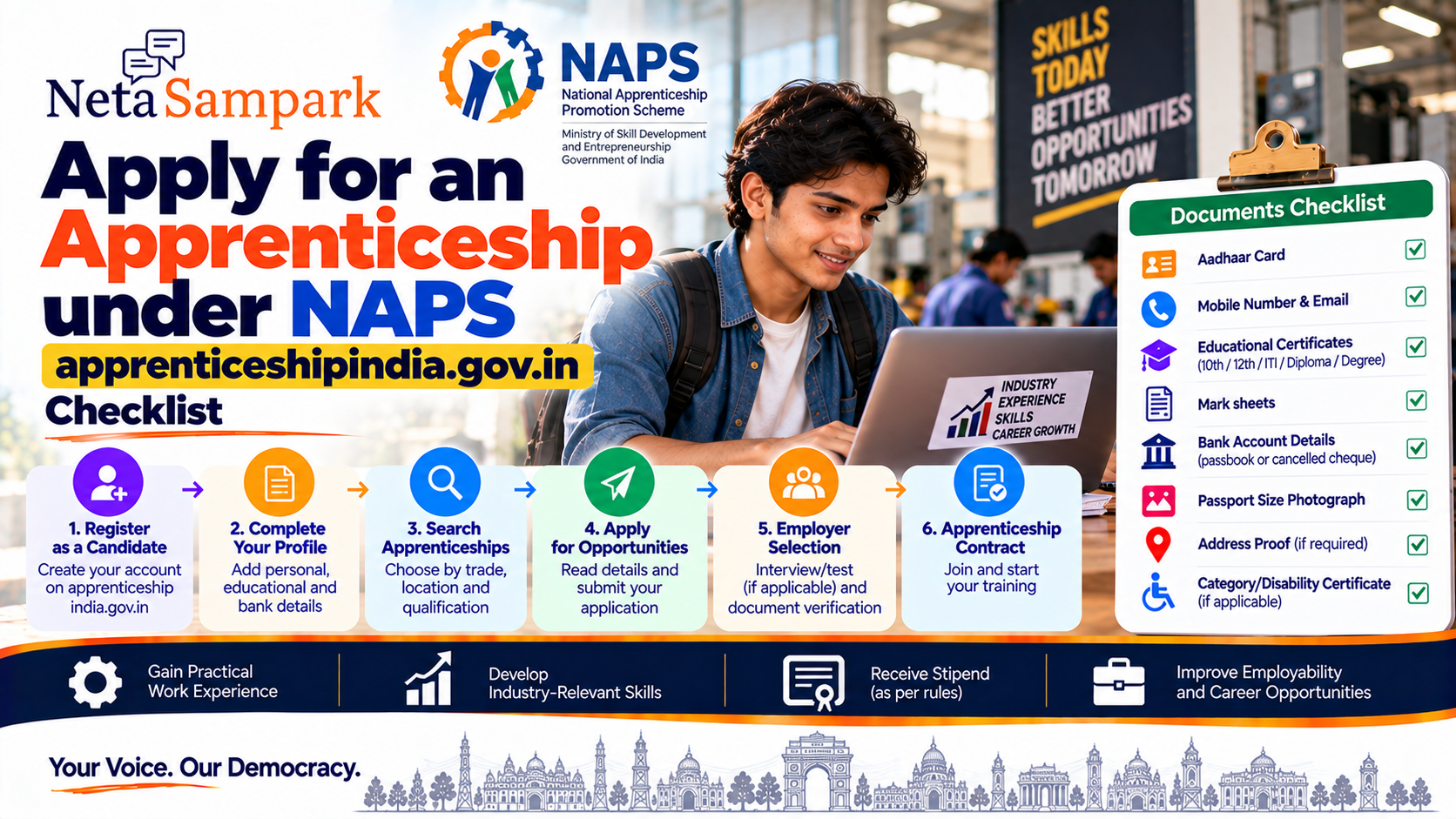
An apprenticeship can give you something that classroom training alone often cannot: practical workplace experience alongside structured training.
The Government of India's apprenticeship system allows eligible candidates to search for apprenticeship opportunities, apply to establishments and complete the required apprenticeship contract through the official portal.
The main online platform is apprenticeshipindia.gov.in, operated within the apprenticeship ecosystem managed by the Ministry of Skill Development and Entrepreneurship (MSDE) and its implementing agencies. (MSDE)
What is NAPS?
The National Apprenticeship Promotion Scheme (NAPS) was introduced to encourage establishments to engage apprentices and expand practical skill training.
The current framework is commonly referred to as NAPS-2 / PM-NAPS. The scheme provides government support towards stipend payments for eligible apprentices, subject to the applicable rules and establishment category. (MSDE)
For candidates, the important point is:
You apply for an apprenticeship opportunity with an establishment — you are not simply applying for a government cash benefit.
What does an apprentice actually do?An apprentice receives structured training while working with an establishment.
Depending on the trade or occupation, training may involve:
The exact training depends on the apprenticeship trade and establishment.
Who can become an apprentice?There is no single educational qualification that applies to every apprenticeship.
The minimum qualification depends on the particular trade or apprenticeship opportunity.
Government apprenticeship information states that apprenticeship eligibility can begin from 14 years, with a higher minimum age of 18 years for hazardous trades. Educational requirements vary according to the trade. (MSDE)
The specific vacancy should therefore be checked before applying.
Depending on the opportunity, candidates may include:
The apprenticeship framework includes categories such as trade apprentices, technician apprentices, technician (vocational) apprentices, graduate apprentices, optional-trade apprentices and degree apprentices. (MSDE)
Is there an age limit?This needs an important distinction.
Under the Apprentices Act framework, the minimum age is generally 14, with 18 for hazardous trades, while the applicable apprenticeship opportunity can impose additional conditions. (MSDE)
For government stipend support under the current PM-NAPS framework, MSDE documentation specifies an upper age limit of 35 years at registration on the portal. Establishments can engage people above that age outside the PM-NAPS stipend-support framework. (MSDE)
Check the age requirement of the specific apprenticeship vacancy rather than assuming that one age rule applies to every apprenticeship.How to apply on apprenticeshipindia.gov.in
Search apprenticeship opportunities
Employer shortlists candidates
The exact screens and options can change as the portal is updated.
Step 1 — Open the official portalAvoid registering through an agent's website when you can use the government portal directly.
Step 2 — Create your candidate accountSelect the candidate registration option and provide the information requested by the portal.
Keep your mobile number and email accessible during registration.
Make sure your personal information is entered carefully because the information in your profile can later be used for applications and apprenticeship documentation.
Step 3 — Complete your profileDon't stop after creating the account.
Complete as much of the candidate profile as applicable, including:
A more complete profile makes it easier to apply for opportunities that match your qualifications.
Documents checklistKeep digital copies of the following where applicable:
Identity
☐ Aadhaar or other accepted identity information
Education
☐ Class 10 certificate/marksheet
☐ Class 12 certificate/marksheet
You don't necessarily need every document. Upload or provide the qualification relevant to the apprenticeship you are applying for.
Other information
☐ Passport-size photograph, if requested
☐ Disability certificate, where applicable
☐ Caste/category certificate, where specifically relevant
☐ Other documents requested by the establishment
Why should you keep your bank details ready?Apprentices are entitled to a stipend according to the applicable apprenticeship rules and contract.
Under PM-NAPS, the government's eligible share of stipend support is transferred through Direct Benefit Transfer (DBT) to apprentices, subject to the scheme conditions. (MSDE)
Therefore, accurate bank information is important.
Check account number → check IFSC → check account holder name.
Step 4 — Search for apprenticeshipsOnce your profile is ready, use the portal's apprenticeship search facilities.
Depending on the portal interface, you can search using information such as:
Don't apply randomly to every vacancy.
Qualification + trade + location + duration + stipend + establishment.
What types of opportunities can you find?The apprenticeship ecosystem covers both Designated Trades and Optional Trades. Optional trades have expanded apprenticeship opportunities into a wider range of service-sector and other occupations. (MSDE)
This means apprenticeships aren't limited only to traditional industrial trades.
Depending on available vacancies, candidates may find opportunities across areas such as:
The actual vacancies available on the portal change over time.
Step 5 — Read the vacancy carefullyQualification
Does your education match the requirement?
Age
Do you satisfy the specified age criteria?
Location
Is the establishment accessible to you?
Duration
How long is the apprenticeship?
Stipend
Trade/job role
Does the actual work match what you want to learn?
Selection process
Does the establishment require an interview, test or document verification?
Apprenticeship durationThe duration depends on the trade and apprenticeship category.
The current PM-NAPS framework generally covers apprenticeship training of six to twelve months, although certain cases can exceed one year subject to the applicable approval/framework. (MSDE)
The broader Apprenticeship Act framework can provide for longer durations depending on the trade and training structure. (MSDE)
So always check the specific vacancy and apprenticeship contract.
How much stipend will you receive?There isn't one universal stipend amount for every apprentice.
The applicable minimum stipend is determined under the apprenticeship rules and depends, among other things, on the prescribed qualification/trade and training year.
MSDE's 2024–25 annual report notes that prescribed minimum stipend rates have historically ranged from ₹5,000 to ₹9,000 per month for the first year, depending on educational qualification, with increases for subsequent years under the applicable rules. (MSDE)
The actual stipend mentioned in an apprenticeship vacancy can therefore differ.
Check the vacancy and contract rather than assuming a fixed amount.
How does NAPS government support work?Under the current PM-NAPS framework, the government shares 25% of the stipend paid, subject to a maximum of ₹1,500 per month per apprentice, for eligible apprentices. The government's share is paid through DBT, subject to the applicable conditions. (MSDE)
This does not mean that every apprentice receives an additional ₹1,500 directly from the government on top of the employer's stipend.
It is a government contribution towards eligible stipend support under the scheme.
Does every establishment receive NAPS support?The NAPS support framework has conditions and exclusions.
For example, MSDE's current scheme documentation states that stipend support is not continued under PM-NAPS for Central/State Government Departments and Public Sector Undertakings, including public-sector banks. (MSDE)
That does not necessarily mean an establishment cannot engage apprentices; it means the PM-NAPS government stipend-support treatment can differ.
Always check the individual vacancy.
What happens after you apply?Submitting an application doesn't automatically mean that you have been selected.
Your application status should be monitored through the portal.
What is the apprenticeship contract?An apprenticeship is not simply an informal internship.
The apprenticeship arrangement is documented through an apprenticeship contract under the applicable legal framework.
The contract establishes important details such as:
Read the contract before accepting.
Is an apprenticeship the same as a permanent job?An apprenticeship is structured training with an establishment.
Completing an apprenticeship does not automatically guarantee permanent employment with that company.
However, it can provide practical workplace experience and an opportunity to develop industry-relevant skills.
If an establishment says that it will offer a permanent job after completion, ask for the terms in writing rather than assuming that conversion is guaranteed.
Can graduates apply?Yes, depending on the apprenticeship category and vacancy.
The apprenticeship framework includes graduate apprentices and degree apprentices, in addition to trade and technician categories. (MSDE)
A graduate should therefore search specifically for apprenticeship opportunities matching their degree rather than assuming apprenticeships are only for ITI candidates.
Can an ITI student apply?ITI candidates are an important part of the apprenticeship ecosystem, particularly for designated trades.
But the exact ITI trade and qualification must match the apprenticeship vacancy.
does not automatically make a candidate eligible for every technical apprenticeship.
Check the vacancy's required trade.
Can someone without an ITI certificate apply?The apprenticeship system includes fresher apprentices and optional trades, and not every apprenticeship requires an ITI qualification. (MSDE)
The required qualification depends on the particular opportunity.
What if you don't have previous work experience?That's one of the reasons apprenticeships exist.
Many apprenticeship vacancies are intended for people who are entering an occupation and need structured workplace training.
Don't reject a vacancy simply because it says "experience preferred" — but do follow the exact eligibility requirements stated by the establishment.
What happens during training?Your training can include both:
Practical training
Learning directly in the workplace.
Basic/theoretical training
Depending on the apprenticeship structure, candidates can receive classroom or other foundational training alongside practical work.
The objective is to build skills relevant to the occupation rather than simply place the candidate in an ordinary job.
What certificate do you receive?On successful completion, the applicable apprenticeship framework provides for assessment and certification.
The exact certificate and assessment process depends on the apprenticeship category/trade.
These can be useful when demonstrating your training to future employers.
Can an apprentice leave before completion?The apprenticeship contract contains the applicable conditions for termination and completion.
Don't simply stop attending without understanding the consequences.
If there is a genuine problem — such as unsafe conditions, non-payment of stipend or another contractual issue — use the appropriate grievance/support mechanism.
Keep written records of communications.
What if the employer doesn't pay the stipend?What stipend is specified in your apprenticeship contract?
Then compare it with the amount actually received.
If there is a dispute, use the applicable apprenticeship authority/grievance mechanism rather than paying an intermediary to "fix" the issue.
What if an employer asks for money to select you?A legitimate apprenticeship opportunity should clearly state its terms.
"Pay ₹10,000 and we will guarantee your apprenticeship."
don't assume that the request is legitimate.
Verify the establishment and vacancy through the official apprenticeship portal.
with a recruiter or intermediary.
NAPS application checklistBefore registration
☐ ITI/diploma/degree documents, where applicable
During registration
☐ Enter qualifications correctly
Before applying
After applying
☐ Save application/reference information
☐ Respond to employer communication
☐ Attend test/interview if required
☐ Read apprenticeship contract before accepting
Common mistakes to avoid1 Incomplete profile
A half-completed profile can make it harder to apply for suitable opportunities.
2 Wrong qualification
Don't select an ITI trade or degree that you haven't actually completed.
3 Ignoring location
Some apprenticeships require daily attendance at a physical establishment.
4 Assuming stipend is the same everywhere
Stipend depends on the applicable rules and vacancy.
5 Confusing apprenticeship with permanent employment
An apprenticeship is structured training, not an automatic permanent job.
6 Paying an unofficial agent
Use the official portal and verify the employer.
7 Not checking the contract
Read the duration, stipend and conditions before accepting.
Apprenticeship application processHere's the entire process in simple terms:
Open apprenticeshipindia.gov.in
Upload/enter qualification details
Compare trade + employer + location + stipend
Complete training and assessment
Receive applicable completion/certification
Before you click "Apply"1. Am I eligible?
2. Is this the right trade?
Don't choose an apprenticeship only because the company is well known.
3. Can I attend the location?
Check travel and working arrangements.
4. Do I understand the stipend?
Check the actual vacancy/contract.
5. Have I read the conditions?
Understand the duration and training requirements.
Official portal
Apprenticeship India: apprenticeshipindia.gov.in
Ministry of Skill Development and Entrepreneurship: msde.gov.in
The apprenticeship portal is part of the government apprenticeship ecosystem, with MSDE responsible for overall regulation/monitoring and NSDC managing the portal and relevant scheme functions. (MSDE)
NetaSampark checklist
If you're looking for practical work experience after school, ITI, diploma or graduation, start with the official portal:
Register → Complete your profile → Search by trade/location → Check eligibility → Apply → Track selection → Read the contract → Start apprenticeship.
The most important thing is to check the individual vacancy rather than assuming that every apprenticeship has the same age, qualification, duration or stipend conditions.
Apprenticeship vacancies, eligibility requirements, stipend rates and portal workflows can change. Confirm the current details on the official Apprenticeship India portal and the specific vacancy before applying.