
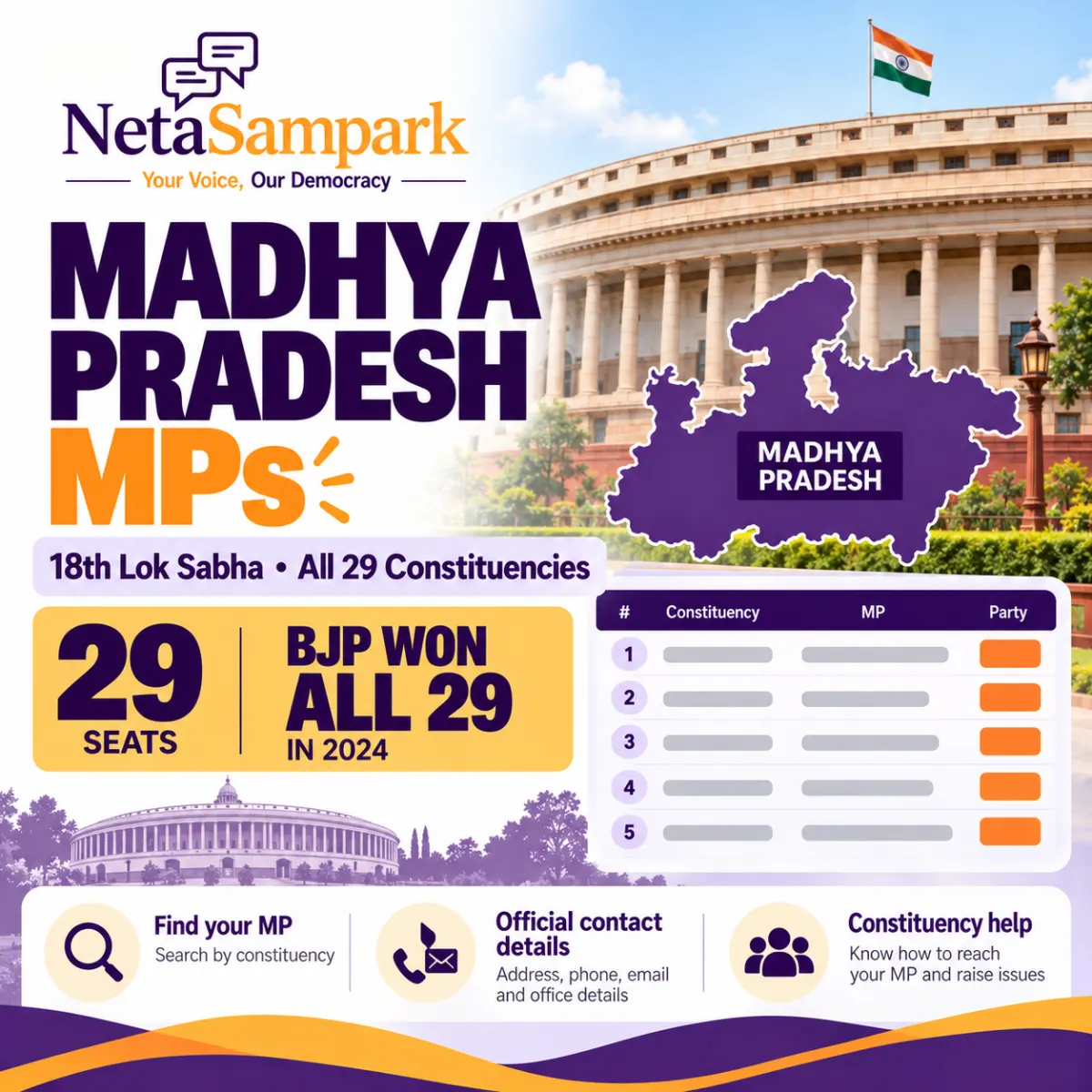
Who is your Member of Parliament? Which party do they belong to? And where can you find their official contact details if you want to raise an issue about roads, railways, public services or development in your constituency?
Madhya Pradesh sends 29 elected representatives to the Lok Sabha, the lower house of India’s Parliament. In the 2024 general election, the Bharatiya Janata Party (BJP) won all 29 seats in the state.
This NetaSampark guide lists all 29 constituencies and their MPs in the 18th Lok Sabha, explains what an MP does, and shows you how to find official contact details and raise a concern.
1 Madhya Pradesh MPs: All 29 constituencies and parties
The following list is based on the 2024 Lok Sabha election results and the 18th Lok Sabha member directory.
| No. | Lok Sabha constituency | Elected MP | Party |
|---|---|---|---|
| 1 | Morena | Shivmangal Singh Tomar | BJP |
| 2 | Bhind (SC) | Sandhya Ray | BJP |
| 3 | Gwalior | Bharat Singh Kushwah | BJP |
| 4 | Guna | Jyotiraditya M. Scindia | BJP |
| 5 | Sagar | Dr. Lata Wankhede | BJP |
| 6 | Tikamgarh (SC) | Dr. Virendra Kumar | BJP |
| 7 | Damoh | Rahul Singh Lodhi | BJP |
| 8 | Khajuraho | Vishnu Datt Sharma | BJP |
| 9 | Satna | Ganesh Singh | BJP |
| 10 | Rewa | Janardan Mishra | BJP |
| 11 | Sidhi | Rajesh Mishra | BJP |
| 12 | Shahdol (ST) | Himadri Singh | BJP |
| 13 | Jabalpur | Ashish Dubey | BJP |
| 14 | Mandla (ST) | Faggan Singh Kulaste | BJP |
| 15 | Balaghat | Bharti Pardhi | BJP |
| 16 | Chhindwara | Bunty Vivek Sahu | BJP |
| 17 | Hoshangabad | Darshan Singh Choudhary | BJP |
| 18 | Vidisha | Shivraj Singh Chouhan | BJP |
| 19 | Bhopal | Alok Sharma | BJP |
| 20 | Rajgarh | Rodmal Nagar | BJP |
| 21 | Dewas (SC) | Mahendra Singh Solanky | BJP |
| 22 | Ujjain (SC) | Anil Firojiya | BJP |
| 23 | Mandsour | Sudheer Gupta | BJP |
| 24 | Ratlam (ST) | Anita Nagarsingh Chouhan | BJP |
| 25 | Dhar (ST) | Savitri Thakur | BJP |
| 26 | Indore | Shankar Lalwani | BJP |
| 27 | Khargone (ST) | Gajendra Singh Patel | BJP |
| 28 | Khandwa | Gyaneshwar Patil | BJP |
| 29 | Betul (ST) | Durgadas D. D. Uikey | BJP |
Source: Chief Electoral Officer, Madhya Pradesh, 2024 Lok Sabha election results; PRS Legislative Research, 18th Lok Sabha MP directory. Names and spellings follow commonly used official or parliamentary listings.
SC = Scheduled Caste-reserved constituency; ST = Scheduled Tribe-reserved constituency.
The list reflects the elected MPs for the 18th Lok Sabha. For current contact details or any subsequent change in membership, check the official Parliament directory.
2 How to find and contact your MP
You do not need to know an MP’s personal phone number to begin contacting their office. Parliament publishes official member profiles and contact information.
Method 1: Use Parliament’s Constituency Connect directory
Start here: Official Constituency Connect — Parliament of India
- Open the directory.
- Search by the MP’s name, state or constituency.
- Select the relevant member.
- Review the published email address, parliamentary address, local address or telephone details, where available.
- Use the official contact channel most appropriate to your request.
You can also visit the Lok Sabha website and open the Members section to find member profiles and other parliamentary information. Parliament’s official FAQ confirms that member profiles provide contact details, including email and addresses.
Method 2: Find your constituency first
If you do not know your Lok Sabha constituency, you can identify it using your locality, district or polling information.
- Check the constituency name on your previous election-related documents, if available.
- Ask your local election office.
- Consult the Election Commission’s official voter services.
- Use Parliament’s directory to search for a constituency once identified.
Important: Your Lok Sabha constituency is not necessarily the same as your Assembly constituency, municipal ward or district. Several Assembly constituencies fall within one parliamentary constituency.
3 What can your MP help you with?
A Member of Parliament represents a parliamentary constituency in the Lok Sabha. MPs participate in lawmaking, debate national issues, scrutinise the Union government and raise constituency concerns through parliamentary and other appropriate channels.
You may contact your MP’s office about issues such as:
- National highways, railways and other Union-government infrastructure.
- Problems involving central government departments or services.
- Matters affecting access to central welfare schemes.
- Issues requiring representation to a Union ministry.
- Local development concerns that need coordination with the appropriate authority.
- Policy suggestions or concerns affecting residents of the constituency.
However, an MP does not directly control every government service. State highways, municipal roads, local policing, land administration and many other matters may fall under state or local authorities.
If you are unsure which government body is responsible, explain the issue to the MP’s office and ask whether it can be referred to the appropriate department.
4 How to write an effective message to your MP
A clear, concise message is easier for an office to understand and route to the right person.
Include:
- Your name and locality: Give enough information to establish the constituency concerned.
- The issue: Explain what happened and where.
- Relevant dates: Include when the problem began and any deadlines.
- Previous action: Mention complaints or applications already submitted.
- Supporting evidence: Attach relevant documents or photographs where appropriate.
- The action requested: State what you would like the MP’s office to consider doing.
Avoid sending passwords, OTPs or unnecessary sensitive information. Use the official contact details published by Parliament or the MP’s office.
Sample email to your MP
Subject: Request for Assistance Regarding [Issue] in [Locality/Constituency]
Dear Honourable Member of Parliament,
I am a resident of [locality], within [Lok Sabha constituency], Madhya Pradesh.
I am writing to bring to your attention an issue concerning [briefly describe the problem]. The issue has been affecting residents since [date or approximate period].
I have already contacted [relevant department or authority], and the complaint/reference number, if available, is [number]. However, the matter remains unresolved.
I request your office to kindly examine the matter and, if appropriate, take it up with the responsible department or authority.
I have attached the relevant documents and supporting information for your reference.
Thank you for your time and consideration.
Yours sincerely,
[Your name]
[Locality and constituency]
[Contact details]
5 What if your MP does not respond?
An MP’s office may receive a large volume of correspondence, and a response time is not guaranteed. If you do not hear back, consider the following steps.
- Follow up politely: Refer to the date and subject of your original message.
- Contact the constituency office: Use the official local contact details published by Parliament or the MP’s office.
- Approach the responsible department: For a service-specific grievance, submit a complaint to the agency that actually controls the service.
- Keep the record: Save your email, complaint reference and any replies.
- Use the appropriate grievance system: Central government complaints may be raised through the relevant department’s official grievance channel or CPGRAMS, where applicable.
Contacting an MP can help bring an issue to an elected representative’s attention, but it does not guarantee that a department will approve a request or that a particular outcome will follow.
6 Frequently asked questions
How many Lok Sabha constituencies are there in Madhya Pradesh?
Madhya Pradesh has 29 Lok Sabha constituencies.
Which party won the 2024 Lok Sabha election in Madhya Pradesh?
The BJP won all 29 seats in Madhya Pradesh in the 2024 general election. <Cite refs={["turn551388search6"]}/>
Where can I find my MP’s official email address?
Use Parliament’s Constituency Connect directory or the Lok Sabha members directory. Search by constituency or member name and consult the official profile.
Can I contact an MP if I do not live in their constituency?
You may contact an MP about a public or national issue, but constituency-specific requests are generally best directed to the representative for the relevant constituency. For individual service grievances, also approach the responsible department.
Can my MP directly order a government department to resolve my complaint?
An MP can raise concerns, seek information and make representations through appropriate channels. However, an MP does not automatically have executive authority over every department or a power to guarantee a particular decision.
What is the difference between an MP and an MLA?
An MP represents a parliamentary constituency in the Lok Sabha and works on national legislation and Union-government oversight. An MLA represents an Assembly constituency in the state legislature and deals with state legislation and state-government oversight.
Conclusion: Know your representative and use the right channel
Your Member of Parliament is one of the elected representatives you can approach to raise public concerns, seek information or request that an issue be taken up with the relevant authority.
Use the list above to identify the MP for your Madhya Pradesh constituency, then verify the current contact details through Parliament’s official directory. When writing to the MP, provide a clear description, relevant documents and a specific request.
Find your representative: Parliament of India — Constituency Connect.
About NetaSampark
NetaSampark helps citizens understand their elected representatives, public institutions and civic processes through practical, accessible guides.
Explore more resources at NetaSampark.com.