
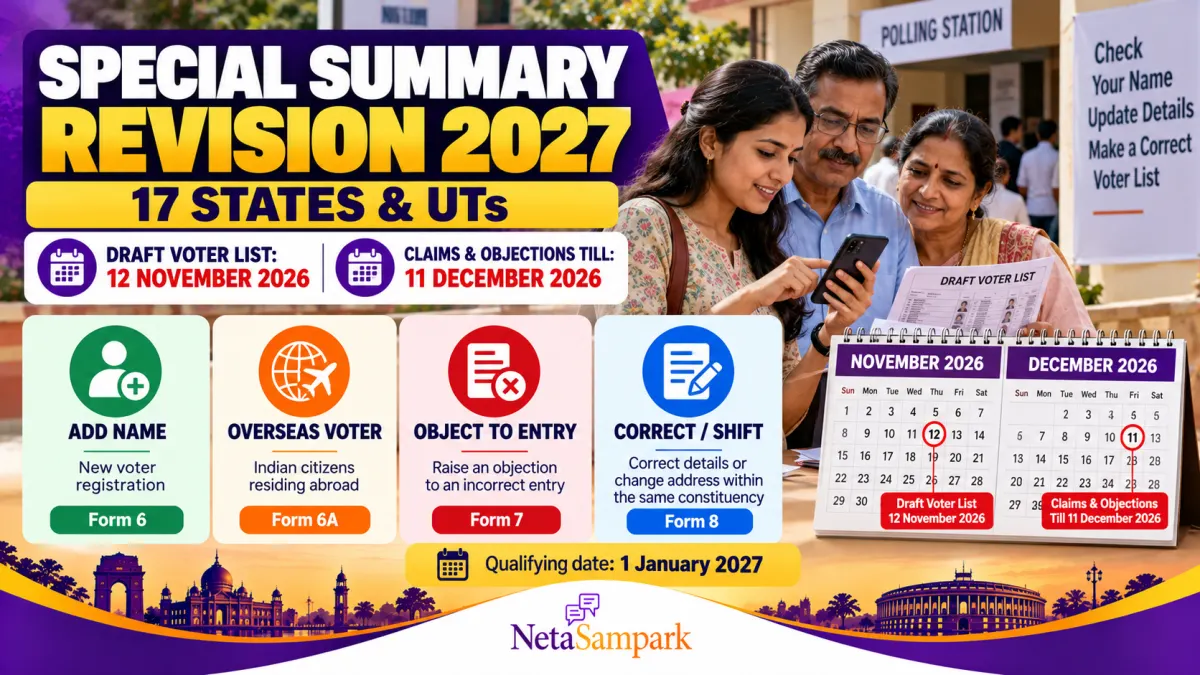
Special Summary Revision 2027 in 17 States: Draft Voter List on 12 November 2026, Claims Till 11 December — Who Should Apply and How
The Election Commission of India (ECI) has announced a Special Summary Revision (SSR) of electoral rolls for 2027 in 17 states and Union Territories. The exercise will give eligible citizens an opportunity to check their voter details, apply for inclusion, correct errors and raise objections to entries in the electoral roll.
The draft voter list is scheduled for publication on 12 November 2026, and the period for filing claims and objections runs until 11 December 2026. The qualifying date for this revision is 1 January 2027.
If you have recently turned 18, will become eligible by the qualifying date, have shifted residence, or cannot find your name in the electoral roll, this revision is an important opportunity to check your registration.
You can begin at the official Election Commission of India Voters’ Service Portal.
1 What Is the Special Summary Revision 2027?
The Special Summary Revision is a process through which the Election Commission updates existing electoral rolls.
The exercise is intended to help ensure that eligible voters are included, personal details are accurate, and entries requiring correction or removal are examined under the applicable rules.
During the revision, citizens can:
- Apply to register as new voters.
- Check whether their names appear in the draft electoral roll.
- Correct errors in existing voter details.
- Apply to shift their registration when they move residence.
- Raise objections to entries that appear incorrect or ineligible, following the prescribed procedure.
- Apply through the relevant process if they are eligible overseas Indian voters.
SSR is different from Special Intensive Revision (SIR). SSR is a regular electoral-roll updating exercise based on the existing roll, whereas SIR involves a more intensive verification process as directed by the Election Commission. The applicable procedure depends on the revision ordered for the particular state or Union Territory.
The 2027 SSR has a qualifying date of 1 January 2027, meaning eligibility for the main revision is assessed with reference to that date.
Official reference: Election Commission of India — Special Summary Revision.
2 Which 17 States and Union Territories Are Covered?
The announced SSR programme covers the following 17 states and Union Territories:
| No. | State / Union Territory |
|---|---|
| 1 | Andaman and Nicobar Islands |
| 2 | Assam |
| 3 | Bihar |
| 4 | Chhattisgarh |
| 5 | Goa |
| 6 | Gujarat |
| 7 | Kerala |
| 8 | Lakshadweep |
| 9 | Madhya Pradesh |
| 10 | Manipur |
| 11 | Puducherry |
| 12 | Punjab |
| 13 | Rajasthan |
| 14 | Tamil Nadu |
| 15 | Uttar Pradesh |
| 16 | Uttarakhand |
| 17 | West Bengal |
The Election Commission's announced programme includes 13 states and three Union Territories where the SIR process has been completed, along with Assam, where the Commission decided not to conduct SIR.
The schedule for other states and Union Territories is separate and may be announced later. Do not assume that the dates in this article apply to every part of India.
Reference: The Indian Express — Election Commission announces annual voter-roll revision.
3 Important Dates for the 2027 Voter List
12 November 2026
Draft electoral roll scheduled for publication. Check whether your name and details appear correctly.
12 November–11 December 2026
Claims and objections period. Submit the appropriate application or objection within the prescribed window.
4 January 2027
Final electoral roll scheduled for publication, according to the announced programme.
The qualifying date is 1 January 2027. The Election Commission has also provided for advance applications relating to subsequent qualifying dates of 1 April, 1 July and 1 October 2027, under the applicable process.
Always check the latest notice from your Chief Electoral Officer (CEO) or the Election Commission in case the schedule is revised.
4 Who Should Check the Draft Voter List?
You should check your entry during the revision if any of the following applies to you.
A. You are turning 18
If you are an Indian citizen and will be at least 18 years old on 1 January 2027, you may apply for inclusion, provided you meet the other eligibility requirements and are not disqualified under the law.
You do not need to wait until the day you turn 18 to find out how to apply. Use the official portal to check the available advance-registration process.
B. Your name is missing from the electoral roll
Even if you voted in an earlier election, check the draft list rather than assuming your entry is unchanged.
If your name is missing, submit the prescribed application for inclusion and provide the information required by the Election Commission.
C. You have moved to a new address
If you have shifted residence, check whether your voter registration reflects your current ordinary residence. Use the applicable procedure to update your address or transfer your registration.
Do not submit a fresh registration at a second location without following the rules for shifting an existing entry.
D. Your name, age, photograph or other details are incorrect
Spelling mistakes, incorrect dates of birth and other errors should be corrected using the prescribed form.
Check the details carefully before submitting the application and provide supporting documents where required.
E. You find a duplicate or potentially ineligible entry
If you believe an electoral-roll entry is incorrect, duplicated or relates to a person who is no longer eligible, use the prescribed objection process.
Do not attempt to remove another person's entry merely because you disagree with their residence or circumstances. Objections must be made honestly and are subject to verification by the electoral registration authorities.
F. You are an Indian citizen living abroad
Eligible overseas Indian electors should check the registration requirements and use the specific application process for overseas voters. Their eligibility and documentation requirements differ from those for ordinary resident electors.
5 Which Form Should You Use?
Choose the form according to the change you need to make. Using the wrong form can delay processing.
| Form | Purpose | Who should use it? |
|---|---|---|
| Form 6 | New voter registration | Eligible citizens applying to be included in the electoral roll |
| Form 6A | Registration of overseas electors | Eligible Indian citizens residing abroad |
| Form 7 | Objection to inclusion or application for deletion | A person raising a permitted objection or seeking deletion under the applicable rules |
| Form 8 | Correction, shifting residence, replacement EPIC or marking of disability | Existing electors who need an eligible change or correction |
Official forms and online services are available through the Voters’ Service Portal.
Form 6: Add your name to the voter list
Use Form 6 if you are applying for voter registration for the first time or if your name is missing and you are eligible to be included.
You will generally need to provide:
- Your name and date of birth
- Your current ordinary-residence address
- Contact details, where requested
- A recent photograph, where required
- The prescribed age and residence documents
Follow the current form instructions for the accepted evidence. Do not assume that every applicant must submit the same set of documents.
Form 6A: Register as an overseas elector
Form 6A is for eligible Indian citizens living abroad who want to register as overseas electors.
The applicant must meet the applicable eligibility conditions, including citizenship and the relevant ordinary-residence requirements. Check the Election Commission's current instructions before applying.
Form 7: Raise an objection or seek deletion
Use Form 7 for objections or deletion requests permitted under the electoral-roll rules.
Provide the reason and supporting information requested. The electoral registration authority may verify the claim before deciding whether the entry should be changed.
Form 8: Correct details or shift your registration
Form 8 is used for eligible corrections to an existing entry, shifting residence and other specified changes, including replacement EPIC and marking disability.
If you have moved within the same constituency or to another address, follow the current instructions in Form 8 to ensure your registration is updated correctly.
6 How to Apply Online During the SSR 2027 Window
You can submit the appropriate application through the Election Commission's official online services.
Step 1: Open the official portal
Visit https://voters.eci.gov.in/.
Step 2: Sign in or register
Follow the portal's instructions to access the service. Use your own mobile number and contact details where required.
Step 3: Select the correct form
Choose Form 6, Form 6A, Form 7 or Form 8 according to your situation.
Step 4: Enter your details carefully
Check the spelling of your name, date of birth, address and other information. Ensure that your application matches your supporting documents.
Step 5: Upload the required documents
Submit the documents requested by the form. Use clear, legible copies and follow the specified file requirements.
Step 6: Submit and save the reference number
After submitting, save the acknowledgement or application reference. You may need it to check progress or respond to a request for further information.
Step 7: Track your application
Use the portal's application-tracking service to check the status. If further verification is required, follow the instructions issued by the electoral registration authority.
You can also consult your Booth Level Officer (BLO) or the relevant Electoral Registration Officer (ERO) if you need assistance with the application.
7 How to Check Your Name in the Draft Electoral Roll
When the draft list is published on 12 November 2026, check your entry rather than relying only on your EPIC voter ID card.
- Visit the official Electoral Search portal.
- Search using the available options, such as your personal details or EPIC number.
- Confirm that your name appears in the correct constituency and polling area.
- Check your spelling, age and other displayed details.
- If the entry is missing or incorrect, use the relevant application or objection procedure during the claims period.
If your name is absent, do not assume that the issue will correct itself automatically. Submit the required application and keep its reference number.
8 Can You Apply Without Aadhaar?
Aadhaar is used in certain electoral-roll processes, but it is not proof of citizenship and should not be treated as a substitute for the eligibility requirements under election law.
The Election Commission's stated framework provides that furnishing Aadhaar is voluntary in the relevant electoral-roll process, and an application for inclusion should not be rejected solely because Aadhaar has not been furnished. Applicants must still meet the applicable eligibility requirements and provide other required information or documents.
If you do not have Aadhaar, follow the form instructions and ask your BLO or ERO which alternative documents are accepted for your particular application.
Never share your Aadhaar OTP or other authentication secrets with an unofficial agent.
9 What Happens After You Submit a Claim or Objection?
Submitting an application does not automatically guarantee that the requested change will be approved.
The electoral registration authorities examine claims and objections under the applicable rules. Depending on the case, they may verify documents, seek further information or conduct an enquiry.
You should:
- Save the application acknowledgement.
- Track the status through the official portal.
- Respond to notices or requests for documents within the specified time.
- Contact the relevant BLO or ERO if the application remains pending.
- Check the final electoral roll after its scheduled publication.
If an application is rejected, read the reason provided and follow the available review or appeal procedure, where applicable.
Frequently Asked Questions
When will the draft voter list for SSR 2027 be released?
The draft electoral roll is scheduled for publication on 12 November 2026 in the 17 states and Union Territories covered by the announced programme.
What is the last date to file claims and objections?
The announced claims and objections period runs until 11 December 2026. Submit your application early enough to address any document or verification issue.
What is the qualifying date for the 2027 revision?
The main SSR 2027 uses 1 January 2027 as its qualifying date. Eligibility depends on meeting the statutory conditions on the relevant qualifying date.
I already have a voter ID card. Do I still need to check the list?
Yes. A voter ID card does not guarantee that your current entry is correct or appears in the latest electoral roll. Check the draft list and report any missing or incorrect details.
I have shifted to another address. Should I submit Form 6?
For an existing elector shifting residence, Form 8 is generally the appropriate form. Follow the current instructions on the official portal.
Can I object to someone else's voter entry?
You may submit a permitted objection using Form 7, provided you have a genuine, legally relevant reason. The authority will examine the objection under the applicable rules.
Is the final voter list due in January 2027?
Yes. The announced schedule lists 4 January 2027 for final publication. Check the latest Election Commission notification for any subsequent change.
Final Checklist: What Every Voter Should Do
- Check whether your state or Union Territory is covered by this SSR schedule.
- Mark 12 November 2026 for checking the draft electoral roll.
- Verify your name, address, age and other voter details.
- Use Form 6 for eligible new registrations, Form 6A for overseas electors, Form 7 for permitted objections or deletion requests, and Form 8 for eligible corrections or shifting.
- Submit your claim or objection by 11 December 2026.
- Save your application reference and track its status.
- Check the final roll after its scheduled publication.
Conclusion
The Special Summary Revision 2027 is an opportunity for eligible citizens in the 17 covered states and Union Territories to verify and update their voter registration.
The most important dates are 12 November 2026 for the draft voter list and 11 December 2026 for the end of the claims and objections period. If you are turning 18, have moved, cannot find your name or notice an error, use the correct form and submit the required information through official channels.
Do not wait until the last day. Check your entry, keep your acknowledgement and follow the application until you receive an outcome.
Official resources:
- Election Commission of India
- Voters’ Service Portal — Forms and applications
- Search the electoral roll
- Election Commission — Special Summary Revision
Schedule based on the Election Commission's announced SSR 2027 programme as reported on 15 October 2026. Dates and procedures may be updated by subsequent official notifications.