
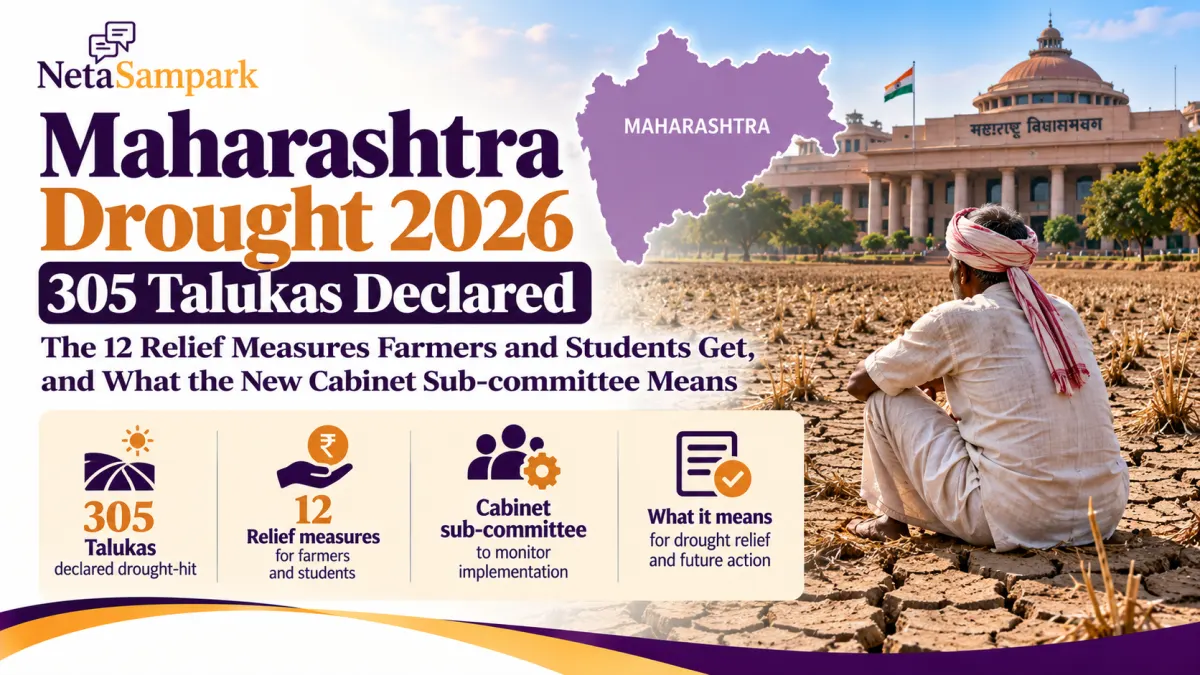
Maharashtra is facing a serious drought situation after a weak monsoon and prolonged dry spells damaged crops across several regions. The state government has extended drought-relief concessions, announced ₹5,000 in advance assistance for eligible farmers and formed a cabinet sub-committee to coordinate relief.
One important detail: the government’s reported figures differ. The Chief Minister announced that 305 talukas were affected, while subsequent reports based on government resolutions and district-wise lists put the official total at 304. Check the latest government list for your taluka before applying for assistance.
Sources: News On AIR | The Financial Express
1 Why has Maharashtra declared drought in so many talukas?
The state initially declared drought in 265 talukas in September 2026. In October, additional areas were considered after complaints that some places had suffered crop damage despite being left out of the first assessment.
The prolonged dry spell affected crops such as soybean and cotton in Vidarbha and Marathwada, while paddy crops were also affected in parts of Konkan.
The drought declaration allows the government to extend relief concessions and direct authorities to assess crop losses. However, being in a drought-affected taluka does not automatically guarantee every farmer the same compensation.
2 What are the 12 drought-relief measures?
The state has extended 12 standard drought-relief concessions to affected talukas. These cover farming, education, employment, water and livestock needs.
| Relief measure | What it means |
|---|---|
| 1. Land revenue concession | Eligible farmers receive relief on land revenue payments. |
| 2. Crop-loan restructuring | Eligible crop loans can be rescheduled under the applicable rules. |
| 3. Pause on agricultural loan recovery | Recovery of eligible agriculture-related loans is deferred under the relief directions. |
| 4. Agricultural electricity-bill concession | Eligible agricultural pump electricity bills receive relief. |
| 5. Examination-fee waiver | Eligible school and college students receive examination-fee relief. |
| 6. Additional rural employment | Employment-guarantee work can be expanded through relaxed applicable norms. |
| 7. Drinking-water tankers | Tankers can be arranged where local drinking-water supplies are inadequate. |
| 8. Protection of agricultural pump power | Electricity supply to agricultural pumps in designated scarcity-affected areas receives protection under applicable directions. |
| 9. Foodgrain availability | Authorities make arrangements to support eligible farmers and agricultural labourers facing shortages. |
| 10. Fodder availability | Measures are taken to address fodder shortages for livestock. |
| 11. Water-conservation works | Local works can be undertaken to conserve water and improve availability. |
| 12. Drinking water for people and animals | Authorities prioritise essential drinking-water requirements in affected areas. |
The exact benefit, eligibility and implementation process depend on the applicable government resolution and local arrangements. For example, a loan concession does not necessarily mean that the loan itself is cancelled.
Sources: The Free Press Journal | The New Indian Express
3 Who can get the ₹5,000 drought assistance?
The Maharashtra Cabinet approved an advance payment of ₹5,000 for eligible farmers in drought-affected talukas. The government has said the money will be transferred directly to bank accounts through Direct Benefit Transfer (DBT).
The advance is intended to provide immediate support while crop-loss assessments and further relief procedures continue.
According to reports on the government’s assistance criteria:
- Farmers must meet the applicable eligibility conditions.
- Crop loss exceeding 33% is an important criterion under the announced advance scheme.
- Certain categories, including some income-tax-paying individuals and specified public representatives or government employees, may be excluded.
- The payment is an advance, not necessarily the final crop-loss compensation.
The government has sanctioned funds for the scheme, but the payment date and status can differ by beneficiary.
For the latest eligibility requirements, see the Maharashtra Relief and Rehabilitation Department and contact your local Tahsil office.
4 What relief do students receive?
Students in eligible drought-affected areas are included in the examination-fee relief measures.
The state’s Higher and Technical Education Department has directed colleges not to charge examination fees to eligible students covered by the announcement. Reports also state that fees already collected must be refunded in applicable cases.
If your school or college is still asking you to pay:
- Ask the institution to confirm whether your course and area are covered.
- Keep your fee receipt and relevant eligibility documents.
- Contact the college administration or the relevant education department if the fee is not waived or refunded.
Students should confirm the precise conditions with their institution, especially where professional, private or autonomous colleges are involved.
Source: News On AIR — Maharashtra drought relief
5 What does the new cabinet sub-committee do?
The Maharashtra government formed a cabinet sub-committee to coordinate drought-relief measures and respond to problems in affected regions.
The committee is headed by Revenue Minister Chandrashekhar Bawankule. Ministers Girish Mahajan, Gulabrao Patil, Pankaja Munde and Babasaheb Patil have been reported as members.
Its work includes reviewing the drought situation, coordinating departments, monitoring crop-loss assessments and addressing urgent concerns such as water availability and farmer assistance.
The Chief Minister has also directed officials to inspect damaged fields and complete crop-loss assessments.
For farmers, the committee is important because it provides a mechanism to review problems and coordinate government action. However, its formation does not automatically approve a particular payment or guarantee compensation to every applicant.
Source: The New Indian Express — Cabinet sub-committee
6 How can farmers check their relief status?
Farmers who believe they qualify should check whether their village is covered and whether their crop damage has been recorded.
Follow these steps:
- Contact your Tahsil office: Confirm the drought declaration and applicable relief measures for your area.
- Check your crop-loss survey: Ask whether the field inspection or panchnama has been completed and recorded.
- Keep your documents ready: Keep your land and crop records, bank details and relevant identity documents available.
- Ask about e-KYC: Complete Aadhaar authentication through an authorised channel if required for your payment.
- Follow up on pending assistance: If the payment has not arrived, ask the local office whether your beneficiary record has been approved and sent for payment.
The state’s Relief and Rehabilitation Department provides information about crop-loss relief and the beneficiary verification process.
Do not pay unofficial agents who promise to secure your drought-relief payment.
7 Is the ₹5,000 payment the final compensation?
No. The ₹5,000 amount has been described as advance assistance. Crop-loss assessment and any further compensation are separate processes.
The state has also been pursuing additional financial assistance from the Centre. The amount a farmer ultimately receives depends on the applicable rules, the assessment of crop damage and the government decisions covering the farmer’s case.
It is useful to distinguish between three things:
- Drought concessions: Measures such as loan restructuring, fee waivers and water or fodder support.
- Advance assistance: The announced ₹5,000 payment for eligible farmers.
- Further crop-loss compensation: Any additional payment determined under the applicable assessment and relief process.
Frequently asked questions
How many talukas are drought-affected in Maharashtra in 2026?
The Chief Minister announced 305 talukas, while subsequent reports citing government resolutions and district-wise lists put the total at 304. Check the latest official list for your area.
Will every farmer receive ₹5,000?
No. Farmers must meet the applicable eligibility criteria. Crop-loss conditions and specified exclusions may apply.
Is the ₹5,000 payment the final compensation?
No. It is advance assistance. Further compensation depends on the applicable rules and crop-loss assessments.
Are examination fees waived for students?
The government has announced examination-fee relief for eligible students in affected areas. Students should confirm coverage with their institution.
Where should farmers report missing crop-loss records?
Contact your local Tahsil office or District Collector’s office and ask about the crop-loss survey and beneficiary-record process.
Where can I find official information?
Start with the Maharashtra Relief and Rehabilitation Department or your local Tahsil office.
The bottom line
Maharashtra’s drought response includes 12 relief concessions, ₹5,000 in announced advance assistance for eligible farmers and a cabinet sub-committee to coordinate action. If you are affected, confirm that your area is covered, check that your crop damage has been recorded and verify your eligibility before expecting a payment.