
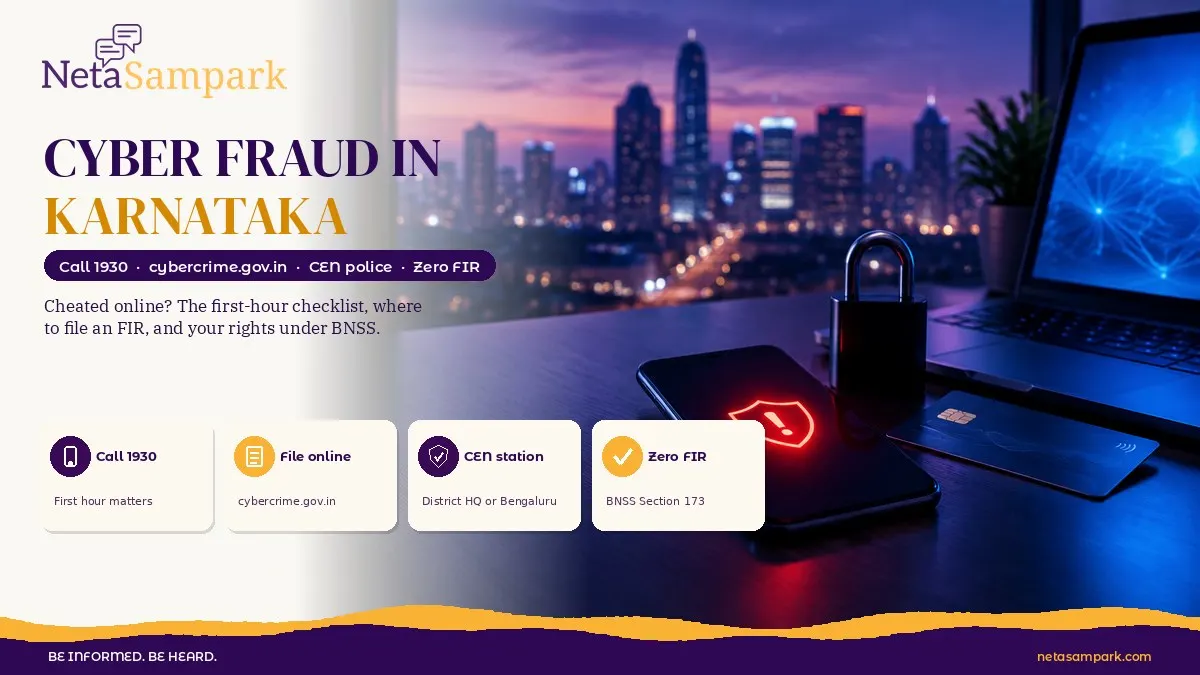
Lost money to a fake UPI request, investment scam, online shopping fraud or impersonation call? If you are in Karnataka, report the fraud immediately on 1930 and the National Cyber Crime Reporting Portal. Then preserve your evidence and follow up with the appropriate police station.
Many victims hesitate because they do not know which police station to approach or whether an online complaint is enough. Here is a practical guide to reporting cyber fraud, contacting a Cyber, Economic and Narcotics (CEN) Police Station and understanding your rights when requesting an FIR.
1 What Should You Do Immediately After Cyber Fraud?
If money has been transferred from your bank account, act as quickly as possible.
- Call 1930: This is India's national cybercrime helpline for reporting financial cyber fraud.
- Contact your bank or payment provider: Report the unauthorised transaction and ask them to take urgent protective action.
- File a complaint online: Visit the National Cyber Crime Reporting Portal.
- Save the acknowledgement number: Keep your complaint reference and any SMS or email confirmation.
- Preserve evidence: Save transaction receipts, UPI IDs, bank messages, screenshots, phone numbers, emails and chat records.
- Follow up with the police: If necessary, approach the appropriate CEN Police Station or another police station to report the offence and seek registration of an FIR.
The purpose of prompt reporting is to help authorities and financial institutions take timely action. Reporting a fraud does not guarantee that the money will be recovered, so do not delay while collecting every possible document.
Official sources: National Cyber Crime Reporting Portal and Karnataka State Police.
2 How to Report Cyber Fraud on 1930
The 1930 helpline is intended for immediate reporting of financial cyber fraud, including scams involving online payments and bank transfers.
When calling, keep these details ready if available:
- Your name and contact number.
- Name of the bank, wallet or payment service involved.
- Transaction ID or UTR number.
- Date and time of the transaction.
- Amount lost.
- Relevant account, merchant or UPI details.
Explain what happened clearly. Tell the operator whether the transaction was authorised by you under deception or was completely unauthorised.
After the call, follow the instructions provided and complete the online reporting process if directed. Keep the acknowledgement or reference number for follow-up.
Important: A helpline report is an important first step, but it should not be treated as a substitute for every other action needed in your case.
3 How to File a Complaint on cybercrime.gov.in
The National Cyber Crime Reporting Portal is the Government of India's online platform for reporting cybercrime to law enforcement agencies.
Step-by-step process
- Open www.cybercrime.gov.in.
- Select Report Other Cybercrimes for financial fraud, online scams, hacking, social media fraud and similar offences.
- Register or sign in using your mobile number and the required verification process.
- Select the relevant complaint category and subcategory.
- Enter the incident date, time, description and other requested information.
- Provide transaction details and upload supporting evidence where requested.
- Submit the complaint and save the acknowledgement number.
Use the portal's Check Status facility to follow a complaint submitted through the relevant tracking option.
What evidence should you upload?
| Evidence | Examples |
|---|---|
| Transaction records | UPI receipt, UTR number, bank statement |
| Communication | SMS, WhatsApp chats, emails, call details |
| Suspect information | Phone number, UPI ID, bank account details, website URL |
| Supporting documents | Screenshots, payment confirmations, relevant documents |
Do not delete original messages or call records. Avoid editing screenshots in ways that could affect their evidentiary value.
The portal's official complaint instructions list information that complainants should keep ready.
4 What Is a CEN Police Station in Karnataka?
CEN stands for Cyber, Economic and Narcotics. CEN Police Stations handle cybercrime and other cases falling within their assigned jurisdiction and responsibilities.
Depending on the incident, this may include online financial fraud, digital impersonation, fraudulent investment schemes, hacking and other technology-enabled offences.
If you live in Bengaluru or elsewhere in Karnataka, you can approach the relevant CEN Police Station for assistance with your complaint.
How do you find the right CEN Police Station?
- Visit the Karnataka State Police website or the official Karnataka Police portal.
- Check the relevant district or city police website for current station contact details.
- Ask your nearest police station to direct you to the appropriate cybercrime unit if you are unsure.
- Keep your online complaint acknowledgement and supporting documents ready.
Station names, contact numbers and assigned jurisdictions can change. Verify the current details through official police channels before travelling.
You do not need to wait for an online complaint to be processed before seeking police assistance, particularly where urgent action may be necessary.
5 Do You Have the Right to Get an FIR Registered?
This is one of the most important questions for cybercrime victims.
Under Section 173 of the Bharatiya Nagarik Suraksha Sanhita (BNSS), 2023, information relating to a cognizable offence may be given orally or electronically to the officer in charge of a police station, irrespective of the area where the offence occurred.
Where the information is given orally, it must be reduced to writing and read over to the informant before signature. Information submitted electronically must be signed by the person giving it within three days for it to be taken on record under the provision.
The law also provides that a copy of the recorded information must be given to the informant or victim free of cost.
Read the text of Section 173 of the BNSS.
What does this mean for a cyber fraud victim?
If the facts you report disclose a cognizable offence, you can request that the police record the information and register an FIR in accordance with the law.
However, not every complaint automatically results in an FIR. The applicable legal provisions and the facts of the case matter. A portal acknowledgement or complaint number alone is not the same as an FIR number.
What if the police refuse to register an FIR?
Section 173(4) of the BNSS provides a route when an officer in charge refuses to record information relating to a cognizable offence.
You may:
- Send the substance of the complaint in writing and by post to the Superintendent of Police concerned.
- Explain the incident, the facts indicating a cognizable offence and the steps already taken.
- Attach copies of the online complaint acknowledgement, transaction records and other supporting documents.
- Keep copies of the letter and proof of delivery.
- If the matter remains unresolved, consider applying to the jurisdictional Magistrate under the applicable legal procedure.
For the precise procedure and any case-specific legal questions, seek advice from a qualified lawyer or legal aid service.
Remember: You can ask for the FIR number and a copy of the recorded FIR. Do not confuse a cybercrime portal acknowledgement with a registered FIR.
6 Can You File a Zero FIR Outside Your Local Jurisdiction?
Yes. Section 173(1) of the BNSS states that information concerning a cognizable offence may be given to a police station irrespective of the area where the offence was committed.
This supports the principle commonly known as Zero FIR: a person can approach a police station even if the offence occurred outside its usual territorial jurisdiction.
For example, if you are in Bengaluru when you discover that someone has fraudulently transferred money from your account following an incident elsewhere, you can approach a police station and report the suspected cognizable offence. The appropriate police authorities can deal with jurisdiction and transfer or further processing as required.
Do not let uncertainty about which station has jurisdiction prevent you from promptly reporting a serious incident.
7 What If Your Bank Says to Contact the Police, and the Police Say to Contact the Bank?
These are separate steps, and you may need to pursue them in parallel.
| Action | Why it matters |
|---|---|
| Report to 1930 | Provides a rapid channel for reporting financial cyber fraud |
| Submit the online complaint | Creates a report that can be tracked through the portal |
| Notify the bank or payment provider | Allows the institution to consider available protective measures |
| Approach the police | Enables law enforcement to assess the alleged offence and take action under the law |
| Preserve all acknowledgements | Helps demonstrate when and where you reported the incident |
A bank complaint does not replace a police complaint, and a police complaint does not replace notifying your bank. Keep the reference numbers for both.
If your portal complaint is not receiving an appropriate response, the National Cyber Crime Reporting Portal provides contact details for State and Union Territory nodal and grievance officers. See its official contact list.
8 What Should You Avoid After a Cyber Fraud?
- Do not pay anyone who promises guaranteed recovery of your stolen money.
- Do not share OTPs, PINs, passwords or remote-access permissions with strangers.
- Do not delete messages, payment receipts or other evidence.
- Do not assume that a complaint is an FIR without checking its status and number.
- Do not delay reporting because the amount involved seems small.
- Do not post your full bank account number, Aadhaar details or other sensitive information publicly on social media.
Fraudsters sometimes contact victims again while pretending to be police officers, lawyers, bank employees or recovery agents. Verify identities through official channels before sharing information or making any payment.
Frequently Asked Questions
1. Is 1930 available for cyber financial fraud in Karnataka?
Yes. The national cybercrime helpline is used to report financial cyber fraud. You can also file a complaint through cybercrime.gov.in.
2. Should I visit a CEN Police Station after filing online?
If you need to provide documents, seek further assistance or report an offence requiring police action, you can approach the appropriate CEN Police Station or another police station. Keep your acknowledgement number and evidence with you.
3. Is an online cybercrime complaint the same as an FIR?
No. An online complaint creates a report and acknowledgement. An FIR is a separate police record registered according to the applicable legal requirements.
4. Can the police refuse an FIR because the incident happened in another district?
Section 173(1) of the BNSS allows information about a cognizable offence to be given irrespective of where the offence occurred. The police can address jurisdiction through the applicable procedure.
5. What can I do if police refuse to record my complaint?
For information disclosing a cognizable offence, Section 173(4) of the BNSS allows you to send the substance of the complaint in writing and by post to the Superintendent of Police concerned. If necessary, the law also provides for approaching the Magistrate.
6. Will reporting through 1930 guarantee that I get my money back?
No. Prompt reporting may help the authorities and financial institutions take action, but recovery depends on the circumstances, the movement of funds and other factors.
Final Takeaway
If you become a victim of cyber fraud in Karnataka, call 1930 immediately, report the incident at cybercrime.gov.in, notify your bank and preserve every piece of evidence. Follow up with the appropriate police station or CEN unit where necessary.
You also have legal routes to seek registration of an FIR when the information discloses a cognizable offence. Section 173 of the BNSS explains how such information can be given and what steps are available if an officer refuses to record it.
Knowing these steps can help you report faster, preserve evidence and follow the process with greater confidence.
This article is for general public information and is not a substitute for legal advice. Verify current police contact details and follow official instructions for your specific case.
Official resources
- National Cyber Crime Reporting Portal
- Cybercrime Portal FAQs
- Karnataka State Police
- Bharatiya Nagarik Suraksha Sanhita — Section 173