
Want to know how a government department spent public money, why your application is pending, or whether a public service request was processed? You can use the Right to Information (RTI) Act, 2005, to seek records held by public authorities.
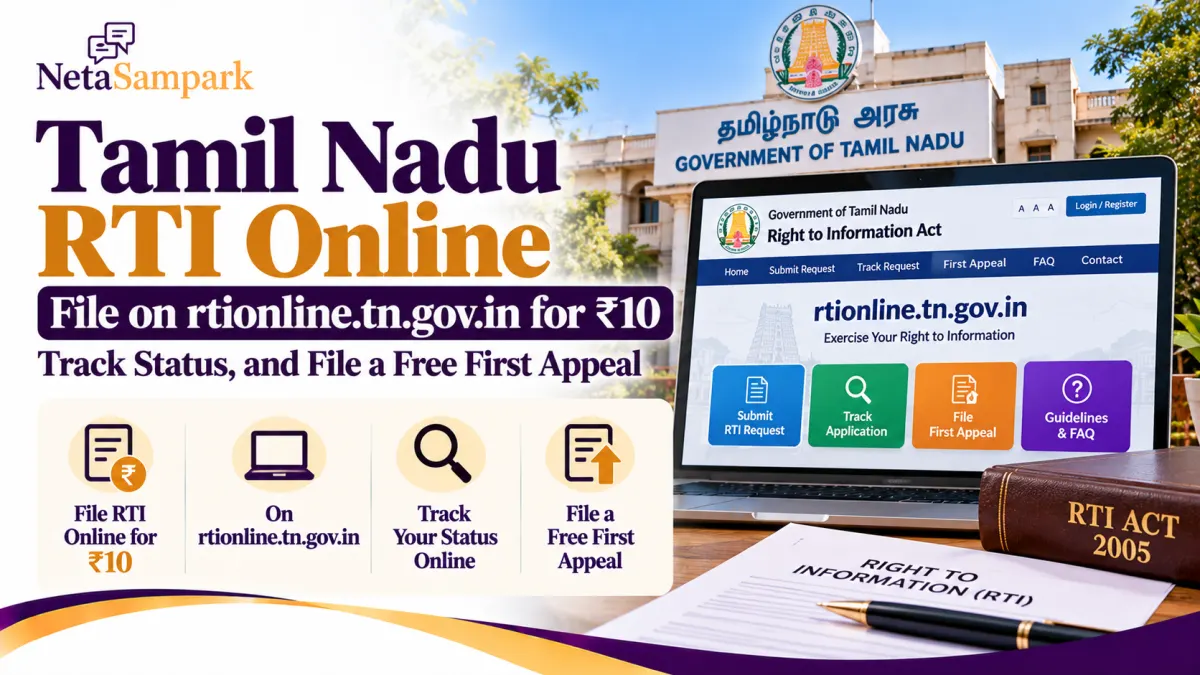
Tamil Nadu provides an online RTI portal where Indian citizens can submit eligible applications, pay the fee online, track progress and file a first appeal without paying an appeal fee.
Official portal: https://rtionline.tn.gov.in/
Tamil Nadu RTI Online: Key Details
| Particular | Details |
|---|---|
| Official website | rtionline.tn.gov.in |
| Who can apply online? | Indian citizens |
| Application fee | ₹10 |
| BPL applicants | No application fee, with valid supporting certificate |
| Payment | Online payment options shown on the portal |
| Application tracking | Available through “View Status” |
| First appeal fee | Free |
| Application text limit | 3,000 characters; longer requests can be attached as a PDF |
| Governing law | Right to Information Act, 2005 |
Important: The portal does not yet cover every office in Tamil Nadu. It says online filing is available for listed departments and public authorities, while applications for offices not yet enabled should be submitted manually to the appropriate office. Check the list before filing.
Source: Official Tamil Nadu RTI portal and guidelines
What information can you request?
You can ask for existing records held by the relevant public authority, such as:
- Copies of government orders, circulars and official records.
- The status and action taken on a particular application.
- Details of expenditure, approved budgets or payments.
- Copies of eligible inspection reports, registers or meeting minutes.
- Reasons recorded in official files for a decision, where those records are held.
- Details of the officer or department responsible for a matter.
Keep the questions specific. RTI is a way to obtain information from records; it is not the same as filing a grievance or asking a department to create a new explanation.
For example, instead of writing “Please solve my road problem,” ask for the sanctioned estimate, work order, expenditure details and completion report for the specified road.
How to file an RTI application online
Step 1: Open the official website
Visit https://rtionline.tn.gov.in/ and read the instructions.
Step 2: Select “Submit Request”
Choose the relevant department or public authority from the options available. Make sure the authority selected is responsible for holding the records you need.
Step 3: Enter your application details
Fill in the required information and write your request clearly. The portal currently limits the main application text to 3,000 characters. If your request needs more space, prepare a PDF and upload it in the supporting-document section.
Step 4: Pay the ₹10 fee
For applicants who are not exempt, the prescribed application fee is ₹10. Use the payment options available on the portal and keep the receipt.
Applicants who qualify under the Below Poverty Line (BPL) exemption do not have to pay the application fee, but must attach the required government-issued certificate.
Step 5: Submit and save the registration number
After successful submission, the portal issues a unique registration number. Save it along with the payment receipt and a copy of your request. You will need the registration details for future tracking and an online first appeal.
Source: Official portal guidelines
How to track your RTI application
You do not need to file a new application just to check progress.
- Open the Tamil Nadu RTI portal.
- Select “View Status” or the relevant status option.
- Enter the details requested by the portal.
- Check the latest status, any communication from the department and whether additional fees have been requested.
The portal also provides a status facility for first appeals. Keep your registered email address and mobile number accessible, as verification may be required.
If the department asks for an additional fee for copies or other permitted charges, read the notice carefully and follow the instructions shown in your status report.
Direct link: View RTI application status
How to file a free first appeal
What if you receive no response, or the information provided is incomplete or unsatisfactory?
You can generally file a first appeal under Section 19(1) of the RTI Act. The first appeal is free on Tamil Nadu’s online portal.
When can you appeal?
You may appeal if the prescribed response period has expired without a decision, or if you are aggrieved by the decision received. The usual appeal deadline is 30 days from the relevant decision or expiry of the response period. The appellate authority may admit a delayed appeal where the law permits and sufficient cause is shown.
Steps to file the appeal
- Visit rtionline.tn.gov.in.
- Select “Submit First Appeal.”
- Enter the registration number of your original RTI application and the other details requested.
- Explain briefly why you are appealing. For example, no response was received, the reply omitted requested records, or access was denied.
- Attach relevant documents if required and submit the appeal.
- Save the appeal registration number and check its status online.
The portal requires the original application’s registration details for reference. If your original application was filed offline or relates to an office not enabled on the portal, check the applicable procedure with the public authority before trying to file online.
Source: RTI Act, 2005 — Section 19
How long should you wait for a reply?
Under Section 7(1) of the RTI Act, the normal response period is 30 days from receipt of the request by the relevant public authority. Certain cases have different time limits, including requests concerning a person's life or liberty, which are subject to a 48-hour limit under the Act.
If additional fees are required, or the request is transferred or falls under a statutory exemption, the applicable rules can affect how the matter proceeds. Read any notice from the department before deciding your next step.
Other charges you should know about
The ₹10 amount is the application fee, not necessarily the total cost of obtaining every record.
Under Tamil Nadu's RTI fee rules, copies of A4 or A3 documents are generally charged at ₹2 per page. Inspection of records is free for the first hour and generally costs ₹5 for each subsequent hour or part of an hour. Other formats or materials may have different charges.
Applicants eligible for the BPL exemption should follow the relevant rules and attach the required proof.
Source: Tamil Nadu RTI fee rules
Frequently asked questions
1. Is the Tamil Nadu RTI application fee ₹10?
Yes. The official portal states that the current application fee is ₹10, subject to the applicable exemption for eligible BPL applicants.
2. Is the first appeal really free?
Yes. The portal states that no fee is payable for a first appeal under the RTI Act.
3. Can I file an RTI against any government office in Tamil Nadu online?
Not necessarily. Only the departments and public authorities available for online filing should be selected. For offices not yet enabled, the portal directs applicants to submit their applications manually.
4. Can I track my application online?
Yes. Use the portal’s “View Status” facility and keep your registration number and registered contact details ready.
5. What if my RTI application is rejected or ignored?
If you receive an adverse decision or no decision within the applicable period, you can generally approach the First Appellate Authority under Section 19(1), following the prescribed procedure and deadline.
Final reminder
Before filing, identify the correct public authority, ask for specific existing records, save your registration number and check the status periodically. If no satisfactory response arrives, consider a first appeal within the applicable time limit.
Official links
- Tamil Nadu RTI Online Portal
- Portal Guidelines
- View Application Status
- Tamil Nadu Directorate of e-Governance — RTI information
This guide is for public awareness and is not legal advice. Follow the current portal instructions and the RTI Act and rules applicable to your request.