
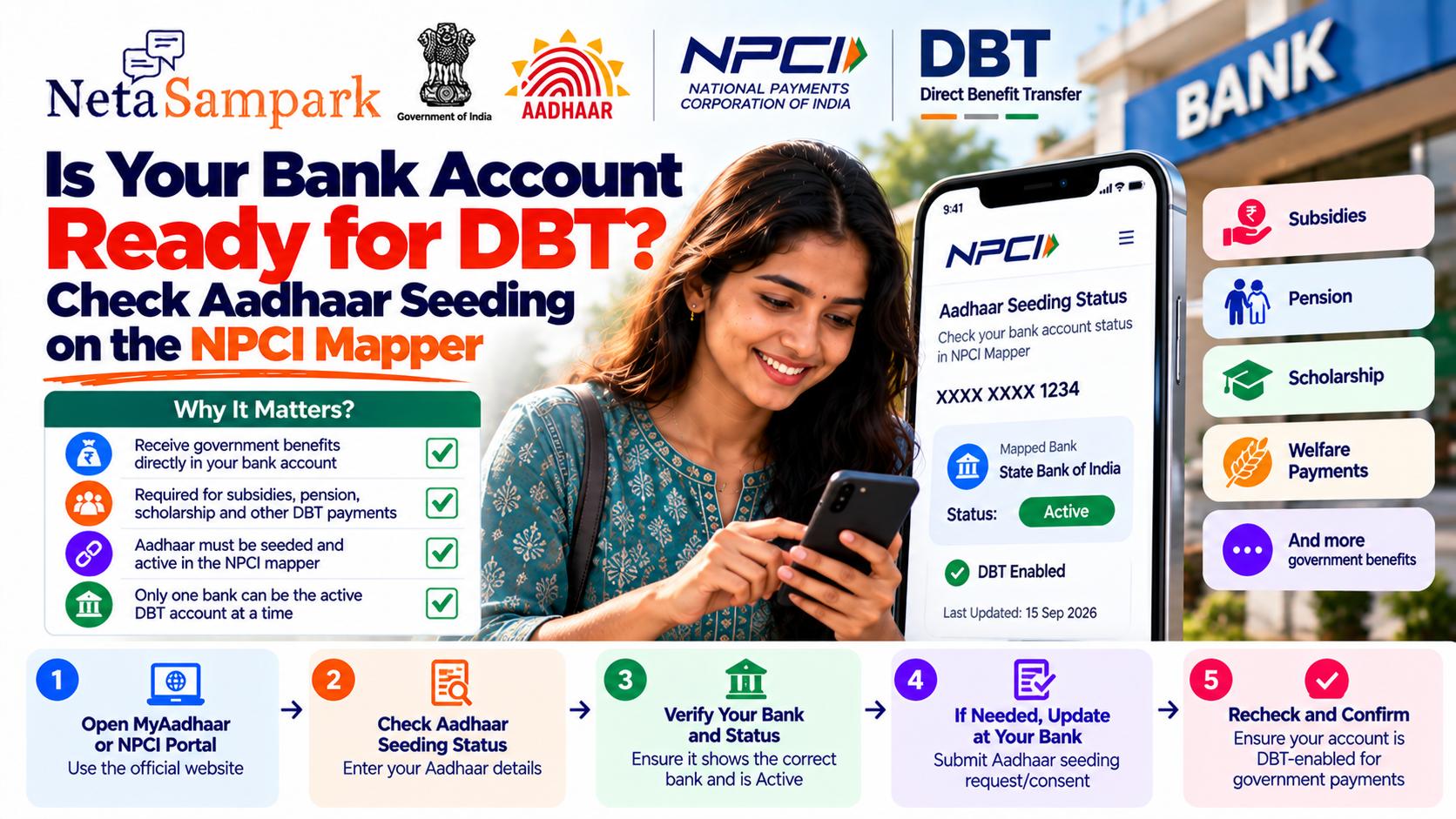
Waiting for a government subsidy, pension, scholarship or other Direct Benefit Transfer (DBT) payment?
Before assuming the payment is delayed, check whether your Aadhaar is seeded with the bank account that is active in the NPCI mapper.
Aadhaar linking with your bank and NPCI mapper status are related, but they are not exactly the same thing. For Aadhaar-based DBT, the bank must seed the Aadhaar in the NPCI mapper so that the account can operate as a DBT-enabled account. (UIDAI)
What is DBT?
Direct Benefit Transfer (DBT) is a mechanism used by government schemes to transfer eligible benefits directly into beneficiaries' bank accounts.
Depending on the scheme, DBT can be used for things such as:
- Subsidies
- Pensions
- Scholarships
- Welfare payments
- Other government benefits
UIDAI explains that Aadhaar-enabled DBT can help transfer benefits directly to a beneficiary's DBT-enabled bank account. (UIDAI)
But being enrolled in a government scheme and having a DBT-enabled bank account are two different things.
You first need to satisfy the relevant scheme's eligibility and enrolment requirements. The bank account then needs to be correctly enabled for Aadhaar-based DBT where the scheme uses that mechanism. (UIDAI)
Aadhaar linking vs NPCI mapper: What's the difference?This is the most important part.
You may have:
Aadhaar linked to your bank account
but still need to ensure that the Aadhaar is correctly seeded/mapped in the NPCI mapper for DBT.
UIDAI explains that when you ask your bank to link Aadhaar for DBT, the bank seeds the account with the NPCI mapper to operate it as a DBT-enabled account. (UIDAI)
Think of the process as:
Aadhaar
↓
Bank account
↓
Bank seeds Aadhaar
↓
NPCI mapper
↓
DBT payment routed to the active mapped bank
Why does the NPCI mapper matter?The NPCI mapper helps determine the bank to which an Aadhaar-based DBT payment should be routed.
NPCI's documentation states that when an Aadhaar is seeded with multiple banks, the latest active mapping becomes the operative mapping for DBT. (NPCI)
That means simply having several bank accounts isn't the same as having several accounts available for simultaneous Aadhaar-based DBT credit.
Can I have multiple bank accounts linked to Aadhaar?You may have Aadhaar linked to multiple bank accounts for different purposes, but only one bank account can be the active Aadhaar-to-bank mapping for DBT through the NPCI mapper at a time.
NPCI says that if a customer seeds Aadhaar in multiple bank accounts, the previous NPCI mapping is overwritten by the fresh seeding. The latest bank mapping becomes the active one for DBT. (NPCI)
Example
Suppose you have:
Bank A → Aadhaar seeded
Later you give consent to seed Aadhaar with:
Bank B
The NPCI mapper can move the active mapping to Bank B.
So if you're expecting a DBT payment, don't assume it will automatically arrive in Bank A simply because Bank A is where you normally receive money.
How to check Aadhaar seeding statusUIDAI currently points users to MyAadhaar for checking bank-seeding status.
It also provides an NPCI link for the same information. UIDAI notes that the information displayed through MyAadhaar is fetched from NPCI's server. (UIDAI)
Official routes
Option 1: MyAadhaar
Go to the official UIDAI MyAadhaar portal and look for the Bank Seeding Status service.
Option 2: NPCI
NPCI provides the Aadhaar Seeding Status facility through its customer services. (NPCI)
What should you look for?The key question isn't simply:
"Is my Aadhaar linked to a bank?"
The more useful question is:
Which bank is currently mapped for DBT?
Check the displayed bank/mapping information and compare it with the account where you want to receive the government payment.
NPCI's documentation describes mapping statuses including Active, Inactive, Invalid and Not Present for bank-side/Aadhaar lookup purposes. (NPCI)
What does "Active" mean?An active NPCI mapping indicates that the Aadhaar is mapped to that bank for the relevant Aadhaar-based payment mechanism.
If you're expecting a DBT payment, this is the type of status you want to verify.
However, an active bank mapping does not by itself guarantee that a particular government benefit will be credited.
The government scheme must also have:
- Enrolled you correctly
- Confirmed your eligibility
- Processed the payment
- Sent the payment through the applicable payment route
So:
Active mapper status ≠ guaranteed payment.
It means the bank-side Aadhaar mapping is in place for DBT routing.
What if the status is "Inactive"?NPCI's customer guidance says that where the Aadhaar status is inactive, the customer should approach the relevant bank branch and submit the required customer consent form. (NPCI)
So the practical route is:
Inactive
↓
Contact your bank
↓
Submit/refresh Aadhaar-seeding consent
↓
Bank verifies the account
↓
Bank updates NPCI mapper
↓
Check status again
What if the status says "Not Present"?This generally means there is no corresponding active Aadhaar mapping in the NPCI mapper.
If you need Aadhaar-based DBT, contact your bank and request Aadhaar seeding for the account.
UIDAI says you should visit the bank branch where the account is held and request Aadhaar linking by completing the bank's mandate and consent process. The bank then seeds the account in the NPCI mapper for DBT. (UIDAI)
What if your old bank is mapped instead?This is a common situation when people change banks.
For example:
Old account: Bank A
New account: Bank B
You may have stopped using Bank A but still find that Bank A is the active NPCI mapping.
If you want future Aadhaar-based DBT payments to go to Bank B, submit the required mandate/consent to Bank B.
NPCI's process documentation specifically provides for moving Aadhaar seeding from one bank to another. (NPCI)
How to move DBT to another bankThe basic process is:
Step 1
Choose the bank account where you want the DBT.
Step 2
Ask that bank to link/seed your Aadhaar for DBT.
Step 3
Complete the bank's consent/mandate process.
Step 4
The bank processes the request and updates the NPCI mapper.
Step 5
Check your Aadhaar seeding status again.
NPCI's documentation says that the bank must obtain customer consent before updating the NPCI mapper. (NPCI)
Keep the bank acknowledgementWhen you submit an Aadhaar-seeding request to the bank, keep the acknowledgement or reference.
This becomes useful if the status doesn't update.
NPCI specifically says that if the Aadhaar number does not appear in the NPCI mapper after the customer has submitted the required documents, the matter rests with the bank. Customers should first approach the bank's customer-service mechanism and follow its escalation process if the issue isn't resolved. (NPCI)
How long should you wait before checking again?Don't assume that a bank's internal Aadhaar-linking confirmation means the NPCI mapper has already updated.
The bank needs to process and submit the relevant seeding information.
NPCI's procedural documentation describes bank-side processes for updating the mapper after Aadhaar is seeded in the bank's core-banking system. (NPCI)
If the status isn't updated after the bank's stated processing period, contact the bank again with your acknowledgement.
What if the bank says "Aadhaar is linked" but DBT still isn't coming?Ask a more specific question.
Instead of:
"Is Aadhaar linked?"
ask:
"Is my Aadhaar seeded and active in the NPCI mapper for this account for DBT?"
The distinction matters because Aadhaar linking in the bank's system and NPCI mapping are connected steps in the DBT process.
UIDAI specifically says the bank seeds the Aadhaar with the NPCI mapper to operate the account as a DBT-enabled account. (UIDAI)
What if I have two bank accounts?You should decide which account you want to be the DBT account.
For example:
AccountNormal useDBT mappingBank ASalaryNot activeBank BSavingsActive
If Bank B is the active NPCI mapping, Aadhaar-based DBT should be routed through the mapped bank, subject to the government's payment process and scheme rules.
NPCI says that when Aadhaar is seeded at multiple banks, the latest active mapping is used. (NPCI)
What if you want to change the DBT bank later?You can request a change.
UIDAI says that to change the bank account receiving DBT funds, you should visit the relevant bank branch and submit the bank's mandate and consent form. (UIDAI)
In practical terms:
New bank
→ Submit Aadhaar-seeding consent
→ Bank processes request
→ NPCI mapping changes
→ Verify the new status
What if you don't have internet banking?That's not necessarily a problem.
The bank can process Aadhaar seeding through its branch and other supported channels.
NPCI's documentation also says banks may provide Aadhaar-mapping status through channels such as internet banking, ATMs or other customer channels. (NPCI)
You can therefore contact your bank and ask:
"How can I submit the Aadhaar-seeding consent form and check NPCI mapping status?"Is Aadhaar seeding mandatory for every government benefit?
No.
Different government schemes can have different enrolment, authentication and payment requirements.
UIDAI explains that beneficiaries first need to enrol in the relevant government scheme through its implementing authority and authenticate using Aadhaar where required by that scheme. (UIDAI)
So don't assume:
No NPCI mapping = no government benefit whatsoever.
The requirement depends on the scheme and its payment mechanism.
What if your DBT payment has already failed?First identify where the failure occurred.
Possible issues include:
- Scheme enrolment problem
- Eligibility problem
- Incorrect beneficiary information
- Bank-account issue
- Aadhaar-seeding issue
- NPCI mapping issue
- Payment-processing issue
If the NPCI mapping is inactive or points to an unexpected bank, fix the bank-side issue first.
For a failed DBT transaction, the relevant government department or scheme authority may also need to reprocess the payment.
NPCI's customer guidance notes that for certain failed transactions, the relevant OMC should be approached for reinitiation to the last-seeded bank account. (NPCI)
What if your Aadhaar is mapped to a bank you closed?This should be corrected.
Contact the bank where you maintain the account you want to use for DBT and submit the applicable Aadhaar-seeding mandate.
Then verify that the new mapping is active.
Don't assume that closing an old bank account automatically removes every Aadhaar mapping associated with it.
What if the bank refuses to update the mapper?Start with the bank's customer-service or grievance mechanism.
NPCI's customer guidance specifically says the customer should approach the bank's customer-service cell and follow the bank's escalation matrix if the Aadhaar mapping issue isn't resolved. (NPCI)
Keep:
- Consent form copy
- Bank acknowledgement
- Complaint number
- Date of submission
- Branch details
- Any written response
NPCI says that if a customer writes to NPCI about the matter, the acknowledged bank consent form should be provided. (NPCI)
Don't give your Aadhaar details to random websitesFor a bank-seeding check, use:
UIDAI's official MyAadhaar portal
or
NPCI's official service
rather than third-party websites claiming to check your DBT status.
UIDAI itself points users to MyAadhaar and NPCI's seeding-status service. (UIDAI)
Keep your OTP privateIf you use an official Aadhaar service, you may need authentication.
Never share:
- Aadhaar OTP
- Bank OTP
- UPI PIN
- ATM PIN
- Internet-banking password
with another person who claims they need it to "activate DBT."
A legitimate bank employee should not require you to disclose an OTP or PIN verbally.
A simple DBT readiness checklistBefore expecting an Aadhaar-based government payment, check:
☐ I am enrolled in the relevant government scheme
☐ I meet that scheme's eligibility requirements
☐ My bank account is active
☐ My Aadhaar is linked/seeded as required
☐ My Aadhaar is mapped to the intended bank for DBT
☐ The NPCI status is active
☐ My mobile number/contact details are current with the bank where relevant
☐ I have saved the bank acknowledgement
5-minute DBT check1. Open MyAadhaar
Use the official UIDAI portal.
2. Check Bank Seeding Status
Review the bank information returned from NPCI.
3. Compare the bank
Ask:
Is this the account where I want my DBT?
4. Check the status
Look for the relevant active mapping/status.
5. If it's wrong
Contact the bank where you want the DBT account and submit the required consent/mandate.
ExampleSuppose Ravi has:
Bank A: old savings account
Bank B: current savings account
He expects a government scholarship payment.
He checks the NPCI mapping and finds:
Mapped bank → Bank A
But he wants the scholarship to go to Bank B.
He should not simply wait for the scholarship payment.
Instead:
Bank B → Aadhaar-seeding consent → bank processing → NPCI mapper update → verify status
NPCI states that the latest active Aadhaar mapping is used for DBT when multiple banks have been seeded. (NPCI)
One important point: NPCI doesn't decide your scheme eligibilityNPCI's role here is related to the payment infrastructure and Aadhaar-to-bank mapping.
Whether you qualify for a:
- Pension
- Scholarship
- Subsidy
- Welfare payment
is determined under the relevant government scheme.
So if your NPCI status is active but the payment hasn't arrived, don't automatically conclude that the bank is responsible.
Check the scheme/application/payment status separately.
DBT vs UPIThese are different systems.
UPI
Used primarily for person-to-person and merchant payments initiated through a UPI app/account.
Aadhaar-based DBT
Used to route eligible government benefits to a beneficiary's DBT-enabled bank account through the applicable payment infrastructure.
Having UPI does not mean your Aadhaar is correctly mapped for DBT.
Likewise, having an active NPCI DBT mapping doesn't mean you need a UPI app to receive the benefit.
What the bank needs from youNPCI's APB documentation says banks must obtain the customer's consent before updating the NPCI mapper. (NPCI)
The bank may therefore ask you to complete an Aadhaar-seeding/DBT mandate or consent form.
Keep a copy.
This is especially important if you later need to prove that you requested a change.
Your DBT troubleshooting flowPayment not received
↓
Check government scheme/application status
↓
Check bank account
↓
Check Aadhaar seeding
↓
Check NPCI mapper status
↓
Wrong/inactive mapping?
↓
Contact bank + submit consent
↓
Save acknowledgement
↓
Recheck mapping
↓
If still unresolved, use bank grievance escalation
This separates a scheme/payment problem from a bank-mapping problem.
Official linksUIDAI — Direct Benefit Transfer information:
MyAadhaar:
NPCI — Aadhaar Seeding Status:
Bottom line
If you're expecting an Aadhaar-based DBT, don't check only whether your Aadhaar is "linked" to a bank.
Check the complete chain:
Government scheme enrolment → eligible beneficiary → bank account → Aadhaar seeding → NPCI mapper → active DBT bank
UIDAI says the bank seeds the Aadhaar-linked account in the NPCI mapper so it can operate as the DBT-enabled account. (UIDAI)
And if you have multiple bank accounts, remember:
Only one active Aadhaar-to-bank mapping is used for DBT at a time, with the latest active seeding determining the mapped bank. (NPCI)
If the mapping is wrong or inactive, contact the bank, submit the required consent/mandate and keep your acknowledgement until the NPCI status is updated.
The exact process and available online facilities can change. Use the current UIDAI, NPCI and your bank's official channels for the latest status and instructions.