
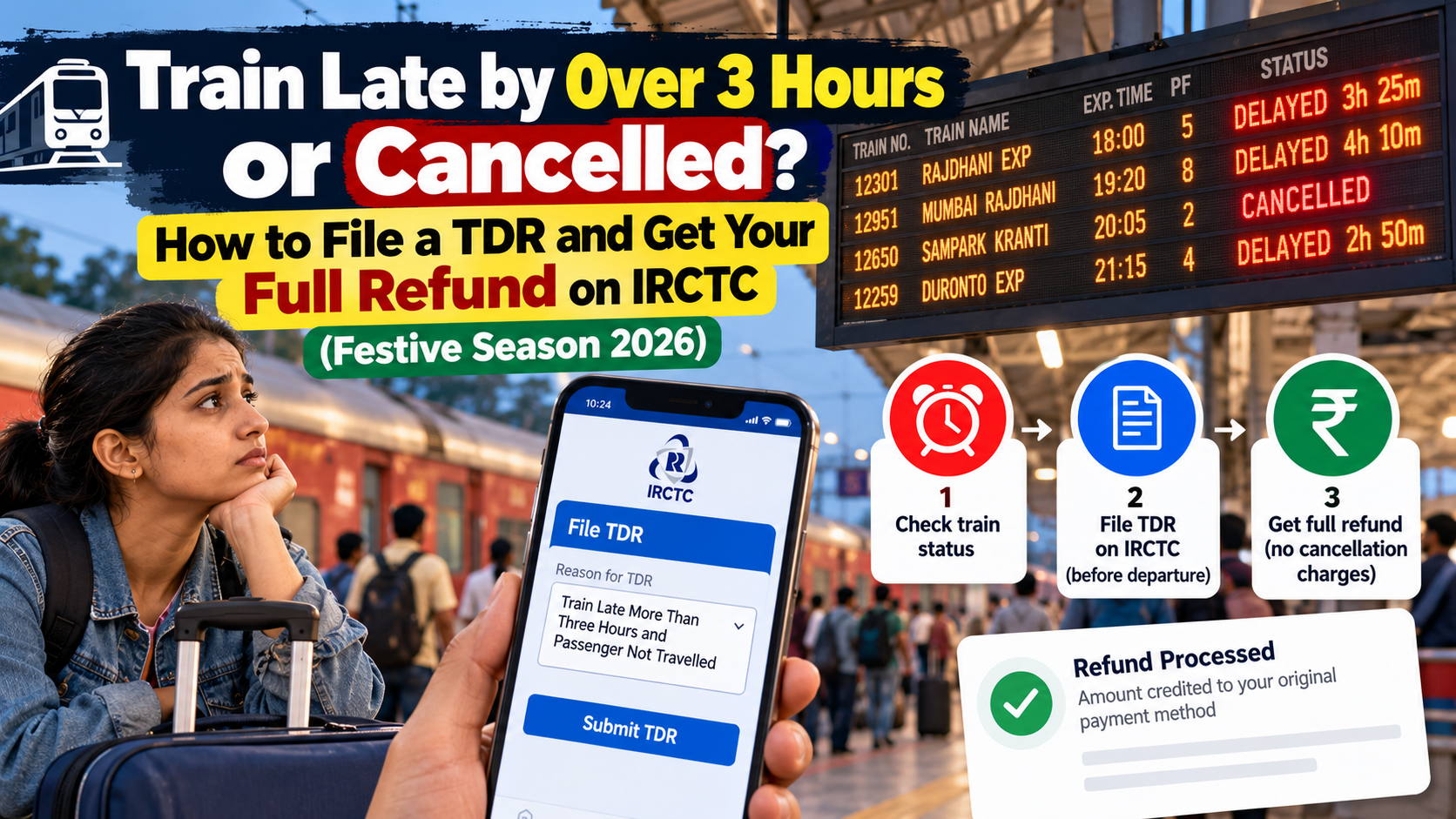
Train Late by Over 3 Hours or Cancelled? How to File a TDR and Get Your Full Refund on IRCTC
Festive-season train travel can turn into a long wait when a train is running hours behind schedule. If your train is running more than three hours late and you decide not to travel, Indian Railways provides a route to claim a full fare refund without cancellation charges or clerkage, subject to the applicable conditions.
There is an equally important rule for cancelled trains: if an e-ticket train is officially cancelled, the fare is normally refunded automatically, so you generally do not need to cancel the ticket or file a TDR. IRCTC
Here is what passengers should know before travelling during the 2026 festive season.
If Your Train Is More Than 3 Hours Late
The key rule is simple:
Train more than 3 hours late + you do not travel = full fare refund, subject to the prescribed TDR deadline and conditions.
For an IRCTC e-ticket, the current IRCTC refund rules specify that the TDR must be filed online before the actual departure of the train from your boarding station to claim the full refund under the more-than-three-hours-late provision. All passengers booked on the PNR must not have travelled. IRCTC
This means you should not wait until after the train has actually left your boarding station to file the TDR.
Example
Suppose your train is scheduled to leave your boarding station at:
6:00 PM
But the latest railway information shows that it is running more than three hours late.
If you decide not to travel, you should file the TDR before the train actually departs from your boarding station.
If you simply wait until after the train has departed and then file the TDR, the special full-refund provision for late running may not be available under the current IRCTC e-ticket rules. IRCTC
What Does “More Than 3 Hours Late” Mean?
The relevant comparison is with the train's scheduled departure from your journey-commencing/boarding station.
It is not enough that the train was three hours late at some earlier station.
For the IRCTC late-running refund provision, the train must be running more than three hours late at the passenger's boarding station, and the passenger must not undertake the journey. IRCTC
So before filing, check the latest running status for your boarding station, rather than relying on a message saying the train is delayed somewhere else on its route.
How to File a TDR on IRCTC
If the train qualifies and you are not travelling, the basic process is:
Step 1: Log in to IRCTC
Open the official IRCTC website and sign in to your account.
Step 2: Open Your Booked Tickets
Go to:
My Account → My Transactions → Booked Ticket History
Select the relevant PNR/ticket. IRCTC's online ticketing instructions direct passengers to their booked-ticket history for ticket-related actions. IRCTC
Step 3: Choose the TDR option
If the ticket is eligible for online TDR filing, select the option to File TDR.
IRCTC's instructions identify “Train Late More Than Three Hours and Passenger Not Travelled” as a specific TDR reason. IRCTC
Step 4: Select the appropriate reason
Choose the reason corresponding to:
Train Late More Than Three Hours and Passenger Not Travelled
Make sure this is actually the reason you are claiming the refund.
Step 5: Submit the TDR
Submit the request before the actual departure of the train from your boarding station.
Save the TDR/reference details and take a screenshot for your records.
Step 6: Wait for railway processing
IRCTC forwards the refund claim to the concerned Railway administration for processing. Once the refund is sanctioned and received by IRCTC, it is credited back to the account/payment method used for the booking. IRCTC
Do Not Simply Cancel the Ticket Normally
This is one of the biggest mistakes passengers can make.
A normal ticket cancellation and a TDR claim for a train running more than three hours late are not the same thing.
Normal cancellation can involve cancellation charges depending on when you cancel. The special late-running provision exists specifically for passengers who do not undertake the journey because the train is running more than three hours late. Indian Railways
So if your reason is qualifying late running, use the appropriate TDR route within the prescribed time rather than treating it as an ordinary voluntary cancellation.
What If the Train Is Cancelled?
This situation is easier.
Under the current IRCTC refund rules for e-tickets:
If the train itself is officially cancelled, the full fare is automatically refunded.
You do not normally need to:
- cancel the e-ticket manually;
- file a TDR;
- visit a railway reservation counter.
The refund is credited to the account from which the booking transaction was made. IRCTC
Cancelled Train vs Delayed Train
| Situation | What you should do |
|---|---|
| Train officially cancelled | Automatic full refund for eligible e-ticket |
| Train >3 hours late and you do not travel | File online TDR before actual departure from boarding station |
| Train >3 hours late but you travel | Late-running non-travel refund does not apply |
| You voluntarily cancel because you changed your plans | Normal cancellation rules apply |
| You file the late-running TDR after actual departure | Full-refund provision may not be available |
What If the Train Is Delayed but You Still Travel?
You cannot normally claim the full-refund benefit for “train late more than three hours and passenger not travelled” if you actually undertake the journey.
The special rule is intended for passengers who do not travel because of the qualifying delay. IRCTC
So decide before the train actually departs from your boarding station if you intend to use this particular refund provision.
What If Only One Passenger Doesn't Travel?
Be careful with party bookings.
The IRCTC rule specifically states that for the more-than-three-hours-late full-refund provision, all passengers booked on the PNR must not have travelled. IRCTC
If some members of a family travel while others do not, the refund situation can be different and should not automatically be treated as a standard full-PNR late-running refund.
What About RAC and Waitlisted Tickets?
The current IRCTC refund rules extend the more-than-three-hours-late provision to reserved, RAC and wait-listed tickets, provided the applicable conditions are satisfied and the journey is not undertaken. IRCTC
However, different rules apply to fully waitlisted e-tickets after chart preparation. IRCTC says that when all passengers on an e-ticket remain waitlisted after chart preparation, their names are dropped from the chart and the fare is refunded electronically after the applicable clerkage deduction. IRCTC
Therefore, don't confuse a normal waitlist refund with a late-running train TDR.
What About Confirmed Tatkal Tickets?
A confirmed Tatkal ticket normally does not receive a refund merely because the passenger changes their mind.
IRCTC's cancellation information states that no refund is granted for cancellation of a confirmed Tatkal e-ticket under ordinary cancellation rules. IRCTC
But special railway refund provisions can apply in circumstances such as train cancellation or qualifying late running. The reason and applicable rule matter.
Keep Evidence Before Filing
During the festive rush, train running information can change quickly.
Before filing your TDR, it is sensible to preserve:
- PNR number;
- train number and name;
- scheduled departure time;
- boarding station;
- current running status;
- delay information;
- TDR/reference number;
- screenshots of relevant status information.
This is particularly useful if the refund claim later requires clarification.
What Happens After You File the TDR?
Filing a TDR does not necessarily mean the refund appears instantly.
IRCTC explains that TDR claims are forwarded to the concerned Railway administration for processing. The refund amount is credited after the Railway processes and sanctions the claim. IRCTC
Therefore, don't panic if the amount does not immediately appear in your bank account or payment instrument.
Keep the TDR reference until the claim is settled.
If Your Refund Is Stuck
If you believe you have filed a valid TDR but the refund has not been resolved, IRCTC provides an online eQuery facility for submitting and tracking customer queries.
IRCTC also lists:
14646 for customer support within India.
For problems involving e-ticket cancellation or TDR filing, IRCTC lists etickets@irctc.co.in, with the instruction to write from the registered email ID. IRCTC
A Festive-Season Checklist
Before heading to the station, keep these rules in mind:
If your train is more than 3 hours late
- Check the delay at your boarding station.
- Decide whether you will actually travel.
- If you are not travelling, use the appropriate TDR reason.
- File the TDR before actual departure from your boarding station.
- Save the TDR/reference number.
- Keep your PNR and screenshots.
- Wait for Railway processing of the refund.
If your train is officially cancelled
- Check that the cancellation is reflected in the railway system.
- For an eligible IRCTC e-ticket, do not file a duplicate TDR merely because the train was cancelled.
- The fare should be refunded automatically.
- Monitor the original payment account.
- Contact IRCTC if the expected refund does not materialise.
Don't Confuse a Train Delay With Your Own Change of Plans
A full refund is not automatically available just because you no longer want to travel.
There is a major difference between:
“The train is more than three hours late and I did not travel.”
and
“The train is running normally, but I decided not to go.”
The first can qualify for the special full-refund provision, subject to the conditions and deadline. The second is generally governed by the normal cancellation rules and applicable charges. Indian Railways
Bottom Line
For the 2026 festive travel season, remember two rules above all:
Train cancelled: For an eligible IRCTC e-ticket, the fare is normally refunded automatically, so you don't need to file a TDR. IRCTC
Train more than 3 hours late: If you decide not to travel, an eligible passenger can claim a full fare refund without cancellation charges, but for an e-ticket the TDR must be filed online before the train's actual departure from the boarding station. IRCTC
The safest approach during Diwali, Chhath and other peak travel periods is therefore to check the train's actual status at your boarding station and act before the train departs, rather than waiting until after departure to sort out the refund.