
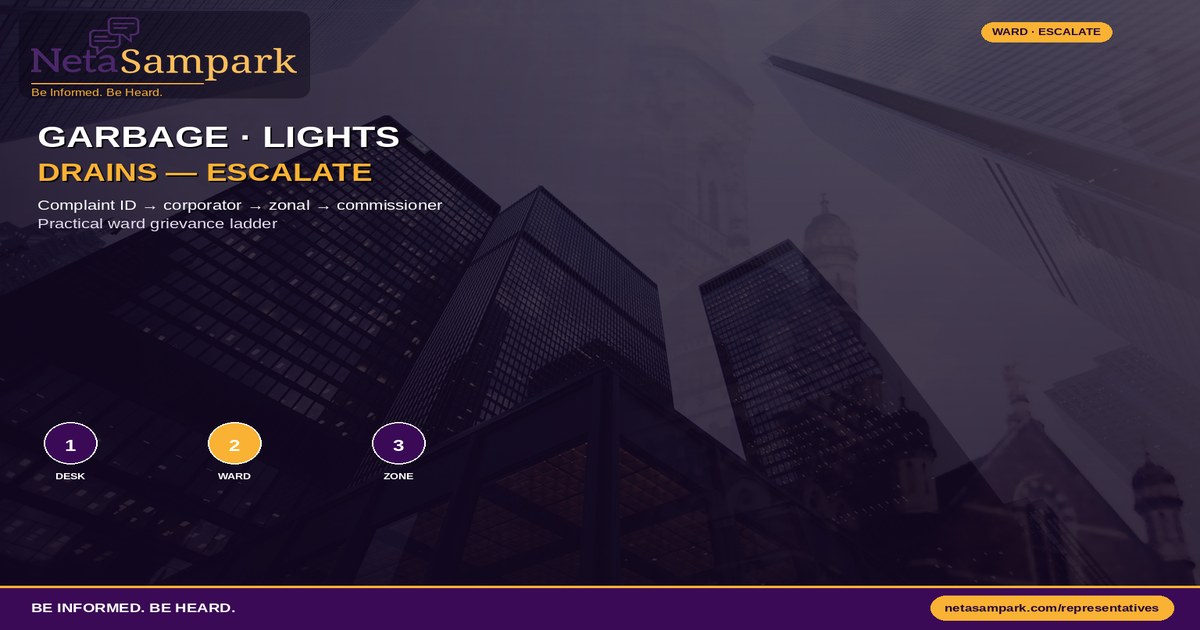
Quick take: For a garbage black spot, dead streetlight or choked drain, don't start with a viral post. Start with a municipal complaint ID.
Then escalate in a sequence:
Municipal complaint → Ward councillor/corporator → Zonal/Executive Engineer → Municipal Commissioner
Carry photos, dates, location details and reference numbers at every stage.
The objective isn't to create noise. It's to create a documented trail that becomes harder to ignore.
Why an Escalation Ladder Works Better Than Viral Anger
A social-media post can attract attention.
A complaint number creates a record.
That's the difference.
When a civic problem isn't resolved, you want to be able to show:
When was it reported? Who received it? What was the promised response? What happened afterward?
Your escalation should therefore build on the previous step rather than restart the story every time.
This is different from asking what a newly elected councillor should accomplish in their first 30 days.
This guide is for the situation where:
You've reported the problem — and nothing happened.Step 0 — Build Your Evidence Pack
Spend 20–30 minutes getting the basics together.
For a garbage, streetlight or drain complaint, collect:
- 📷 2–3 clear photographs
- 📍 Exact location or map pin
- 📅 Date and approximate time
- 📝 Short description of the problem
- 🆔 Existing complaint/reference number
- 📏 Useful measurements if relevant
- 🚗 Nearby landmark, road or building
- ⚠️ Safety impact, if any
Example
Instead of:
"Drain is blocked near our area."
Write:
"Drain beside 14th Cross, near the community hall, has been blocked since 8 September. Water is accumulating across approximately 20 metres of the road after rain. Complaint ID: XXXXX."
Now somebody else can locate the problem without calling you for another explanation.
Step 1 — File the Municipal ComplaintStart with your city's official municipal complaint channel.
Depending on the city, this could be:
- Municipal website
- Official civic app
- Helpline
- Ward office
- Physical complaint register
Use whichever channel your municipality officially provides.
Save these immediately:
Complaint ID
Date/time
Department/category
Location
Screenshot or acknowledgement
Expected resolution/SLA, if shown
Don't assume that submitting a complaint means it has been successfully recorded.
Look for a reference number.
What If the App Doesn't Work?Don't let a broken app stop the paper trail.
If your municipal system is unavailable and the ward office accepts physical complaints, ask for the complaint to be entered in the appropriate register.
Keep proof of submission where possible.
The principle is:
No reference number? Create a documented submission.Step 2 — Contact Your Ward Councillor/Corporator
Don't necessarily contact the elected representative five minutes after filing the complaint.
Give the municipal system an opportunity to respond first.
If the published service timeline has passed and the issue remains unresolved, contact your ward councillor/corporator.
Your message should be short.
Sample message
Subject: Unresolved civic complaint — [location]
Complaint ID: XXXXX
Filed: 10 September
Issue: Garbage accumulation at [location]
Status: No resolution after the applicable response period
The issue remains at the location shown in the attached photographs. Requesting your intervention with the concerned municipal team.
Thank you.
Attach two useful photographs, not twenty.
The objective is to make the problem easy to understand in 30 seconds.
How to Find the Right RepresentativeOne common problem is simply not knowing:
Who represents this ward?
That's where NetaSampark can be useful.
Use the representative directory to identify the relevant:
- Ward councillor/corporator
- MLA
- MP
Then match the problem to the appropriate level of government.
Don't send a streetlight complaint to five representatives simultaneously just because their names are available.
Start with the authority closest to the actual service.
Step 3 — Move to the Zonal or Executive DeskSuppose the councillor acknowledges your complaint but the municipal field team still doesn't act.
Now move upward administratively.
Depending on your city, this may mean contacting the relevant:
- Zonal office
- Assistant Executive Engineer
- Executive Engineer
- Health/Sanitation officer
- Solid Waste Management officer
- Storm-water/drainage engineering division
- Electrical/streetlight division
The exact titles vary by municipality.
Your message should contain:
Original complaint ID
Date filed
Location
Problem
Current status
Previous escalation
What you want inspected or fixed
You're no longer reporting a new problem.
You're reporting:
An unresolved municipal complaint.
That distinction matters.
Step 4 — Municipal Commissioner: Use This for PatternsThe Commissioner shouldn't be your first stop for every broken streetlight.
Escalation to senior municipal administration becomes more meaningful when there is evidence of:
- Repeated complaints without resolution
- Multiple locations with the same problem
- Repeated false/incorrect closures
- A zonal office failing to act
- A recurring sanitation or drainage problem
- A problem crossing departmental boundaries
- A safety issue that remains unresolved
At this stage, prepare a one-page escalation note.
Your One-Page Commissioner BriefKeep it boring.
That's a compliment.
Problem
Recurring garbage accumulation at [location]
Timeline
DateActionReferenceResult8 SepMunicipal complaint#1234No action11 SepFollow-up#1234Pending13 SepCouncillor contacted—Acknowledged15 SepZonal office contacted#5678Inspection requested17 SepSite checked—Garbage remains
Attach
- 2–3 photographs
- Location/map
- Complaint acknowledgements
- Previous correspondence
Ask
"Requesting a site inspection and written confirmation of the action proposed."
That's far more useful than a three-page angry letter.
The Escalation LadderSave this.
🟢 Level 1 — Municipal system
File complaint
↓
🟡 Level 2 — Ward representative
Councillor/Corporator
↓
🟠 Level 3 — Zonal administration
Relevant officer/Executive Engineer
↓
🔴 Level 4 — Senior municipal administration
Municipal Commissioner
↓
⚖️ Level 5 — Other appropriate authority
Only where the issue actually falls under another agency, statutory mechanism or legal route.
Don't Escalate to the Wrong Government LevelThis is where citizens often lose time.
A councillor cannot personally repair every road.
A municipal commissioner may not control a road belonging to another agency.
An MLA may have no direct administrative authority over a municipal sanitation worker.
An MP isn't the normal first escalation for a neighbourhood garbage pile.
Before escalating, ask:
Who owns this asset or service?
A road could belong to:
- Municipal corporation
- PWD
- Development authority
- NHAI
- Another agency
A drain could similarly belong to different authorities depending on the city.
Find the actual service owner before deciding who should fix it.
What About an MLA or MP?MLAs and MPs can be useful when the issue involves matters within their sphere of representation or when a broader government programme/agency is involved.
But don't automatically send every broken pavement, overflowing bin or dead streetlight to them.
For a routine ward-level civic problem:
Municipal system → ward representative → municipal administration
is generally the more relevant starting trail.
What If the Complaint Says "Resolved" — But It Isn't?This is one of the most frustrating situations.
You open the app:
Status: Resolved
You visit the location:
Problem still exists.
Don't create a completely new complaint immediately unless the system requires it.
First document the discrepancy.
Take a fresh photograph showing:
- Location
- Date
- Continuing problem
Then reopen/reject the closure if the municipal system provides that option.
If it doesn't, create a follow-up complaint and reference the original complaint ID.
Example
"Complaint #1234 was marked resolved on 15 September. The problem remains at the same location as of 18 September. Attached photograph taken on 18 September."
Now the record shows that the closure itself is disputed.
Safety Problems Should Move FasterNot every civic problem deserves the same urgency.
Prioritise issues involving:
High priority
- Open manholes
- Exposed electrical wires
- Dangerous dark stretches
- Major drain overflow
- Sewage entering public areas
- Waste creating a health/safety hazard
- Flooding that blocks emergency access
- Collapsed or structurally dangerous infrastructure
Lower priority
- Cosmetic damage
- Missing paint
- Park appearance issues
- Minor non-safety defects
The principle is simple:
Escalate based on risk, not annoyance.Don't Create a Social-Media Pile-On
Social media can be useful as a communication channel.
But don't make it your entire strategy.
A post saying:
"Municipality doesn't care!"
creates attention but very little administrative information.
A post saying:
"Complaint #1234 filed on 8 September. SLA passed. Issue remains unresolved at [location]. Requesting inspection."
is much more useful.
And you should still maintain the official complaint trail.
RWA Coordination Without Losing the Paper TrailIf you're part of an apartment association, RWA or neighbourhood group, coordination can help.
But don't create 40 unrelated complaints about the same issue unless the municipality's system specifically benefits from individual reporting.
A cleaner approach can be:
One primary complaint ID
Evidence from multiple residents
A short joint escalation
For example:
"Residents of 14th Cross have reported the same drain blockage since 8 September. Complaint ID #1234 remains unresolved. Attached are photographs from three dates."
That's a much stronger evidence trail.
A Simple Civic Escalation TemplateUse this whenever you're stuck.
Subject: Unresolved civic complaint — [issue] — [location]
Complaint ID: ______
Date filed: ______
Location: ______
Issue:
[One or two sentences]
Current status:
[What has/hasn't happened]
Previous action:
[Municipal complaint / councillor / zonal office]
Evidence:
[Photos + location]
Request:
Please arrange an inspection and take the appropriate action. Kindly provide the updated status/reference number.
Regards,
[Name]
Short enough to read.
Specific enough to act on.
Your Civic Escalation ChecklistBefore filing
- ☐ Identify the actual service owner
- ☐ Photograph the problem
- ☐ Record location
- ☐ Record date
- ☐ Check the official municipal channel
After filing
- ☐ Save complaint ID
- ☐ Save acknowledgement
- ☐ Note expected response time
- ☐ Follow up after the applicable timeline
If unresolved
- ☐ Contact ward councillor/corporator
- ☐ Escalate to relevant zonal/engineering desk
- ☐ Keep the original complaint ID
- ☐ Escalate recurring/systemic problems to senior administration
If marked "resolved"
- ☐ Photograph the continuing problem
- ☐ Record the new date
- ☐ Reopen/follow up where possible
- ☐ Reference the original complaint
One garbage pile is a complaint.
Twenty unresolved complaints across the same zone can become evidence of a service-delivery pattern.
That's when citizen documentation becomes more powerful.
Instead of saying:
"Our ward is neglected."
You can say:
"Here are 18 complaint IDs, the dates filed, the published response timelines and the current status of each."
That changes the conversation from opinion to evidence.
How NetaSampark HelpsYou shouldn't need to memorise every government hierarchy.
NetaSampark can help you identify the relevant representative and civic-service information so that your escalation reaches the right level.
The goal isn't to shout louder.
It's to know:
Who owns the problem → who received the complaint → what happened → who should be contacted next.
Be Informed. Be Heard.
Municipal structures, officer titles, grievance portals and escalation procedures vary by city and State. Always use your municipality's current official complaint channel and verify which agency owns the particular road, drain, streetlight or sanitation service before escalating.