
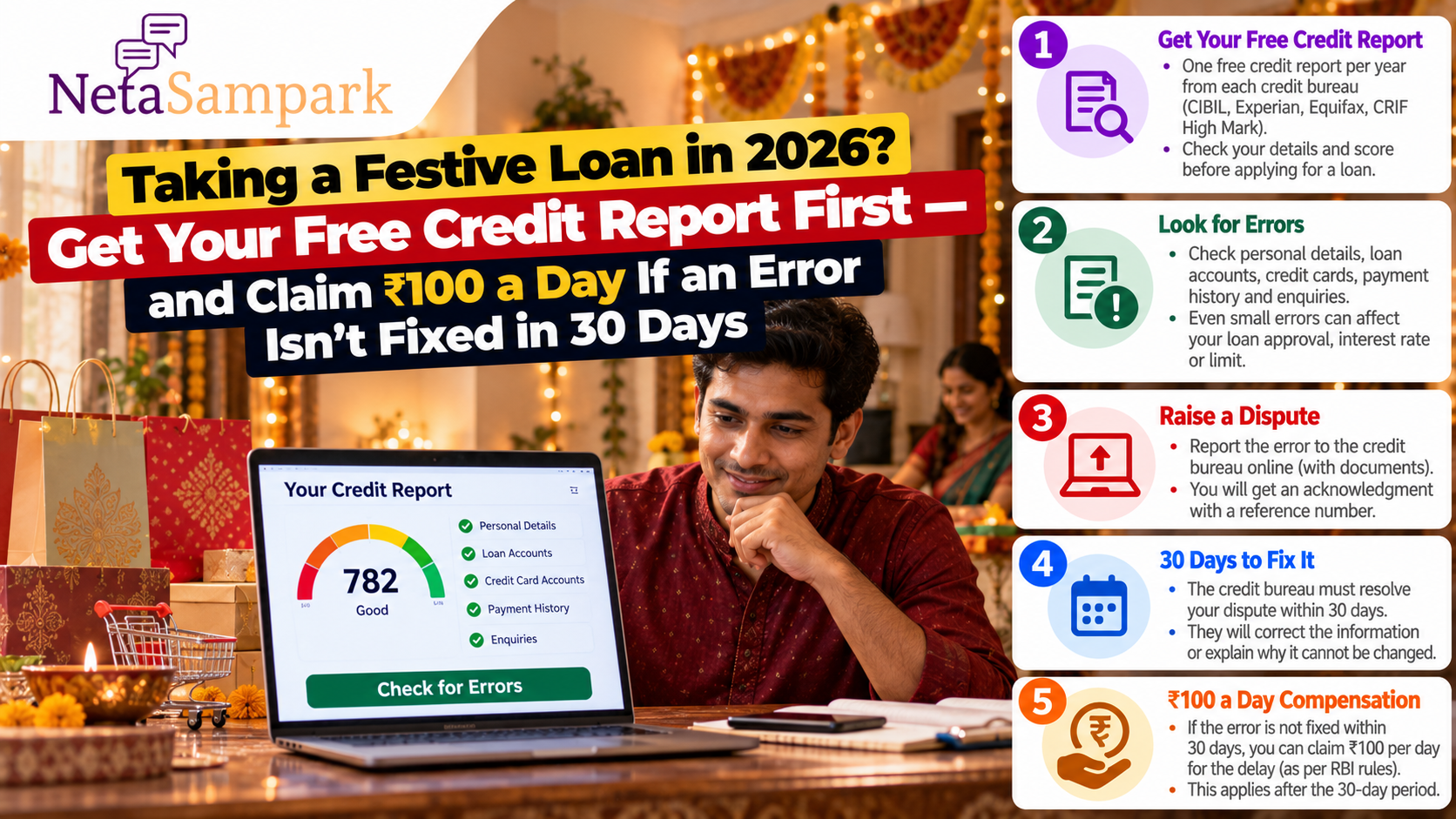
Taking a Festive Loan in 2026? Get Your Free Credit Report First — and Claim ₹100 a Day If an Error Isn’t Fixed in 30 Days
Planning to take a personal loan, consumer loan, car loan or other credit during the festive season? Before submitting a new loan application, take a few minutes to check your credit report.
Your credit report can contain your loan and credit-card accounts, repayment history, outstanding balances, defaults and credit enquiries. Lenders use credit information along with other factors when assessing loan applications. RBI's financial-awareness material also confirms that individuals with a credit history can obtain one free full credit report, including the credit score, once every calendar year from each credit information company (CIC). Reserve Bank of India
There is another protection many borrowers miss: if you dispute inaccurate credit information and the complaint is not resolved within 30 calendar days, RBI's compensation framework provides for ₹100 per calendar day of delay, subject to the framework's conditions. System Health
That makes a credit-report check useful before, not after, you apply for a festive loan.
Why Check Your Credit Report Before Taking a Loan?
A credit report can reveal problems that you may not know about, such as:
- A loan account you never took
- A credit card incorrectly linked to your name
- A payment incorrectly shown as overdue
- A loan marked active after you closed it
- An incorrect outstanding balance
- A wrong personal detail
- A duplicate account
- An incorrect "settled", "written-off" or default status
- Credit enquiries you do not recognise
Even when the underlying error is small, incorrect information can complicate a lender's assessment.
RBI notes that credit scores and credit history are among the factors banks and financial institutions consider when sanctioning loans, and that a higher score will usually help a borrower obtain credit on better terms, all else being equal. Reserve Bank of India
You Can Get a Free Full Credit Report
RBI requires credit information companies to provide individuals with credit history access to one free full credit report (FFCR), including the credit score, once during a calendar year. Reserve Bank of India
India has four credit information companies:
- TransUnion CIBIL
- Experian
- Equifax
- CRIF High Mark
RBI's consumer-awareness material identifies all four and states that individuals can obtain their free full credit report once a year from the respective CICs. Reserve Bank of India
One Important Point
The free-report entitlement is not the same thing as one report across all four companies.
If you have credit information reported to multiple CICs, you can check the respective CIC reports according to their access process.
That can be useful because the information held by different credit bureaus may not always be identical.
What Should You Look for in the Report?
Don't just look at the three-digit credit score.
Open the detailed report and check the underlying information.
1. Personal Details
Check:
- Name
- Date of birth
- PAN or other identifying information
- Address
- Mobile/contact information
A minor spelling variation may not necessarily affect your borrowing, but an identity mismatch or incorrect personal information should be investigated.
2. Loan Accounts
Check every listed:
- Personal loan
- Home loan
- Vehicle loan
- Education loan
- Consumer loan
- Business loan
- Other credit facility
Ask yourself:
Did I actually take this loan?
If not, treat it as a potentially serious identity or reporting issue.
3. Credit Cards
Look for:
- Cards you currently use
- Closed cards
- Outstanding balances
- Payment history
- Credit limits
- Accounts you don't recognise
An old account that you thought was closed but still appears as active should be checked with the card issuer.
4. Repayment History
Look for incorrect:
- Late payments
- Overdues
- Defaults
- Days-past-due entries
- Settled/write-off classifications
If you paid an EMI on time but the report shows a missed payment, collect your bank statement, payment receipt or lender confirmation.
5. Outstanding Amount
Compare the reported outstanding balance with your lender's latest statement.
This is particularly important for loans you have recently:
- Repaid
- Prepaid
- Closed
- Restructured
- Settled
6. Credit Enquiries
Check who has accessed your report for a credit application.
If you see an enquiry from a lender you never approached, investigate it.
One unfamiliar enquiry does not automatically prove fraud, but it is a reason to check what happened.
What If You Find an Error?
Don't wait until your festive loan application is rejected.
Raise a formal dispute.
You can approach the relevant credit information company and/or the credit institution that supplied the information, depending on the nature of the problem.
For example:
Wrong EMI payment status → complain to the lender that reported it and the CIC.
Account does not belong to you → dispute the account and contact the lender immediately.
Wrong personal information → request correction through the relevant reporting institution/CIC.
Keep documentary evidence.
What Documents Should You Attach?
The exact documents depend on the error.
Useful evidence can include:
- Loan closure letter
- No-dues certificate
- Bank statement
- EMI payment receipt
- Loan statement
- Credit-card statement
- Identity document
- Correspondence from the lender
- Screenshot/PDF of the incorrect credit-report entry
- Complaint/reference number
Don't send more sensitive information than necessary, and use the official dispute channel.
The 30-Day Rule
This is where the RBI compensation framework becomes important.
Under RBI's Framework for compensation to customers for delayed updation/rectification of credit information, a complainant is entitled to ₹100 per calendar day if the complaint is not resolved within 30 calendar days from the date of initial filing of the complaint with the credit institution or credit information company. System Health
But there is an important nuance.
The 30 days are not simply a period during which the CIC can do nothing.
RBI's framework explains that:
- The credit institution (CI) has 21 calendar days to send updated/corrected information after being informed of the inaccuracy.
- The overall resolution period is 30 calendar days.
- The CIC effectively has the remaining period to complete its part of the resolution process after receiving the corrected information. System Health
So, if your lender is responsible for correcting the underlying information, don't assume the credit bureau alone can fix it immediately.
How Does the ₹100-a-Day Compensation Work?
Suppose you file a qualifying complaint on 1 December.
If the complaint is not resolved within the applicable 30-calendar-day period, compensation can become payable for the delay beyond that period under the RBI framework.
For illustration, if a qualifying complaint is resolved after 37 calendar days, the delay beyond 30 days would be:
37 − 30 = 7 days
Potential compensation:
7 × ₹100 = ₹700
The actual amount depends on the dates and circumstances of the specific complaint and the allocation of responsibility between the concerned credit institution and CIC. System Health
Who Has to Pay the Compensation?
It depends on where the delay occurred.
RBI's framework provides that:
- A credit institution must compensate if it failed to send the updated/corrected information to the CIC within the prescribed 21-calendar-day period.
- A CIC must compensate where the credit institution furnished the updated information within 21 days but the complaint still was not resolved within 30 days.
- Where more than one institution is involved, compensation can be apportioned among the concerned entities. System Health
The complainant should be informed about the action taken and, where applicable, the total delay and compensation amount.
When Does the Resolution Date Count?
RBI defines the resolution date as the date when the rectified Credit Information Report (CIR) is sent by the CIC or credit institution to the postal address or email ID provided by the complainant. System Health
This is why you should keep:
- Complaint date
- Complaint/reference number
- Email confirmation
- Screenshots
- Responses from the lender
- Responses from the CIC
- Revised credit report
Do not delete the emails after the error appears to be fixed.
What If the Complaint Is Rejected?
A correction request does not mean that the lender or CIC must accept every allegation.
If the information is verified as accurate, the complaint may be rejected.
RBI's framework says that where a complaint is rejected, the credit institution or CIC should provide the reasons for rejection. System Health
If you disagree, examine the reason and supporting records before escalating.
What If the Error Is Still Not Fixed After 30 Days?
If the applicable complaint remains unresolved beyond 30 days, calculate the delay and check the compensation position.
The RBI framework also allows a complainant to approach the RBI Ombudsman in cases of wrongful denial of compensation, subject to the applicable scheme and maintainability requirements. System Health
The RBI's consumer-awareness material similarly advises borrowers that if an inaccuracy complaint remains unaddressed for more than 30 days, or the borrower is dissatisfied with the resolution, they can approach the RBI Ombudsman through the RBI's complaint-management system. Reserve Bank of India
Don't Confuse a Credit-Report Dispute With a Loan Dispute
This distinction matters.
Suppose your report correctly says you owe ₹2 lakh, but you believe the lender charged you an incorrect interest rate.
The credit-report dispute mechanism is primarily about incorrect credit information.
It is not automatically a way to cancel a genuine loan liability.
Similarly, if a lender legitimately reported a missed EMI, you cannot demand deletion simply because the entry hurts your credit score.
The question is:
Is the information inaccurate?
What If Someone Took a Loan in Your Name?
Treat this more seriously than an ordinary reporting error.
If you find a loan account you never opened:
- Download/save the credit report.
- Record the lender name and account number.
- Raise a dispute with the CIC.
- Contact the lender's official fraud/grievance channel.
- Ask for the application and account-opening details through the appropriate process.
- Secure your identity and financial accounts.
- If identity theft or fraud is suspected, consider reporting it to the appropriate law-enforcement/cybercrime authorities.
Do not make a payment on an unfamiliar loan merely because someone calls and threatens you.
Check Your Credit Report Before Applying for the Festive Loan
A sensible order is:
Credit report → correct errors → wait for updated report → compare loans → apply.
This is better than:
Apply for loan → get a problem in underwriting → discover the credit-report error afterward.
It also gives you time to resolve an old closed-loan or payment-history issue before you need new credit.
Don't Apply to Five Lenders at Once
If you're shopping for a festive loan, compare offers carefully rather than submitting full loan applications indiscriminately.
Ask each lender about:
- Interest rate
- Annualised cost where applicable
- Processing fee
- GST/taxes on applicable fees
- Insurance or bundled products
- Prepayment charges
- Late-payment charges
- Tenure
- EMI
- Total amount payable
A loan advertised with a low monthly EMI can still be expensive if the tenure and fees are high.
Your Credit Score Is Not the Only Thing a Lender Checks
A high credit score does not guarantee loan approval.
Lenders may also consider:
- Income
- Existing EMIs
- Debt-to-income position
- Employment/business stability
- Existing relationship with the lender
- Loan amount
- Repayment capacity
- Internal credit policies
- Other information in the credit report
RBI itself notes that lenders consider credit score and credit history along with other factors. Reserve Bank of India
So don't obsess over one number.
The more important exercise is making sure the underlying credit information is accurate.
RBI Has Also Tightened Credit-Data Reporting
Credit information is now expected to be updated more frequently.
RBI directed credit institutions and CICs to move to fortnightly updating of credit information, with credit institutions required to submit information within seven calendar days of the relevant reporting fortnight. CICs were subsequently directed to ingest the information within five calendar days of receipt. These instructions took effect from January 1, 2025. System Health
That makes checking your report even more useful when you have recently:
- Closed a loan
- Paid off an overdue amount
- Settled an account
- Corrected a reporting error
However, don't assume a payment made today will immediately appear in tomorrow's report. Reporting and ingestion operate according to the prescribed cycles.
A 10-Minute Pre-Loan Credit Check
Before taking that festive loan:
Step 1
Get your free full credit report from the relevant CIC.
Step 2
Check your personal details.
Step 3
Check every loan and credit-card account.
Step 4
Check repayment history and overdue entries.
Step 5
Check outstanding balances.
Step 6
Check closed accounts.
Step 7
Check recent credit enquiries.
Step 8
Dispute anything inaccurate immediately.
Step 9
Save the complaint/reference number and evidence.
Step 10
Track the 30-calendar-day resolution period.
If the qualifying complaint crosses the 30-day limit, check whether ₹100 per calendar day compensation is due under RBI's framework. System Health
A Simple Example
Imagine you closed a personal loan in September.
In October, you download your credit report before applying for a festive purchase loan and discover that the old lender still shows the account as active with an outstanding balance.
You should:
1. Download/save the report.
2. Obtain your loan closure/no-dues document.
3. Raise a correction request with the lender and relevant CIC.
4. Record the complaint date and reference number.
5. Monitor the 21-day lender correction window and overall 30-day resolution period.
6. Check the revised credit report.
7. If the qualifying complaint remains unresolved beyond 30 days, calculate the delay and pursue the applicable compensation/escalation route.
That is much safer than simply applying for another loan and hoping the lender overlooks the incorrect entry.
What Not to Do
Don't pay a "credit repair agent" simply because they promise to erase genuine negative information.
Accurate repayment history cannot legitimately be made to disappear just because someone charges a fee.
Also:
- Don't share your banking OTP.
- Don't share UPI PINs.
- Don't give remote access to your phone.
- Don't upload your complete financial records to an unknown website.
- Don't click credit-report links received through suspicious SMS or WhatsApp messages.
- Use the official CIC and RBI channels.
Festive Loan Credit-Report Checklist
Before applying, ask:
- Did I obtain my free annual full credit report?
- Is my name and personal information correct?
- Do I recognise every loan account?
- Do I recognise every credit card?
- Are all closed loans actually shown as closed?
- Is my payment history accurate?
- Are the outstanding balances correct?
- Do I recognise all recent enquiries?
- Have I disputed every genuine error?
- Did I save the dispute reference number?
- Am I tracking the 30-calendar-day deadline?
- If the complaint is delayed, have I checked my ₹100/day compensation entitlement?
Bottom Line
Before taking a festive loan in 2026, check your credit report before the lender checks it for you.
You are entitled to a free full credit report including your credit score once every calendar year from each credit information company, according to RBI's framework. Reserve Bank of India
If you find inaccurate information, dispute it promptly. Under RBI's compensation framework, a qualifying complaint that is not resolved within 30 calendar days can attract compensation of ₹100 for each calendar day of delay, with responsibility allocated between the credit institution and CIC depending on where the delay occurred. System Health
The practical sequence is simple:
Download → Check → Dispute → Save the reference → Track 30 days → Claim applicable compensation if the correction is delayed.
And only after your credit information is clean should you compare the festive-loan offers themselves.