Smoke Season Is Back in October 2026: Check Your AQI and Report Garbage or Crop Burning Near You
October is bringing back a familiar warning across parts of India: smoke, dust and stagnant air can quickly turn a manageable AQI into unhealthy air, particularly as the post-monsoon period sets in.
Delhi's air quality, for example, deteriorated sharply in the first week of October. The city's AQI reached 187 on 6 October, while Noida and Ghaziabad entered the Poor category. Satellite monitoring also detected crop-residue burning events across several States. The Times of India
But crop burning is not the only source. Vehicle exhaust, road dust, construction, industries, waste burning and weather conditions can all contribute to local air pollution. So if you see a pile of garbage being burned or crop residue being set on fire near your home, don't just watch the smoke—report it through the appropriate local channel.
First: Check Your AQI
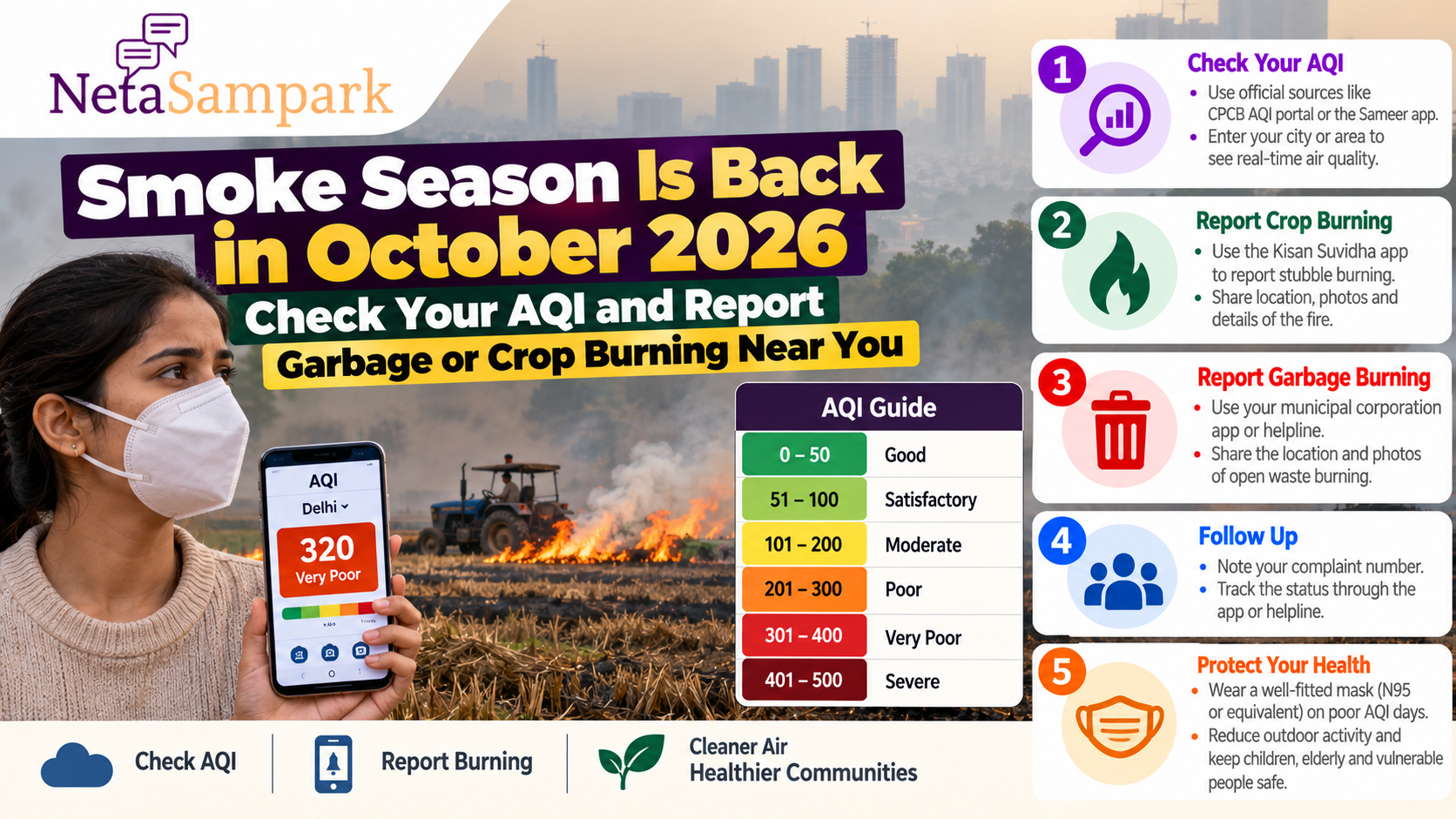
The Central Pollution Control Board's National Air Quality Index (AQI) uses six categories:
| AQI | Category | What it means |
|---|---|---|
| 0–50 | Good | Minimal impact |
| 51–100 | Satisfactory | Minor breathing discomfort possible for sensitive people |
| 101–200 | Moderate | Breathing discomfort possible, especially for vulnerable groups |
| 201–300 | Poor | Prolonged exposure can cause breathing discomfort |
| 301–400 | Very Poor | Prolonged exposure can cause respiratory illness |
| 401–500 | Severe | Health effects possible even for healthy people |
CPCB's AQI framework uses pollutants including PM10, PM2.5, nitrogen dioxide, sulphur dioxide, carbon monoxide, ozone, ammonia and lead, depending on available monitoring data. Central Pollution Control Board
Don't rely on one app alone
Different platforms can display different AQI numbers because they may use different datasets, locations or calculation methods.
For an official Indian reading, check CPCB's air-quality information and the relevant State pollution-control authority.
Look at the monitoring station nearest to you, rather than assuming that the city-wide number represents the air immediately outside your home.
Why October Matters
The post-monsoon transition can change air quality quickly.
Rainfall that previously helped remove particulate pollution begins to reduce, winds can become weaker and local emissions can accumulate. In northern India, crop harvesting and residue burning can add another source of particulate pollution.
Delhi's early-October deterioration illustrates the pattern: on 5 October, the city recorded an average AQI of 187, with PM10 identified as the dominant pollutant, while several individual monitoring stations were already in the Poor category. Hindustan Times
But it is important not to reduce every pollution episode to stubble burning.
Weather + local emissions + regional pollution + crop-residue burning can interact.
Crop Burning Is Already Being Monitored
The government uses satellite-based monitoring to detect active crop-residue fires.
A standard protocol developed with ISRO, State remote-sensing centres and the Indian Agricultural Research Institute is used for detecting and reporting crop-residue-burning events. Press Information Bureau
The Centre has also announced additional measures for the 2026 season, including real-time monitoring, machinery support and stubble-management measures in NCR-linked areas. Press Information Bureau
CAQM has separately reviewed Punjab, Haryana and Uttar Pradesh preparedness for the 2026 paddy-harvesting season and emphasised stronger enforcement and crop-residue management. Press Information Bureau
That means citizens do not have to wait for an official satellite alert before reporting a fire they can actually see.
How to Report Crop Burning
If you see crop residue being deliberately burned, record the location and time and use the reporting mechanism available in your State/district.
For agricultural advisories and farmer-facing government services, the Kisan Suvidha platform is an official government agricultural-information channel. Manage
In areas covered by dedicated crop-burning enforcement systems, reports may also be routed through district administration, agriculture officials, pollution-control authorities or local enforcement teams.
What to include in a complaint
Give officials enough information to locate the fire:
- Exact location
- Village/locality
- Nearby landmark
- Date and approximate time
- Type of burning, if known
- Photograph or video, if safely captured
- Your contact details if required
- Any repeat occurrence
A GPS-tagged photograph can be particularly useful where the reporting platform supports it.
Do not enter a burning field or confront the farmer.
Your job is to report the incident, not physically stop it.
How to Report Garbage Burning
Open burning of waste is a different problem from crop-residue burning and normally needs to be reported to the local municipal body or sanitation authority, with pollution-control authorities involved where appropriate.
Depending on your city, the reporting route could be:
- Municipal corporation app
- Municipal helpline
- Ward office
- Sanitation complaint system
- State pollution-control board
- District administration
- Official grievance portal
If your city has a dedicated pollution-reporting app, use that rather than sending the complaint only through social media.
Take a useful photograph
If safe, capture:
- The burning waste
- Location/landmark
- Smoke plume
- Nearby road or building
- Date/time information
Don't put yourself close to the fire simply to obtain a better photograph.
Delhi-NCR Residents Have the Sameer App
For people in Delhi-NCR, CPCB specifically provides the Sameer App for reporting air-pollution complaints.
CPCB's citizen guidelines say an NCR resident can use the app to lodge a public complaint, with the location picked automatically through GPS or entered manually. Users can select the complaint category, upload photographs and receive a complaint ID. The complaint can then be tracked through the app. Central Pollution Control Board
The basic process is:
Open Sameer → Public Complaint → confirm location → select category → add photographs/details → Lodge Complaint → save Complaint ID → Track Complaint.
CPCB's published complaint data also shows that complaints filed through Sameer are forwarded to concerned agencies for action. Central Pollution Control Board
If you're outside Delhi-NCR, don't assume Sameer is the correct route for every local complaint. Use your State pollution-control board or municipal reporting mechanism.
What If You See Burning on the Roadside?
Not every fire is crop burning.
You may see:
- Household garbage
- Plastic waste
- Dry leaves
- Construction waste
- Agricultural residue
- Industrial waste
The distinction matters because the responsible authority can differ.
If you're unsure, describe what you actually observed rather than guessing who is responsible.
For example:
"Open burning of mixed waste beside the road near [landmark], producing heavy smoke."
is better than:
"Illegal factory pollution."
unless you actually know it is coming from a factory.
Why Garbage Burning Is Particularly Concerning
Burning mixed waste can release particulate matter and other pollutants, particularly when plastics, rubber, treated materials or mixed municipal waste are involved.
The smoke may be highly irritating even when the fire looks small.
If burning is occurring near:
- Schools
- Hospitals
- Residential buildings
- Markets
- Bus stops
- Playgrounds
mention that in your complaint because it helps officials understand the immediate public-health impact.
What Should You Do on a Bad-AQI Day?
Your response should depend on the AQI, your health and local conditions.
When pollution is elevated:
- Reduce prolonged outdoor exercise.
- Avoid unnecessary exposure near visible smoke.
- Keep windows closed when outdoor air is particularly poor, where practical.
- Avoid adding indoor pollution through smoking or incense.
- Use a properly fitted N95 or equivalent respirator if you need to be outdoors during significant particulate pollution.
- Use air filtration indoors if available.
- Keep children, older adults and people with heart/lung conditions away from smoke.
CPCB's AQI health-impact framework specifically notes greater risks for people with respiratory or heart disease, children and older adults as AQI increases. Central Pollution Control Board
Don't Use an AQI Number as a Diagnosis
AQI is an environmental indicator, not a medical diagnosis.
Two people exposed to the same AQI can experience different symptoms.
If you develop:
- Significant breathing difficulty
- Chest pain
- Severe wheezing
- Fainting
- Bluish lips
- Severe or rapidly worsening symptoms
seek urgent medical attention.
People with asthma, COPD, heart disease and other conditions should follow their doctor's existing action plan and medication instructions.
What About Children?
Children can be particularly vulnerable to polluted air because their lungs are still developing and they breathe more air relative to body size.
On days with significant pollution:
- Avoid unnecessary outdoor exertion.
- Keep children away from visible smoke.
- Check school advisories.
- Move outdoor sports indoors when conditions are poor.
- Pay attention to coughing, wheezing or breathing difficulty.
Don't wait for the AQI to reach "Severe" before taking visible smoke seriously.
Crop Burning Is Not the Whole Pollution Story
This distinction is important.
When Delhi or another city experiences poor air quality, multiple sources can contribute.
These may include:
- Transport
- Road dust
- Construction and demolition
- Industries
- Power generation
- Waste burning
- Domestic fuel use
- Regional pollution
- Crop-residue burning
- Weather and atmospheric conditions
Recent Delhi monitoring illustrates this complexity. During the early October deterioration, PM10 was identified as a dominant pollutant, while local road dust, construction activity and regional sources were also part of the broader pollution picture. Hindustan Times
So reporting one burning site is useful—but it is not a complete solution to a city's air pollution problem.
What Happens After You Report?
That depends on the reporting channel and the authority responsible.
A complaint may be:
- Registered.
- Assigned to an agency or field officer.
- Verified on the ground.
- Investigated.
- Action taken where a violation is established.
- Complaint status updated.
For Sameer complaints, CPCB specifically provides a complaint ID and tracking mechanism. Central Pollution Control Board
For municipal or State systems, save the acknowledgement/reference number.
If Nothing Happens, Follow Up
Don't simply submit the same complaint five times.
Instead:
Save the complaint number → wait for the stated response period → check status → escalate through the designated grievance channel if necessary.
If the fire continues, submit a fresh report if the system treats each incident separately, and mention the earlier complaint/reference number.
A repeat offender or recurring burning location should be described as such.
Don't Confront the Person Burning the Waste
This is especially important in rural areas and neighbourhood disputes.
You don't know:
- Who owns the land
- Why the fire was started
- Whether chemicals or hazardous materials are involved
- Whether the person may react aggressively
Stand at a safe distance and report it.
If the fire threatens people, buildings, electrical infrastructure or roads, contact the local emergency/fire-service number as appropriate rather than waiting for an environmental complaint to be processed.
A Simple Smoke-Reporting Checklist
When you see a burning incident:
1. Check the AQI
Use the official CPCB/state monitoring information.
2. Identify the source
Is it:
- Crop residue?
- Garbage?
- Construction waste?
- Industrial smoke?
- Something else?
3. Record the location
Use GPS or a precise landmark.
4. Take evidence safely
A photograph or short video can help.
5. Report it
Use the relevant municipal, agriculture, pollution-control or NCR-specific reporting channel.
6. Save the complaint number
Don't lose the acknowledgement.
7. Follow up
Track the complaint and escalate if necessary.
October 2026: Don't Wait for Winter Smog
The early October deterioration in Delhi is a reminder that air quality can begin worsening before the peak winter-smog period. Delhi's average AQI reached 187 on 5 October, with several monitoring stations already registering Poor air. Hindustan Times
At the same time, satellite systems were already detecting crop-residue fires in multiple States. On 5 October, 36 such events were reported across six study States, although none were detected in Haryana, Delhi or Uttarakhand that day. The New Indian Express
That does not mean every smoke plume you see is coming from a farm.
It means this is the time to start paying attention to where the smoke is coming from, what your local AQI is, and whether pollution sources are being reported and acted upon.
Bottom Line
You don't need to wait for a citywide smog emergency to take action.
Check the AQI → identify the source of smoke → safely record the location → report crop or garbage burning through the appropriate official channel → save the complaint number → follow up.
And remember the most important distinction:
Crop burning is one pollution source. Garbage burning, vehicles, road dust, construction, industry and weather can all matter too.
The goal isn't simply to find someone to blame for a bad AQI. It is to identify individual pollution sources, report them to the authority that can act, and reduce exposure while the wider air-quality problem is being addressed.