
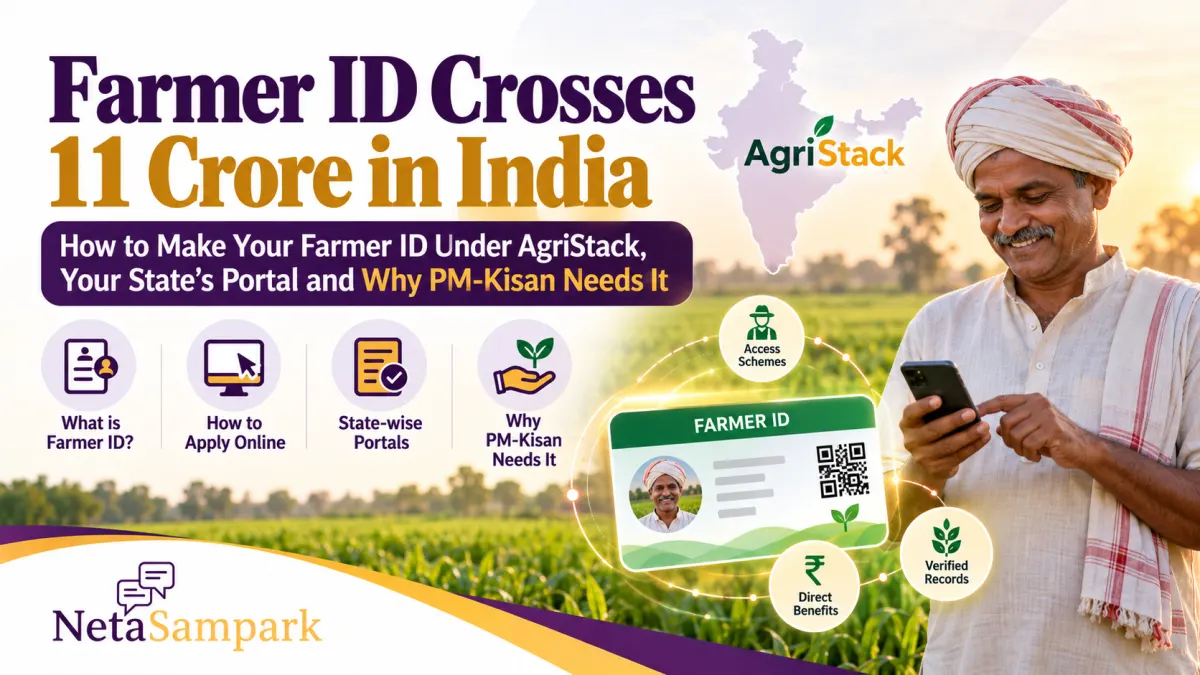
India has created 11 crore Farmer IDs under AgriStack, achieving the national target five months ahead of its March 31, 2027 deadline. The Ministry of Agriculture and Farmers Welfare announced the milestone on October 24, 2026, stating that the target had been reached by the night of October 23. The initiative is designed to connect farmers' identities with verified agricultural records and make access to government services more efficient.
For farmers, the milestone raises practical questions: What is a Farmer ID? How can you register online? Which state portal should you use? Is a Farmer ID compulsory for PM-Kisan? And what should you do if your land records or Aadhaar details do not match?
This guide explains the registration process, documents to keep ready, state-level portals, PM-Kisan requirements and ways to get help if your application is delayed.
Farmer ID registration: Key details at a glance
| Detail | Information |
|---|---|
| National milestone | 11 crore Farmer IDs |
| Announcement date | October 24, 2026 |
| Programme | AgriStack under the Digital Agriculture Mission |
| Implementing authorities | State and Union Territory governments, supported by the Centre |
| Registration method | State Farmer Registry portal, authorised operators or assisted registration |
| Commonly required information | Aadhaar, mobile number and agricultural land details, as applicable |
| PM-Kisan requirement | Mandatory for new registrations in states where the requirement has been implemented; check your state |
| Official starting point | AgriStack |
| PM-Kisan services | pmkisan.gov.in |
The national total does not mean that every farmer has already been registered. Farmers who do not yet have an ID should check their state's registration arrangements and complete the process if required for the services they use.
What is a Farmer ID under AgriStack?
A Farmer ID is a unique digital identity issued through the State Farmers Registry under AgriStack. It is designed to link a farmer's identity with relevant agricultural records, including land information, and help authorised government systems verify eligibility for agricultural schemes and services.
AgriStack is part of the Digital Agriculture Mission, approved by the Union Cabinet in September 2024. Its broader digital infrastructure includes three main components:
- Farmers Registry: creates a unique digital identity for farmers.
- Geo-referenced village maps: provide a spatial reference for village and land-related information.
- Crop Sown Registry: records information about crops cultivated on agricultural plots.
State governments and Union Territory administrations maintain the foundational registries, using common standards to support service delivery across government systems.
A Farmer ID is not the same as an Aadhaar number, a PM-Kisan beneficiary registration number, a bank account number or a state's older agriculture registration number. These records serve different purposes, even when they are linked during verification.
Official reference: AgriStack — Government of India.
Why is the Farmer ID important?
The purpose of the Farmer ID is to reduce repeated verification and make agricultural services easier to access. Depending on the scheme, state rules and system integration, it may support:
1. PM-Kisan registration and verification
The Farmer ID can help connect farmer and land records with PM-Kisan registration. Whether it is compulsory for a new application depends on the state and the stage of implementation.
2. Crop insurance
Verified farmer and land information can help streamline processes connected with the Pradhan Mantri Fasal Bima Yojana (PMFBY), subject to the scheme's rules.
3. Minimum Support Price (MSP) procurement
Farmer Registry integration can support verification for crop procurement and reduce repeated paperwork where the relevant state system uses it.
4. Agricultural credit
Verified records may help simplify certain checks for agricultural loans and Kisan Credit Card services. A Farmer ID does not guarantee loan approval.
5. Input assistance and disaster relief
The registry can support the identification and verification of eligible farmers for certain agricultural inputs, compensation and relief programmes.
Important: Having a Farmer ID does not automatically make someone eligible for every government scheme. Each scheme's eligibility conditions, application requirements and verification rules continue to apply.
How to make your Farmer ID online
The registration interface and exact steps can differ from state to state. Use your state's authorised Farmer Registry portal rather than assuming that one national form works for every farmer.
Step 1: Open the official AgriStack website
Visit agristack.gov.in and look for the Farmer Registry or state registration information. Follow the official route for your state or Union Territory.
Do not rely on sponsored search results, unofficial registration websites or links received through unsolicited messages. If you cannot identify the correct portal, ask your local agriculture office or Common Service Centre (CSC).
Step 2: Select the appropriate registration option
Depending on your state, you may be offered self-registration, assisted registration through a CSC, or registration with the help of authorised agriculture or revenue officials.
Choose the option that matches your circumstances. Farmers without smartphones or reliable internet access can seek assistance through an authorised service centre or local government office.
Step 3: Complete identity verification
The portal may ask you to enter your Aadhaar details and verify your identity using an authorised authentication process, such as an OTP or another supported method.
Use only the official portal or an authorised operator. Never disclose an OTP to an unknown caller, agent or person claiming they can guarantee approval.
Step 4: Provide your agricultural land details
You may need to identify the land associated with your farming activity. Depending on the state, this may involve a survey number, plot number, khasra number, khata or khatauni, Record of Rights (RoR), RTC or another state-specific land record.
If your family owns or cultivates land in more than one village, make sure you follow the portal's instructions for linking the relevant plots. Do not assume that entering one parcel automatically verifies every other parcel.
Step 5: Review the information before submission
Check that your name, identity details, land particulars and other requested information match the relevant records as closely as possible.
If you find an error in the underlying land record, you may need to approach the revenue department before the Farmer Registry can be completed. The Farmer ID registration process itself does not change legal ownership of land.
Step 6: Submit and track your application
Complete the required consent and declarations, submit the application, and save the acknowledgement or application reference if one is generated.
If the portal issues your Farmer ID immediately, save it securely. If the application remains pending, use the official status-check or grievance facility, where available, or contact the relevant state office.
Documents and details to keep ready
The precise requirements vary by state and farmer category. Before visiting a CSC or beginning online registration, keep these details available where applicable:
- Aadhaar card or the identity information required by the official portal.
- A mobile number that can receive verification messages, if OTP verification is used.
- Land records, such as the RTC, RoR, khasra, khatauni, survey or plot details relevant to your state.
- Existing agriculture registration details, if requested.
- Bank or scheme-related information if the official application specifically requires it.
- Supporting documents requested for a particular case, such as inheritance, tenancy or other cultivation-related records.
Do not upload every document you possess unless the official process asks for it. Requirements can differ, particularly for tenant farmers, sharecroppers, joint landholders and people whose land records are incomplete.
State-wise Farmer ID portals: Where should you register?
Farmer Registry implementation is managed at the state and Union Territory level. The portal name, login method, land-record terminology and assisted-registration arrangements can therefore differ.
Start with the official AgriStack website and follow its state-specific guidance. If you cannot locate the appropriate portal, contact your state's agriculture department or visit an authorised CSC.
Some states also use established state agricultural platforms for related farmer services. For example:
| State | Where to start |
|---|---|
| Karnataka | FRUITS Karnataka and the official state agriculture/revenue authorities |
| Maharashtra | MahaDBT Farmer and the state's Farmer Registry arrangements |
| Uttar Pradesh | Start from AgriStack and follow the current Uttar Pradesh Farmer Registry link |
| Madhya Pradesh | Start from AgriStack and follow the current Madhya Pradesh Farmer Registry link |
| Other states and Union Territories | Use the official AgriStack route or your local agriculture department/CSC |
Please note: A state's older agriculture, subsidy or farmer-services portal is not necessarily the same as its AgriStack Farmer Registry. Before submitting information, confirm that the destination is the current official registration service. Portal addresses and workflows may change as implementation expands.
Is Farmer ID compulsory for PM-Kisan?
This is one of the most important questions for farmers.
The Government of India has stated that the Farmer ID requirement for new PM-Kisan registrations is being implemented in states where the Farmer Registry has commenced. An official parliamentary response in August 2025 said it was mandatory for new PM-Kisan registrations in 14 states at that time. Later government information reported the requirement in 19 states where registry work had begun, while new registrations could continue without Farmer ID in states where the registry had not yet started.
This means the requirement is not safe to describe as a single nationwide rule that applies identically to every farmer in every state. The applicable process can change as states implement the registry.
What should PM-Kisan applicants do?
- Visit the official PM-Kisan portal.
- Check the current new-registration process and instructions for your state.
- If the application requests a Farmer ID, complete registration through the official state Farmer Registry route.
- If your Farmer ID application is pending or your records do not match, seek help through the relevant state agriculture office or authorised CSC.
- Complete any other PM-Kisan requirements, including e-KYC where applicable.
An existing PM-Kisan beneficiary should not assume that their instalments will automatically stop merely because they have not yet seen a Farmer ID. Check the current instructions applicable to your state and beneficiary status, and resolve any specific notice or pending requirement through official channels.
Farmer ID registration also does not replace PM-Kisan eligibility rules, bank-account requirements, Aadhaar-related verification or e-KYC.
Official references:
Can tenant farmers and sharecroppers get a Farmer ID?
The national programme is not intended to be limited to a single category of landowner in every circumstance. The government has stated that the registry application can accommodate cultivators such as tenants and sharecroppers, while states are taking steps under their applicable rules to bring actual cultivators onto the platform.
However, the documents, verification process and eligibility conditions can differ depending on state rules and the farmer's circumstances.
If you cultivate land but are not listed as its owner in the revenue records:
- Contact your local agriculture or revenue office before applying.
- Ask which registration route applies to tenant farmers or sharecroppers in your state.
- Keep any cultivation, tenancy or supporting documents required by the official process.
- Do not enter another person's land details as your own or make an unsupported ownership declaration.
The Farmer Registry is a digital identification and service-delivery system. Registration does not itself confer ownership of land or settle a land dispute.
What if your Farmer ID application is rejected or delayed?
Common issues can include mismatches in a farmer's name, Aadhaar-related details, mobile verification, land records or the mapping of a plot to the relevant village or revenue record.
Try these steps:
Name or identity mismatch: Check the spelling and other particulars in the underlying documents. Follow the official correction procedure for whichever record contains the error.
Land record not found: Confirm the survey, plot, khasra, khatauni, RTC or other state-specific details. If the land record itself is incorrect or missing, approach the revenue department.
Joint ownership or inherited land: Ask the local revenue or agriculture office how the portal handles joint holders, mutations and inherited parcels. Do not assume that one family member's record automatically covers everyone.
Application pending: Save your acknowledgement number and use the portal's official status or grievance facility, if available. If there is no online resolution, contact the local agriculture office or authorised CSC.
No smartphone or internet access: Ask about assisted registration through a Common Service Centre, agriculture office or an authorised field-level official.
Avoid paying an unofficial agent who promises guaranteed approval or immediate release of government benefits.
How to check your PM-Kisan status after Farmer ID registration
Once you have completed the required registration, visit pmkisan.gov.in and use the available beneficiary-status or registration services.
Check the details shown for your application or beneficiary record. If a payment or registration issue remains, follow the portal's instructions and contact the designated state or district authority.
Keep in mind that a successful Farmer ID application does not, by itself, establish that your PM-Kisan application has been approved or that a pending instalment will be released. Scheme eligibility, verification and payment processing remain separate steps.
Protect yourself from Farmer ID registration scams
As digital agricultural services expand, farmers should be careful about fake portals, calls and messages.
- Use government websites reached through official department links.
- Never share Aadhaar OTPs or account passwords with unknown people.
- Do not trust messages promising guaranteed PM-Kisan payments in exchange for a fee.
- Ask for a receipt when paying an authorised service charge, if one applies.
- Keep your application acknowledgement and Farmer ID in a safe place.
- Review consent screens before authorising the use or sharing of your information.
If a website claims to be an official Farmer Registry but its identity cannot be verified, stop and confirm the link with your state agriculture department or CSC.
Frequently asked questions (FAQs)
1. Has India created 11 crore Farmer IDs?
Yes. The Ministry of Agriculture and Farmers Welfare announced on October 24, 2026, that the target of 11 crore Farmer IDs had been achieved five months ahead of the March 31, 2027 deadline.
2. Is Farmer ID registration free?
Do not assume that every assisted service has identical charges. Check the official state portal and ask an authorised CSC or government office about any applicable service charge before proceeding. Be cautious of unofficial fees or promises of guaranteed approval.
3. Can I make my Farmer ID using my mobile phone?
Many states support self-registration or online registration, but the exact process varies. You may need Aadhaar-based verification and details from your state's land records. Assisted registration may be available if you cannot complete the process online.
4. Is Farmer ID mandatory for all PM-Kisan beneficiaries?
The requirement has been introduced for new PM-Kisan registrations in states where the Farmer Registry has commenced. Check the current rules for your state and beneficiary situation rather than assuming that the same requirement applies everywhere.
5. Does Farmer ID guarantee PM-Kisan instalments?
No. Farmer ID helps with identification and verification, but PM-Kisan eligibility, e-KYC, bank details and other applicable conditions still matter.
6. Can a tenant farmer or sharecropper register?
The national registry framework provides for onboarding cultivators such as tenants and sharecroppers, subject to the applicable state process. Contact your state agriculture or revenue office to confirm the route and supporting documents.
7. What if my land record is incorrect?
Contact the appropriate revenue authority to correct the underlying record, then follow the Farmer Registry's procedure to update or retry your application. A Farmer ID application does not itself change land ownership.
8. Where can I find my state's official Farmer ID portal?
Begin at agristack.gov.in and follow the current state-specific registration guidance. You can also seek assistance from your local agriculture department or authorised CSC.
Final takeaway
The creation of 11 crore Farmer IDs is a significant milestone in India's move towards a more connected digital agriculture system. For individual farmers, the practical next step is to check their own state's Farmer Registry process, verify that their identity and land details are accurate, and understand whether their PM-Kisan application requires a Farmer ID.
Use official government portals, ask for assistance when records do not match, and remember that Farmer ID registration is not a guarantee of eligibility for every agricultural scheme.
Official resources
- AgriStack — Government of India
- PM-Kisan Samman Nidhi
- Press Information Bureau — 11 crore Farmer IDs milestone, October 24, 2026
- PIB — Farmer ID and PM-Kisan registration requirements
Disclaimer: This article is for general informational purposes and is not a substitute for current instructions issued by the Government of India or the relevant state or Union Territory. Registration steps, document requirements and PM-Kisan implementation may change. Always confirm the current process through official channels.