
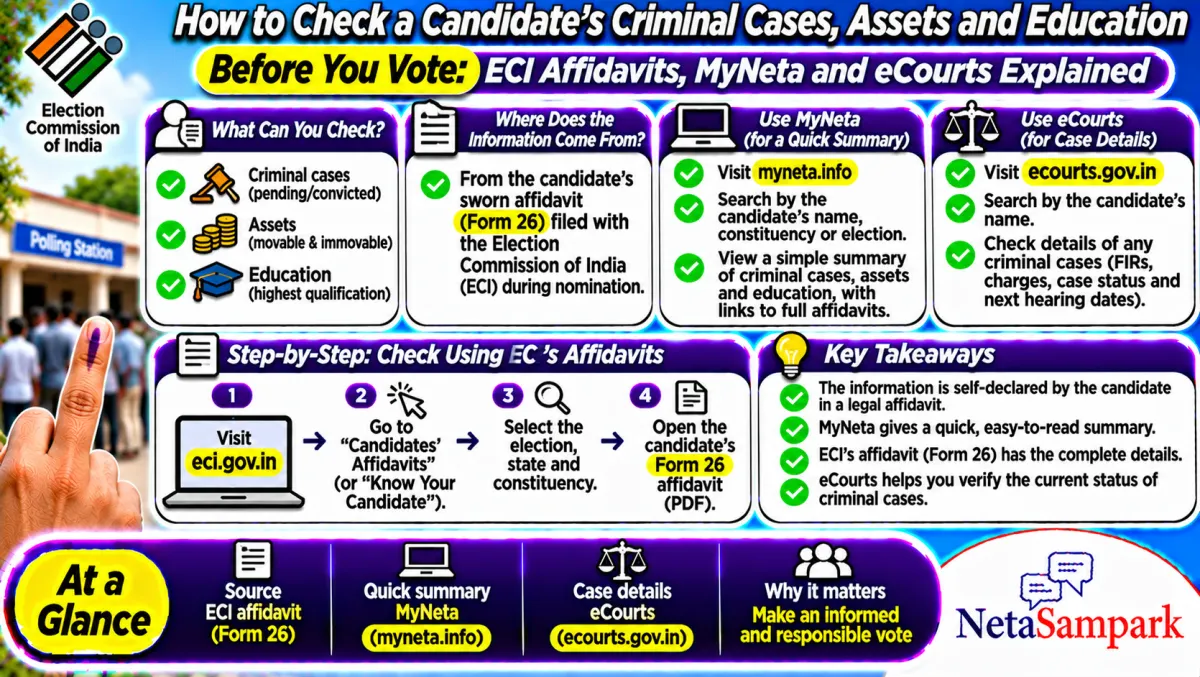
You can check any candidate's criminal cases, assets, debts and education from the sworn affidavit (Form 26) they file with their nomination. Read it free on the Election Commission's affidavit portal, affidavit.eci.gov.in, or the KYC app, cross-check on MyNeta, and confirm case status on eCourts.
Updated 21 November 2026
Before you hire a driver or rent out a flat, you ask around. You check references. But when it comes to the person who'll run your constituency for five years, most of us go by posters, caste equations or what someone said on WhatsApp.
You don't have to. Every candidate in a Lok Sabha or Assembly election has to file a sworn affidavit listing their pending criminal cases, convictions, assets, liabilities and education. It's public, it's free and it takes about five minutes to read once you know where to look. This guide shows you exactly how, and how to read the affidavit without getting confused by legal terms.
Quick facts
| Item | Details |
|---|---|
| Official portal | ECI Candidate Affidavit portal (affidavit.eci.gov.in) and the ECI's Know Your Candidate (KYC) app |
| Helpline | 1950 (Voter Helpline) |
| Fee | None. Viewing affidavits is free |
| Deadline | Affidavits go up after nominations are filed. Check before polling day |
| Documents | None needed. Just the candidate's name or your constituency |
| Form | Form 26 affidavit under the Conduct of Election Rules, 1961 |
| Other tools | MyNeta by ADR (non-official, easy to read) and eCourts for case status |
| False affidavit | An offence under Section 125A of the Representation of the People Act, 1951 |
Why do candidates have to disclose all this?
It started with two Supreme Court judgments. In Union of India v. Association for Democratic Reforms (2 May 2002) and PUCL v. Union of India (13 March 2003), the court held that voters have a right to know about the people they vote for, as part of free speech under Article 19(1)(a). After that, candidates had to disclose criminal antecedents, assets, liabilities and educational qualifications.
These days it's done through Form 26, a sworn affidavit filed with the nomination paper. It covers:
• Pending criminal cases, with case numbers, sections, court and stage
• Convictions, if any
• Movable and immovable assets of the candidate, spouse and dependants
• Liabilities, including loans and government dues
• Educational qualification
• Income shown in income tax returns for recent years
Later rulings went further. In Public Interest Foundation v. Union of India (25 September 2018), the Supreme Court said candidates must publicise their criminal cases in newspapers and on TV at least three times after filing nominations. And in its February 2020 order in Rambabu Singh Thakur v. Sunil Arora, the court told political parties to publish why they picked candidates with pending cases. A 2021 order fixed that parties must do it within 48 hours of selecting the candidate.
How to check a candidate's affidavit on affidavit.eci.gov.in
This is the official source. Everything else copies from here.
1. Open the portal. Go to affidavit.eci.gov.in.
2. Pick the election. The home page lists elections, for example a general election or a by-election with its month and year.
3. Filter by state and constituency. Choose the election type (Assembly or Parliamentary), your state, the phase if there is one, and your constituency.
4. See the candidate list. It shows each candidate, their party, and status: accepted, rejected, withdrawn or contesting.
5. Click "View more". Open the candidate's page and download the affidavit PDF.
6. Read the key parts. Jump to the criminal cases section first, then assets and liabilities, then education.
You can also use the ECI's Know Your Candidate (KYC) app on your phone. Search by candidate name and it shows whether they have criminal antecedents, with the affidavit linked.
For local body polls like panchayat and municipal elections, the State Election Commission handles affidavits, not the ECI. We showed how this works in our guide to reading AP municipal candidates' affidavits.
How to use MyNeta to compare candidates quickly
MyNeta is run by the Association for Democratic Reforms (ADR) and National Election Watch. It isn't a government site. It takes data from the same affidavits and puts it in neat tables.
What makes it handy:
• Side-by-side comparison of all candidates in a constituency
• Total assets and liabilities shown as one number
• Count of criminal cases and whether any are "serious" by ADR's definition
• Asset growth for candidates who contested before
The catch: it's a second-hand copy. Typing mistakes can happen, and some affidavits get updated after scrutiny. If you're going to share something about a candidate, always open the original affidavit on the ECI portal first.
How do you read the criminal cases section without getting confused?
This is where most people misread things. A pending case is not a conviction. Here's what to look for.
Pending cases. These are cases where an FIR is registered or a court has taken cognizance, but there's no final verdict. The affidavit lists the FIR or case number, police station, sections of law, and the court. Many politicians have cases from protests or agitations. Others have cases for serious crimes. The sections tell you which is which.
Charges framed. If the affidavit says charges have been framed, a court has found enough material to put the person on trial. That's more serious than a bare FIR.
Convictions. If there's a conviction, read the sentence. Under Section 8 of the Representation of the People Act, 1951, a person convicted of certain offences, or sentenced to two years or more for most others, is disqualified. After the Supreme Court's Lily Thomas judgment of 10 July 2013, sitting MPs and MLAs lose their seat from the date of such conviction.
How to check where a case stands now. Take the case number and court from the affidavit and search on eCourts services. It shows hearing dates and status. An affidavit is a snapshot from nomination day. eCourts tells you what has happened since.
How do you read the assets and liabilities part?
A few simple checks:
• Compare with last time. If the candidate contested five years ago, compare totals. Big jumps aren't illegal by themselves, but they're worth asking about.
• Look at the spouse's assets. Many candidates show modest assets themselves and larger ones in the spouse's name.
• Check liabilities. Loans, unpaid government dues, electricity or water dues are all listed.
• Look at income in tax returns. Compare declared income with the size of assets.
What if you find something false in an affidavit?
Filing a false affidavit or hiding information is an offence under Section 125A of the Representation of the People Act, 1951. Any voter can complain. On 16 October 2026 the Supreme Court made this clearer. Our guide on how any voter can file a Section 125A false affidavit complaint explains the steps.
Keep it factual. Download the affidavit, mark the exact line, and attach proof like a court record or property document. Don't forward unverified claims. That can land you in trouble.
A quick checklist before you vote
☐ Find all candidates in your constituency on affidavit.eci.gov.in
☐ Open each affidavit and read the criminal cases section
☐ Note whether charges are framed or there's a conviction
☐ Check current case status on eCourts
☐ Compare assets and liabilities, including the spouse's
☐ Check education and income declared
☐ Look up their past record if they've held office before
Frequently asked questions
Where can I see a candidate's affidavit for free?
On the Election Commission's portal, affidavit.eci.gov.in, or the ECI's Know Your Candidate (KYC) app. Both are free and don't need a login.
Is MyNeta an official government website?
No. MyNeta is run by the Association for Democratic Reforms. It uses data from the candidates' own affidavits. Always confirm with the original affidavit on the ECI portal.
Does a pending criminal case stop someone from contesting?
No. Only certain convictions lead to disqualification under Section 8 of the Representation of the People Act, 1951. A pending case doesn't bar a person from contesting.
How do I check if a case against a politician is still going on?
Note the case number and court from the affidavit and search on services.ecourts.gov.in. It shows the case status and hearing dates.
What can I do if a candidate lied in their affidavit?
You can file a complaint under Section 125A of the Representation of the People Act, 1951. False information in the affidavit is punishable with jail up to six months, a fine or both.
Final reminder
Pick one election coming up near you and look up every candidate's affidavit before polling day. It takes five minutes per candidate. Then see how your sitting MP or MLA is doing on Know Your Neta at NetaSampark, and share what you learn with your family. You can also read how to rate your neta's performance once they're in office.
Sources
• ECI Candidate Affidavit portal
• Election Commission of India
• Representation of the People Act, 1951 on India Code
• MyNeta by Association for Democratic Reforms (non-government)