
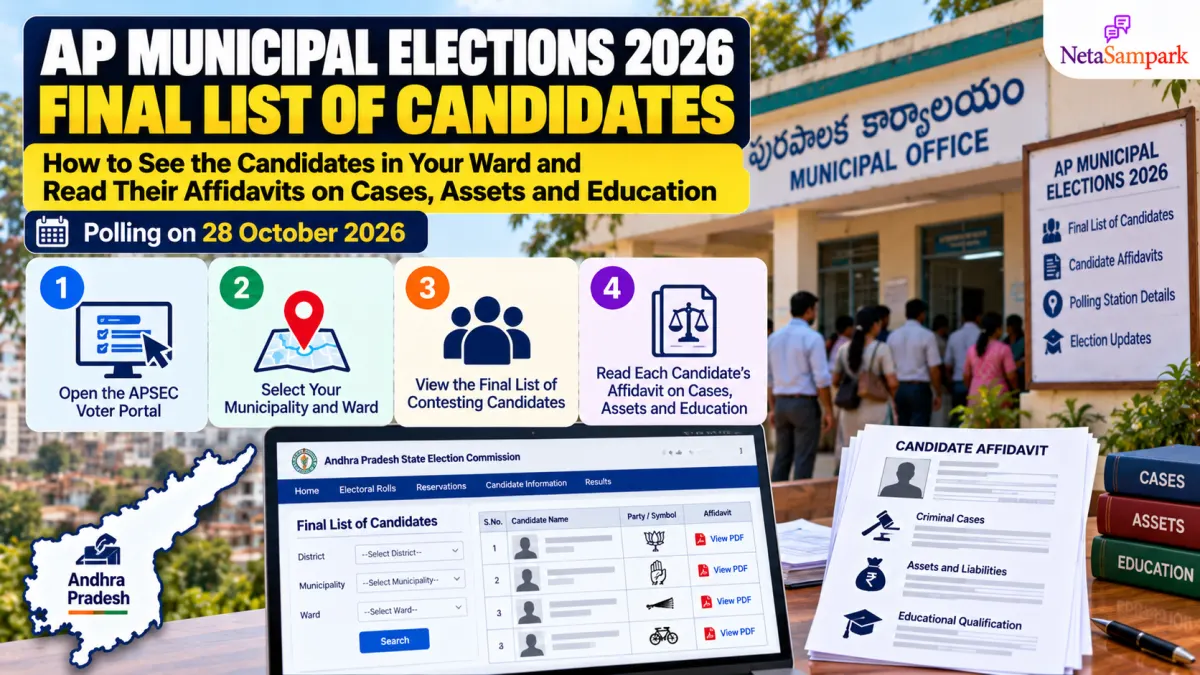
Updated 23 October 2026: The AP State Election Commission rescheduled the urban local body (municipal) elections on 22 October 2026, after a Supreme Court order of 21 October 2026. Polling is now on 1 November 2026 (7 AM–5 PM) and counting on 3 November 2026 (from 8 AM). Fresh nominations are open on 23 and 24 October 2026 in listed wards of Kadapa, Tirupati, Rajampet and Mydukur, and the final candidate list comes after 3 PM on 25 October 2026.
Andhra Pradesh’s municipal elections are now scheduled for 1 November 2026 (rescheduled from 28 October 2026) across 100 urban local bodies. Before polling, voters can check who is contesting their ward, compare candidates’ declared assets and liabilities, review criminal-case disclosures and read their educational qualifications.
However, there is an important development: the Supreme Court has directed the Andhra Pradesh State Election Commission (APSEC) to defer publication of the final candidate list while complaints about nomination filing are examined. The list was originally scheduled for 21 October 2026. Under the revised APSEC schedule of 22 October 2026, the final list for all 100 urban local bodies comes after 3 PM on 25 October 2026. The election authorities’ latest instructions should therefore be checked before relying on an earlier candidate list or schedule.
Official starting point: APSEC Voter Portal.
1 Where to find the final candidate list
Use the official Andhra Pradesh State Election Commission website:
The portal includes the following election services:
- Know Your Contesting Candidates
- Search Your Name in the Electoral Roll
- Know Your Polling Station
- Download Your Voter Slip
- Election Notifications and Results
To find candidates for your ward:
- Open the APSEC Voter Portal.
- Select Know Your Contesting Candidates.
- Choose the relevant election category, district and urban local body where those options are available.
- Select your municipality or municipal corporation and ward.
- Review the candidate names and party or election-symbol information displayed.
- Check whether the list is marked provisional, final or updated following a revised notification.
If the final list is not yet available, return to the portal after APSEC issues its next notice. Do not assume that a candidate appearing in an earlier nomination list is necessarily a final contesting candidate.
2 Why has publication of the final list been delayed?
The original election schedule provided for publication of the final list of contesting candidates on 21 October 2026.
On 21 October, the Supreme Court directed APSEC to defer publication while the commission considered complaints alleging that some candidates had been prevented from filing nominations. The court asked the commission to examine the representations and supporting material and decide whether additional time for nominations was warranted in affected areas.
The court also directed the state authorities to provide appropriate security for candidates and election offices. The matter was scheduled for further consideration on 27 October 2026.
These are allegations under examination, not findings that every disputed nomination was obstructed. The immediate practical consequence for voters is that the final candidate list and any revised election instructions must be confirmed through APSEC.
For updates, follow the official APSEC website and its Voter Portal.
Background reporting: The Tribune — Supreme Court directs deferment of final candidate list.
3 How to read a candidate’s affidavit
Candidates contesting municipal elections are required under the applicable election rules to submit disclosures covering criminal antecedents, assets and liabilities, and educational qualifications.
These declarations help voters understand what candidates have disclosed. They are not, by themselves, independent verification of every statement.
When the affidavit is available, review the following sections.
| Affidavit section | What to look for |
|---|---|
| Criminal antecedents | Cases declared by the candidate, relevant offences and the status of proceedings |
| Assets | Declared movable and immovable assets of the candidate and the family members covered by the prescribed form |
| Liabilities | Declared loans, outstanding liabilities and other amounts required to be disclosed |
| Educational qualifications | Qualifications and educational details declared by the candidate |
| Personal and election details | Candidate name, constituency and other identifying information |
Read the complete affidavit rather than relying on a short social media summary. Check the candidate’s name, ward and election before attributing a declaration to a particular person.
4 Where can you obtain the affidavits?
Start with the APSEC candidate-information facility and look for the affidavit or nomination-document link associated with the candidate.
If the online record is missing or the document does not open:
- Contact the Returning Officer responsible for your municipal ward or local body.
- Ask where the candidate’s filed affidavit can be inspected or obtained.
- Confirm that the document belongs to the correct candidate and election.
- Check whether a revised nomination record or corrected document has been issued.
The Election Commission of India’s Candidate Affidavit Portal provides affidavit information for elections handled through the ECI system. For Andhra Pradesh municipal elections, use APSEC or the relevant Returning Officer as the primary source unless APSEC specifically directs voters to another facility.
The governing municipal election rules also provide for affidavits concerning criminal antecedents, assets, liabilities and educational qualifications. See the Andhra Pradesh Municipal Corporations Election of Mayor and Members Rules, 2026.
5 How to check criminal-case disclosures responsibly
A candidate’s affidavit may disclose criminal cases, but the existence of a case does not automatically mean that the person has been convicted.
When reviewing this section:
- Read the offence and case details exactly as declared.
- Check the procedural status, where provided.
- Distinguish pending cases from convictions.
- Do not treat an allegation as proof of guilt.
- Compare the affidavit with official court records if an important detail needs verification.
If a candidate declares no criminal cases, that is a declaration in the submitted document, not an independent guarantee that no case exists. If a discrepancy appears, seek clarification from the relevant election authority or consult the appropriate court record.
The Election Commission of India’s Know Your Candidate information explains how candidate criminal-antecedent information can help voters examine disclosures where the service applies.
6 How to compare assets and liabilities
Assets may include property, vehicles, investments, bank deposits and other items covered by the prescribed affidavit form. Liabilities may include loans and other declared financial obligations.
A useful comparison should look at more than the headline value of a candidate’s assets.
- Movable assets: Check the categories and values disclosed.
- Immovable assets: Review declared land, buildings and other property.
- Liabilities: Compare declared loans and outstanding obligations.
- Family disclosures: Check which family members are covered by the form.
- Previous declarations: If a comparable earlier affidavit is available, review changes carefully and account for differences in reporting periods and categories.
Higher declared assets do not establish wrongdoing, and lower assets do not automatically establish better public service. The purpose is to understand the disclosures and ask informed questions.
7 What should voters know about education details?
The educational section records the qualifications declared by the candidate in the prescribed format.
Check the exact qualification, institution or other particulars stated in the document. Do not infer a candidate’s eligibility or competence solely from a short description of their education.
If a material discrepancy appears, ask the election authority about the procedure for raising it and consult the relevant records where available.
8 Election dates: what to check before 1 November 2026
The original schedule for the urban local-body elections included the following dates. Because the final candidate list has been delayed by the court’s directions, voters should confirm whether APSEC has subsequently revised any stage.
| Election activity | Original scheduled date |
|---|---|
| Election notification | 14 October 2026 |
| Nomination filing | 16–18 October 2026 |
| Scrutiny of nominations | 19 October 2026 |
| Withdrawal deadline and final candidate list | 21 October 2026 |
| Polling | 28 October 2026 (now 1 November 2026) |
| Possible re-poll | 29 October 2026 (now 2 November 2026) |
| Counting and results | 30 October 2026 (now 3 November 2026) |
The final candidate-list date is subject to the Supreme Court’s directions and any subsequent APSEC order. Do not rely on the original 21 October date as confirmation that the final list has already been published.
Check the APSEC website for revised notices before travelling to vote or sharing candidate information.
9 A simple checklist before polling
- Find the official final candidate list for your ward.
- Confirm the candidate’s name and election symbol.
- Read the affidavit rather than relying on a summary.
- Review criminal-case disclosures carefully and distinguish allegations from convictions.
- Compare declared assets and liabilities using the same categories.
- Read the educational qualifications as stated in the document.
- Check the latest APSEC notice for any revised election dates.
- Confirm your polling station and voter-slip details through the official portal.
Frequently asked questions
When will the final AP municipal candidate list be published?
The original publication date was 21 October 2026. Following the Supreme Court’s directions, the revised APSEC schedule of 22 October 2026 puts the final list after 3 PM on 25 October 2026. Check APSEC for the latest official status and any further order.
Can I read a candidate’s affidavit online?
Start with the APSEC Voter Portal and its candidate-information facility. If an affidavit is not available online, contact the relevant Returning Officer to ask how to inspect or obtain it.
What information is included in the affidavit?
The prescribed disclosures cover criminal antecedents, assets, liabilities and educational qualifications.
Does a pending criminal case mean a candidate has been convicted?
No. A pending case and a conviction are different legal statuses. Read the affidavit carefully and verify important details against official records.
Are the 28 October 2026 polling and 30 October 2026 counting dates still confirmed?
No. On 22 October 2026 APSEC revised the schedule: polling is now on 1 November 2026 and counting on 3 November 2026. The Supreme Court hears the case again on 27 October 2026, so check APSEC for any further change.
Final takeaway
Before the Andhra Pradesh municipal elections, check the final candidate list for your ward and read the candidates’ affidavits on criminal cases, assets, liabilities and education. These documents can help you ask better questions and compare what candidates have formally declared.
Because publication of the final list has been delayed by the Supreme Court’s directions, use APSEC’s latest official notice rather than an older candidate list or an unverified social media post.
Start here: APSEC Voter Portal.