
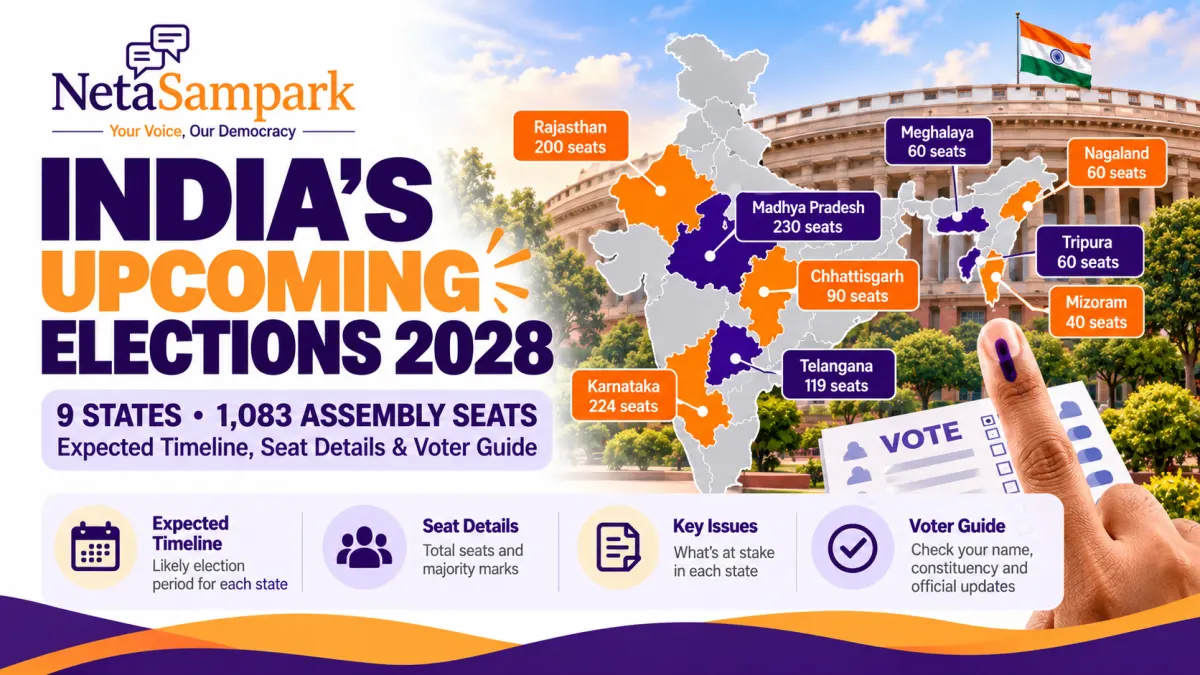
Upcoming Elections in India 2028: Complete State-Wise List, Expected Dates and Assembly Seats
India's 2028 election calendar is expected to feature Legislative Assembly elections in nine states: Tripura, Meghalaya, Nagaland, Karnataka, Mizoram, Chhattisgarh, Madhya Pradesh, Rajasthan and Telangana.
These elections will determine the composition of the next state governments and the representatives elected to their Legislative Assemblies. From the northeastern states voting early in the year to the larger electoral contests expected later in 2028, these elections will be important milestones in India's democratic calendar.
Together, the nine states have 1,083 Legislative Assembly seats. The exact polling dates, nomination deadlines, voting phases and counting dates will be announced by the Election Commission of India (ECI).
Official source: Election Commission of India
Upcoming Elections in India 2028: Quick Overview
The following table summarises the nine state Assembly elections expected in 2028. The election periods are indicative estimates based on the current terms of the Legislative Assemblies, not confirmed polling dates.
| State | Assembly seats | Expected election period | Current governing party |
|---|---|---|---|
| Tripura | 60 | February–March 2028 | BJP |
| Meghalaya | 60 | February–March 2028 | National People's Party (NPP)-led government |
| Nagaland | 60 | February–March 2028 | Nationalist Democratic Progressive Party (NDPP)-led government |
| Karnataka | 224 | April–May 2028 | Indian National Congress (INC) |
| Mizoram | 40 | November–December 2028 | Zoram People's Movement (ZPM) |
| Chhattisgarh | 90 | November–December 2028 | BJP |
| Madhya Pradesh | 230 | November–December 2028 | BJP |
| Rajasthan | 200 | November–December 2028 | BJP |
| Telangana | 119 | November–December 2028 | INC |
| Total | 1,083 | Throughout 2028 | — |
Governing-party information reflects the position reported as of October 2026. Political arrangements may change before the next elections. The ECI's official announcements will determine the final schedule.
1 Tripura Assembly Election 2028
Total seats: 60
Tripura is expected to hold its next Legislative Assembly election in early 2028. The northeastern state has a 60-member Assembly, and the BJP formed the government following the 2023 election.
Key details
- Assembly seats: 60
- Majority mark: 31 seats, assuming all 60 seats are filled
- Expected election period: February–March 2028
- Current governing party: BJP
- Official election information: Election Commission of India
Issues voters may consider
Important public-policy issues include employment, education, healthcare, rural development, connectivity, agriculture and infrastructure.
Tripura's ethnic diversity and the concerns of Indigenous communities are also important elements of public discussion. Voters may examine policies relating to community representation, development and the administration of local areas.
How to prepare
Citizens should check their electoral registration, identify their Assembly constituency and follow official announcements concerning the election schedule and candidate nominations.
2 Meghalaya Assembly Election 2028
Total seats: 60
Meghalaya is expected to hold its next Assembly election in early 2028. Its 60-member Legislative Assembly is responsible for state-level legislation and oversight of the government.
Key details
- Assembly seats: 60
- Majority mark: 31 seats, assuming all seats are filled
- Expected election period: February–March 2028
- Current governing arrangement: NPP-led government
- Official election information: Election Commission of India
Issues voters may consider
Public discussions may include employment, tourism, roads, healthcare, education, rural development, mining regulation and environmental protection.
Meghalaya's diverse communities and local governance arrangements mean that priorities can vary considerably across constituencies.
What voters should check
Compare candidates' declared information, local development proposals and records in public office. Use official election resources to confirm voter registration and polling arrangements when they become available.
3 Nagaland Assembly Election 2028
Total seats: 60
Nagaland's next Assembly election is expected in early 2028. The state has a 60-member Legislative Assembly and a political landscape shaped by regional parties, coalition arrangements and discussions about peace and development.
Key details
- Assembly seats: 60
- Majority mark: 31 seats, assuming all seats are filled
- Expected election period: February–March 2028
- Current governing arrangement: NDPP-led government
- Official election information: Election Commission of India
Issues voters may consider
Issues relevant to voters include employment, road connectivity, education, healthcare, rural infrastructure, economic opportunities and the implementation of peace-related arrangements.
Public priorities may differ across districts and communities. Candidates' constituency-level commitments can help voters understand what each contest involves.
How to follow the election
Monitor announcements from the ECI and the Chief Electoral Officer of Nagaland. Check the official electoral roll and review candidate information when nominations open.
4 Karnataka Assembly Election 2028
Total seats: 224
Karnataka is expected to hold its next Legislative Assembly election in 2028. The state last voted in May 2023, when the Indian National Congress formed the government.
Karnataka's election will be closely followed because of the state's large population, technology and manufacturing sectors, agricultural economy and regional differences in development priorities.
Key details
- Assembly seats: 224
- Majority mark: 113 seats, assuming all seats are filled
- Expected election period: April–May 2028
- Current governing party: Indian National Congress
- Official election information: Election Commission of India
Issues voters may consider
Public-policy discussions may focus on:
- Employment and economic growth
- Bengaluru's traffic, public transport and infrastructure
- Drinking water and urban planning
- Agriculture and rural incomes
- Education and healthcare
- Welfare schemes and their implementation
- Regional development across Karnataka
- Environmental protection and resource management
The priorities of voters in Bengaluru may differ from those in northern Karnataka, coastal districts, Malnad and agricultural regions.
What citizens should do
Voters should check their electoral registration, identify their Assembly constituency and review the records and proposals of candidates standing in their area.
For Bengaluru residents, it can be useful to distinguish between issues handled by the state government, municipal authorities and other agencies when evaluating public commitments.
5 Mizoram Assembly Election 2028
Total seats: 40
Mizoram is expected to hold its next Assembly election towards the end of 2028. The state has a 40-member Legislative Assembly, and the Zoram People's Movement formed the government after the 2023 election.
Key details
- Assembly seats: 40
- Majority mark: 21 seats, assuming all seats are filled
- Expected election period: November–December 2028
- Current governing party: Zoram People's Movement (ZPM)
- Official election information: Election Commission of India
Issues voters may consider
Issues that may feature in the election include employment, road connectivity, public finances, healthcare, education, rural development and economic opportunities.
Mizoram's geography and dependence on transport links make connectivity and access to public services important considerations for many communities.
How to prepare
Check the electoral roll, review official announcements and compare candidates' plans for development and public-service delivery.
6 Chhattisgarh Assembly Election 2028
Total seats: 90
Chhattisgarh is expected to hold its next Assembly election towards the end of 2028. The state has a 90-member Legislative Assembly.
Key details
- Assembly seats: 90
- Majority mark: 46 seats, assuming all seats are filled
- Expected election period: November–December 2028
- Current governing party: BJP
- Official election information: Election Commission of India
Issues voters may consider
Important areas of public discussion include agriculture, rural incomes, tribal welfare, forest-based livelihoods, mining, employment, education, healthcare and infrastructure.
Security and public administration in areas affected by Maoist violence may also remain relevant to election discussions, alongside development and access to essential services.
What voters should examine
Citizens can compare the government's performance, the proposals of competing parties and candidates' plans for their constituencies. Local priorities may vary between urban centres, agricultural areas, forest regions and mining districts.
7 Madhya Pradesh Assembly Election 2028
Total seats: 230
Madhya Pradesh is expected to hold its next Assembly election towards the end of 2028. With 230 seats, it will be one of the largest state Assembly elections of the year.
The BJP formed the government after the 2023 Assembly election.
Key details
- Assembly seats: 230
- Majority mark: 116 seats, assuming all seats are filled
- Expected election period: November–December 2028
- Current governing party: BJP
- Official election information: Election Commission of India
Issues voters may consider
Key public-policy topics include agriculture, irrigation, employment, education, healthcare, rural infrastructure, women's welfare, tribal development and urban services.
The state's diverse agricultural and regional economies mean that the issues affecting voters in one district may differ from those in another.
How to follow the election
Citizens should verify their voter registration, follow official announcements and review candidate affidavits and public commitments once the nomination process begins.
8 Rajasthan Assembly Election 2028
Total seats: 200
Rajasthan is expected to hold its next Assembly election towards the end of 2028. The state has a 200-member Legislative Assembly, and the BJP formed the government following the 2023 election.
Key details
- Assembly seats: 200
- Majority mark: 101 seats, assuming all seats are filled
- Expected election period: November–December 2028
- Current governing party: BJP
- Official election information: Election Commission of India
Issues voters may consider
Important topics include water availability, agriculture, employment, tourism, education, healthcare, roads, electricity and rural development.
Water management is particularly relevant given Rajasthan's climate and geographic conditions. Priorities can vary between urban areas, desert districts, agricultural regions and tourism centres.
What citizens should do
Review the delivery of public services in your area, compare candidates' proposals and verify your electoral details through official sources.
9 Telangana Assembly Election 2028
Total seats: 119
Telangana is expected to hold its next Assembly election towards the end of 2028. The state has a 119-member Legislative Assembly, and the Indian National Congress formed the government after the 2023 election.
Key details
- Assembly seats: 119
- Majority mark: 60 seats, assuming all seats are filled
- Expected election period: November–December 2028
- Current governing party: Indian National Congress
- Official election information: Election Commission of India
Issues voters may consider
Public discussions may focus on agriculture, irrigation, employment, education, healthcare, urban development, welfare programmes and state finances.
In Hyderabad and other urban centres, transport, housing, infrastructure and employment may be prominent concerns. Rural constituencies may place greater emphasis on agriculture, irrigation, water supply and access to public services.
How to prepare
Check your electoral registration, identify your constituency and follow official announcements about the election schedule, candidates and polling arrangements.
2028 Election Timeline: Which States Vote First?
The following is an indicative timeline based on expected Assembly terms. The actual schedule may differ when announced by the ECI.
| Expected period | States |
|---|---|
| February–March 2028 | Tripura, Meghalaya and Nagaland |
| April–May 2028 | Karnataka |
| November–December 2028 | Mizoram, Chhattisgarh, Madhya Pradesh, Rajasthan and Telangana |
The ECI determines polling dates after considering administrative readiness, security arrangements, weather, logistical requirements and other relevant factors.
Important: These are estimates, not official polling dates. Check the Election Commission of India for formal notifications and changes.
Are Lok Sabha Elections Also Scheduled for 2028?
No regular general election to the Lok Sabha is due in 2028 under the ordinary five-year electoral cycle. The next general election is expected in 2029, unless an extraordinary constitutional or political development changes the timetable.
The elections discussed in this guide are State Legislative Assembly elections. They determine representation in state legislatures and the formation of state governments.
| Feature | Assembly election | Lok Sabha election |
|---|---|---|
| Representatives elected | Members of Legislative Assemblies (MLAs) | Members of Parliament (MPs) in the Lok Sabha |
| Government formed | State government | Union government |
| Main legislative responsibilities | State and concurrent subjects, as provided by the Constitution | Union and concurrent subjects, as provided by the Constitution |
| Usual term | Five years, unless dissolved earlier | Five years, unless dissolved earlier |
State election results can influence national political discussion, but they do not automatically determine the composition of the Union government.
Will There Be Local-Body, Rajya Sabha or By-Elections in 2028?
There may also be local-body elections, Rajya Sabha elections and by-elections during 2028. These have different schedules and electoral processes.
Municipal and Panchayat elections
Municipal corporations, municipalities and Panchayati Raj institutions have their own election cycles. State Election Commissions oversee local-body elections, and the timing depends on the term of the relevant institution and applicable legal requirements.
For local election updates, check the relevant State Election Commission.
Rajya Sabha elections
Rajya Sabha elections take place according to members' terms and the occurrence of vacancies. They follow a different process from direct Assembly elections and are announced separately.
By-elections
By-elections may be required when a seat becomes vacant because of resignation, death, disqualification or another legally recognised reason. Their number and locations cannot be comprehensively predicted in advance.
For confirmed by-election schedules, refer to official ECI announcements.
How to Check Your Voter Registration for the 2028 Elections
If you are eligible to vote in one of the states holding elections, checking your electoral registration well in advance is a useful first step.
Step 1: Visit the official voter services portal
Open the ECI Voters' Services Portal.
Step 2: Search for your name
Use the electoral-roll search facility and provide the information requested to locate your registration.
Step 3: Verify your details
Check your name, constituency and other displayed information. If you have moved or noticed an error, review the official process for updating your registration.
Step 4: Apply for registration or correction if needed
Use the appropriate official service for new registration, correction or change of address. Retain your application reference.
Step 5: Recheck before election day
Review the latest electoral-roll information and polling details closer to the election.
Remember: Having a voter ID card is not a substitute for confirming that your name appears on the electoral roll.
How to Find Your Constituency and Candidates
Once the election schedule is announced, voters can use official resources to identify their constituency, review candidates and find polling information.
- Voter registration and electoral-roll search: voters.eci.gov.in
- Election Commission of India: eci.gov.in
- State Chief Electoral Officers: Follow the relevant state's official CEO website for election notices and voter information.
- Candidate affidavits: Review declarations published through official election resources during nominations.
- Polling station information: Verify your assigned polling station and any relevant instructions before voting.
Avoid relying on unverified candidate lists, unofficial polling dates or misleading campaign messages.
Why the 2028 Elections Matter
The nine state elections will take place across different regions and political environments. They will determine representation in state legislatures and the formation of state governments for the next term, subject to constitutional provisions.
They also give voters an opportunity to evaluate issues that affect everyday life, including:
- Jobs, wages and livelihoods
- Education and healthcare
- Agriculture, irrigation and water supply
- Roads, transport and urban services
- Public safety and law enforcement
- Social welfare programmes
- Environmental protection and disaster preparedness
- Government finances and delivery of public commitments
The importance of these issues varies by state and constituency. Voters can make informed decisions by comparing documented government performance, candidate records and specific policy proposals.
Frequently Asked Questions
1. Which states will have Assembly elections in India in 2028?
Nine states are expected to hold Assembly elections: Tripura, Meghalaya, Nagaland, Karnataka, Mizoram, Chhattisgarh, Madhya Pradesh, Rajasthan and Telangana.
2. How many Assembly seats are involved in the 2028 elections?
The nine states have a combined total of 1,083 Assembly seats: Tripura 60, Meghalaya 60, Nagaland 60, Karnataka 224, Mizoram 40, Chhattisgarh 90, Madhya Pradesh 230, Rajasthan 200 and Telangana 119.
3. When will the 2028 Assembly elections take place?
Tripura, Meghalaya and Nagaland are expected to vote early in the year, followed by Karnataka around April–May. Mizoram, Chhattisgarh, Madhya Pradesh, Rajasthan and Telangana are expected to vote later in 2028. The ECI will announce the official dates.
4. Has the Election Commission announced the final 2028 election schedule?
The periods in this guide are indicative estimates based on expected Assembly terms. Consult the ECI website for official notifications and any revisions.
5. Which state has the largest Assembly election in 2028?
Madhya Pradesh has the largest Assembly among the nine states listed, with 230 seats, followed by Rajasthan with 200 and Karnataka with 224.
6. Will India hold a Lok Sabha election in 2028?
No regular Lok Sabha general election is due in 2028 under the normal five-year cycle. The next general election is expected in 2029, subject to any extraordinary developments.
7. Will Karnataka have an Assembly election in 2028?
Yes. Karnataka's next Assembly election is expected in 2028, with the current Assembly's term scheduled to end in May 2028. The exact polling dates will be announced by the ECI.
8. Can there be local-body elections in addition to Assembly elections?
Yes. Municipal and Panchayat elections follow separate schedules set through the relevant State Election Commission and applicable rules.
9. How can I check my name on the voter list?
Visit the ECI Voters' Services Portal and use the electoral-roll search facility to verify your registration.
10. Where can I find official election results?
Use the Election Commission of India's official website and results portal. Avoid relying on unverified social media posts for final results.
Conclusion
India's 2028 election calendar is expected to feature Assembly elections in nine states, involving a total of 1,083 seats.
Tripura, Meghalaya and Nagaland are expected to vote early in the year, Karnataka around the middle of the year, and Mizoram, Chhattisgarh, Madhya Pradesh, Rajasthan and Telangana later in 2028. These periods are estimates, and the final polling schedule will be announced by the Election Commission of India.
Citizens can prepare by checking their voter registration, learning about their constituency, reviewing candidate information and following official announcements.
For reliable election information, use the Election Commission of India and the relevant State Chief Electoral Officer or State Election Commission.
About NetaSampark
NetaSampark helps citizens understand India's democratic institutions, public services and electoral processes through accessible, practical guides.
Visit NetaSampark for more resources on elections, elected representatives, civic participation and government services.