
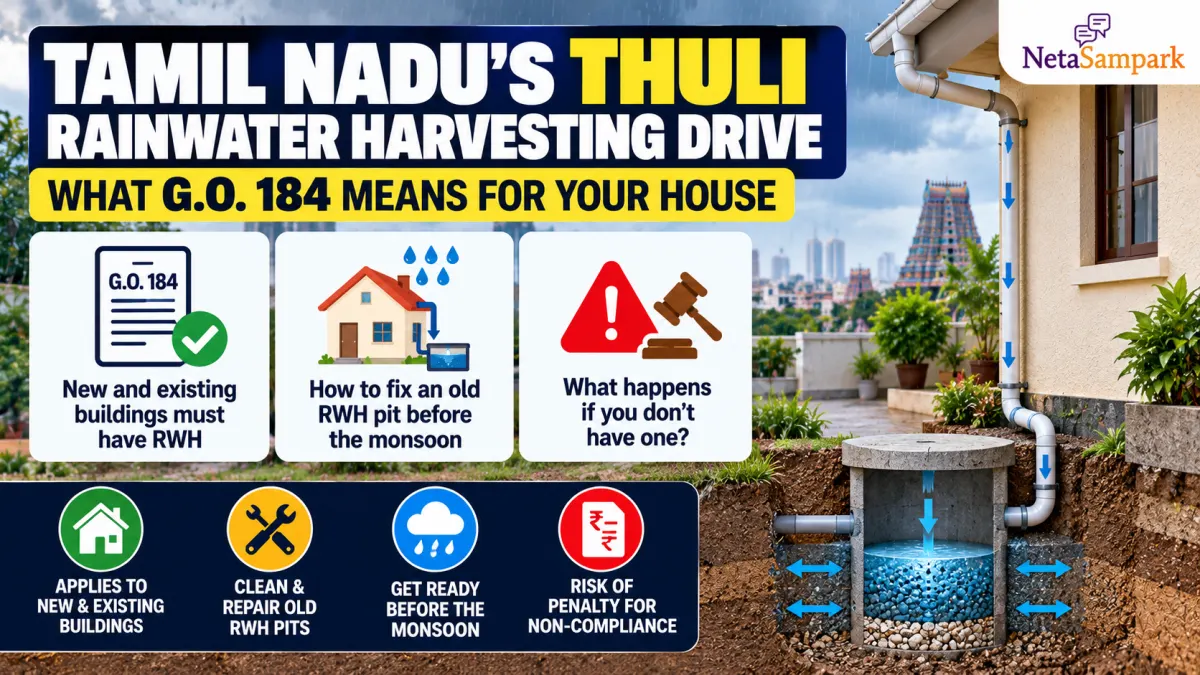
Tamil Nadu’s Thuli Rainwater Harvesting Drive: What G.O. 184 Means for Your House, How to Fix an Old RWH Pit Before the Monsoon, and What Happens If You Don’t Have One
Tamil Nadu is renewing its rainwater harvesting push ahead of the northeast monsoon. Through the new Thuli awareness campaign, the state government is asking local bodies to check existing rainwater harvesting (RWH) systems, restore those that no longer work, and enforce requirements for buildings that do not have them.
The key government order is G.O. (Ms.) No. 184, dated 16 October 2026, issued by the Municipal Administration and Water Supply Department. It calls for a statewide campaign covering government buildings, homes, apartments, commercial premises and public institutions. The emphasis is not just on constructing rainwater harvesting systems, but also on keeping them functional. Read the order and its provisions.
For homeowners, the practical message is straightforward: check your rainwater harvesting system now, repair it if necessary, and do not assume an old pit is working simply because it is still there.
What is Thuli, and why has the government renewed the drive?
Thuli is the state’s renewed rainwater harvesting awareness campaign. It was launched on 21 October 2026 to encourage households, institutions and communities to collect rainwater and support groundwater recharge.
The government order identifies four broad priorities:
- Restore existing rainwater harvesting structures.
- Create new systems where they are required or missing.
- Build public awareness and encourage community participation.
- Strengthen monitoring, reporting and review of implementation.
The pre-monsoon campaign calls for inspections of existing systems, cleaning and desilting of rooftops, channels, filter chambers, recharge pits and recharge wells, and repairs to damaged or non-functional structures wherever technically feasible. Government departments and local bodies have been directed to make the systems under their control functional before the northeast monsoon. The New Indian Express reported on the order and campaign.
This matters because a rainwater harvesting structure can become ineffective when gutters are blocked, filters are clogged, pipes are disconnected or a recharge pit fills with silt.
What does G.O. 184 mean for your house?
The order directs local bodies to enforce existing building regulations relating to rainwater harvesting and actively promote rooftop harvesting in both new and existing buildings where the facility is absent.
| Your situation | What you should do |
|---|---|
| Your house already has an RWH system | Check that the gutters, pipes, filter and recharge structure are clear and functional. |
| Your old RWH pit is blocked or damaged | Arrange an inspection and repair or retrofit it where technically feasible. |
| Your house has no RWH facility | Contact your local body or a qualified professional to identify a suitable compliant system. |
| You live in an apartment | Ask the association or maintenance team to inspect the common rainwater harvesting system and document any repairs. |
| You own a shop, office or commercial building | Check the building’s RWH arrangement and address missing or non-functional components. |
| You are a tenant | Inform the owner or property manager about a missing or defective system and request corrective action. |
G.O. 184 is a renewed implementation and enforcement drive, not the beginning of rainwater harvesting law in Tamil Nadu. The state has had legal requirements for rainwater harvesting for years. The specific rules applicable to a property can depend on its location, building type and the relevant local-body regulations.
How to inspect and repair an old rainwater harvesting pit
A system that has been neglected for several years may need more than a quick cleaning. Start with a basic visual inspection, then arrange professional help if the pit or pipework is damaged.
Step 1: Check the rooftop and gutters
Remove leaves, plastic, mud and other debris from roof drains and gutters. Make sure rainwater can reach the downpipes without overflowing onto walls or foundations.
Look for broken joints, disconnected pipes and signs of leakage.
Step 2: Inspect the downpipes and first-flush arrangement
Rainwater flowing from a roof can carry dust, leaves, bird droppings and other contaminants. Check whether the first-flush device, where installed, is working and whether the pipes are connected to the intended filter or recharge structure.
Do not assume water is suitable for drinking just because it has passed through a rainwater harvesting system.
Step 3: Clean the filter chamber
A filter chamber may contain accumulated silt, sand, leaves and other debris. Have it cleaned and inspect the filter media for clogging or deterioration.
Replace or restore filter materials as appropriate for the design. A poorly maintained filter can restrict water flow and allow sediment to enter the recharge structure.
Step 4: Check the recharge pit or well
Look for signs of blockage, excessive sediment, damaged covers, broken masonry or water backing up during rainfall.
A recharge pit should be assessed according to the site’s soil conditions, groundwater conditions and original design. Do not enter a pit, underground chamber or recharge well yourself. These spaces can be dangerous because of collapse, restricted access and other hazards.
Step 5: Repair the system and test the flow
A qualified plumber or rainwater harvesting professional can help reconnect pipes, repair damaged chambers, remove accumulated silt and assess whether retrofitting is needed.
Once repairs are complete, test the system with a controlled flow of water and check that it reaches the intended storage or recharge point without leakage or overflow.
Step 6: Keep a maintenance record
Save photographs of the system before and after repairs, invoices and any inspection report. For apartment buildings, the association should keep a record of common-system maintenance and communicate unresolved issues to residents.
What if your house does not have a rainwater harvesting system?
Do not wait until heavy rain exposes the problem. Contact the relevant municipal corporation, municipality, town panchayat or village panchayat, depending on where your property is located.
Ask what type of system is appropriate for your building and what local requirements apply. A solution might involve rooftop collection, a filter chamber, a recharge pit or well, a storage arrangement, or another site-suitable design.
The correct design depends on factors such as roof area, available space, soil conditions, groundwater conditions and existing drainage. Avoid copying a neighbour’s pit dimensions without checking whether the same design is suitable for your property.
For technical guidance, Tamil Nadu’s Municipal Administration and Water Supply Department provides information on urban local-body services and rainwater harvesting. Residents of Chennai can also contact the Greater Chennai Corporation or Chennai Metropolitan Water Supply and Sewerage Board to ask about available guidance and repair assistance.
What happens if you do not have an RWH system?
There is an important distinction between the new campaign and the legal provisions that already apply.
G.O. 184 directs local bodies to strengthen enforcement of rainwater harvesting requirements in building regulations. The order does not, by itself, establish a single new fine or universal deadline for every private house.
Existing laws can, however, provide for enforcement action. Under provisions relating to rainwater harvesting in Tamil Nadu’s municipal laws, the local authority may issue notice to the owner or occupier, arrange for installation of a required structure and recover the cost and incidental expenses in the same manner as property tax. Some applicable provisions also allow the water supply connection to be disconnected until the required structure is provided.
The exact provision and procedure depend on the local body and applicable law. For example, the Chennai City Municipal Corporation Act’s rainwater harvesting provision addresses installation, recovery of costs and water-supply disconnection. The Tamil Nadu District Municipalities Act provision contains similar language.
That does not mean every household will automatically face disconnection or a penalty simply because an inspection takes place. Notice, the relevant statutory requirements and the applicable procedure matter. If you receive an official notice, read it carefully and contact the issuing authority rather than ignoring it.
Who is responsible in an apartment building?
In an apartment complex, the system may collect water from multiple rooftops and route it through common pipes, filters and recharge structures. A blocked common line can affect the entire building even if individual flats have no visible problem.
The residents’ association, apartment management or responsible property owner should arrange for inspection of the common system. Residents can ask for:
- The location of the recharge pit, well or storage structure.
- Confirmation that roof drains are connected to it.
- The date of the last cleaning or desilting.
- Details of repairs still required.
- A maintenance plan before the monsoon.
If you own or rent a flat, ask the association to confirm that the shared system is functional—not merely that a pit exists somewhere on the property.
Pre-monsoon rainwater harvesting checklist
Use this checklist before the next spell of heavy rain.
- Clear roof drains and gutters.
- Check downpipes and joints for damage.
- Inspect the first-flush device, where fitted.
- Clean the filter chamber and remove accumulated debris.
- Have the recharge pit or well inspected safely.
- Repair broken pipes, covers or masonry.
- Check that overflow is routed safely.
- Arrange professional assessment if water backs up or the structure remains blocked.
- Keep photographs and repair records.
- For apartments, ask the association to confirm that common systems are operational.
Never open an underground structure without appropriate precautions, and do not allow contaminated runoff to enter a drinking-water storage tank.
Frequently asked questions
Is rainwater harvesting mandatory in Tamil Nadu?
Tamil Nadu has had rainwater harvesting requirements for years. G.O. 184, dated 16 October 2026, renews the statewide implementation drive and directs local bodies to enforce the applicable building regulations for new and existing buildings. Check the rules applicable to your specific property and local authority.
Does G.O. 184 mean I must dig a brand-new pit?
Not necessarily. The order specifically calls for cleaning, desilting, repair, restoration and retrofitting of existing structures wherever technically feasible. A professional assessment can establish whether your old system can be restored or needs modification.
Is there a new deadline for every private house?
The order directs a statewide pre-monsoon campaign and requires government departments and local bodies to make their own systems functional before the northeast monsoon. It does not state one universal new deadline for every private household in the publicly available text. Follow any applicable local-body notice or direction issued for your property.
Will my water connection be disconnected if I do not have an RWH system?
Applicable municipal-law provisions can allow disconnection in certain circumstances if a required system is not provided. It is not an automatic outcome of the campaign announcement alone. The relevant law, notice and procedure must be considered.
Can I clean the recharge pit myself?
You can usually inspect accessible rooftop gutters and remove ordinary debris safely. Underground pits and wells can be hazardous; do not enter them yourself. Use a qualified professional for inspection, desilting and structural repairs.
Where should I ask for help?
Contact the local body responsible for your property. In Chennai, residents can approach the Greater Chennai Corporation or Chennai Metropolitan Water Supply and Sewerage Board for guidance on the appropriate repair or installation route.
The bottom line
Thuli is a reminder that rainwater harvesting is not a one-time construction exercise. A system that is blocked, disconnected or filled with silt may contribute little to water conservation.
Before the northeast monsoon, check your roof drains, filters, pipes and recharge structure. If the system is missing or defective, seek guidance from your local body and arrange appropriate repairs. The aim is simple: make every suitable system functional so that rainwater can be collected, stored or directed into the ground safely.
NetaSampark civic takeaway: Don’t wait for an inspection notice—or the first heavy downpour—to find out whether your rainwater harvesting system works.