
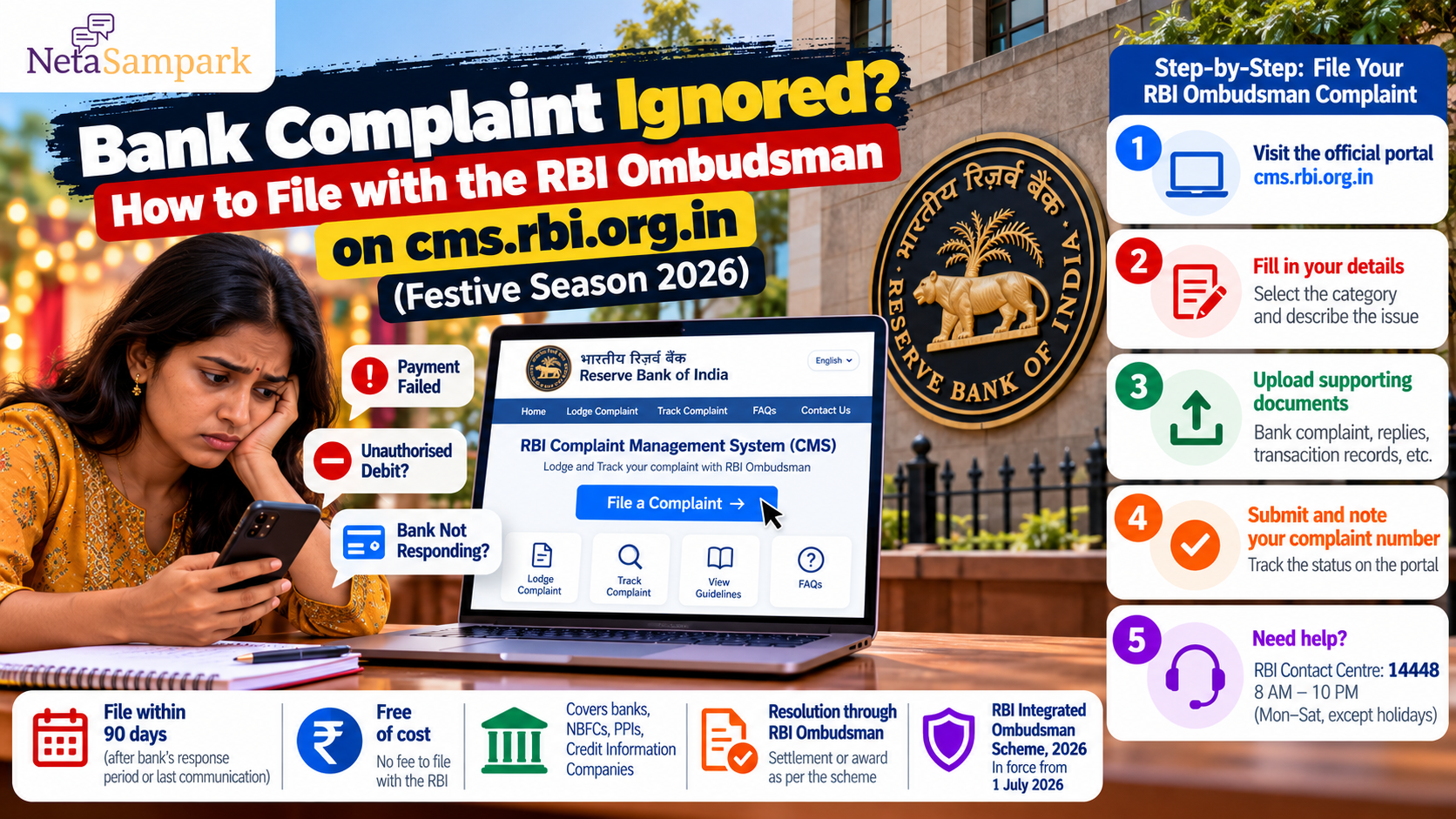
Bank Complaint Ignored? How to File with the RBI Ombudsman on cms.rbi.org.in (Festive Season 2026)
A failed UPI transaction, an unauthorised debit, a credit-card dispute or a bank refusing to resolve a complaint can become especially stressful during the festive season, when households are making more digital payments and purchases.
If you have already complained to your bank and received no response, or its reply has not resolved the issue, you may be able to escalate the matter to the Reserve Bank of India (RBI).
The official portal is cms.rbi.org.in. It provides a central route for eligible customers to raise complaints against covered banks and other RBI-regulated entities.
There is an important update for 2026: the Reserve Bank – Integrated Ombudsman Scheme, 2026 (RB-IOS, 2026) came into force on 1 July 2026, replacing the 2021 scheme for new complaints covered by the new framework. Among the changes, the time limit for approaching the Ombudsman has been shortened to 90 days after the relevant waiting period or the regulated entity’s last communication, whichever is later.
This guide explains who can complain, what documents to prepare, how to use the portal and which deadlines to watch.
Official sources: RBI Ombudsman Scheme 2026 FAQs | RBI Complaint Management System
1 When can you approach the RBI Ombudsman?
You generally need to give the bank or other covered regulated entity the first opportunity to resolve your grievance.
You can approach the RBI Ombudsman if:
- You have already submitted a complaint to the concerned bank or regulated entity.
- You receive a reply or resolution but are not satisfied with it.
- You receive no response within 30 days, or within a longer period specified under applicable RBI, NPCI or card-network guidelines, where relevant.
- Your complaint concerns a deficiency in a service the regulated entity is required to provide.
Examples may include a qualifying complaint about an unauthorised transaction, a failure to reverse an eligible failed transaction, a banking-service issue or a credit-reporting dispute involving a covered Credit Information Company.
The scheme is a cost-free grievance-redress mechanism. However, not every disagreement with a bank qualifies. Complaints about a bank’s commercial judgment, matters outside RBI’s regulatory jurisdiction and certain disputes already before a court or tribunal may be excluded.
2 The 2026 deadline: do not wait too long
One of the most important changes under RB-IOS, 2026 is the deadline for filing a complaint.
| Situation | What to do |
|---|---|
| The bank has not replied | Wait until the applicable response period expires, generally 30 days, unless a longer prescribed period applies |
| The bank has replied, but you are dissatisfied | You may approach the Ombudsman without waiting for the full 30-day period to expire |
| The response period has expired, or you have received the bank’s last communication | File within the scheme’s applicable 90-day window |
| Your complaint may be time-barred under other applicable law | Check the limitation requirements before filing |
The 90-day period is calculated from the date on which the applicable response timeline expires or the date of the regulated entity’s last communication, whichever is later.
You must also have approached the regulated entity within the applicable limitation period under the Limitation Act, 1963. Do not assume that filing a complaint with the bank automatically extends every other legal deadline.
Example: Suppose you submit a bank complaint on 1 October 2026 and the bank receives it that day. If the applicable response period is 30 days and there is no reply or longer prescribed period, the response period would ordinarily expire around 31 October. You should then calculate the applicable 90-day filing window carefully and submit the Ombudsman complaint well before it closes.
This is an illustration, not a determination of the deadline in a particular case. The actual calculation depends on the applicable rules, dates and communications.
3 Which complaints can be filed?
The 2026 scheme covers specified categories of regulated entities, including:
- Commercial banks and specified cooperative banks.
- Eligible non-banking financial companies (NBFCs).
- Non-bank prepaid payment instrument issuers.
- Credit Information Companies.
The scheme does not cover every entity that may be associated with a financial transaction. For example, some NBFC categories and entities outside the scheme’s specified coverage are excluded.
Common examples of grievances that may qualify, depending on the facts and applicable rules, include:
- A failed digital payment that has not been resolved.
- An eligible refund or reversal that remains outstanding.
- An unauthorised debit or disputed transaction that the bank has not properly addressed.
- A bank service deficiency relating to an account, loan or card.
- An eligible complaint about incorrect credit information maintained by a covered Credit Information Company.
The Ombudsman assesses whether there has been a deficiency in service. Filing a complaint does not automatically mean the customer will receive a refund, compensation or a favourable decision.
4 Keep these documents ready before opening the portal
Preparing your evidence first can make the online filing process easier.
- Your name, mobile number, email address, and full postal address.
- The name and relevant branch or office details of the bank or regulated entity.
- The original complaint submitted to the bank.
- The complaint acknowledgement number and date.
- Any reply, rejection or resolution received from the bank.
- The transaction date, amount and reference number, where applicable.
- Relevant account, card, loan or payment details.
- Supporting statements, screenshots, receipts, correspondence and other records.
- A concise explanation of what happened and the remedy you are requesting.
Share only the information needed to establish the grievance. Never provide your ATM PIN, UPI PIN, internet-banking password or OTP as part of a complaint. Do not publish full account or card details in public posts.
5 Step-by-step: file a complaint on cms.rbi.org.in
<PRIVATE_PERSON> Step 1: Open the official portal
Visit https://cms.rbi.org.in/. Check that the address is correct and that you are using the official RBI portal rather than a third-party complaint website.
Step 2: Start a new complaint
Follow the portal’s instructions for lodging a complaint under the RBI grievance-redress framework. Select the appropriate category and regulated entity based on the actual problem.
Step 3: Enter your details
Provide the required personal and contact information. Enter the bank or other regulated entity’s details accurately.
Step 4: Explain the grievance
Describe the events in chronological order. Include the date you first complained to the bank, its acknowledgement number and the response received, if any.
A useful structure is:
- What happened.
- When it happened.
- What you did to resolve it with the bank.
- What response you received.
- What remains unresolved.
- What remedy you are requesting.
Step 5: Upload supporting documents
Attach the relevant complaint acknowledgement, correspondence, transaction records and other supporting evidence requested by the portal. Make sure the documents are readable and match the facts in your description.
Step 6: Review and submit
Check the dates, amounts, reference numbers and requested relief before submitting. An incomplete or inaccurate submission can create delays or affect whether the complaint can be considered.
Step 7: Save your complaint number
After successful registration, retain the complaint number and confirmation. Use the CMS portal’s tracking facility to follow the status of your complaint.
The portal’s precise screens and options may change. Follow the instructions displayed at the time of filing.
6 What should you write in the complaint?
Keep your description factual, specific and supported by evidence. Avoid lengthy accusations or unrelated details.
Illustrative complaint template
Subject: Complaint regarding unresolved banking service issue
I submitted a complaint to [name of bank or regulated entity] on [date] concerning [brief description of the issue].
The complaint reference number is [reference number]. The issue relates to [transaction date, amount and transaction reference, if applicable].
I have requested a resolution from the regulated entity. However, [no response has been received within the applicable period / the response dated [date] does not resolve the issue].
The matter remains unresolved because [briefly explain the outstanding issue].
I request that the complaint be examined and that the regulated entity be directed to provide an appropriate resolution under the applicable rules. The relief requested is [state the specific refund, reversal, correction or other remedy sought].
I am attaching the relevant complaint acknowledgement, correspondence and supporting documents for consideration.
7 Is there a fee to file with the RBI Ombudsman?
No. Filing and resolution under RB-IOS, 2026 are free of charge.
You do not need to pay an agent, intermediary or private website to submit an eligible complaint. Be cautious of anyone claiming that payment will guarantee an RBI order or a refund.
If you need help understanding the procedure, RBI’s Contact Centre can provide guidance.
- Toll-free number: 14448
- Interactive Voice Response System (IVRS): available 24 hours a day, seven days a week.
- Contact-centre personnel: available from 8:00 AM to 10:00 PM, Monday to Saturday, excluding national holidays, in English, Hindi and specified regional languages, including Kannada.
The Contact Centre can guide you through the process and assist with status-related queries. It does not itself register an Ombudsman complaint by telephone.
8 What happens after you submit the complaint?
The complaint is first checked for maintainability under the scheme.
If it qualifies for consideration, the concerned regulated entity is asked to respond, and the Ombudsman’s office examines the complaint, the entity’s response and the supporting material.
Possible outcomes include:
- Settlement: The matter is resolved through facilitation, conciliation or another accepted resolution.
- Award: Where the matter remains unresolved and the conditions are met, the Ombudsman may issue an award directing appropriate remedial action or compensation.
- Rejection or closure: The complaint may be rejected or closed where the scheme’s requirements are not met or the evidence does not establish a deficiency in service.
Keep checking the status and respond promptly if additional information is requested.
If an award is issued, read the communication carefully. Under the 2026 scheme, a complainant generally has 30 days from receiving an award to appeal, subject to the applicable rules. The scheme also sets out conditions for accepting an award and for the regulated entity’s compliance.
Not every closure or rejection has an appeal route, so check the reason for the decision and the relevant scheme provisions before taking further action.
9 How much compensation can the Ombudsman award?
Under RB-IOS, 2026, there is no monetary limit on the amount involved in a dispute that may be brought for settlement or an award.
However, the compensation powers have specific limits:
- Up to ₹30 lakh for consequential loss suffered by the complainant.
- Up to ₹3 lakh for loss of time, expenses incurred, harassment or mental anguish, as applicable.
These are limits on the Ombudsman’s compensation powers, not guaranteed payments. Any award depends on the facts, evidence, the applicable rules and the Ombudsman’s findings.
10 Festive-season checklist: protect yourself while escalating a complaint
During periods of increased shopping and digital payments, keep a record of important transactions and communications.
- Save payment confirmations and transaction reference numbers.
- Report suspicious or unauthorised transactions to your bank immediately.
- For suspected financial fraud, contact your bank and use the appropriate official cybercrime reporting channels promptly; do not wait for the Ombudsman process.
- Preserve screenshots and complaint acknowledgements.
- Track the bank’s response period and the applicable 90-day Ombudsman filing window.
- Use only the official RBI CMS portal.
- Never share an OTP, PIN or password with someone claiming to help you obtain a refund.
Frequently asked questions
Can I complain directly to the RBI without first contacting my bank?
Generally, no. You must first approach the concerned regulated entity and retain proof of that complaint. Exceptions are not a substitute for checking the scheme’s maintainability rules.
What if the bank rejects my complaint?
If you are dissatisfied with the bank’s response, you may approach the Ombudsman without waiting for the full response period to expire, provided the other requirements are met and you file within the applicable deadline.
Can I file a complaint against an NBFC or payment service?
Potentially, yes. Eligibility depends on whether the particular entity falls within the categories covered by RB-IOS, 2026. Check the scheme’s coverage rules before filing.
Can I file through an advocate?
Under the 2026 scheme, a complaint may be filed by the customer personally or through a properly authorised representative. An advocate cannot act as the representative unless the advocate is personally the aggrieved person.
What if my complaint is still pending?
Use the CMS tracking facility with your complaint number and mobile number. You can also contact RBI’s Contact Centre on 14448 for procedural or status-related assistance.
Does the 2026 scheme apply to every older complaint?
No. Complaints received before 1 July 2026, appeals arising from decisions under the 2021 scheme and execution of awards issued under that scheme continue to be governed by the earlier framework and relevant RBI instructions.
The takeaway
If your bank complaint has been ignored or inadequately resolved, the RBI Ombudsman provides a formal, free route to seek redress for eligible service deficiencies.
Start by documenting the complaint with your bank, preserve the acknowledgement and supporting evidence, and check the applicable waiting period and filing deadline. For complaints governed by the new framework, the 90-day filing window under RB-IOS, 2026 is especially important.
Begin at the official RBI Complaint Management System and consult the RBI’s 2026 scheme FAQs for the current rules.
This article is for general information and is not a substitute for legal or financial advice. The applicable scheme and RBI instructions should be checked for the specific complaint.