
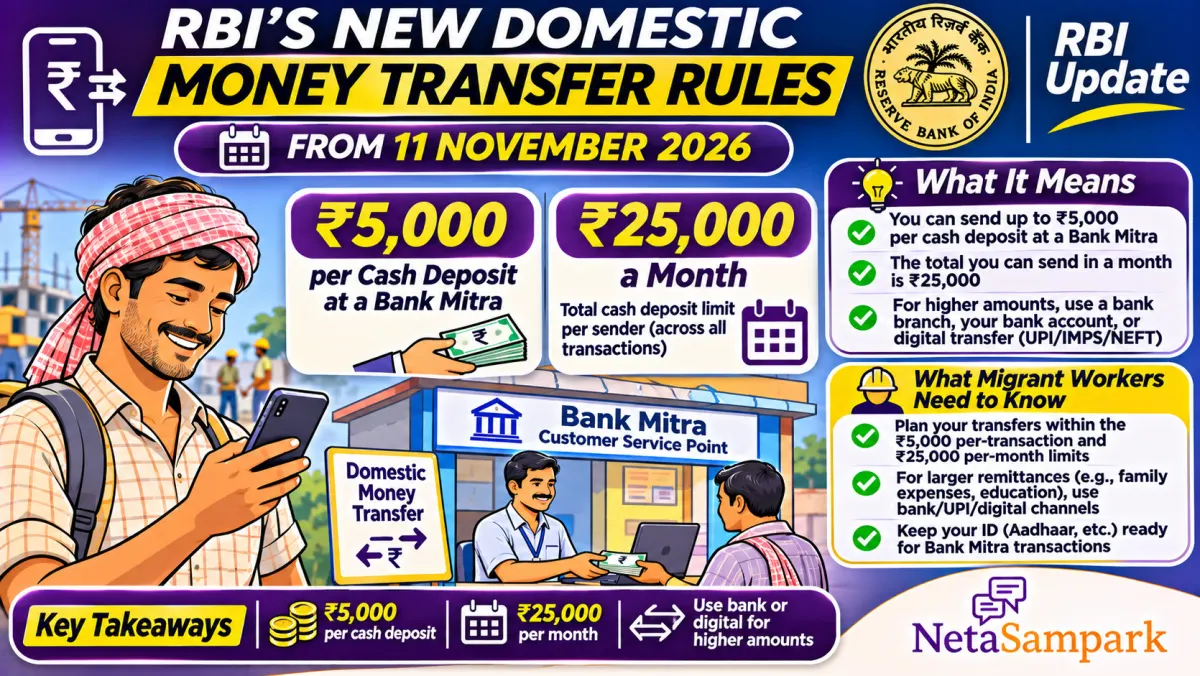
On 11 November 2026, RBI put all its domestic money transfer rules in one rulebook, effective immediately. A walk-in sender can deposit ₹5,000 per transaction and ₹25,000 a month through a bank mitra or ATM, or up to ₹50,000 by NEFT at a branch. Cash payouts to people without accounts are capped at ₹10,000.
Updated 12 November 2026
If you work away from home and send money back in cash through the bank mitra at the corner shop, this one's for you. So is your family if they collect cash because they don't have a bank account. The Reserve Bank of India issued the Reserve Bank of India (Domestic Money Transfer) Directions, 2026 on 11 November 2026. The headlines made it sound like a new crackdown. It's mostly not. RBI has taken two older circulars, one from 2011 and one from July 2024, and folded them into a single set of directions that apply to every bank and payment company offering this service.
So what does it mean for you on the ground? Your limits are clear, your ID check is fixed, and if something goes wrong you now know exactly where to complain. Let's go through it.
Quick facts
| Item | Details |
|---|---|
| Official portal | RBI notification RBI/DPSS/2026-27/476 and RBI complaint portal cms.rbi.org.in |
| Helpline | Your bank's customer care first; RBI contact centre 14448; cyber fraud 1930 |
| Fee | Banks and agents can charge a "reasonable" fee. RBI hasn't fixed an amount |
| Deadline | Effective from 11 November 2026, no transition period |
| Documents | Verified mobile number and a self-certified officially valid document (Aadhaar, passport, driving licence, voter ID, NREGA job card or similar) |
| Cash to a bank account via bank mitra or ATM | ₹5,000 per transaction, ₹25,000 a month per sender |
| Cash to a bank account at a branch by NEFT | Up to ₹50,000 |
| Cash pay-out to someone without an account | ₹10,000 per transaction, ₹25,000 a month per receiver |
What is a domestic money transfer?
It's the service that lets someone without a bank account, or someone far from their own branch, move money through a bank. RBI says plainly that it was built for people like migrant workers who don't always have papers for a regular account.
There are two kinds.
Cash pay-in. You walk in with cash and it goes into someone's bank account. This is what most workers use to send money to the family account back in the village.
Cash pay-out. Money leaves a bank account and the receiver collects it in cash at an ATM or from a business correspondent (BC), also called a bank mitra. This is for receivers with no bank account.
Card-to-card transfers are not covered by these rules.
What are the limits now?
Here's the full picture from the directions.
| Service | Per transaction | Monthly cap |
|---|---|---|
| Cash deposit to someone's account through a bank mitra, ATM or similar | ₹5,000 | ₹25,000 per sender |
| Cash deposit at a bank branch, sent by NEFT | ₹50,000 | Not specified in the directions |
| Money from an account paid out in cash to a person without an account | ₹10,000 | ₹25,000 per receiver |
A real example: Ramesh works in a Surat textile unit and sends money to his wife's account in Ganjam, Odisha. Through the bank mitra near his room, he can send ₹5,000 at a time and ₹25,000 in a month. If he wants to send ₹40,000 for a medical bill, he'll have to go to a bank branch and send it by NEFT, where the cap is ₹50,000.
What do you need to send money in cash?
Every bank and bank mitra has to register you before you can send cash. Here's what they need.
☐ A mobile number that's verified, usually by OTP
☐ One officially valid document, self-certified, like Aadhaar, passport, driving licence, voter ID or NREGA job card
☐ The receiver's account number and IFSC
☐ An extra authentication for every transaction, like an OTP or biometric
The extra authentication on every transaction is the part people notice. If your phone's switched off or you've changed your number, the transfer won't go through. Keep the registered number active.
Your name and details also travel with the money. The bank has to put the sender's details into the IMPS or NEFT message and mark it as a cash-based transfer. So the family at home can see who sent it, and it's easier to trace if something goes wrong.
How do you send money safely through a bank mitra?
1. Use an authorised agent. Ask which bank the bank mitra works for. A real BC has an ID and a fixed location listed with the bank.
2. Register once with your own ID. Don't let the agent use someone else's ID "to save time". The transfer is linked to the sender's details.
3. Read out the account number twice. A wrong digit or an old IFSC after a bank merger is a common reason transfers fail.
4. Take the receipt. Make sure it shows the amount, the receiver's account, the date and a reference number.
5. Check the SMS. You should get an alert. Ask your family to confirm the credit the same day. Transfers are expected to be real-time or near real-time.
What about the fee?
RBI lets banks and agents charge "reasonable" fees to keep the service popular, but hasn't set a number. Ask before you pay. If the agent charges far above the posted rate, note it and complain to the bank.
What if your money doesn't reach?
Start with the bank, not the agent's promises.
1. Wait a few hours, then call the bank whose bank mitra you used. Give the reference number from the receipt.
2. Raise a written complaint at the branch or on the bank's grievance page and get a complaint number.
3. Escalate to the RBI Ombudsman. Complaints about these services fall under the Reserve Bank - Integrated Ombudsman Scheme, 2026. If the bank doesn't fix it in the time the scheme allows, or you're unhappy with the reply, file on cms.rbi.org.in. It's free.
4. If it's fraud, call 1930 at once and report on cybercrime.gov.in. Our guide on what to do in the first hour after a UPI fraud works for these cases too.
If cash was debited but the transaction failed at an ATM, the rules on refunds and compensation are different. See our post on failed ATM and card transactions.
Why your account could get flagged
Here's the bit that affects even people who never send cash. Banks must now run "velocity checks" and alert customers about credits coming in through these services. Any sudden spurt of cash credits into one account, or a group of accounts, has to be investigated at once, and suspicious transactions get reported.
That's aimed at mule accounts, where fraudsters pay people to let their accounts receive scam money. If a stranger offers you money to "receive some transfers", say no. Your account can get frozen, and you'd be the one answering questions.
Frequently asked questions
How much cash can I send through a bank mitra in a month?
Up to ₹25,000 a month as a sender, and no more than ₹5,000 in one transaction, under RBI's Domestic Money Transfer Directions, 2026.
Is the ₹50,000 NEFT limit only at a bank branch?
Yes. A walk-in customer at a bank branch can deposit cash up to ₹50,000 to be sent by NEFT to someone's bank account. Through a bank mitra or an ATM, the per-transaction cap stays ₹5,000.
Do I need Aadhaar to send money?
You need a verified mobile number and one self-certified officially valid document. Aadhaar is one option, but a passport, driving licence, voter ID or NREGA job card also count as valid documents under RBI's KYC rules.
Can my family collect cash if they don't have a bank account?
Yes, through the cash pay-out service. They can collect up to ₹10,000 per transaction and ₹25,000 a month at an ATM or from a bank mitra, if your bank offers it.
Where do I complain if a bank mitra overcharges me?
Complain to the bank the bank mitra works for. If the bank doesn't sort it out, you can go to the RBI Ombudsman on cms.rbi.org.in, as these services come under the Integrated Ombudsman Scheme, 2026.
Final reminder
Keep your registered mobile number active, register once with your own ID, and always collect a receipt with a reference number. If you need to send more than ₹5,000 at a time, use a bank branch for NEFT. If something goes wrong, complain to the bank first and then to the RBI Ombudsman. Want to know who represents you back home and in the city where you work? Look them up on NetaSampark.
Sources
• RBI notification: Reserve Bank of India (Domestic Money Transfer) Directions, 2026, 11 November 2026
• RBI Master Directions page for the same directions