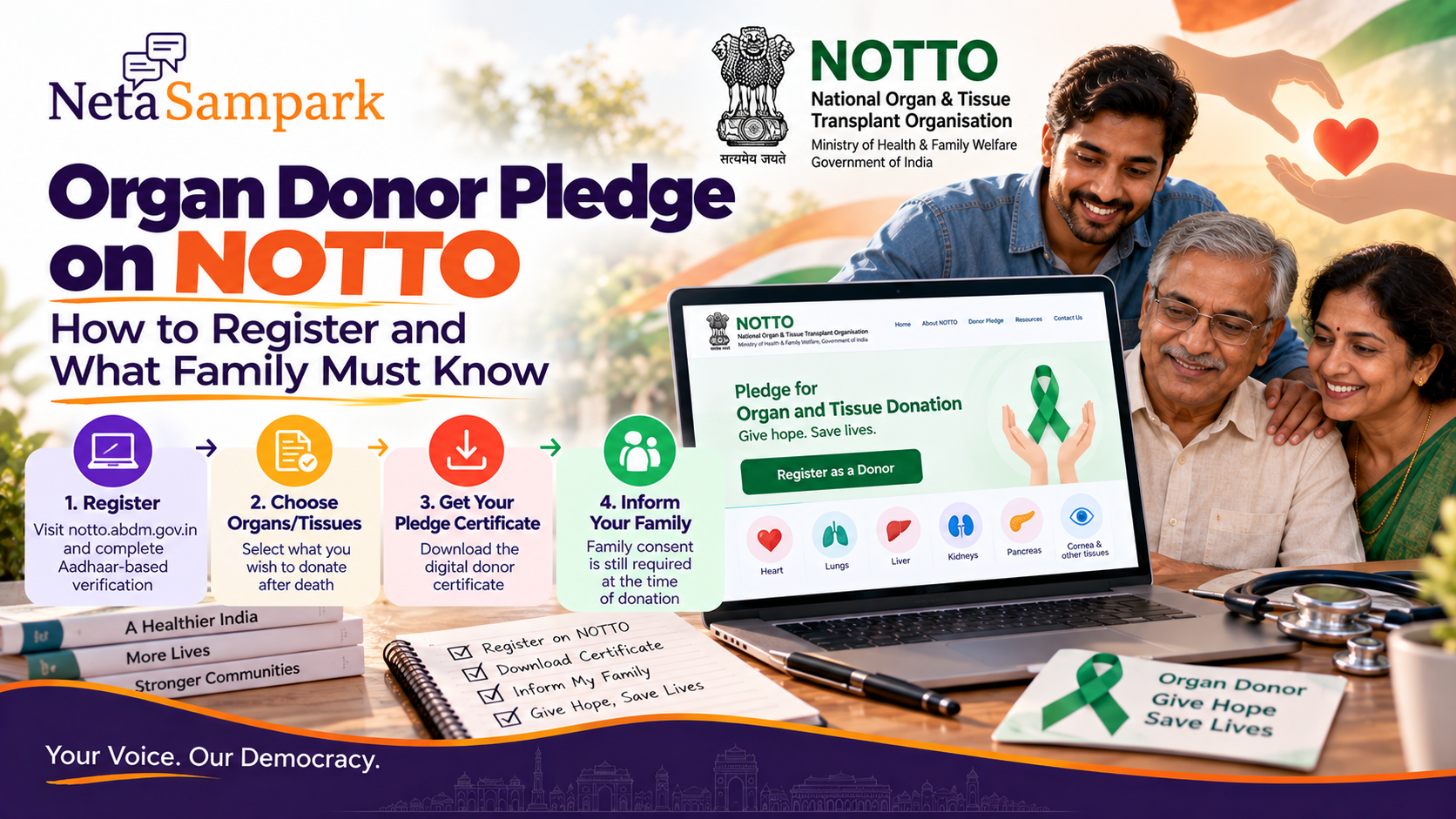
Quick take: Adults aged 18 or above can record an organ and tissue donation pledge through the Government of India's National Organ & Tissue Transplant Organisation (NOTTO) portal. The current NOTTO guidance says online pledging is done through notto.abdm.gov.in, with Aadhaar and OTP verification. The pledge records your intention to donate after death; it does not mean your organs are automatically retrieved. NOTTO specifically tells people to discuss the decision with their family because family/legal next-of-kin consent is still required at the time of donation. (NOTTO)


What NOTTO is
NOTTO — National Organ & Tissue Transplant Organisation — operates under the Directorate General of Health Services, Ministry of Health and Family Welfare.
It is the national-level organisation involved in India's deceased organ and tissue donation and transplantation system and maintains the national registry of donors and recipients. NOTTO also coordinates with Regional and State Organ & Tissue Transplant Organisations. (Directorate General of Health Services)
The official pledge portal is:
NOTTO donor pledge portal
The NOTTO website also provides information and a 24×7 toll-free helpline: 1800-11-4770. (Directorate General of Health Services)
Who can make a pledge?
NOTTO's current awareness material says:
You must be 18 years or older to make the online organ/tissue donation pledge. (NOTTO)
The pledge is an expression of your intention to donate organs and/or tissues after death.
It is not the same as becoming a living organ donor.
What you need for online registration
Keep these ready:
- Aadhaar
- Mobile number linked to Aadhaar
- Your basic personal details
- Access to the OTP sent during verification
- A few minutes to complete the pledge
NOTTO's current booklet specifically says Aadhaar and OTP verification are required, so keep the Aadhaar-linked mobile phone available. (NOTTO)
How to register
1. Open the official portal
Go to:
notto.abdm.gov.in — official NOTTO pledge portal
Be careful with lookalike websites.
You do not need to pay a private website to register an organ donation pledge.
2. Start the donor pledge
Select the option for registering your organ/tissue donation pledge.
The pledge corresponds to Form 7 under the applicable rules. The official Form 7 is specifically titled “For Organ or Tissue Pledging” and is for an individual aged 18 or above. (NOTTO)
3. Complete Aadhaar verification
The current NOTTO guidance says Aadhaar and OTP verification are used for the online pledge.
Keep your Aadhaar-linked phone nearby.
Never give the OTP to an unrelated caller or agent.
4. Choose what you wish to donate
Form 7 provides options for organs and tissues.
The listed organs include:
- Heart
- Lungs
- Kidneys
- Liver
- Pancreas
- Other specified organs
- All organs
Tissues listed include:
- Corneas/eyeballs
- Skin
- Bones
- Heart valves
- Blood vessels
- Other specified tissues
- All tissues
The form also provides an “All Organs” and “All Tissues” option. (NOTTO)
Choose according to your own decision. You don't have to make the choice based on what someone else tells you.
5 Submit the pledge
Review your information before submitting.
Keep the confirmation/pledge certificate after registration.
NOTTO's official material says a digital donor pledge certificate can be downloaded immediately after registration. (NOTTO)
Save a copy somewhere secure.
6 Tell your family
This is arguably the most important step after registration.
Don't simply register and close the browser.
Tell:
- Spouse
- Parents
- Children
- Siblings
- Close family member who is likely to be involved in medical decisions
Say clearly:
“I have registered my organ and tissue donation pledge with NOTTO. If I die in circumstances where donation is medically possible, I want you to support my decision.”
NOTTO itself repeatedly advises people to discuss their pledge with family. (NOTTO)
The important part: Does the pledge guarantee donation?No.
This is the most important distinction in the entire process.
A pledge records your intention.
At the time of death, donation still involves the legally prescribed consent process.
NOTTO's current awareness booklet explicitly states that family or legal next of kin must still give consent after death, and describes this consent as mandatory. (NOTTO)
NOTTO's transplant manual likewise describes obtaining consent from the next of kin in the brain-stem-death donation process. (NOTTO)
So the practical chain is:
You make pledge
↓
Family knows your decision
↓
Death occurs
↓
Medical team determines whether donation is medically possible
↓
Brain-stem/cardiac death is established according to the applicable process
↓
Required consent is obtained
↓
Organ/tissue retrieval proceeds where legally and medically appropriate
Why family discussion matters
Imagine a family member is in ICU after a catastrophic medical event.
The doctors explain that the patient has been declared brain-stem dead and ask the family about organ donation.
If the family has never heard the patient's wishes, they may be making an emotionally difficult decision without knowing what the person wanted.
A pledge plus a family conversation changes that.
Your family can say:
“Yes, this is what they wanted.”
That is why NOTTO emphasises communicating the decision to family, rather than treating online registration as the end of the process. (NOTTO)
What happens if someone dies at home?This is another commonly misunderstood point.
NOTTO's public information explains that vital-organ donation generally requires the donor to be in a hospital/ICU and declared brain-stem dead. It also states that some tissues, such as corneas and skin, may be retrieved within specified time limits after death at home. (NOTTO)
So don't interpret an organ-donor card as meaning:
“Any hospital can remove my organs after I die anywhere.”
The circumstances of death and medical suitability matter.
Brain-stem death is not the same as comaNOTTO explains that brain-stem death is a legally recognised death determination involving irreversible loss of brain-stem function.
A person in a coma is not automatically brain-stem dead.
In a brain-stem-death situation, the heart may continue beating temporarily with ventilatory support, which is why organ donation can be medically possible in an ICU setting. (NOTTO)
NOTTO says brain-stem death is declared by an authorised medical board through prescribed testing procedures. (NOTTO)
Does organ donation mean the body is disfigured?
NOTTO's public material says organs are removed carefully in an operation theatre and the incision is sutured, similar to surgical closure. (NOTTO)
Families can therefore discuss funeral arrangements with the transplant team without assuming that donation means the body cannot receive normal last rites.
NOTTO states that after retrieval, the body is returned to the family with dignity for last rites. (NOTTO)
Can the family sell the organs?
No.
Organ donation is not a commercial transaction.
The legal framework prohibits commercial dealings in human organs and tissues. The Transplantation of Human Organs and Tissues Act, 1994 regulates removal, storage and transplantation for therapeutic purposes and prohibits commercial dealings. (India Code)
Be particularly cautious if anyone approaches a family asking for money in exchange for an organ.
Use the official health authorities and transplant network.
Is there a fee for making the pledge?
The NOTTO pledge process is presented as an online registration of your donation intention; it is not a paid organ-sale or matching service.
If a third-party website asks you for money simply to "register your NOTTO donor card," go back to the official portal.
Can I change my mind?
Yes.
NOTTO's Form 7 explicitly says the person making the pledge has the option to withdraw the pledge. (NOTTO)
NOTTO's awareness material also says you can un-pledge at any time. (NOTTO)
If you change your decision, don't merely tell one family member.
Update your pledge through the official mechanism and tell your family about the change.
What can actually be donated?
The NOTTO material distinguishes between organs and tissues.
Potential organs include:
- Heart
- Lungs
- Kidneys
- Liver
- Pancreas
- Intestine
Potential tissues include:
- Cornea
- Skin
- Bone
- Heart valves
- Blood vessels
- Other tissues
Medical suitability is determined at the time of death. Registering for donation does not mean every listed organ will necessarily be usable. (NOTTO)
Organ donation vs body donationDon't confuse the two.
Organ/tissue donation
The purpose is transplantation for therapeutic purposes.
Body donation
The body is donated after death for medical education and research, subject to the applicable laws and institutional procedures.
NOTTO explicitly distinguishes these two forms of donation. (NOTTO)
If you want to make a body donation pledge for medical education, that is a separate process from simply registering as an organ/tissue donor on NOTTO.
What the family should keepCreate a small organ donation information note containing:
Donor's name
NOTTO pledge confirmation/certificate
Family contact
Hospital/doctor information if relevant
Statement that the family has been informed
The goal isn't paperwork for its own sake.
It's making sure the family can quickly communicate the person's wishes when emotions are high.
A simple family conversation
You don't need a dramatic announcement.
Try:
“I've registered as an organ donor through the Government of India's NOTTO portal. If something happens to me and donation is medically possible, I want you to know that this is my decision.”
Then ask:
“Do you understand what I want?”
That conversation may be more useful than simply forwarding a donor-card screenshot.
What happens at the hospital?In a potential brain-stem-death case, NOTTO's transplant manual describes a process in which the family is counselled about donation and, after the required death determination, consent is obtained from the next of kin using the prescribed process. (NOTTO)
The medical team also determines whether donation is medically possible.
The family does not decide which recipient gets a particular organ.
Organ allocation is handled through the authorised transplant network and applicable allocation rules.
Important safety pointDon't give your Aadhaar OTP to:
- A WhatsApp “organ donor agent”
- A social-media volunteer
- A private hospital tout
- An unknown caller
- Someone promising a faster donor certificate
Use the official NOTTO portal.
For questions about organ donation or pledging, NOTTO lists the 24×7 toll-free helpline 1800-11-4770. (Directorate General of Health Services)
One-minute family checklist
☐ I am 18+
☐ I registered through the official NOTTO pledge portal
☐ I completed the required verification
☐ I downloaded/saved my pledge certificate
☐ I told my family
☐ My family knows where the certificate is
☐ I understand the pledge does not replace the required consent process
☐ I know I can withdraw/change my pledge
The simple workflow
Decide to donate
↓
Register on NOTTO
↓
Aadhaar + OTP verification
↓
Select organs/tissues
↓
Submit pledge
↓
Save donor certificate
↓
Tell your family
↓
If death occurs, doctors assess medical suitability
↓
Required family/legal consent process
↓
Donation proceeds only where medically and legally appropriate
How NetaSampark helps
Organ donation is a national health system, but citizens still need to know where to register, what a pledge actually means and why their family needs to know about it.
Use NetaSampark Explore Guides to understand the government process before you register.
Be Informed. Be Heard.