
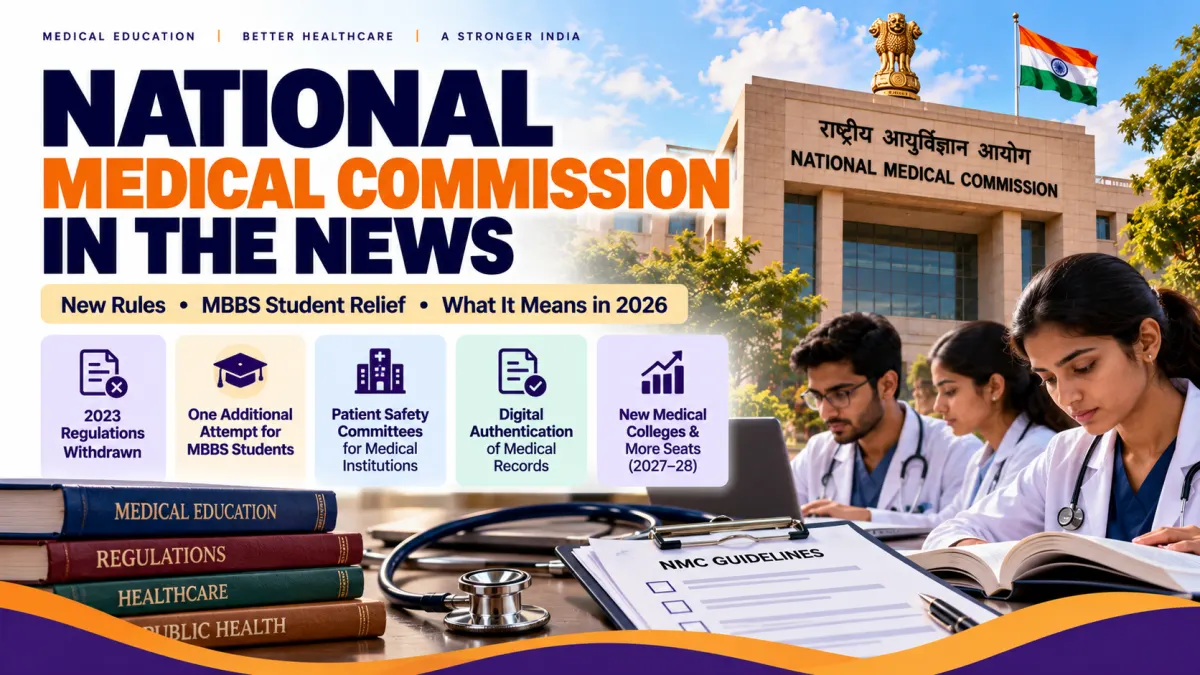
The National Medical Commission (NMC), India’s medical education regulator, is in the news following a series of significant decisions affecting medical colleges, MBBS students and healthcare professionals.
In October 2026, the NMC withdrew its Maintenance of Standards of Medical Education Regulations, 2023, prompting questions about how medical colleges will be monitored and what enforcement mechanisms will apply going forward. The Commission has said that the withdrawal does not dilute medical education standards or remove its regulatory oversight.
The NMC has also announced a one-time additional attempt for certain MBBS students to clear their First Professional examination. Other recent notices cover patient safety committees, digital authentication of medical records and applications to establish new medical colleges or expand MBBS seats.
This article explains the latest developments, why they matter, what has changed, what remains in place and where students and institutions can find official updates.
Last updated: 25 October 2026. Regulatory requirements can change. Readers should consult the relevant NMC notification for the latest applicable rules.
Why Is the National Medical Commission Trending?
The NMC has attracted attention because of several recent regulatory announcements.
| Development | What it means |
|---|---|
| Withdrawal of the 2023 medical education standards regulations | The specific regulatory framework has been withdrawn, while other statutory requirements and NMC oversight continue. |
| One-time additional MBBS examination attempt | Eligible students admitted from academic year 2019–20 onwards may qualify for one additional attempt to clear the First Professional examination, subject to the NMC’s conditions. |
| Patient safety committees | Medical colleges and institutions have been directed to establish patient safety committees or cells and designate nodal officers. |
| Digital authentication of medical records | The NMC has issued clarification on remote authentication through digital or electronic signatures. |
| New medical college and seat applications | Applications have been invited for establishing new MBBS colleges or increasing intake for academic year 2027–28. |
These developments appear in the official NMC notices and recent reporting by The Indian Express.
1 NMC Withdraws Medical Education Standards Regulations, 2023
The most prominent recent development is the withdrawal of the Maintenance of Standards of Medical Education Regulations, 2023 (MSMER-2023).
The NMC issued a notification dated 14 October 2026, de-notifying the regulations that had been notified in September 2023.
The regulations had provided a framework for evaluating medical institutions and prescribing consequences for specified violations. Their withdrawal has raised questions about how medical colleges will be held accountable for non-compliance with requirements concerning faculty, infrastructure, clinical facilities and educational standards.
Why did the NMC withdraw the regulations?
According to the Commission’s explanation reported by The Indian Express, the 2023 framework created overlapping procedures for institutional evaluation, renewal and enforcement across the NMC’s regulatory boards.
The Undergraduate Medical Education Board (UGMEB) and Postgraduate Medical Education Board (PGMEB) prescribe relevant academic standards and educational requirements. The Medical Assessment and Rating Board (MARB) assesses medical institutions, inspects them and takes regulatory action within its statutory powers.
The NMC said the withdrawal was intended to remove duplication and align the regulatory framework with the National Medical Commission Act, 2019.
The Commission has stated that the change does not dilute medical education standards or its regulatory oversight.
Source: The Indian Express — NMC’s explanation of the withdrawal.
What did the withdrawn regulations cover?
The 2023 regulations included provisions relating to:
- Institutional assessment and compliance.
- Minimum requirements for medical education.
- Faculty and institutional records.
- Infrastructure and clinical facilities.
- Consequences for specified violations.
- Procedures for appeals against penalties.
The regulations also specified monetary penalties for certain violations, including penalties for institutions and individual officials who submitted false information.
Because the specific framework has been withdrawn, its provisions should not automatically be treated as the current enforcement mechanism. The legal effect of individual provisions must be assessed against the de-notification and the other applicable laws and regulations.
Does this mean medical colleges can operate without meeting standards?
No. The withdrawal should not be interpreted as permission for medical colleges to disregard regulatory requirements.
The NMC has said that prescribed standards, institutional disclosures, inspections and its statutory oversight continue under the applicable legal framework.
MARB retains powers to assess institutions and take action under relevant provisions of the NMC Act and other applicable regulations.
The important distinction is that withdrawal of one set of regulations does not mean that all medical education rules have been abolished.
What happens to penalties and earlier decisions?
The withdrawal removes the specific penalty and appeal framework established by MSMER-2023. However, the NMC has also indicated that actions already taken, liabilities incurred and proceedings initiated under the regulations are not automatically erased.
The exact consequences for a particular institution or proceeding depend on the applicable notification, transitional provisions and other legal requirements.
Medical colleges should therefore seek clarification from the relevant regulator or legal adviser before assuming that a particular obligation or proceeding has ended.
2 NMC Grants One Additional Attempt to Eligible MBBS Students
Another major recent development is the NMC’s decision to provide a one-time additional attempt to certain MBBS students to clear their First Professional examination.
The Commission announced the relief following its 18th meeting on 23 September 2026. The notice was published on 15 October.
According to the reported decision, the relaxation applies to eligible students admitted from academic year 2019–20 onwards, subject to the conditions specified by the NMC.
Why has the additional attempt been allowed?
The decision provides transitional relief to students who encountered difficulties, including disruptions associated with the COVID-19 pandemic and certain personal or health-related circumstances.
Medical education follows prescribed examination and course-completion requirements. A student who does not clear an examination within the permitted attempts or period may face consequences for progression through the programme.
The one-time relaxation creates an additional opportunity for eligible students covered by the notification.
Who is eligible?
Students should not assume that the additional attempt applies automatically to every MBBS student who has failed an examination.
Eligibility depends on the academic year of admission and the conditions in the official NMC notice. Students should confirm their individual circumstances with their medical college and consult the original notification.
What should students do next?
Eligible students should:
- Read the official NMC notification carefully.
- Confirm their admission year and examination status.
- Contact their college’s academic section or examination office.
- Check the applicable registration, examination and application deadlines.
- Obtain written confirmation of eligibility where necessary.
The additional attempt is a specific transitional relaxation. It should not be interpreted as a general change to all MBBS examination rules.
Official source: NMC — What's New.
3 What the Regulatory Change Means for Medical Colleges
Medical colleges must continue to comply with the standards and requirements applicable to their courses and permissions.
The NMC’s withdrawal of MSMER-2023 changes the specific framework that had prescribed certain compliance and penalty procedures. It does not eliminate the need for institutions to meet requirements under the NMC Act and other applicable regulations.
Institutions should pay particular attention to the following areas.
Faculty and staffing
Colleges must continue to meet applicable requirements for faculty, teaching staff and other personnel. The withdrawal of the 2023 regulations should not be treated as an exemption from the requirements governing institutional recognition or permitted student intake.
Infrastructure and teaching facilities
Medical institutions must continue to meet applicable requirements relating to classrooms, laboratories, teaching facilities and other infrastructure.
Clinical material and patient exposure
Clinical training is a core component of medical education. Institutions must comply with applicable requirements relating to clinical facilities, patient exposure and teaching arrangements.
Institutional disclosures
The NMC has clarified that the requirement to submit Annual Disclosure Reports continues under the applicable statutory framework.
These reports contain information about matters such as faculty, infrastructure, clinical facilities and other institutional parameters. The relevant authorities may use the disclosures for scrutiny and verification.
Inspections and regulatory action
The NMC has stated that MARB retains its statutory powers to inspect institutions and initiate appropriate action when requirements are not met.
Colleges should therefore continue to maintain accurate records, comply with applicable norms and respond to official directions.
4 NMC Issues Guidance on Digital Authentication of Medical Records
The Commission has also issued a clarification regarding remote authentication of medical records through digital or electronic signatures.
Digital authentication can support electronic medical records and administrative workflows, but it also raises questions about professional responsibility, record integrity and accountability.
The reported NMC guidance emphasises that doctors must review relevant clinical records before authenticating them, keep their authentication credentials under their sole control and authenticate records only from healthcare facilities with which they are associated.
Why does this matter?
Medical records can be important for ongoing treatment, clinical decisions, continuity of care and legal accountability.
Electronic signatures should not be treated as a substitute for a doctor’s professional review or responsibility for the records being authenticated.
Healthcare institutions and medical practitioners should consult the original NMC notice for the exact requirements applicable to their work.
Official updates: NMC website.
5 NMC Directs Medical Institutions to Establish Patient Safety Committees
The NMC has also issued a notice concerning the establishment of Patient Safety Committees or Cells in medical colleges and medical institutions.
The direction calls for institutions to constitute committees with representation from relevant specialties and designate a Patient Safety Nodal Officer.
The initiative is intended to support a more systematic approach to patient safety, appropriate protocols and standard operating procedures in healthcare institutions.
What could patient safety committees do?
Depending on the applicable instructions and institutional arrangements, patient safety structures can help coordinate work related to:
- Identifying and reviewing patient safety risks.
- Strengthening adherence to clinical protocols.
- Improving communication between departments.
- Supporting reporting and review of safety incidents.
- Promoting training and institutional learning.
- Coordinating implementation of relevant safety measures.
The precise responsibilities, required representation and implementation arrangements should be taken from the official notification rather than inferred from general patient-safety practices.
6 NMC Invites Applications for New Medical Colleges and Additional MBBS Seats
The NMC has invited online applications for establishing new medical colleges offering MBBS programmes and increasing annual intake capacity at existing colleges for the 2027–28 academic year.
This is relevant to institutions planning to expand medical education capacity.
Applications are subject to the applicable eligibility requirements, assessment procedures, infrastructure and faculty standards, and approval processes.
What should institutions know?
Institutions interested in applying should:
- Review the latest NMC notification and application instructions.
- Check eligibility and the applicable submission window.
- Prepare the required documentation.
- Review requirements for infrastructure, faculty and clinical facilities.
- Follow the prescribed assessment and approval process.
An invitation to apply does not itself constitute approval to establish a college or increase seats. Institutions should wait for the relevant decision and permission before advertising or admitting students under an expanded intake.
The latest notices and application details are available on the NMC official website.
7 What Is the National Medical Commission?
The National Medical Commission is a statutory body established under the National Medical Commission Act, 2019. It replaced the Medical Council of India and became operational in 2020.
Its broad mission includes improving access to quality and affordable medical education, ensuring an adequate supply of qualified medical professionals and supporting equitable healthcare.
The NMC operates through specialised autonomous boards that have distinct responsibilities.
| Board | Broad area of responsibility |
|---|---|
| Undergraduate Medical Education Board (UGMEB) | Undergraduate medical education standards |
| Postgraduate Medical Education Board (PGMEB) | Postgraduate medical education standards |
| Medical Assessment and Rating Board (MARB) | Assessment and inspection of medical institutions and related regulatory functions |
| Ethics and Medical Registration Board (EMRB) | Professional ethics, registration and related functions under the applicable framework |
The specific powers and responsibilities of each board are set out in the Act and applicable regulations.
Official source: National Medical Commission.
8 How Do the Latest NMC Developments Affect Students and Doctors?
The impact depends on a person's role in the medical education system.
For MBBS students
The one-time additional attempt may be relevant to eligible students who have not cleared their First Professional examination. Students should verify the eligibility conditions and deadlines in the official notification.
For medical colleges
Institutions should continue meeting the applicable standards, submitting required disclosures and complying with inspection and regulatory requirements. They should also review any internal compliance procedures that relied specifically on MSMER-2023.
For doctors
The digital authentication guidance is relevant to doctors who handle electronic medical records. They should review the applicable professional responsibilities and follow institutional procedures.
For students seeking admission
Applicants should rely on official admission and counselling notices, approved college information and the latest applicable seat matrices. A regulatory announcement should not be interpreted as an admission guarantee.
For patients
The patient safety initiative is relevant to the broader healthcare environment. However, the existence of a committee requirement does not by itself establish how effectively an institution has implemented patient-safety practices.
9 What Should Readers Watch Next?
As the NMC’s regulatory changes take effect, several developments are worth monitoring.
- Further regulatory clarification: Whether the Commission issues additional guidance on the regulatory framework following the withdrawal of MSMER-2023.
- Institutional compliance: How medical colleges implement the applicable requirements for faculty, infrastructure, clinical facilities and annual disclosures.
- MBBS examination relief: How eligible students and institutions implement the one-time additional attempt.
- Patient safety measures: How institutions constitute committees and appoint nodal officers.
- New college and seat approvals: Which applications are approved after the relevant assessment process.
- Legal developments: Whether further judicial or administrative decisions affect the interpretation or implementation of the regulatory changes.
Readers should distinguish confirmed notifications from reported developments and commentary. The legal position for a particular institution or student may depend on the precise terms of the relevant order or regulation.
Frequently Asked Questions About the National Medical Commission
What is the National Medical Commission?
The NMC is India’s statutory regulator for medical education and related aspects of medical professional regulation. It was established under the National Medical Commission Act, 2019, replacing the Medical Council of India.
Why is the NMC in the news in October 2026?
Recent developments include the withdrawal of the Maintenance of Standards of Medical Education Regulations, 2023, a one-time additional MBBS examination attempt for eligible students, guidance on digital authentication of medical records and directions on patient safety committees.
Has the NMC abolished all medical education standards?
No. The Commission has said that withdrawal of MSMER-2023 does not dilute medical education standards or remove its regulatory oversight. Other applicable statutory requirements and regulations continue to apply.
Does the withdrawal mean medical colleges no longer face inspections?
No. The NMC has stated that MARB retains its powers to assess and inspect institutions and take appropriate regulatory action under the applicable legal framework.
Who can receive the additional MBBS examination attempt?
The one-time relief applies to eligible students admitted from academic year 2019–20 onwards, subject to the NMC notification’s conditions. Students should confirm their individual eligibility with their college and the official notice.
Are all MBBS students allowed another attempt?
No. It is a specific transitional relaxation, not a general rule granting an additional attempt to every MBBS student.
What are Annual Disclosure Reports?
Annual Disclosure Reports are institutional disclosures covering information such as faculty, infrastructure, clinical facilities and other prescribed parameters. The NMC has stated that the requirement to submit them continues under the applicable statutory framework.
Where can I find official NMC notifications?
Visit the National Medical Commission website and open its “What’s New” section for notices, regulations, circulars and other updates.
Conclusion: What the Latest NMC Decisions Mean
The National Medical Commission’s October 2026 announcements affect several parts of India’s medical education system.
The withdrawal of MSMER-2023 has prompted questions about institutional oversight and enforcement. The NMC, however, has said that existing standards and regulatory oversight remain in place under the applicable legal framework.
At the same time, the one-time additional MBBS examination attempt provides specific relief to eligible students, while recent notices address patient safety, digital authentication of medical records and expansion of medical education capacity.
For students, colleges, doctors and healthcare administrators, the practical priority is to understand the exact requirements that apply to them and consult the official notification rather than rely solely on headlines.
For the latest verified notices, regulations and clarifications, visit the National Medical Commission’s official website.
Your Voice. Our Democracy.
— NetaSampark
Sources
- National Medical Commission — Official website and notices
- The Indian Express — NMC withdrawal of medical education standards regulations
- The Indian Express — Latest NMC news
- Times of India — Additional MBBS examination attempt