
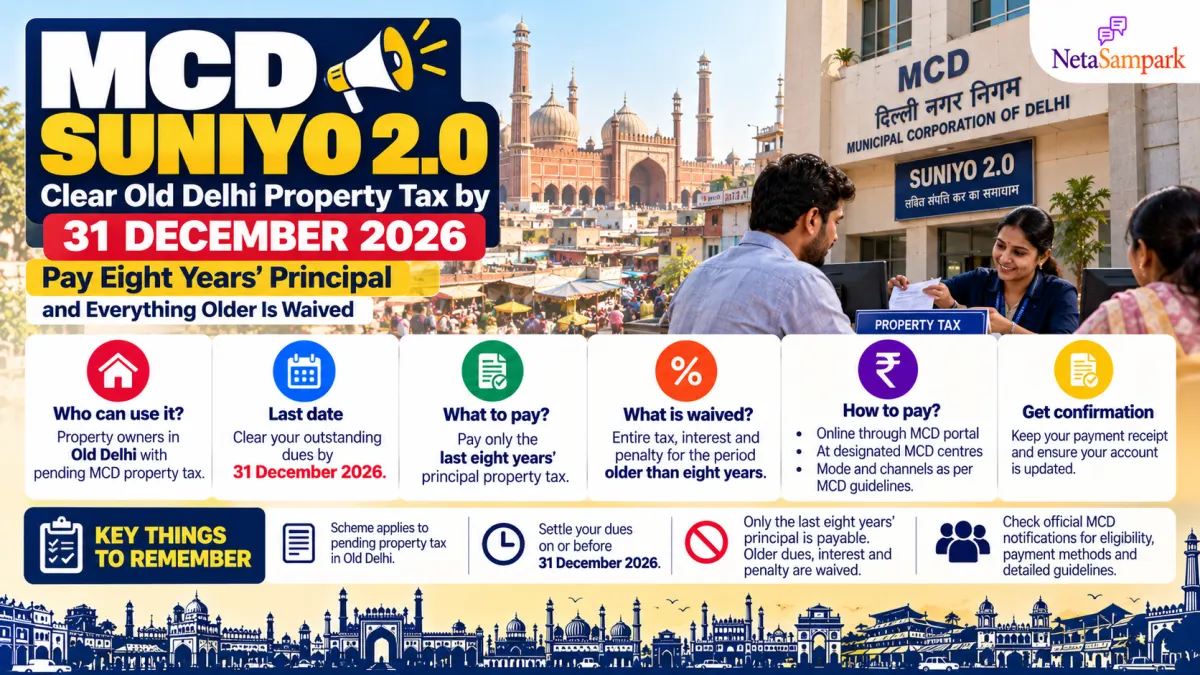
MCD SUNIYO 2.0: Clear Old Delhi Property Tax by 31 December 2026 — Pay Eight Years’ Principal and Get Relief on Older Dues
Have unpaid property tax in Delhi? The Municipal Corporation of Delhi (MCD) has introduced SUNIYO 2.0, also called the “One Plus Seven” property tax amnesty scheme, giving eligible property owners and occupiers an opportunity to settle outstanding dues.
Under the scheme, taxpayers must pay the prescribed principal property tax for the current financial year, 2026–27, and the previous seven financial years, 2019–20 to 2025–26. Eligible older dues, including interest and penalties, are waived under the scheme’s terms.
The last date to take advantage of SUNIYO 2.0 is 31 December 2026. The scheme is available for properties within MCD’s jurisdiction, subject to eligibility conditions.
What is MCD SUNIYO 2.0?
SUNIYO stands for Sampattikar Niptaan Yojana. It is a one-time property tax amnesty scheme intended to help taxpayers regularise outstanding property tax accounts.
The scheme was introduced through an MCD office order dated 29 September 2026 under Section 177 of the Delhi Municipal Corporation Act, 1957, as amended.
SUNIYO 2.0 at a glance
| Feature | Details |
|---|---|
| Scheme name | SUNIYO 2.0 — One Plus Seven |
| Deadline | 31 December 2026 |
| Financial years to pay | FY 2019–20 to FY 2026–27 |
| Amount payable | Prescribed principal property tax for the eight financial years |
| Older outstanding dues | Eligible dues before FY 2019–20 are waived under the scheme |
| Interest and penalties | Relief applies as specified in the scheme terms |
| Application method | Online through the MCD Property Tax Portal |
Which property tax years must you pay?
The scheme follows a “One Plus Seven” formula: one current financial year plus the preceding seven years.
| Financial year | Treatment under the scheme |
|---|---|
| 2019–20 | Principal tax payable |
| 2020–21 | Principal tax payable |
| 2021–22 | Principal tax payable |
| 2022–23 | Principal tax payable |
| 2023–24 | Principal tax payable |
| 2024–25 | Principal tax payable |
| 2025–26 | Principal tax payable |
| 2026–27 | Principal tax payable |
| Before 2019–20 | Eligible outstanding dues, including interest and penalties, waived under the scheme |
The waiver is conditional on meeting the scheme requirements. Do not assume that every amount previously paid or recovered will be refunded or adjusted.
Who can apply for SUNIYO 2.0?
The scheme covers eligible owners and occupiers of properties within MCD’s jurisdiction. It may help taxpayers who:
- Have never paid property tax on their property.
- Have paid property tax irregularly.
- Have underpaid their assessed tax liability.
- Have pending property tax recovery proceedings, including eligible attachment cases.
- Have had property tax cheques dishonoured.
- Have property tax litigation pending before a court, subject to additional conditions.
Specified government properties and properties belonging to certain government departments, Railways, public sector undertakings, autonomous bodies and statutory bodies are excluded. Check the official scheme order to determine whether your property qualifies.
What if your property tax case is pending in court?
Eligible taxpayers with pending property tax litigation may opt for the scheme, but they must submit the prescribed written undertaking agreeing to withdraw the proceedings.
The scheme also restricts refunds or adjustments of amounts already deposited in court, paid to MCD or recovered during the litigation. Review these conditions carefully before applying.
How to apply for MCD SUNIYO 2.0 online
Follow these steps to file your property tax return and claim the eligible relief.
Step 1: Open the official MCD portal
Visit the Municipal Corporation of Delhi website and navigate to the Property Tax Portal.
Step 2: Log in or register
Existing taxpayers can access their property records using the available login options. New taxpayers should register and obtain a Unique Property Identification Code (UPIC) for their property if required.
A separate UPIC is required for each property. If multiple UPICs exist for the same property, the portal provides a facility to request their merger.
Step 3: File the property tax return
Complete the online Self-Assessed Property Tax Return (SAPTR). Select the “Pay Tax (SUNIYO)” option where available.
Enter the correct property details and review the financial years covered by the scheme.
Step 4: Upload relevant documents
Keep previous property tax payment receipts and supporting documents ready. Upload the documents requested by the portal, particularly if you have made earlier payments or need to correct property records.
Step 5: Pay the prescribed principal tax
Pay the eligible principal property tax for FY 2019–20 through FY 2026–27 within the scheme period, following the portal’s calculation and payment instructions.
Step 6: Download your receipt
After successful filing and payment, download and preserve the payment receipt and the waiver certificate generated through the portal, where applicable. Check that your payment and property details are correctly recorded.
Can you pay SUNIYO 2.0 dues in instalments?
Yes. According to reports on the MCD scheme, taxpayers whose total liability under the scheme is ₹5 lakh or more may pay in equal instalments during the scheme period, subject to the prescribed conditions.
However, the full eligible amount must be paid by 31 December 2026. Missing the deadline or failing to complete payment can result in the withdrawal of the scheme benefit.
Confirm the applicable instalment schedule and conditions through the official MCD portal before relying on this facility.
What happens if you underpay or submit incorrect details?
MCD has indicated that returns filed under SUNIYO 2.0 will be scrutinised between 1 April 2027 and 31 March 2028.
If the scrutiny identifies an underpayment, the taxpayer may have to pay the outstanding difference along with a 30% penalty under the scheme’s terms. Incorrect returns may be rectified within two months or before the scheme closes, whichever comes first.
Therefore, do not understate your property details, covered years or tax liability merely to obtain the waiver.
Important things to check before paying
Before submitting your return, make sure you:
- Confirm that your property falls within MCD’s jurisdiction.
- Check the UPIC and property details for accuracy.
- Review the principal tax calculated for all eight financial years.
- Upload relevant earlier payment receipts.
- Read the conditions for pending litigation, if applicable.
- Confirm instalment eligibility if your liability is ₹5 lakh or more.
- Complete the required payment by 31 December 2026.
- Save the payment receipt and waiver certificate for your records.
Where can you get official information?
Use the following sources to check scheme conditions and access the online service:
- MCD official website: https://mcdonline.nic.in/
- MCD Property Tax Portal: Access it through the official MCD website.
- SUNIYO 2.0 office order: Look for the 2026–27 One Plus Seven property tax amnesty order in the MCD website’s Office Order section.
Always rely on the official scheme order and the liability shown on the MCD portal for your property-specific calculation.
Final takeaway
MCD SUNIYO 2.0 gives eligible property taxpayers an opportunity to settle old property tax liabilities under a defined amnesty arrangement. To qualify, taxpayers must pay the prescribed principal tax for FY 2019–20 to FY 2026–27 and meet the scheme’s other conditions.
The deadline is 31 December 2026. Check your property records, file the return online and preserve your payment documents so you can verify that the eligible waiver has been applied.