
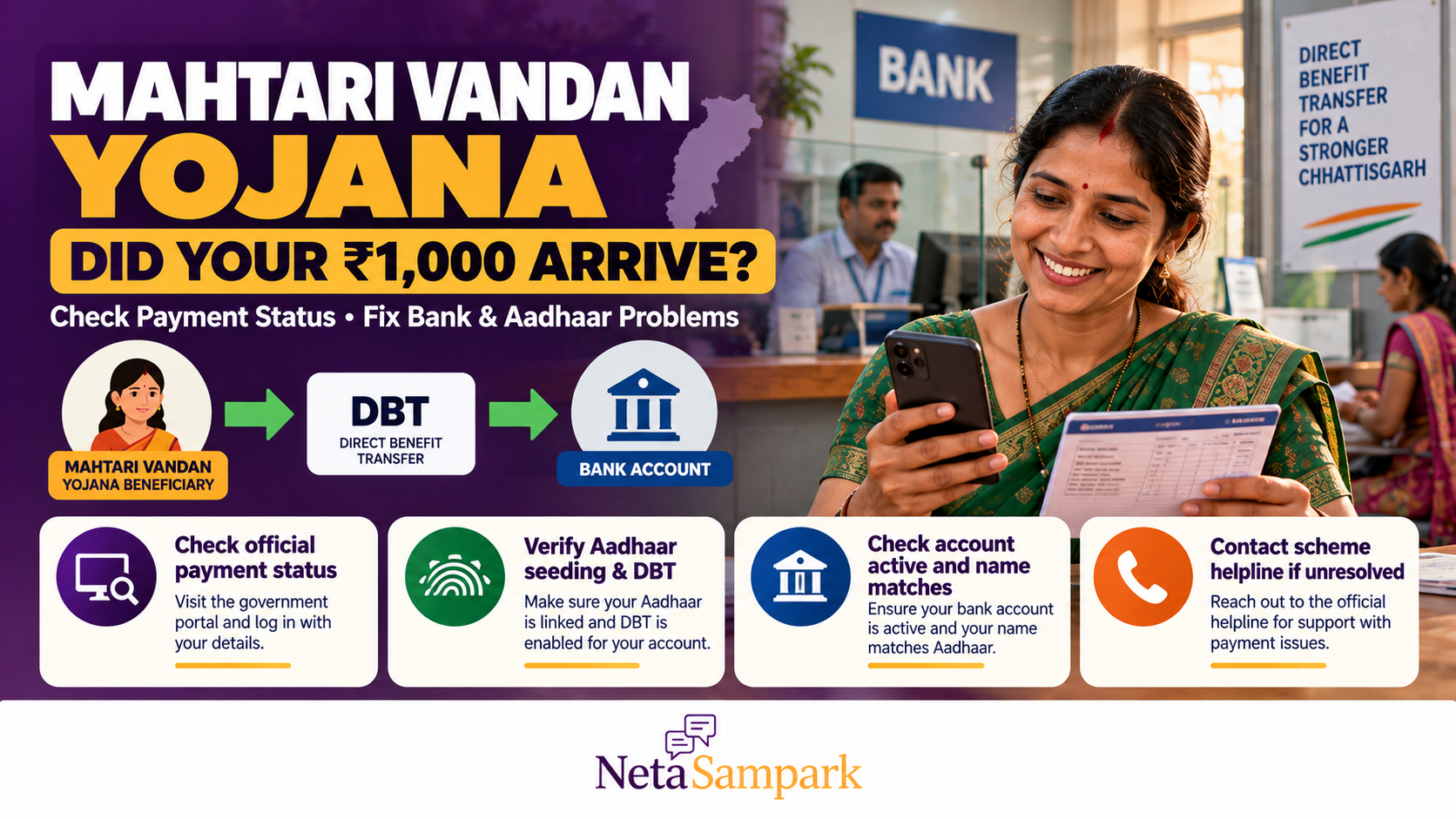
Mahtari Vandan Yojana: Did Your ₹1,000 Arrive? Check Payment Status, Fix Bank and Aadhaar Problems and Know Why an Instalment Stops
Are you a beneficiary of the Mahtari Vandan Yojana in Chhattisgarh, but your monthly ₹1,000 payment has not appeared in your bank account? Before assuming that your instalment has been stopped, check your beneficiary status, payment history and bank account details.
Under the scheme, eligible women receive ₹1,000 per month through Direct Benefit Transfer (DBT). However, a payment may be delayed or fail because of bank-account problems, Aadhaar seeding issues, incorrect beneficiary details or a change in eligibility.
The Chhattisgarh Women and Child Development Department provides an official online facility to check application and payment status using a beneficiary code, registered mobile number or Aadhaar number.
This guide explains how to use that facility, what to do when a payment is missing and where to seek help.
1 Mahtari Vandan Yojana: Key Details
| Particular | Details |
|---|---|
| Scheme | Mahtari Vandan Yojana |
| State | Chhattisgarh |
| Monthly assistance | ₹1,000 for eligible beneficiaries |
| Annual assistance | ₹12,000 if all 12 monthly instalments are received |
| Payment method | Direct Benefit Transfer (DBT) |
| Implementing department | Women and Child Development Department, Chhattisgarh |
| Official website | mahtarivandan.cgstate.gov.in |
| Payment status | Check application and payment status |
| Official portal helpdesk | 0771-2234192 |
| Official email | dirwcd.cg@gov.in |
The scheme was launched on 10 March 2024 to provide monthly financial assistance to eligible married women in Chhattisgarh. The government’s original announcement confirmed the ₹1,000 monthly benefit through DBT.
Official reference: Press Information Bureau — Launch of Mahtari Vandan Yojana.
2 How to Check Your Mahtari Vandan Yojana Payment Status Online
You do not need to rely only on a bank SMS to find out whether your instalment has been processed. Start with the official scheme portal.
Step-by-step process
- Open the official Mahtari Vandan Yojana payment-status page.
- Select one of the available identification options.
- Enter your beneficiary code, registered mobile number or Aadhaar number, as supported by the page.
- Enter the captcha shown on the screen.
- Submit the details.
- Review the information displayed about your application and payment status.
- Check whether the relevant monthly instalment is recorded as paid, pending, failed or otherwise marked by the portal.
The portal's status page lists these identification options and asks beneficiaries to submit the relevant details with the captcha.
What should you check in the result?
Look for the following information, where available:
- Whether your application is approved or requires further action.
- Whether you remain listed as a beneficiary.
- Whether the instalment for the month in question is recorded.
- Whether the payment has been processed or failed.
- Whether a reason or corrective action is displayed.
Save a screenshot or note the status and date for your records. If the portal gives a specific failure reason, use that information when contacting your bank or the scheme office.
Privacy tip: Use the official government website. Do not post your Aadhaar number, beneficiary details, bank account number or OTP in public comments or social-media groups.
3 Your Payment Is Missing: Check These Five Things First
Before submitting a complaint, check the most common causes of a missing DBT credit.
1. Check the payment entry on the scheme portal
A missing SMS does not necessarily mean that a payment has failed. Open the official status page and check the relevant month's entry.
If the portal shows that the payment has been processed, ask your bank to check the transaction history and any returned or rejected credit.
2. Check your bank account statement
Do not depend only on an SMS alert. Check your passbook, bank statement, mobile banking application or another official bank channel.
Confirm that the ₹1,000 credit has not been deposited into another eligible account linked to your beneficiary record.
3. Verify your Aadhaar-bank linking
DBT payments can be affected when Aadhaar seeding or the bank's NPCI mapping is incomplete or incorrect.
Contact your bank and ask whether:
- Your Aadhaar is seeded with the intended account.
- Your account is enabled to receive the relevant DBT payments.
- Your Aadhaar is mapped correctly in the NPCI system, where required.
- The account has any restriction preventing credits.
Aadhaar being linked to a bank account for ordinary identification purposes does not always establish that the account is correctly mapped for Aadhaar-based DBT.
4. Check whether your account is active
An inactive, frozen or otherwise restricted account can cause problems with receiving payments.
Ask your bank to check the account's operating status and whether it can receive government benefit transfers. Complete any required bank verification or account reactivation process.
5. Check your beneficiary details
If your name, Aadhaar details or bank information differs across records, ask the relevant office how to correct the scheme record.
Do not submit a duplicate application simply because a payment is missing. First establish whether the existing application is approved and what has happened to the instalment.
4 How to Fix Aadhaar Seeding and DBT Problems
If your payment status suggests an Aadhaar or DBT issue, the bank is an important first point of contact.
What to do at the bank
- Visit your bank branch or use its official customer-service channel.
- Explain that you are a Mahtari Vandan Yojana beneficiary and have not received the expected DBT payment.
- Ask the bank to verify Aadhaar seeding and NPCI mapping, where applicable.
- Check whether your account is active and eligible to receive DBT credits.
- If a correction is needed, complete the bank's prescribed process.
- Ask for an acknowledgement or reference number.
- After the bank confirms the correction, check the scheme portal again.
Carry your passbook, accepted identity documents and any relevant scheme reference. Follow the bank's instructions about whether an Aadhaar-seeding or DBT-mapping form is required.
What if you have more than one bank account?
Do not assume that the money will arrive in the account you use most often. For Aadhaar-based DBT, the mapped account may determine where a payment is routed.
Ask your bank to confirm which account is currently mapped for the relevant transfer mechanism. If you need to change the mapped account, request the bank's official procedure and obtain confirmation once the change is completed.
Never share your ATM PIN, internet-banking password or OTP with someone claiming they can release a government instalment.
5 Why Can a Mahtari Vandan Yojana Instalment Stop?
A missing payment can have different explanations. The correct solution depends on what the official status and the concerned office confirm.
| Possible reason | What you should do |
|---|---|
| Aadhaar seeding or DBT mapping problem | Ask your bank to verify and correct the relevant details. |
| Bank account inactive or restricted | Ask the bank to check account status and resolve any restriction. |
| Name or beneficiary-detail mismatch | Contact the scheme office or designated local official about correcting the record. |
| Payment marked failed | Check the portal for the stated reason and follow the relevant corrective procedure. |
| Application or beneficiary verification pending | Contact the Women and Child Development Department or designated local office. |
| Instalment not yet reflected online | Check again later and confirm whether the government has processed that month's payment. |
| Eligibility or beneficiary-record issue | Ask the competent scheme authority for the specific reason and the procedure, if any, to seek review. |
These are possible explanations, not a guarantee that any particular problem applies to your case. Use the status displayed for your own beneficiary record and ask the responsible authority to confirm the reason.
Can a payment stop because of eligibility verification?
Yes, a beneficiary record may require review if eligibility information is questioned or needs verification. However, a missing credit alone does not establish that you have become ineligible.
Ask the scheme office whether your beneficiary status has changed, what rule or verification issue is involved and whether you can submit documents or request a review.
6 Where to Complain If Your ₹1,000 Has Not Arrived
If you have checked the portal and your bank account but the issue remains unresolved, escalate it through the official channels.
Option 1: Use the scheme's official portal
Start with the Mahtari Vandan Yojana official website.
Check the application and payment-status section for the relevant month. If the portal offers a complaint facility, follow its instructions and retain the acknowledgement or complaint number.
Option 2: Contact the official helpdesk
The official scheme portal lists these contact details:
- Helpdesk: 0771-2234192
- Email: dirwcd.cg@gov.in
- Website: mahtarivandan.cgstate.gov.in
When contacting the helpdesk, explain the month for which payment is missing, the status displayed on the portal and any bank reference number you received.
Do not email unnecessary sensitive documents. Ask which information is required and use the official channel.
Option 3: Visit the relevant local office
If you cannot resolve the issue online, approach the appropriate Anganwadi centre, local Women and Child Development office or designated scheme official.
Take the information needed to identify your record, such as your beneficiary code and payment-status details. Ask the official to confirm whether the issue concerns eligibility, verification, bank details or payment processing.
Option 4: Escalate an unresolved complaint
If the initial complaint does not resolve the issue, contact the district-level Women and Child Development office or the department through its official grievance mechanism.
Keep a record of the dates you contacted the bank and the department, along with any complaint numbers and written responses.
7 Complaint Template for a Missing Instalment
You can adapt this message for the scheme helpdesk or the relevant district office.
Subject: Request to investigate missing Mahtari Vandan Yojana instalment
To the Concerned Officer,
I am a beneficiary of the Mahtari Vandan Yojana in Chhattisgarh. I have not received the expected ₹1,000 instalment for [month and year].
I checked my application and payment status on the official portal on [date]. The status displayed is [briefly describe the status or failure reason].
I have also checked my bank account and contacted the bank regarding Aadhaar seeding, DBT mapping and account status. The details of the action taken so far are [briefly explain].
I request you to verify my beneficiary record, confirm the reason for the missing payment and inform me of the steps required to resolve the issue.
Details for identification:
- Beneficiary name:
- Beneficiary code:
- District:
- Month of missing instalment:
- Portal status:
- Bank complaint reference, if applicable:
- Contact details:
Please acknowledge my complaint and provide a reference number for follow-up.
Thank you.
[Your name]
Submit sensitive identifying information only through the official channel and only to the extent required.
8 Who Is Eligible for Mahtari Vandan Yojana?
The scheme was introduced to provide financial assistance to eligible married women in Chhattisgarh. The original launch announcement specified monthly assistance of ₹1,000 for eligible women.
Eligibility and exclusions must be checked against the current scheme guidelines and the beneficiary's verified record. Do not assume that every woman in Chhattisgarh automatically qualifies or that a missing instalment necessarily means the beneficiary has been removed.
If your status indicates an eligibility issue, request the exact reason from the competent authority before deciding what action to take.
Frequently Asked Questions
How much money is paid under Mahtari Vandan Yojana?
Eligible beneficiaries receive ₹1,000 per month through DBT. Receiving all 12 instalments in a year would total ₹12,000.
How can I check whether my ₹1,000 has arrived?
Visit the official application and payment-status page. Enter your beneficiary code, registered mobile number or Aadhaar number as supported by the portal, complete the captcha and review the result.
What if the portal shows payment processed but my account has not been credited?
Check your bank statement and ask your bank to trace the transaction. Request a reference number for your enquiry, then contact the scheme helpdesk with the portal status and bank response.
Can an Aadhaar or NPCI mapping problem affect my payment?
Yes. Incorrect or incomplete seeding or mapping can affect Aadhaar-based DBT transfers. Ask your bank to verify the relevant status and correct it if necessary.
Will the government automatically send a missed instalment later?
Do not assume that every missing instalment will automatically be credited later. First establish whether the payment is pending, failed, returned or affected by beneficiary verification. Ask the scheme authority what action is required in your case.
Whom should I contact if I cannot check my status online?
Use the official scheme helpdesk at 0771-2234192 or email dirwcd.cg@gov.in. You can also approach the appropriate local Women and Child Development office.
Final Checklist: What to Do If Your Instalment Is Missing
- Check your beneficiary and payment status on the official portal.
- Review your bank statement rather than relying only on an SMS.
- Verify Aadhaar seeding and DBT mapping with your bank.
- Confirm that your bank account is active and can receive credits.
- Ask the scheme office to clarify any beneficiary-record or eligibility issue.
- Submit a complaint through an official channel and retain the reference number.
- Follow up with the bank or department using the recorded reference.
Official links
- Mahtari Vandan Yojana portal
- Application and payment status
- Press Information Bureau — Scheme launch and monthly assistance
A missing ₹1,000 instalment does not automatically mean your benefit has been cancelled. Check the official status first, verify your bank and Aadhaar-related details, and ask the scheme authority to identify the exact reason before taking further action.