
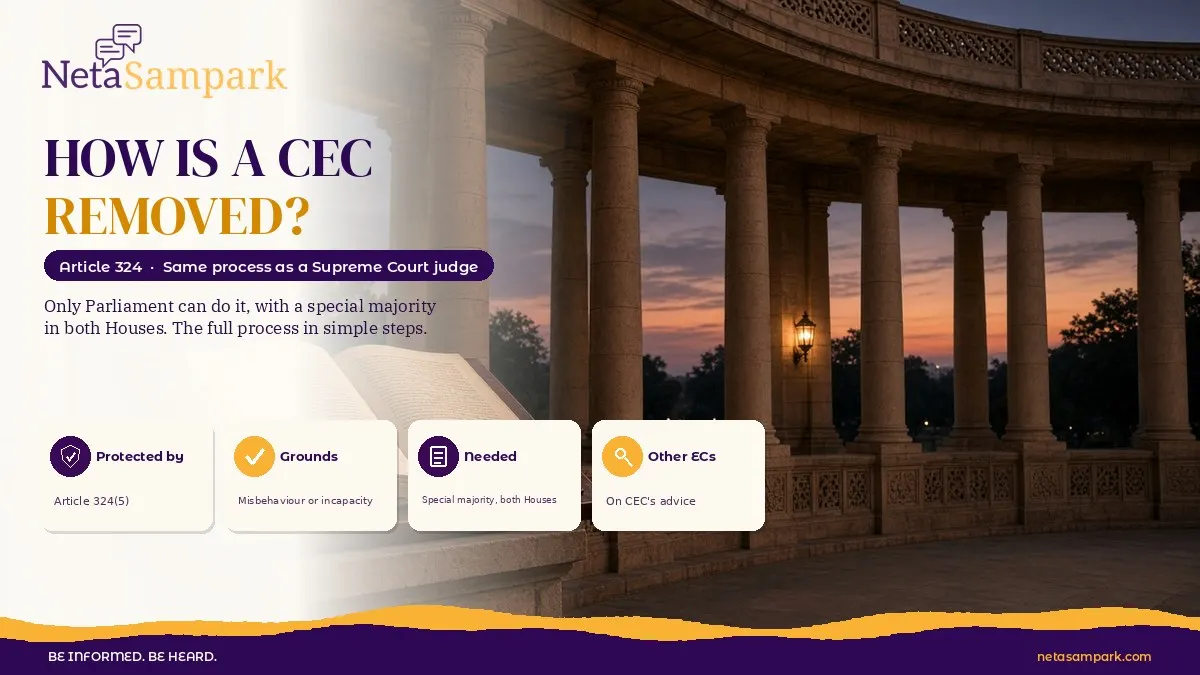
A Chief Election Commissioner can be removed only the way a Supreme Court judge is removed: a motion in Parliament on proved misbehaviour or incapacity, an inquiry by a three-member committee, a special majority in both Houses in the same session, and finally an order of the President. No CEC has ever been removed this way.
Updated 30 October 2026
Quick facts
| Item | Details |
|---|---|
| Official portal | Constitution of India, Legislative Department (Article 324, Article 124) and India Code for the 2023 Act and the Judges (Inquiry) Act, 1968 |
| Helpline | Not applicable; for election complaints call Voter Helpline 1950 |
| Fee | None; this is a parliamentary process |
| Deadline | None fixed; but both Houses must pass the motion in the same session |
| Documents | Notice of motion signed by at least 100 Lok Sabha MPs or 50 Rajya Sabha MPs |
| Grounds | Proved misbehaviour or incapacity only |
| Related posts | How SIR voter list revision works, Why names get deleted in SIR |
Why is this question coming up now?
The Election Commission's Special Intensive Revision (SIR) of voter lists has been in the news all through 2026, with deadline extensions, court hearings and political arguments. Some opposition leaders have publicly talked about removing the Chief Election Commissioner (CEC). Whatever side you're on, it helps to know how the law actually works, because a speech, a rally or a public event doesn't remove anyone. Only Parliament can, through a very tough process.
This explainer sticks to the rules. It doesn't take a side.
What does the Constitution say?
Article 324(5) says the CEC "shall not be removed from his office except in like manner and on the like grounds as a Judge of the Supreme Court". It also says the conditions of service of the CEC can't be changed to his disadvantage after appointment.
The Chief Election Commissioner and Other Election Commissioners (Appointment, Conditions of Service and Term of Office) Act, 2023 repeats this in Section 11. The same section says other Election Commissioners can be removed only on the recommendation of the CEC.
So the CEC gets the same protection as a Supreme Court judge. That's deliberate. The makers of the Constitution wanted the person running elections to be safe from pressure by the government of the day.
What counts as a valid ground?
Only two grounds are allowed:
Proved misbehaviour, meaning wrongdoing that's established through the inquiry.
Incapacity, meaning the person isn't able to do the job, for example due to serious illness.
Political disagreement with decisions isn't a ground by itself. The charge has to be framed and proved before a committee.
How does the removal process work, step by step?
The procedure comes from Article 124(4) and the Judges (Inquiry) Act, 1968.
1. Notice of motion. At least 100 Lok Sabha members or 50 Rajya Sabha members sign a notice for a motion to remove. It's given to the Speaker (Lok Sabha) or the Chairman (Rajya Sabha).
2. Admission or rejection. The Speaker or Chairman may consult people and look at the material, and then decide whether to admit the motion or refuse it. If refused, the process ends there.
3. Inquiry committee. If admitted, a three-member committee is formed: a Supreme Court judge, a High Court Chief Justice and a distinguished jurist. If notices are given in both Houses on the same day, a joint committee is formed only after both Houses admit it.
4. Charges and hearing. The committee frames specific charges, gives the CEC a copy and a fair chance to defend, and can call witnesses.
5. Report. The committee reports to the House. If it finds the charges not proved, the motion goes no further.
6. Vote in both Houses. If the charges are proved, each House must pass the motion by a special majority: a majority of its total membership, and at least two-thirds of members present and voting.
7. Same session. Both Houses have to do this in the same session of Parliament.
8. President's order. An address is then presented to the President, who orders the removal.
How hard is the special majority, in numbers?
Take the Lok Sabha with 543 seats. A majority of total membership means at least 272 votes in favour. On top of that, the "yes" votes must be at least two-thirds of those present and voting. If 450 members vote, you'd need 300 votes. The Rajya Sabha has to clear the same kind of bar.
That's why removal motions against judges have rarely gone all the way, and no CEC has been removed so far.
Can Election Commissioners be removed the same way?
No. Other Election Commissioners don't get the full judge-level protection. They can be removed by the President, but only on the CEC's recommendation, under Article 324(5) and Section 11 of the 2023 Act.
Is there any other way to remove a CEC?
The CEC's term ends on completing six years or reaching 65 years of age, whichever comes first. A CEC can also resign by writing to the President. Apart from these, the parliamentary route above is the only way.
Courts can review specific decisions of the Election Commission, but a court ruling against a decision doesn't remove the CEC.
What can you, as a citizen, actually do?
Know the facts. Read the Commission's own orders on eci.gov.in instead of forwards.
Use your vote. Check your name in the voter list and file Form 6 if it's missing. Our SIR deadline post shows how to track your form.
Talk to your MP. Your MP votes on such motions. Find yours on NetaSampark's Know Your Neta and rate how they represent you.
Examples to make it clear
Example 1. A party holds a rally demanding the CEC's removal. Legally nothing changes. No notice, no committee, no vote.
Example 2. 120 Lok Sabha MPs sign a notice. The Speaker refuses to admit it. The process stops.
Example 3. A notice is admitted, the committee finds the charges not proved. The motion can't be put to vote.
Checklist: what must happen for removal
☐ Notice signed by 100 Lok Sabha MPs or 50 Rajya Sabha MPs
☐ Motion admitted by the Speaker or Chairman
☐ Three-member inquiry committee formed
☐ Charges of misbehaviour or incapacity proved
☐ Special majority in Lok Sabha
☐ Special majority in Rajya Sabha, in the same session
☐ Order of the President
Final reminder
Removing a CEC is meant to be rare and difficult, and that protects the voter more than any politician. If you care about clean elections, the best thing you can do is make sure your own name is on the roll and your MP hears your view.
Frequently asked questions
Who can remove the Chief Election Commissioner?
Only the President, after both Houses of Parliament pass a removal motion by special majority on proved misbehaviour or incapacity.
How many MPs must sign a notice to remove the CEC?
At least 100 Lok Sabha members or at least 50 Rajya Sabha members.
Has any Chief Election Commissioner been removed in India?
No. No CEC has been removed through this process so far.
Can the government remove the CEC on its own?
No. The government can't remove the CEC. Article 324(5) gives the CEC the same protection as a Supreme Court judge.
Can Election Commissioners be removed more easily?
Yes, they can be removed by the President, but only on the recommendation of the CEC.
Sources
Constitution of India, Legislative Department (Article 124(4), Article 324(5))
India Code: Chief Election Commissioner and Other Election Commissioners Act, 2023
India Code: Judges (Inquiry) Act, 1968
Lok Sabha and Rajya Sabha