
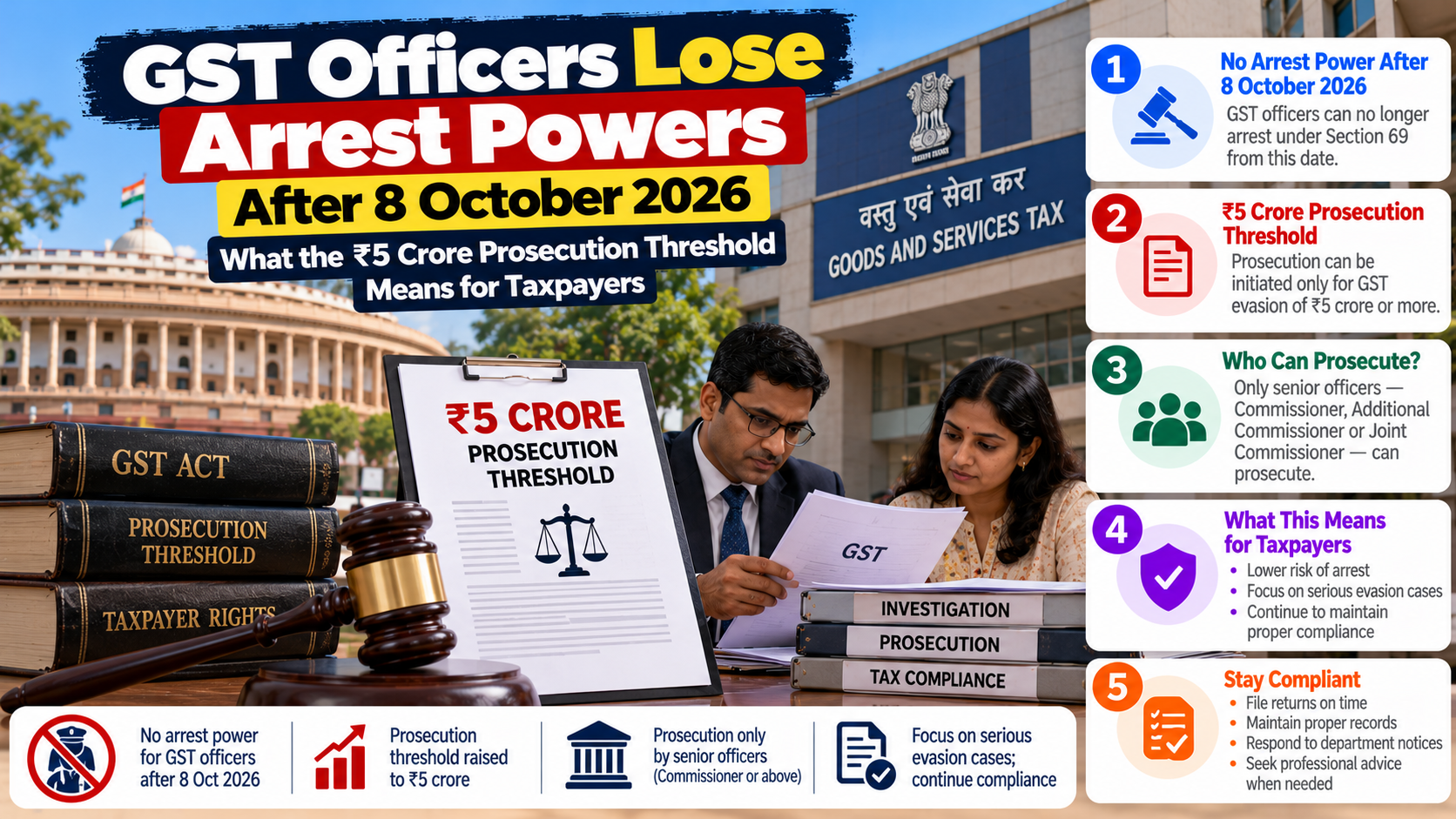
GST Officers Lose Arrest Powers After 8 October 2026? What the ₹5 Crore Prosecution Threshold Means for Taxpayers
The Goods and Services Tax (GST) Council has recommended a major change to how GST-related offences are investigated and prosecuted. At its 57th meeting on 8 October 2026, the Council recommended removing GST arrest provisions, raising the prosecution threshold from ₹1 crore to ₹5 crore and reducing the maximum general penalty under Section 125 of the CGST Act from ₹25,000 to ₹10,000.
These recommendations could significantly change the compliance environment for businesses, traders and other GST-registered taxpayers.
However, there is one important distinction: the GST Council's announcement is a recommendation to amend the law, not proof that the arrest provisions ceased to operate immediately on 8 October 2026. The relevant statutory amendments and commencement notifications must be checked before treating the changes as legally effective.
Official source: Ministry of Finance — Recommendations of the 57th GST Council Meeting.
What Did the GST Council Recommend?
The 57th GST Council meeting focused on simplifying compliance, reducing unnecessary litigation and making GST enforcement more consistent.
The key recommendations relevant to taxpayers are:
| Issue | Earlier provision | Council's recommendation |
|---|---|---|
| GST arrest provisions | Section 69 of the CGST Act provides for arrest in specified circumstances | Omit Section 69 |
| Prosecution threshold | Generally ₹1 crore for relevant offences under Section 132 | Raise the threshold to ₹5 crore |
| General penalty under Section 125 | Maximum ₹25,000 under the provision, subject to its terms | Reduce to ₹10,000 |
| Certain GST offences | Criminal provisions cover specified conduct under Section 132 | Remove or narrow specified offences and rationalise punishment |
These are the principal recommendations announced by the Ministry of Finance on 8 October 2026. Their practical effect depends on the final amendments and the dates on which they come into force.
What Does the ₹5 Crore Prosecution Threshold Mean?
The Council recommended increasing the monetary threshold for prosecution from ₹1 crore to ₹5 crore.
In simple terms, this would reserve criminal prosecution under the relevant GST provisions for cases involving substantially larger amounts than under the previous threshold.
Consider the following illustration:
| Illustrative tax amount involved | What the proposed threshold could mean |
|---|---|
| ₹40 lakh | Below the proposed ₹5 crore threshold |
| ₹90 lakh | Below the proposed ₹5 crore threshold |
| ₹2 crore | Below the proposed ₹5 crore threshold |
| ₹4.8 crore | Below the proposed ₹5 crore threshold |
| ₹5 crore or more | Meets the proposed monetary threshold, subject to the applicable offence and other legal conditions |
Important: These examples explain the monetary threshold only. They do not determine whether a particular case can be prosecuted under the law in force on a given date.
A threshold increase is not the same as a blanket exemption from GST liability. Tax recovery, interest, civil penalties, adjudication and other enforcement provisions can continue to apply even when a case falls below the proposed criminal prosecution threshold.
Does ₹5 Crore Mean Every Case Above That Amount Will Lead to Prosecution?
No.
A monetary threshold does not, by itself, establish that an offence has occurred.
The authorities must still consider the relevant statutory offence, the facts, the evidence and the applicable legal requirements.
The Council also recommended changes to Section 132, including:
- Omitting clause (i) of Section 132(1).
- Removing the words “evades tax” from clause (e).
- Removing the words “or in any other manner deals with” from clause (h).
- Narrowing clause (c) to cover fraudulent availment of input tax credit without receipt of goods or services, or without an invoice or bill.
- Rationalising punishments for specified offences.
These proposed changes matter because the legal definition of an offence can be as important as the amount involved.
The final statutory text should be checked before determining whether conduct is criminally prosecutable.
What Does Removing Arrest Provisions Mean?
Section 69 of the CGST Act currently provides the statutory framework for authorising arrests in specified GST-related cases.
The Council recommended omission of Section 69, which would remove the arrest powers currently provided by that section once the relevant amendment becomes effective.
This is a significant proposal because arrest is a coercive enforcement measure with serious consequences for an individual and a business.
But taxpayers should not interpret the announcement as an immediate legal guarantee that no arrest can take place in connection with any GST matter after 8 October 2026.
The legal position depends on the applicable legislation, amendments, commencement provisions and any other relevant law.
Until the change is formally brought into force, businesses should continue to assess their position under the law currently applicable to their case.
Does This Mean GST Officers Cannot Investigate Tax Evasion?
No.
Removing a statutory arrest provision is different from eliminating the department's investigation and tax-administration functions.
GST authorities can continue to exercise powers available under the law in force, including applicable powers relating to:
- Scrutiny of returns
- Requests for information and documents
- Audits and inspections
- Investigations into suspected tax evasion
- Show-cause notices
- Tax demands and adjudication
- Recovery of legally payable dues
- Penalties and interest where applicable
The Council's recommendations do not mean that GST registration, invoice reporting, return filing or payment obligations disappear.
Businesses should therefore continue to maintain accurate records, report transactions correctly and respond to lawful departmental communications.
What Happens to GST Cases Below ₹5 Crore?
The proposed increase in the prosecution threshold should not be confused with cancellation of the underlying tax demand.
For example, suppose a business faces a disputed GST demand of ₹80 lakh.
If the recommended ₹5 crore threshold becomes applicable to the relevant prosecution provision, the amount would fall below that monetary threshold. That does not automatically mean:
- The tax demand is cancelled.
- Interest is waived.
- A civil penalty cannot be imposed.
- An assessment or adjudication must stop.
- An existing notice is automatically withdrawn.
- The business can ignore departmental proceedings.
The outcome depends on the type of allegation, the statutory provision involved, the procedural stage and the law applicable to the case.
Taxpayers should distinguish between criminal prosecution, civil tax proceedings and recovery of tax dues. They are related but separate legal processes.
What Is Changing About the General Penalty?
The GST Council recommended reducing the maximum general penalty under Section 125 of the CGST Act from ₹25,000 to ₹10,000.
Section 125 is a general penalty provision that applies where a person contravenes the CGST Act or rules and no separate penalty is provided for that contravention.
The recommendation does not mean that every GST penalty will automatically become ₹10,000.
Specific offences have their own penalty provisions. The amount payable depends on the applicable section, the nature of the contravention and the relevant statutory conditions.
The final amendment and commencement date should be checked before applying the revised limit to a particular notice or proceeding.
What Should Small Businesses Do Now?
The announcement may reduce concern about criminal enforcement for certain GST-related matters, but it should not be treated as a reason to relax compliance controls.
Businesses should continue to:
- File GST returns within the prescribed deadlines.
- Reconcile GSTR-1, GSTR-3B and purchase records.
- Verify supplier invoices and input tax credit eligibility.
- Maintain invoices, e-way bills and payment records.
- Respond to show-cause notices within the specified time.
- Keep evidence supporting genuine transactions and ITC claims.
- Seek professional advice where an allegation involves fraud, false invoices or deliberate tax evasion.
- Check official notifications before relying on the new prosecution threshold or arrest-related changes.
For businesses with pending disputes, the relevant question is not simply whether the amount is below ₹5 crore. It is whether the recommended amendment has come into force and how its transitional provisions apply to the particular case.
What About Existing GST Investigations and Notices?
A policy announcement does not automatically terminate ongoing investigations or pending notices.
If a taxpayer already has a notice, investigation, adjudication order or prosecution-related proceeding, the applicable law and the stage of the proceeding must be examined.
Businesses should not assume that:
- An existing notice becomes invalid.
- An ongoing investigation must stop.
- A prosecution already initiated automatically ends.
- A tax demand below ₹5 crore is automatically extinguished.
The final amendment may include commencement and transitional provisions that determine how the changes apply to existing cases. Those provisions should be read carefully once the relevant legal text is officially published.
Where Should Taxpayers Verify the Changes?
Use official sources rather than relying solely on headlines or social-media summaries.
- GST Council recommendations: Ministry of Finance — 57th GST Council meeting
- GST portal: www.gst.gov.in
- CBIC: Central Board of Indirect Taxes and Customs
- Central legislation: India Code
When checking whether a reform is effective, look for the relevant amendment to the CGST Act, the official Gazette notification and the commencement date. A press release describing a recommendation is not a substitute for the operative statutory text.
GST Arrest Powers and the ₹5 Crore Threshold: Key Takeaways
The 8 October 2026 GST Council announcement contains three important proposals:
- Arrest provisions: The Council recommended omitting Section 69 of the CGST Act.
- Prosecution threshold: The Council recommended increasing the threshold from ₹1 crore to ₹5 crore.
- General penalty: The Council recommended reducing the maximum general penalty under Section 125 from ₹25,000 to ₹10,000.
The Council also recommended narrowing or removing specified offences and rationalising punishments under Section 132.
These measures are intended to make GST enforcement more proportionate while retaining mechanisms to address serious fraud and evasion.
The bottom line: The announcement is an important policy development, but taxpayers should not assume that GST officers' arrest powers legally ended on 8 October 2026. Verify the enacted amendments and their effective dates before relying on the proposed changes in an investigation, notice or prosecution.