
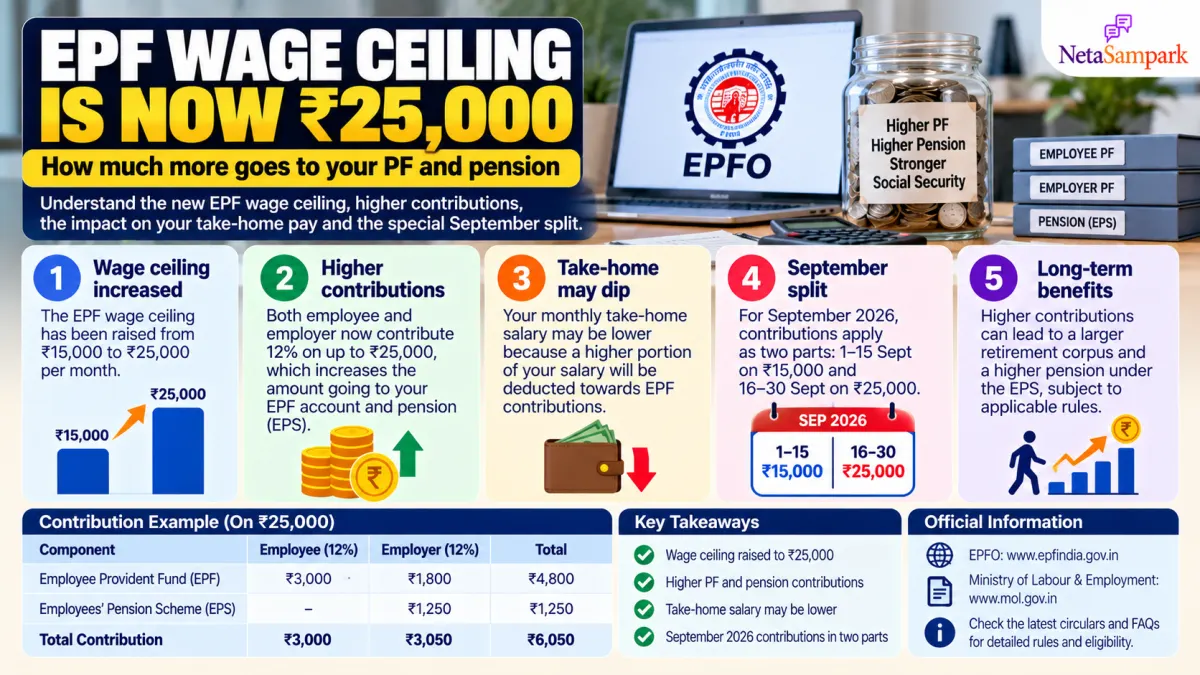
EPF Wage Ceiling Is Now ₹25,000: How Much More Goes to Your PF and Pension, Why Your Take-Home May Dip and What the September Split Means
India’s Employees’ Provident Fund (EPF) wage ceiling has increased from ₹15,000 to ₹25,000 per month, effective 17 September 2026. The change expands mandatory social-security coverage and may increase PF contributions for eligible employees whose contributions were previously restricted to the lower ceiling.
The Union Cabinet approved the change on 16 September, and the revised ceiling was notified the following day. The government estimates that more than 51 lakh additional employees could come under mandatory EPFO coverage, subject to applicable eligibility conditions.
Official announcement: Ministry of Labour and Employment — PIB.
1 What has changed?
The wage ceiling is the limit used to determine mandatory coverage under the EPF framework. It is not a rule requiring every employee to contribute on exactly ₹25,000.
| Particulars | Earlier ceiling | Revised ceiling |
|---|---|---|
| Monthly wage ceiling | ₹15,000 | ₹25,000 |
| Employee EPF contribution at the ceiling (12%) | ₹1,800 | ₹3,000 |
| Employer contribution at the ceiling (12%) | ₹1,800 | ₹3,000 |
| Maximum employer EPS contribution at 8.33% | ₹1,250 | About ₹2,083 |
The contribution rates have not increased simply because the ceiling has changed. Instead, contributions can now be calculated on a higher applicable wage, subject to the scheme rules. The employer’s contribution is divided between EPF and the Employees’ Pension Scheme (EPS), where applicable.
Source: PIB — EPFO wage ceiling revision.
2 How much more could go into your PF?
Consider an employee whose applicable PF wages are ₹20,000 per month and whose contributions were previously capped at ₹15,000.
From October 2026, assuming contributions apply to the full ₹20,000 and the employee is eligible for EPS membership, the monthly calculation would be approximately:
| Contribution | Calculation | Monthly amount |
|---|---|---|
| Employee EPF | 12% of ₹20,000 | ₹2,400 |
| Employer EPS | 8.33% of ₹20,000 | ₹1,666 |
| Employer EPF | 3.67% of ₹20,000 | ₹734 |
| Total employee and employer contributions | 24% of ₹20,000 | ₹4,800 |
Previously, if contributions were restricted to ₹15,000, the employee’s share was ₹1,800 per month. Under the example above, that rises by ₹600 per month.
The employer’s contribution also increases, although the amount credited directly to the EPF account differs because part of the employer’s share goes to EPS.
These figures are illustrative. Actual deductions depend on the applicable PF wage definition, membership status and contribution arrangements.
3 Why your take-home salary may fall
An employee’s EPF contribution is deducted from salary and credited to their provident fund account. If the contribution base increases, the monthly deduction may also increase.
For example:
- Earlier employee contribution on ₹15,000: ₹1,800.
- Employee contribution on ₹20,000: ₹2,400.
- Potential additional monthly deduction: ₹600.
This does not mean the employee has lost ₹600. The additional amount goes towards retirement savings, subject to the applicable rules. However, it can reduce the cash received in the current month.
The impact will differ by employee. Someone already contributing on full wages above the old ceiling may see little or no change from this revision alone. Employees newly brought into mandatory coverage may experience a more noticeable change.
4 What the September 2026 split means
The revised ceiling took effect on 17 September 2026, rather than on the first day of the month. Employers therefore need to account for two periods when calculating September contributions.
| September period | Applicable ceiling |
|---|---|
| 1–16 September 2026 | ₹15,000 |
| 17–30 September 2026 | ₹25,000 |
For an employee earning ₹20,000 in applicable PF wages who was not previously covered because the wages exceeded the old ceiling, the September contribution calculation is different from a full month at ₹20,000. The first 16 days and the remaining 14 days are treated according to the applicable rules and the employee’s membership status.
The September change does not mean that every employee should simply calculate PF on ₹25,000 for the entire month. Employers must use the correct contribution periods and applicable wage base.
EPFO’s guidance also addresses situations where an additional employee deduction could not be made in the September payroll. In eligible cases, recovery may be deferred to the next payroll cycle, while the employer must still meet the applicable statutory filing and remittance requirements.
For details, see the EPFO wage-ceiling FAQs.
5 What happens to your pension?
The Employees’ Pension Scheme (EPS) receives part of the employer’s contribution for eligible members. Raising the wage ceiling permits pensionable wages to be considered up to the revised limit under the applicable provisions.
The maximum employer EPS contribution at 8.33% rises from ₹1,250 on ₹15,000 to approximately ₹2,083 on ₹25,000.
This may improve future pension benefits for eligible employees whose pensionable wages increase under the revised framework. However, it does not mean every existing employee or pensioner will automatically receive a higher pension. Actual benefits depend on pensionable salary, pensionable service, membership history and the applicable EPS rules.
6 Who needs to check their PF status?
The change is particularly relevant to:
- Employees earning applicable PF wages above ₹15,000 and up to ₹25,000 who were previously excluded solely because of the old ceiling.
- Existing members whose contributions were restricted to ₹15,000 despite higher applicable PF wages.
- Employees who are PF members but whose EPS membership or contribution treatment may change under the revised rules.
- Employers and payroll teams processing September 2026 contributions.
The revised ceiling does not automatically mean every person earning up to ₹25,000 qualifies in every circumstance. Eligibility and existing membership provisions still matter. Nor does it mean that an employee earning more than ₹25,000 must stop contributing on higher wages if an applicable higher-wage arrangement already exists.
7 What should employees do now?
- Check your salary slip: Compare the employee PF deduction before and after the change.
- Review your UAN passbook: Check whether contributions have been credited correctly.
- Ask payroll about September: If the deduction looks different, ask how the 1–16 September and 17–30 September periods were calculated.
- Check your EPS status: If your wages fall within the revised ceiling and you were previously excluded, ask whether your membership has been updated.
- Raise discrepancies promptly: Contact your employer’s payroll team first and consult EPFO’s official channels if the issue remains unresolved.
Official resources: EPFO and Ministry of Labour and Employment.
The bottom line
The EPF wage ceiling increase from ₹15,000 to ₹25,000 is intended to bring more eligible workers into formal retirement savings, pension and insurance protection. For some employees, it means higher monthly PF deductions and a lower take-home amount; for others, the impact may be limited.
The key is to check your actual PF wages, membership status and September payroll calculation rather than assuming that the revised ceiling changes everyone’s contributions in the same way.