
Add Up to 4 Nominees to Your Bank Account or Locker: New Nomination Rules, Forms and How to Avoid Claim Delays
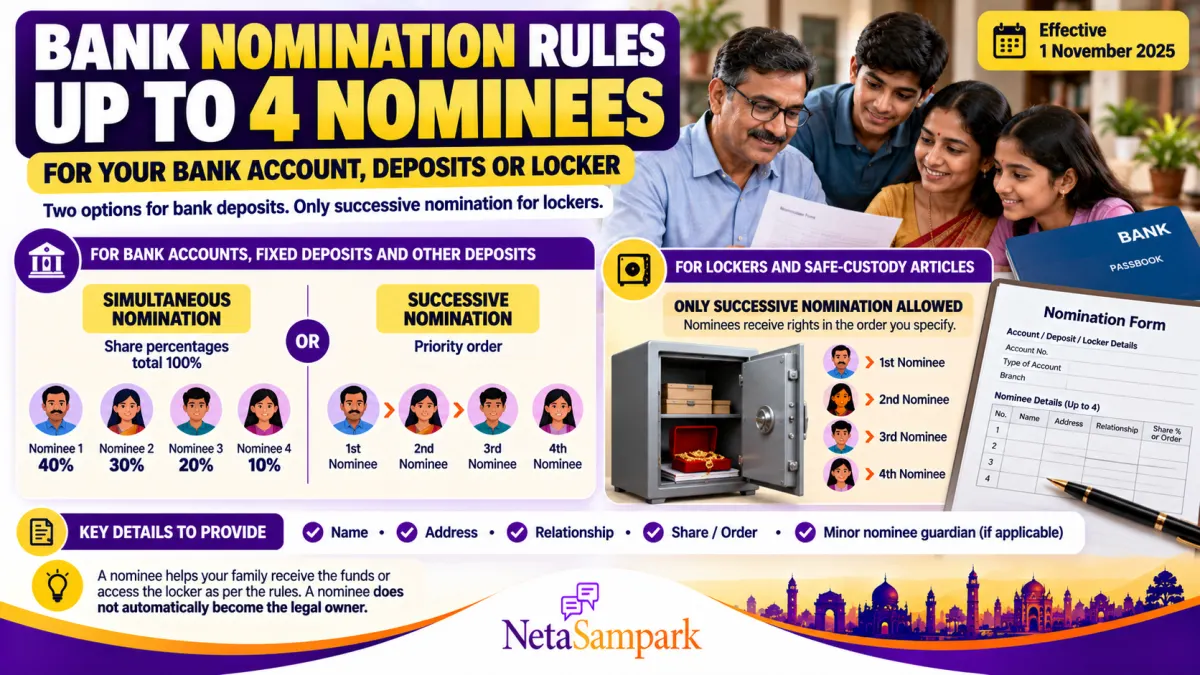
Bank customers in India can now nominate up to four people for eligible bank deposits, safe-custody articles and safety lockers under the Banking Laws (Amendment) Act, 2025. The new nomination provisions took effect on 1 November 2025, giving customers more flexibility in deciding who should receive deposits or access locker contents after their death.
For bank deposits, customers can choose between simultaneous nomination, which allocates specified percentages among nominees, and successive nomination, which establishes an order of priority. For safety lockers and articles kept in safe custody, only successive nomination is permitted.
The change is important for anyone with a savings account, fixed deposit, recurring deposit or bank locker. A correctly completed and registered nomination can help reduce paperwork and delays when a family makes a claim.
Official announcement: Press Information Bureau — Ministry of Finance
New Bank Nomination Rules: Key Details
| Particular | What the rules provide |
|---|---|
| Maximum nominees | Up to four |
| Effective date | 1 November 2025 |
| Bank deposits | Simultaneous or successive nomination |
| Safety lockers | Successive nomination only |
| Safe-custody articles | Successive nomination only |
| Simultaneous nomination | Specify each nominee’s percentage; total must equal 100% |
| Successive nomination | Nominees are listed in priority order |
| Who can be nominated? | Individuals, subject to applicable rules |
| Where to apply | Through your bank’s prescribed nomination process |
These provisions are part of the Banking Laws (Amendment) Act, 2025 and the Banking Companies (Nomination) Rules, 2025.
1 What Has Changed Under the New Nomination Rules?
Previously, bank nomination arrangements generally allowed one nominee for an individual deposit account. The amended framework permits up to four nominees, allowing customers to structure nominations according to their circumstances.
The main changes are:
- Multiple nominees: You can name up to four individuals.
- Two options for deposits: You can allocate shares among nominees or list them in priority order.
- Locker-specific rules: Locker nominations must follow the successive method.
- Clearer allocation: Simultaneous nomination records the percentage assigned to each nominee.
- Updated forms and procedures: Banks use the prescribed nomination framework for making, changing or cancelling nominations.
The rules do not mean that every account holder must appoint four nominees. You can nominate fewer people according to your needs.
2 Simultaneous vs Successive Nomination: Which Should You Choose?
The choice depends on whether you want several nominees to receive specified shares or prefer a priority order.
Option A: Simultaneous nomination
With simultaneous nomination, you name up to four nominees and assign a percentage of the deposit to each one.
For example, suppose a deposit is worth ₹10 lakh. You might specify:
| Nominee | Illustrative share | Amount on a ₹10 lakh deposit |
|---|---|---|
| Spouse | 40% | ₹4,00,000 |
| Child 1 | 30% | ₹3,00,000 |
| Child 2 | 20% | ₹2,00,000 |
| Parent | 10% | ₹1,00,000 |
| Total | 100% | ₹10,00,000 |
These figures are only an illustration. You must select the shares that suit your circumstances, and the total percentage must equal 100%.
Best suited for: Customers who want a stated percentage allocation among multiple nominees for a bank deposit.
Remember that the nomination records the bank’s intended payment arrangement. It does not, by itself, settle every question of inheritance or beneficial ownership.
Option B: Successive nomination
With successive nomination, you list nominees in order of priority. The first nominee is the primary nominee. The next nominee becomes operative if the person placed higher in the order has died, subject to the applicable rules.
For example:
- First nominee: Spouse
- Second nominee: Child
- Third nominee: Parent
- Fourth nominee: Sibling
This is an illustrative order, not a recommended order for every family.
Best suited for: Customers who want a clear sequence of nominees rather than allocating percentages among several people.
For simultaneous and successive nominations, read the instructions on your bank’s current form carefully. Do not fill in both options for the same deposit when the form requires you to select one.
3 What Are the Rules for Bank Lockers?
Locker nominations follow a different rule from deposit accounts.
For safety lockers and articles kept in safe custody, only successive nomination is permitted. You may nominate up to four individuals in priority order, but you cannot use simultaneous nomination to assign percentage shares in the locker contents.
This distinction matters because a locker may contain jewellery, documents, property papers or other valuables that do not have a straightforward monetary division.
When a locker hirer dies, the bank follows the prescribed procedure for verifying the claim and releasing access or contents. The process may involve identity checks, proof of death, nomination records and an inventory of the contents.
What if a locker is jointly operated?
Joint lockers require particular care. The bank must consider the locker agreement, operating instructions, surviving hirers and applicable nomination rules. Do not assume that a nomination automatically overrides the rights or operating conditions recorded for a joint locker.
Ask your bank to confirm the correct nomination procedure for your specific locker arrangement.
4 What Does the Bank Nomination Form Ask?
The exact layout can differ by bank and facility. Before completing a form, check the instructions supplied by your bank. The following details are commonly relevant to nomination records.
Account or facility details
You may be asked for:
- Account number or deposit reference
- Type of account or deposit
- Branch name and details
- Locker number or safe-custody reference, where applicable
- Name of the account holder or locker hirer
- Whether the nomination is new, a change or a cancellation
Nominee details
Keep the following information ready for each nominee:
- Full name, correctly spelt
- Address and other identifying details requested by the bank
- Relationship to the account holder, if requested
- Age or date of birth, where required
- Percentage share for simultaneous deposit nomination, or priority order for successive nomination
- Guardian or person authorised to receive funds on behalf of a minor nominee, where applicable
Account-holder declaration and signatures
The form may also require:
- The account holder’s signature or thumb impression
- Signatures of all relevant account holders for a joint deposit, as applicable
- A declaration confirming the chosen nomination method
- Witness details where required by the applicable form and circumstances
- A date and other prescribed declarations
Important: Do not assume that every bank asks for exactly the same fields. Use the latest form provided by your own bank, and follow its instructions for joint accounts, minors, lockers and safe-custody articles.
5 How to Add or Update a Nominee
The precise process depends on your bank and the service channels it supports. Many banks provide nomination forms through branches, while some also offer digital nomination facilities.
Follow these steps:
Step 1: Identify the facility
Decide whether you are updating a savings account, fixed deposit, recurring deposit, locker or safe-custody arrangement. Separate facilities may require separate nomination records.
Step 2: Get the correct form
Obtain the latest form from your bank’s official website or branch. Confirm that it supports the new rules and the type of facility involved.
Step 3: Choose the nomination method
For eligible deposits, decide whether simultaneous or successive nomination fits your requirements.
For lockers and safe-custody articles, select successive nomination.
Step 4: Enter nominee details carefully
Check names, addresses, dates of birth and other requested information against reliable records. For simultaneous deposit nominations, confirm that the percentages add up to 100%.
Step 5: Complete signatures and declarations
Follow the form’s instructions for account holders, witnesses and minor nominees. Joint accounts may require action by all relevant holders.
Step 6: Submit through the authorised channel
Use your bank’s accepted process, whether that is an eligible digital service or submission at the branch.
Step 7: Obtain acknowledgement
Keep the submission receipt, reference number or confirmation message. If you submit a paper form, ask how you will know when the nomination has been registered.
Step 8: Verify that the nomination is recorded
Do not assume the nomination is active merely because you submitted a form. Check with the bank that it has been registered correctly.
6 Does the New Rule Automatically Update Existing Nominees?
Do not assume that an existing nomination has automatically been converted into a four-person nomination or that your preferred percentage allocation has been recorded.
If your account already has a nominee, check the bank’s records and ask whether any change is needed to use the new options. If you want to add nominees, change the priority order, revise deposit percentages or cancel an earlier nomination, follow the bank’s prescribed procedure.
Keep a copy of any updated nomination acknowledgement with your important financial records.
7 How to Avoid Claim Delays After a Customer’s Death
Nomination can simplify a bank’s claim process, but errors, missing records or conflicting information may still cause delays.
Use this checklist to reduce avoidable problems.
Check that every detail is accurate
A misspelt name, outdated address or incorrect account reference can create questions during verification. Review the details before submission.
Make sure the nomination covers the right facility
A nomination for one deposit should not be assumed to cover every other account, deposit or locker. Check the nomination status for each relevant facility.
Update nominations after family changes
Marriage, separation, the birth of a child, the death of a nominee or other major changes may affect your preferences. Review your nominations periodically and update them through the prescribed process where necessary.
Keep your family informed
Tell a trusted family member where your bank details and nomination acknowledgements are securely stored. Avoid sharing passwords, PINs or OTPs.
Keep nominee contact details current
Where the bank’s process permits, update details that help it contact or verify the nominee. Ask the branch what documentation is needed for any change.
Ensure the nomination is registered
Retain the bank’s acknowledgement and verify that the nomination appears in its records. This is particularly important after submitting a form manually.
Keep the claim documents accessible
After a customer’s death, the claimant may need the death certificate, identity documents, account details and the bank’s claim forms. The exact requirements depend on the case and the bank’s procedures.
8 Does a Nominee Automatically Become the Legal Owner?
No. Nomination and inheritance are not the same thing.
A nominee is the person designated to receive the deposit or handle the release of locker contents under the applicable banking process. A nomination can help the bank settle a claim, but it does not automatically determine all inheritance rights or make the nominee the ultimate beneficial owner in every legal situation.
Succession law, a valid will and the circumstances of the estate may remain relevant. If you want your assets distributed in a particular way, consider reviewing your nomination arrangements alongside your will and seeking qualified legal advice when necessary.
For locker contents, the bank’s process for handing over access or releasing items should also not be confused with a final legal determination of ownership.
9 Can a Minor Be a Nominee?
A minor may be eligible to be nominated, subject to the applicable rules and the bank’s prescribed procedure. The form may ask for details of a person authorised to receive the funds or act on the minor’s behalf while the nominee is underage.
Before submitting the form, ask the bank which details and declarations are required for a minor nominee. Do not leave the guardian-related fields incomplete where they are required.
10 What Should You Do If the Bank Says the Nomination Is Missing?
If a bank cannot locate a nomination or refuses to register a correctly completed form:
- Ask the branch to check the nomination record for the specific account, deposit or locker.
- Request written clarification if the nomination cannot be located or accepted.
- Keep copies of your submitted form and acknowledgement.
- Submit any correction or additional documentation requested through the authorised process.
- If the issue remains unresolved, use the bank’s formal grievance-redressal mechanism.
- If the complaint is not resolved satisfactorily, check the eligibility requirements for escalating it through the RBI Complaint Management System.
Do not assume a nomination has been accepted merely because the bank has received the paperwork.
Frequently Asked Questions
How many nominees can I add to a bank account?
You can nominate up to four individuals under the new framework. For eligible deposits, you can choose simultaneous or successive nomination.
Can I add four nominees to a bank locker?
Yes, up to four nominees may be specified, but locker nominations must be successive. You cannot allocate percentage shares in locker contents through simultaneous nomination.
Can I divide a fixed deposit among four nominees?
For an eligible deposit, simultaneous nomination allows you to specify each nominee’s percentage, with the total adding up to 100%. Confirm the bank’s form and procedures for the specific deposit.
Do I have to visit the bank branch?
Not necessarily. The available process depends on your bank. Check whether your bank supports nomination or nomination changes through its official digital channels; otherwise, obtain the prescribed form and submit it through the branch.
Do existing nominees remain valid?
Do not assume that an existing nomination has become invalid or has automatically changed. Ask your bank to verify the nomination currently recorded and explain how to amend it under the new rules.
Does the nominee inherit the money automatically?
Not necessarily. Nomination facilitates the bank’s payment or release process, but inheritance and beneficial ownership may depend on succession law, a will and other circumstances.
Final Checklist: Review Your Bank Nominations
Before you finish, check that:
- Each relevant account, deposit and locker has been reviewed.
- The correct nomination form has been used.
- No more than four nominees have been named for a facility.
- Simultaneous deposit percentages total 100%, where that option is selected.
- Locker and safe-custody nominations follow the successive method.
- Required signatures, declarations and minor-nominee details are complete.
- The bank has registered the nomination and provided confirmation.
- Your family knows how to locate the relevant financial records securely.
Final Takeaway
India’s updated nomination rules give bank customers greater flexibility to nominate up to four people for eligible deposits, lockers and safe-custody articles. The key distinction is simple: deposits can use simultaneous or successive nomination, while lockers and safe-custody articles use successive nomination only.
Review your existing records, complete the correct form, verify registration and keep your family informed. These steps can help reduce avoidable claim delays when a nominee needs to approach the bank.
For the official announcement, read the Ministry of Finance release on the new nomination provisions and consult your bank for the current forms and submission procedure.