
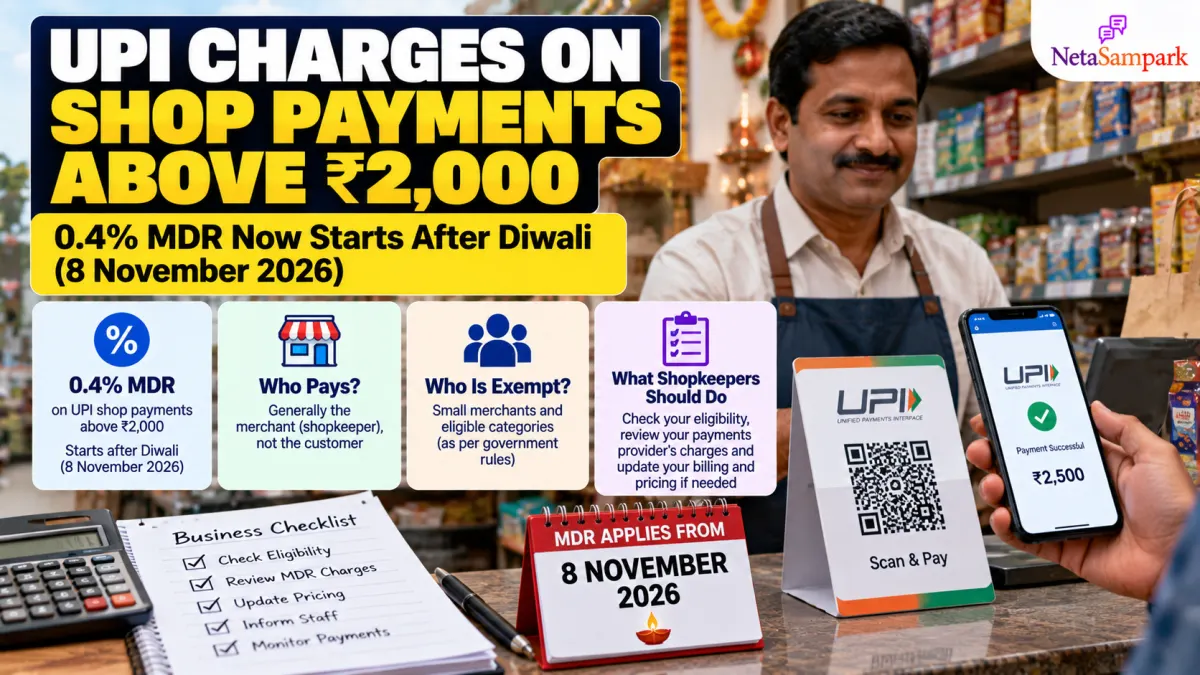
UPI Charges on Shop Payments Above ₹2,000: 0.4% MDR After Diwali 2026 — Who Pays, Who Is Exempt and What Shopkeepers Should Do
India’s proposed Merchant Discount Rate (MDR) framework for selected UPI merchant payments has been postponed until after Diwali 2026. Under the announced framework, eligible merchant transactions above ₹2,000 may attract an MDR of 0.4%, while certain sectors and small merchants receive different treatment.
Important date update: Diwali falls on 8 November 2026, but NPCI’s 13 October announcement said the revised implementation date would be notified separately. Therefore, 8 November is not a confirmed start date. Merchants should check for a subsequent official circular before changing their payment arrangements.
Official update: Ministry of Finance — UPI and MDR clarification.
1 What is changing?
MDR stands for Merchant Discount Rate. It is a fee associated with accepting digital payments, distributed among participants in the payment ecosystem, such as banks and payment service providers.
Under the announced framework, the standard rate for specified UPI merchant transactions above ₹2,000 is 0.4%, subject to the applicable exemptions and caps.
| Payment type | Announced treatment |
|---|---|
| Person-to-person UPI transfers | Remain free |
| Merchant payments up to ₹2,000 | Zero MDR |
| Eligible merchant payments above ₹2,000 | 0.4% MDR under the announced framework |
| Transactions of ₹75,000 and above | MDR capped at ₹300 per transaction |
| Eligible small merchants | Zero MDR under the applicable small-merchant framework |
| Certain essential-sector payments | Special flat-rate treatment |
The framework does not mean that every UPI transaction will attract a fee. Eligibility depends on the payment category, merchant classification and applicable rules.
2 Who pays the 0.4% MDR?
The announced framework places the MDR on the merchant payment ecosystem, rather than making it a direct UPI transaction charge for the customer.
For an eligible merchant transaction, the fee is generally handled through the merchant’s payment provider or acquiring bank arrangements.
Here is an illustrative calculation:
| Customer payment | MDR at 0.4% |
|---|---|
| ₹2,000 | ₹0 under the announced threshold |
| ₹2,500 | ₹10 |
| ₹5,000 | ₹20 |
| ₹10,000 | ₹40 |
| ₹50,000 | ₹200 |
| ₹75,000 | ₹300 |
| ₹1,00,000 | ₹300, subject to the announced cap |
These calculations illustrate the standard rate and cap; they are not a guarantee of the fee applied to every transaction. Exemptions and special-sector rules may change the amount.
The Ministry of Finance has clarified that MDR is not a government tax. Banks have been advised to ensure that merchants do not pass the MDR on to customers as an additional UPI charge.
3 Which merchants are exempt?
The announced framework retains zero MDR for qualifying small merchants receiving up to ₹1 lakh per month through UPI QR codes under the applicable person-to-person-merchant (P2PM) category.
This provision is intended to protect street vendors, neighbourhood shops and other eligible small businesses.
However, the ₹1 lakh threshold should not be treated as a universal exemption for every business. Merchant classification, the payment arrangement and the applicable rules determine eligibility.
Before assuming that your shop is exempt, confirm your classification with your acquiring bank or UPI payment provider.
4 Do fuel, railway, telecom and insurance payments follow the same rate?
No. The announced framework provides different treatment for certain essential services and thin-margin sectors.
| Sector or payment category | Announced treatment |
|---|---|
| Railways | Flat ₹5 MDR for specified transactions above ₹2,000 |
| Telecommunications | Flat ₹5 MDR for specified transactions above ₹2,000 |
| Insurance | Flat ₹5 MDR for specified transactions above ₹2,000 |
| Fuel | Flat ₹5 MDR for specified transactions above ₹2,000 |
| Agricultural inputs | Flat ₹5 MDR for specified transactions above ₹2,000 |
| Capital-market transactions | 0.02% MDR, capped at ₹300, for specified categories |
These are category-specific provisions, not a single rate for every payment in the sector. Merchants should verify the exact classification and conditions in the applicable NPCI circular.
5 What happens to customers paying by UPI?
Customers should not assume that a ₹2,500 or ₹10,000 UPI payment will automatically carry an additional charge.
Under the announced framework:
- Person-to-person UPI transfers remain free.
- Merchant payments up to ₹2,000 remain free of MDR.
- MDR on eligible larger merchant transactions is handled within the merchant payment ecosystem.
- Banks have been advised to ensure merchants do not pass MDR on to customers as a separate charge.
If a shop adds a separate UPI surcharge, ask for an explanation and a proper receipt. If you believe an unauthorised fee has been imposed, contact your bank or UPI application provider and retain the transaction details.
6 When will the new MDR framework start?
The original implementation date was 15 October 2026. NPCI subsequently announced on 13 October that MDR on selected person-to-merchant UPI transactions would be implemented immediately after Diwali, with the new date to be notified separately.
Diwali is on 8 November 2026, but the festival date itself does not establish the effective date of the framework.
Before relying on a specific start date, check:
- NPCI — official website and circulars
- Ministry of Finance — official announcements
- Your acquiring bank or UPI payment provider.
Until the revised effective date and operational instructions are confirmed, merchants should avoid treating 8 November as a guaranteed implementation date.
7 What should shopkeepers do now?
Small businesses should prepare without unnecessarily changing their payment practices before the effective date is confirmed.
- Check your merchant classification. Ask your bank or payment provider whether your account falls under the eligible small-merchant exemption.
- Review your payment agreement. Check the applicable MDR, transaction categories, settlement terms and any other disclosed charges.
- Confirm the effective date. Obtain the latest official circular or written guidance from your payment provider.
- Check settlement statements. Once the framework applies, compare eligible transactions against the fee shown in your merchant settlement records.
- Train staff. Explain that MDR is a merchant-side payment cost under the announced framework, not automatically an extra amount to collect from customers.
- Keep records. Save provider notices, transaction references, settlement reports and complaint acknowledgements.
- Review your margins. Estimate the impact on eligible higher-value payments and account for legitimate provider fees in your business planning.
Do not display a new UPI surcharge or change your QR payment terms based solely on a social media message. Confirm the applicable instructions first.
Frequently asked questions
Will every UPI payment above ₹2,000 attract 0.4% MDR?
No. The announced framework applies to specified merchant transactions and includes exemptions, special-sector rates and a cap. Person-to-person transfers remain free.
Will customers have to pay the MDR?
The announced framework places the MDR within the merchant payment ecosystem. The Ministry has said banks have been advised to ensure that merchants do not pass the charge on to customers.
Are small shops exempt?
Eligible small merchants receiving up to ₹1 lakh per month through UPI QR codes under the applicable P2PM category are covered by the zero-MDR provision. Confirm your account classification with your provider.
Does the framework start on 8 November 2026?
That is Diwali day, but NPCI said the revised implementation date would be notified separately. Check the latest official circular before treating 8 November as the start date.
Is MDR a government tax?
No. The Ministry of Finance has clarified that MDR is a payment-ecosystem fee, not a tax collected by the government or NPCI.
Final takeaway
The announced UPI MDR framework introduces a 0.4% rate for specified merchant payments above ₹2,000, subject to exemptions, special-sector treatment and a transaction cap. Person-to-person transfers and eligible small merchants remain protected under the announced zero-MDR provisions.
For shopkeepers, the immediate priorities are to verify merchant classification, understand provider terms and monitor official updates. The exact post-Diwali implementation date still needs confirmation through an official notice.
Check the NPCI website and Ministry of Finance announcements before making changes to your shop’s payment arrangements.