
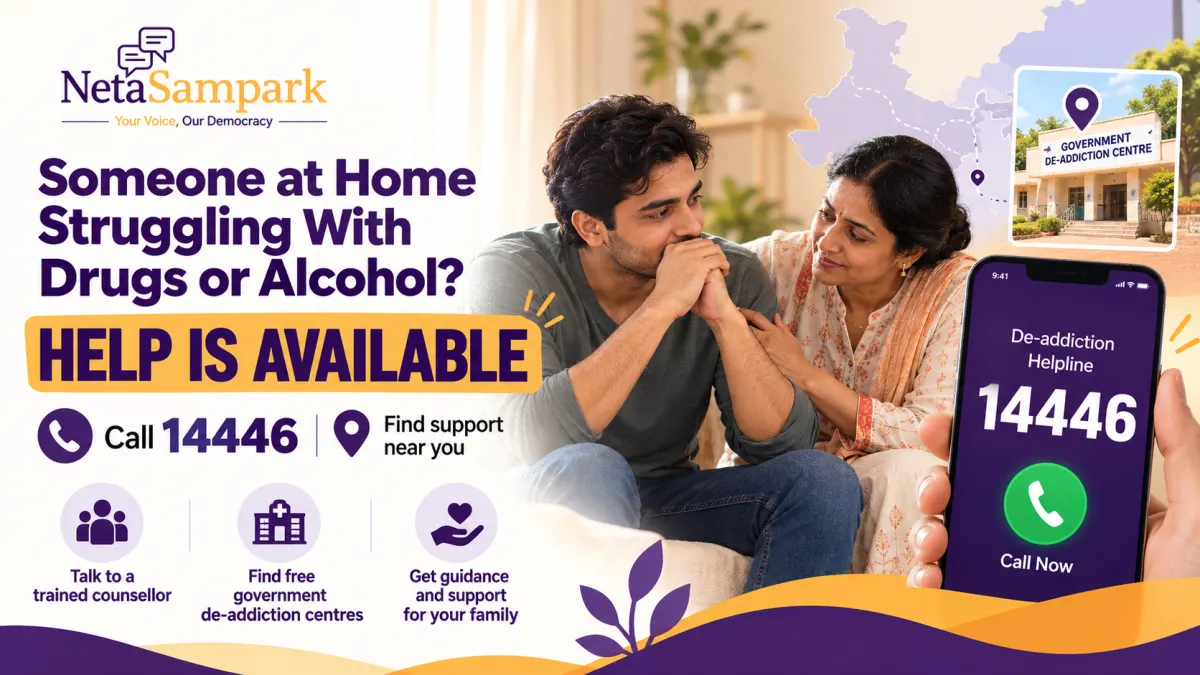
When someone in your family struggles with alcohol or drug use, knowing where to seek help can be difficult. Families often worry about the person's health, the cost of treatment, social stigma and how to approach the subject without making the situation worse.
Many people do not realise that the Government of India operates a national de-addiction helpline and supports treatment, counselling and rehabilitation services through designated facilities across the country.
If someone at home is struggling with drug or alcohol use, you can call 14446 for initial counselling and referral assistance. The helpline is operated under the Ministry of Social Justice and Empowerment's drug demand reduction initiatives. It is intended to help people experiencing substance-related problems, their families and others seeking guidance.
You can also use the government's official online directory to search for de-addiction facilities by state and district.
This guide explains how to call the helpline, find a government-supported de-addiction centre near you, understand which services may be free, and support a family member through the process of seeking treatment.
Important helpline: 14446
Official centre-search portal: https://idams.dosje.gov.in/
Official programme website: https://nmba.dosje.gov.in/
Quick Answer: How to Find a Free Government De-Addiction Centre Near You
If you need help for someone struggling with alcohol or drugs, follow these steps.
- Call 14446: Seek initial counselling and guidance on suitable treatment or referral options.
- Open the official directory: Visit https://idams.dosje.gov.in/.
- Select your state and district: Use the centre-search facility to identify available services.
- Check the type of facility: Determine whether it provides inpatient treatment, outpatient care, counselling or referrals.
- Call the centre before visiting: Confirm admission requirements, treatment availability, eligibility and charges.
- Arrange a professional assessment: A qualified healthcare professional can help determine the appropriate treatment.
- Support the person's recovery: Follow the treatment plan and seek family counselling or aftercare support where available.
Remember: Government support does not automatically mean every service is free. Confirm the charges and eligibility directly with the centre before making arrangements.
What Is the 14446 De-Addiction Helpline?
The 14446 helpline is a national toll-free drug de-addiction helpline established by the Government of India's Ministry of Social Justice and Empowerment.
It operates under the government's broader efforts to prevent substance misuse and improve access to counselling, treatment and rehabilitation services.
According to the Ministry, the helpline provides primary counselling and immediate referral assistance to people seeking help. Family members and others concerned about someone experiencing substance-related problems can also seek guidance.
The helpline is part of the wider Nasha Mukt Bharat Abhiyaan (NMBA), a nationwide initiative launched on 15 August 2020 to address substance use through awareness, prevention, treatment, rehabilitation and community participation.
The initiative has expanded beyond its initial districts and now covers districts across India.
Official information is available at:
- Ministry of Social Justice and Empowerment: https://socialjustice.gov.in/
- Nasha Mukt Bharat Abhiyaan: https://nmba.dosje.gov.in/
- Government de-addiction facility directory: https://idams.dosje.gov.in/
What can you ask when calling 14446?
You can explain the situation and ask for guidance on:
- Where to seek help for someone struggling with alcohol or drug use.
- Whether counselling is available for the affected person or family.
- Which government-supported facilities operate in your district.
- Whether inpatient treatment or outpatient services may be appropriate.
- How to approach a family member who is reluctant to seek help.
- What steps to take to access treatment and rehabilitation.
- Where to seek further assistance if the problem has become urgent.
The helpline provides initial counselling and referral assistance. It is not a substitute for a medical assessment, emergency care or treatment by a qualified healthcare professional.
Is 14446 free to call?
The government describes 14446 as a toll-free helpline. Standard toll-free calling arrangements generally mean that the caller does not pay a call charge, although access can depend on the telephone service and calling conditions.
If you experience difficulty connecting, consult the official Nasha Mukt Bharat Abhiyaan website for current helpline information.
How to Find a Government De-Addiction Centre Near You Online
You do not have to know the name of a rehabilitation centre before seeking help. The Government of India provides an online directory through its Integrated Drug Addiction Monitoring System (IDAMS).
The portal includes a search facility for de-addiction centres and other supported services.
Official directory: https://idams.dosje.gov.in/
Follow these steps to identify facilities in your area.
Step 1: Open the official government directory
Visit https://idams.dosje.gov.in/.
Look for the section titled Search De-Addiction Center or the equivalent centre-search facility on the website.
Use the official government website rather than relying only on advertisements or unverified rehabilitation-centre listings.
Step 2: Select your state
The directory provides a state-selection field.
Choose the state in which you want to find treatment. For example, if the person lives in Jaipur, select Rajasthan.
If the family can travel to another district for treatment, you can also investigate facilities in nearby districts.
Step 3: Select your district
Choose the relevant district from the available options.
Selecting the district helps narrow the search to facilities associated with that area.
If you do not find a suitable centre in your district, expand the search to neighbouring districts and ask the helpline about additional referral options.
Step 4: Review the available facilities
The directory lists supported facilities and provides information about different types of services.
Depending on the centre and the information available, you may be able to identify organisations operating inpatient rehabilitation centres, district de-addiction centres and other treatment or counselling facilities.
Read the available details carefully. A centre that offers counselling and referral services may not provide residential treatment, while an inpatient facility may have specific admission requirements.
Step 5: Contact the centre before travelling
Once you identify a suitable facility, contact it to confirm the details.
Ask the following questions:
- Do you currently accept new patients?
- Do you treat alcohol dependence, drug dependence or both?
- Is a doctor's assessment required before admission?
- Do you provide outpatient treatment, inpatient care or both?
- Which services are covered by government support?
- Are consultation, medicines, tests, accommodation or meals chargeable?
- What documents should the family bring?
- Can a family member accompany the patient?
- Is there a waiting list?
- What arrangements are available for emergencies?
Do not assume that a centre provides a particular service merely because it appears in the directory.
Step 6: Arrange an assessment
The appropriate treatment depends on the substance involved, the person's health, the severity of dependence and other individual circumstances.
A qualified healthcare professional can assess the situation and recommend the appropriate level of care.
Some people may benefit from outpatient counselling and medical treatment. Others may require supervised withdrawal management, inpatient care or a structured rehabilitation programme.
The treatment decision should be made with qualified professionals rather than based solely on the family's assumptions.
Which Government-Supported De-Addiction Centres Are Available in India?
The Ministry of Social Justice and Empowerment supports several types of facilities and programmes under the National Action Plan for Drug Demand Reduction (NAPDDR).
The main categories include the following.
1. Integrated Rehabilitation Centres for Addicts (IRCAs)
Integrated Rehabilitation Centres for Addicts provide inpatient treatment and rehabilitation services for people experiencing substance dependence.
Depending on the facility, services may include:
- Assessment and counselling.
- Support for de-addiction and recovery.
- Treatment and rehabilitation.
- Psychosocial support.
- Follow-up and aftercare.
- Assistance with reintegration into family and community life.
An IRCA may be suitable when a person needs a structured residential programme, subject to professional assessment and the centre's admission criteria.
Before admission, ask which medical services are provided onsite and how the centre handles withdrawal symptoms or medical complications.
2. District De-Addiction Centres (DDACs)
District De-Addiction Centres are designed to bring several forms of support together at the district level.
Depending on the facility, services may include prevention, assessment, counselling, treatment, rehabilitation and referrals.
These centres can be a useful starting point for families who are unsure where to seek help.
Contact the centre to establish whether it provides the specific service needed or refers patients to another institution.
3. Outreach and Drop-In Centres (ODICs)
Outreach and Drop-In Centres provide community-based support, screening, assessment, counselling and referrals to treatment and rehabilitation services.
They can help connect people experiencing substance-related problems with suitable services.
An ODIC is not necessarily a residential treatment facility. Ask whether it offers the treatment required or can refer the person to an appropriate centre.
4. Addiction Treatment Facilities (ATFs)
Addiction Treatment Facilities are supported through the government's initiatives and may operate in government hospitals.
Their services and treatment arrangements depend on the institution.
If you prefer treatment through a hospital, ask the hospital about its addiction-treatment services, outpatient department, psychiatric services or referral arrangements.
5. Community-based peer-led programmes
Community-based Peer Led Intervention programmes focus on prevention, awareness and peer support, including work with vulnerable young people.
They are part of the broader effort to reduce substance-related harm and connect communities with support.
These programmes should not be confused with medical detoxification or inpatient treatment.
The official directory can help you investigate available facilities and services:
For programme information, visit:
https://socialjustice.gov.in/schemes/42/archive
Are Government De-Addiction Centres Completely Free?
This is one of the most important questions families ask before seeking treatment.
The Government of India provides financial assistance to designated organisations and supports various treatment and rehabilitation services under NAPDDR. However, the precise services covered can differ by facility, funding arrangement, eligibility and treatment needs.
Do not assume that every centre listed online provides every service free of charge.
Before choosing a centre, confirm what is covered and whether the patient will have to pay for any part of the treatment.
What should you ask about the cost?
| Service | What to confirm |
|---|---|
| Initial consultation | Whether the assessment is free or chargeable. |
| Counselling | Whether individual and family counselling are included. |
| Medical treatment | Whether doctors' fees, medicines and clinical monitoring are covered. |
| Withdrawal management | Whether medically supervised withdrawal care is available and covered. |
| Inpatient admission | Whether accommodation and treatment are supported by government funding. |
| Diagnostic tests | Whether laboratory tests and other investigations are chargeable. |
| Food and accommodation | Whether meals and residential facilities are included. |
| Aftercare | Whether follow-up consultations and continued support are available without charge. |
The answer may differ between centres.
If the first facility you contact cannot provide free treatment, ask 14446 or the relevant government department whether another supported facility is available.
How can you avoid unexpected charges?
Before admission:
- Ask for a written explanation of the treatment charges.
- Confirm which services are covered by government support.
- Ask whether any medicines, tests or additional services are chargeable.
- Request a receipt for any payment.
- Verify that the centre is listed or appropriately authorised for the services it claims to provide.
- Avoid paying anyone who promises guaranteed recovery or a government-funded admission without proper confirmation.
Be cautious about claims that a person can be cured within a fixed number of days. Recovery varies, and treatment should be based on the person's clinical needs.
How to Help a Family Member Who Is Struggling With Alcohol or Drugs
Finding a centre is only one part of the process. Families often need help understanding how to approach someone who may deny the problem, refuse treatment or become defensive when substance use is discussed.
A supportive approach can make it easier to begin a conversation about seeking professional help.
1. Choose a calm moment to talk
Avoid starting a difficult conversation when the person is intoxicated, highly distressed or behaving aggressively.
Choose a time when the person is relatively calm and you can speak privately.
Explain what you have observed without labelling or insulting them.
For example:
"I am concerned because I have noticed that alcohol is affecting your health and our family life. I want to understand what you are going through and help you find professional support."
2. Focus on the impact rather than blame
Substance dependence is a health issue that may involve physical, psychological and social factors.
Calling someone weak, irresponsible or a failure is unlikely to help them engage constructively with treatment.
Instead, explain the specific concerns you have noticed, such as health problems, missed work, financial difficulties or changes in behaviour.
Avoid arguing about whether the person is an addict. Focus on the need for a professional assessment.
3. Offer a practical first step
Some people may feel overwhelmed by the idea of entering a rehabilitation centre.
A smaller first step may be more manageable.
You could offer to:
- Call 14446 together.
- Speak with a qualified doctor.
- Find a government-supported centre.
- Accompany the person to an initial assessment.
- Ask about treatment options and costs.
- Arrange a confidential conversation with a counsellor.
The aim is to make seeking help easier, not to force the person into a confrontation.
4. Understand that treatment may involve several stages
Recovery is not always a single event or a fixed-duration programme.
Depending on the person's needs, care may involve assessment, medical treatment, counselling, rehabilitation and ongoing follow-up.
Some people need help managing withdrawal symptoms. Others need support with cravings, emotional difficulties, relationships or returning to work and family responsibilities.
A qualified professional can explain the appropriate plan.
5. Seek support for yourself and other family members
Living with someone who has a substance-related problem can be exhausting.
Family members may experience stress, fear, financial pressure and uncertainty about what to do next.
You can seek counselling or guidance even if the affected person is not yet willing to attend treatment.
It is also reasonable to set boundaries to protect your safety, finances and wellbeing.
Supporting someone does not mean accepting violence, threats or unsafe behaviour.
6. Avoid unqualified treatment advice
Do not attempt to manage severe withdrawal symptoms at home without medical advice.
Alcohol withdrawal can be life-threatening, and withdrawal from certain drugs can also require urgent medical supervision.
Do not stop, start or change prescription medicines on the person's behalf without consulting a qualified professional.
When Should You Seek Emergency Medical Help?
A de-addiction helpline can help with initial guidance and referral, but some situations require immediate medical attention.
Seek emergency medical care if the person experiences:
- Seizures.
- Severe confusion or disorientation.
- Hallucinations or extreme agitation.
- Difficulty breathing.
- Loss of consciousness or inability to wake up.
- Suspected overdose.
- Severe vomiting or other serious symptoms during withdrawal.
- Immediate risk of self-harm or harm to another person.
Call 112 in India for emergency assistance when there is an immediate threat to life or safety.
Do not wait for a helpline referral if the person appears to be experiencing a medical emergency.
If someone may have overdosed, do not leave them alone while waiting for help. Follow the emergency operator's instructions and do not try to make them vomit.
A special warning about alcohol withdrawal
If a person drinks heavily or has been drinking regularly for a long period, abruptly stopping alcohol can trigger dangerous withdrawal symptoms.
A doctor should assess whether medically supervised withdrawal management is required.
Do not attempt an unsupervised detoxification programme based on advice from friends, online videos or unqualified practitioners.
What If the Person Refuses to Go to a De-Addiction Centre?
A family member may recognise the problem before the affected person does.
They may deny that their substance use is harmful, fear social judgement or worry about losing control over their life.
You cannot always persuade someone to seek treatment in a single conversation. However, you can still take constructive steps.
Start with a conversation rather than an ultimatum
Explain what worries you and listen to the person's concerns.
Ask what they think is happening and whether they would be willing to speak with a doctor or counsellor.
Avoid making promises that treatment will be easy or that recovery is guaranteed.
Offer confidential guidance
You can call 14446 to ask about the available counselling and referral process.
Explain that the person is reluctant to seek help and ask what options may be appropriate for a family in this situation.
Confirm the helpline's current procedures for supporting family members.
Do not confuse refusal with a lack of treatment options
Even when the affected person is unwilling to attend a centre, family members can seek guidance about communication, safety, boundaries and appropriate next steps.
A qualified mental-health professional or addiction specialist may help the family understand how to proceed.
Protect children and vulnerable family members
If substance use is associated with violence, neglect, unsafe driving or other dangerous behaviour, prioritise the safety of everyone in the household.
Seek emergency assistance where necessary. Do not put yourself at risk by attempting to physically restrain or forcibly transport an intoxicated person.
Any decision about involuntary treatment must follow applicable law and appropriate medical assessment.
How Much Does De-Addiction Treatment Cost in India?
There is no single price for all de-addiction treatment in India.
Costs can vary substantially depending on whether a person receives outpatient counselling, medical treatment, inpatient care or a residential rehabilitation programme.
The cost may also depend on the institution, location, length of treatment, medical complications and services provided.
Government-supported centres may offer some services without charge, subject to their funding arrangements and eligibility rules.
Private rehabilitation centres may charge for consultations, accommodation, medicines, therapy and other services.
Rather than choosing a centre solely on the basis of its advertised price, confirm:
- Whether it has qualified medical professionals.
- Whether it can manage withdrawal safely.
- Whether the treatment plan is appropriate for the substance involved.
- Whether the charges are transparent.
- Whether follow-up care is available.
- Whether the centre is appropriately registered or authorised for its services.
A low price does not necessarily indicate poor treatment, and a high price does not guarantee better outcomes.
Frequently Asked Questions About the 14446 De-Addiction Helpline
1. What is the 14446 helpline number?
14446 is the Government of India's national toll-free de-addiction helpline under the Ministry of Social Justice and Empowerment. It provides primary counselling and referral assistance to people seeking help with drug or alcohol-related problems and their families.
2. Is 14446 available for alcohol addiction as well as drug addiction?
The government describes 14446 as a drug de-addiction helpline within its broader substance-use support initiatives. If the problem involves alcohol, explain the situation when calling and ask for suitable counselling or referral options.
3. Can a family member call 14446 on behalf of someone else?
The helpline is intended to assist affected individuals, their families and others seeking help. A family member can contact the service to ask about available guidance and referral options.
4. How do I find a government de-addiction centre in my district?
Visit the official Integrated Drug Addiction Monitoring System directory at https://idams.dosje.gov.in/.
Use the centre-search facility to select your state and district, review the available facilities and contact the relevant centre to confirm services and admission arrangements.
5. Are all government-supported de-addiction centres free?
Not necessarily. Government support may cover designated services at particular facilities, but the charges and eligibility rules can vary. Confirm the cost of consultation, treatment, medicines, tests and accommodation directly with the centre.
6. Can I find a free rehabilitation centre near me online?
You can use the government's official centre directory to identify supported facilities near your district. Contact the centre to determine whether it offers the required treatment free of charge and whether the person is eligible.
If no suitable option appears, call 14446 and ask about referral assistance.
7. What is the difference between an IRCA and a District De-Addiction Centre?
An Integrated Rehabilitation Centre for Addicts provides inpatient treatment and rehabilitation. A District De-Addiction Centre is designed to bring together multiple forms of support, which may include treatment, counselling, prevention and rehabilitation.
The services available at an individual facility should be confirmed before visiting.
8. Does every de-addiction centre provide inpatient treatment?
No. Some facilities focus on screening, counselling, outreach and referrals, while others provide inpatient treatment. Check the centre's services and admission requirements before travelling.
9. What should I do if the person refuses treatment?
Seek guidance yourself by calling 14446 or contacting a qualified healthcare professional. You can learn how to approach the conversation, protect family members and identify suitable treatment options without waiting for the person to agree to every step.
10. Can someone recover from alcohol or drug dependence?
Many people improve with appropriate treatment and continuing support. The treatment approach and recovery process depend on the substance involved, the person's health and other individual circumstances. A qualified healthcare professional can help determine the appropriate care.
11. Is rehabilitation the only treatment option?
No. Treatment may involve outpatient consultations, counselling, medication, medically supervised withdrawal management, inpatient care or a combination of services. The appropriate approach depends on the person's clinical needs.
12. What should I do if someone has an overdose?
Seek emergency medical assistance immediately. Call 112 in India when emergency assistance is required. Do not wait for a routine de-addiction referral or attempt to manage a serious overdose at home.
13. Where can I find official information about government de-addiction programmes?
Visit the Ministry of Social Justice and Empowerment at https://socialjustice.gov.in/ or the Nasha Mukt Bharat Abhiyaan website at https://nmba.dosje.gov.in/.
The government facility directory is available at https://idams.dosje.gov.in/.
Official Links and Resources
If you or someone in your family needs help, start with these official resources.
- National de-addiction helpline: 14446
- Government de-addiction centre directory: https://idams.dosje.gov.in/
- Nasha Mukt Bharat Abhiyaan: https://nmba.dosje.gov.in/
- Ministry of Social Justice and Empowerment: https://socialjustice.gov.in/
- National Action Plan for Drug Demand Reduction: https://socialjustice.gov.in/schemes/42/archive
- Emergency assistance in India: 112
The directory and official programme websites are the primary sources for identifying government-supported services. Call the relevant facility to confirm that its contact information, treatment availability and charges are current.
Conclusion: Asking for Help Is the First Step Towards Recovery
When someone in the family struggles with drugs or alcohol, it can be difficult to know where to begin. Families may feel overwhelmed by uncertainty, the cost of treatment or fear of social judgement.
You do not have to navigate the situation without guidance.
The Government of India's 14446 helpline offers initial counselling and referral assistance. Its official online directory can help you identify supported de-addiction facilities by state and district.
Start by seeking guidance, speak with a qualified healthcare professional and find out which treatment options are appropriate for the person concerned. Confirm the services and charges before arranging admission.
Most importantly, approach the situation with compassion while protecting the safety and wellbeing of everyone involved.
If someone at home needs help, call 14446 or visit https://idams.dosje.gov.in/ to begin looking for support.
About NetaSampark
NetaSampark is a civic engagement platform that helps citizens access useful information about government services, public institutions, citizens' rights and democratic participation.
Through practical guides and civic resources, NetaSampark aims to make public information easier to understand and help people identify the appropriate channels for seeking assistance.
Visit https://netasampark.com/ to explore more guides and resources that help citizens navigate government services and access public information.