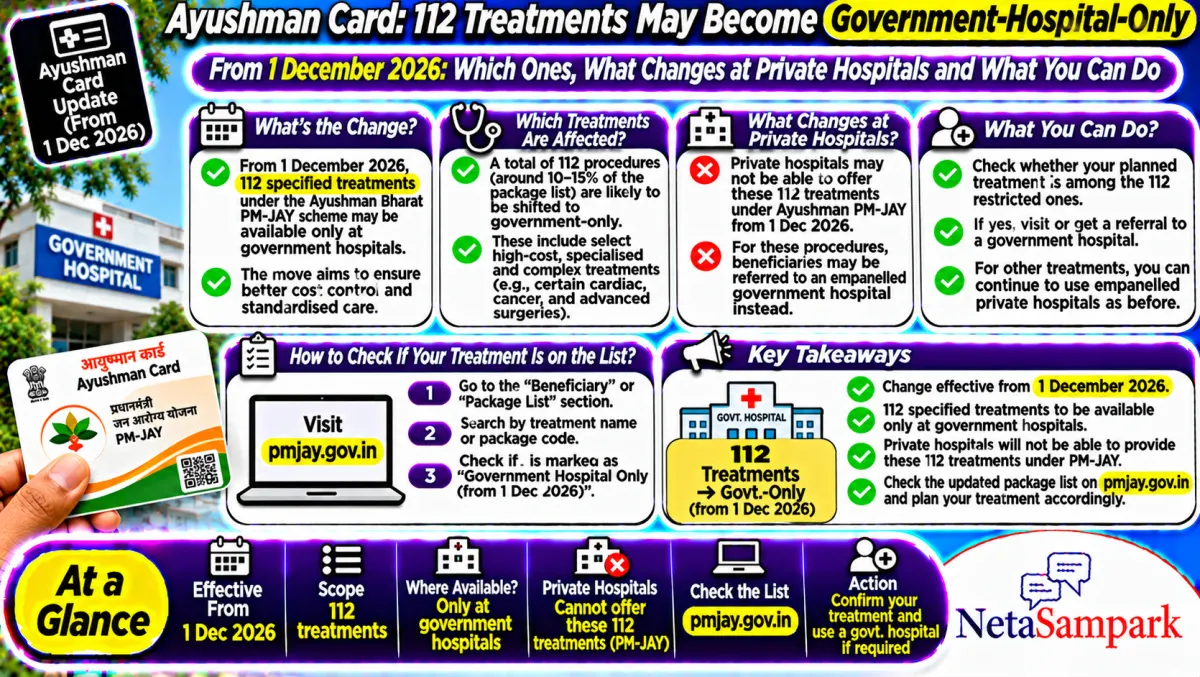
The National Health Authority has proposed reserving 112 Ayushman Bharat PM-JAY treatments for government hospitals, up from 23. States had to send views by 25 November 2026, and the change is proposed from 1 December 2026. If it goes through, cashless care for these at private hospitals may stop, depending on your state.
Updated 21 November 2026
If you or your parents carry an Ayushman card, this one matters. Many families use the card at a nearby private hospital for things like piles surgery, a hysterectomy, a kidney stone attack or a bad bout of diarrhoea. Under this proposal, those could become "government hospital only" packages. The private hospital may then say no to cashless treatment for them.
Nothing has changed yet. It's a proposal sent to states through an Office Memorandum dated 13 October 2026, as reported by ThePrint, The New Indian Express and PTI. But the proposed start date is just days away, so it's worth knowing what's on the list and what you can do if a hospital turns you away.
Quick facts
| Item | Details |
|---|---|
| Official portal | PM-JAY (pmjay.gov.in) and the beneficiary portal (beneficiary.nha.gov.in) |
| Helpline | 14555 (Ayushman Bharat national helpline) |
| Fee | None. PM-JAY treatment is cashless for eligible families, up to ₹5 lakh a year |
| Deadline | States' views due 25 November 2026; change proposed from 1 December 2026 (not final yet) |
| Documents | Ayushman card or Aadhaar for verification at the hospital's Arogya Mitra desk |
| Packages reserved now | 23 (13 obstetrics and gynaecology, 10 mental health) |
| Packages proposed | 112 (89 more) |
| Who decides finally | NHA with your State Health Agency. States can add more; cutting needs the state health department's written approval |
What exactly is changing?
Since 2019, 23 PM-JAY packages have been reserved for public hospitals. That means a private empanelled hospital generally can't book them as cashless PM-JAY cases. Most of these are things like caesarean deliveries and some types of hysterectomy, plus mental health packages.
The NHA now wants to take that national list to 112. The idea, as NHA officials explained to reporters on 18 November 2026, is that these are common conditions that a community health centre or sub-divisional hospital should be able to handle. It wants patients treated closer to home and more PM-JAY money flowing into government hospitals.
Here's the timeline as reported:
| Step | Date |
|---|---|
| NHA Office Memorandum sent to State Health Agencies | 13 October 2026 |
| Officials explain the plan to the media | 18 November 2026 |
| Last date for states to send suggestions | 25 November 2026 |
| Proposed start in the hospital software (TMS) | 1 December 2026 |
Which treatments are on the proposed list?
The full list of 112 hasn't been put up on a public portal yet. From what NHA officials and the reports describe, the 89 new ones include:
Surgeries and procedures
• More hysterectomy types, including vaginal and laparoscopically assisted
• Piles (haemorrhoids) and anal fissure surgery
• Hydrocele surgery and circumcision
• Breast lump removal, biopsies, and removal of cysts and lipomas
• Dilation and curettage (D&C), myomectomy (fibroid removal), diagnostic laparoscopy
• Medical termination of pregnancy (MTP)
Medical conditions
• Severe anaemia and accelerated hypertension
• Acute bronchitis, diarrhoea, dysentery and gastroenteritis
• Urinary tract infection and renal colic (kidney stone pain)
• Acute fever illnesses and diabetic foot problems
• Screening for diabetic retinopathy and glaucoma
Mental health
• About 12 packages, mostly for children and teenagers, such as ADHD, anxiety and depression, conduct disorders and developmental disorders
Treat this as the reported list. The final list your state adopts could be shorter or longer.
Will your state follow it?
That's the big question. NHA officials have said states can reserve more packages than the national list. But if a state wants to reserve fewer, it needs written approval from its own health and family welfare department.
Several states already reserve extra packages for government hospitals. So in some states you won't notice much change, and in others it could be a big shift. If your district's government hospital doesn't have a working operation theatre or a surgeon, the change could mean longer travel. Health experts quoted by ThePrint raised exactly this worry, pointing to the Health Ministry's own data that rural community health centres had only 4,413 specialists in place against 13,232 sanctioned posts as of 31 March 2023.
What should you do if you need one of these treatments?
Don't panic and don't delay treatment. Here's a practical plan.
1. Before 1 December 2026, nothing changes. If a private empanelled hospital has already planned your surgery as a cashless PM-JAY case, ask them to complete pre-authorisation now.
2. After 1 December 2026, ask the Arogya Mitra first. Every empanelled hospital has an Arogya Mitra desk. Ask plainly: "Is this package reserved for government hospitals in our state now?"
3. Check your nearest government hospital. Use the hospital search on the PM-JAY portal to find empanelled government hospitals. Our guide on finding an empanelled Ayushman hospital near you walks you through it.
4. Ask about referral. If the government hospital can't do the procedure, ask for a written referral. Under PM-JAY practice, a reserved package can usually be done at a private hospital on referral from a public hospital. Confirm this rule with 14555 or your State Health Agency, because states set it differently.
5. Emergencies come first. If it's an emergency, go to the nearest hospital. Don't let a package rule stop you from getting care.
6. Never pay cash for a covered package without asking. If a private hospital asks for money for something covered under PM-JAY, call 14555 first.
What if a hospital refuses you or asks for money?
You have a grievance route. Call 14555, or file a complaint on the grievance system. We've explained the steps in Ayushman hospital refused cashless care? Call 14555 and file a CGRMS grievance.
Keep these handy when you complain:
☐ Your Ayushman card number or PM-JAY ID
☐ Hospital name and the date you went
☐ What they told you, and any bill or written note
☐ The treatment or package name, if you know it
If your Ayushman card isn't active or your e-KYC is pending, fix that first. Our Ayushman card e-KYC guide has the steps.
Who is eligible for PM-JAY anyway?
PM-JAY covers families listed in the scheme's beneficiary database, mostly based on the Socio-Economic Caste Census data and state additions, plus all citizens aged 70 and above under Ayushman Vay Vandana. Each eligible family gets cover of up to ₹5 lakh a year for hospital treatment. You can check your eligibility on the beneficiary portal with your mobile number or Aadhaar.
This proposal doesn't change who is eligible or the ₹5 lakh cover. It only changes where some treatments can be taken cashless.
Is this good or bad for patients?
Both sides have a point, honestly.
The case for it: Government hospitals get more PM-JAY money, which they can spend on equipment, medicines and staff. Some packages, like unnecessary hysterectomies and C-sections, have been misused at private hospitals. Former NHA CEO Indu Bhushan told ThePrint that shifting hard-to-audit treatments to public hospitals could cut misuse.
The worry: Many rural public hospitals don't have the specialists or theatres to take on more surgeries. If the government hospital can't do it and the private one won't take the card, the patient pays out of pocket.
That's why the state-level decision is so important. If you see problems at your local hospital, tell your MLA. Health infrastructure is a state subject, and your MLA can raise it in the assembly.
What happens next?
Watch for two things after 25 November 2026. First, whether NHA publishes the final national list. Second, whether your State Health Agency issues its own order on reserved packages. We'll update this post when the final list is out.
Frequently asked questions
Is the 112-package rule final?
No. As of 21 November 2026 it's a proposal. States had to send their views by 25 November 2026, and the change is proposed from 1 December 2026 after considering that feedback.
Will my Ayushman card stop working at private hospitals?
No. Your card still works at empanelled private hospitals for all packages that aren't reserved. Only the reserved packages would need a government hospital, as per your state's final list.
Can a private hospital still treat me for a reserved package?
In emergencies, go to the nearest hospital. For planned treatment, a referral from a government hospital usually helps. Check the exact rule with 14555 or your State Health Agency.
Where can I see the full list of 112 treatments?
It hasn't been published on a public portal yet. Ask the Arogya Mitra at your hospital or call 14555 after 1 December 2026 to check a specific treatment.
Does this change the ₹5 lakh cover?
No. The cover stays up to ₹5 lakh per family per year. Only where certain treatments can be taken cashless may change.
Final reminder
If anyone in your family has a planned surgery that's on the reported list, talk to the hospital's Arogya Mitra this week (before 1 December 2026). Save 14555 on your phone. And if your district hospital can't handle these treatments, raise it with your MLA. Find your MLA and MP on NetaSampark and tell them what you saw.
Sources
• Ayushman Bharat PM-JAY official website
• ThePrint: 112 treatments for government hospitals, 19 November 2026 (news report)
• The New Indian Express: 89 additional packages, 18 November 2026 (news report)