
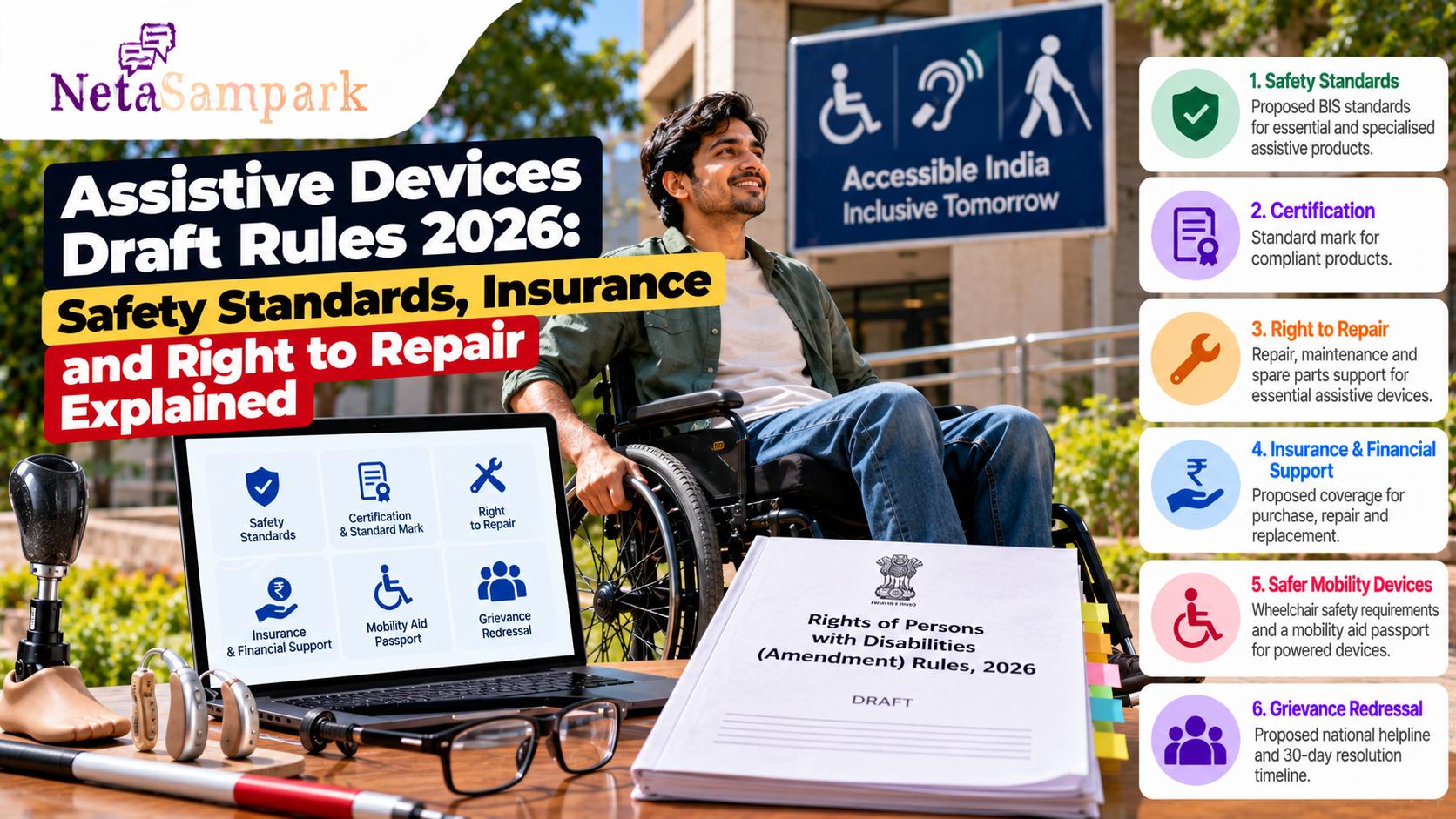
Assistive Devices Draft Rules 2026: Safety Standards, Insurance and Right to Repair Explained
The Centre has proposed a new framework for assistive products and technology used by persons with disabilities, covering everything from wheelchairs and hearing aids to prosthetics, screen readers and emerging technologies.
The proposals are contained in the draft Rights of Persons with Disabilities (Amendment) Rules, 2026, notified by the Department of Empowerment of Persons with Disabilities (DEPwD), Ministry of Social Justice and Empowerment. The draft was published in the Official Gazette on 3 October 2026, and the government has invited objections and suggestions before the rules are finalised. Gazette Tracker
The proposed framework covers four issues that matter directly to users and families:
Safety standards → certification → financial/insurance support → repair and replacement rights.
But there is an important qualification: these are draft rules, not yet a final regulatory framework. The proposals can still change after public consultation.
What Are the Draft Rules Trying to Change?
The proposed framework would add specific provisions on Assistive Products and Technology (Standards and Accessibility) to the Rights of Persons with Disabilities Rules, 2017.
It follows the Supreme Court's direction in Rajive Raturi v. Union of India, which called for clear, non-negotiable accessibility requirements rather than relying only on broad guidelines. Gazette Tracker
The draft would create a framework covering:
- Classification of assistive products
- Safety and quality standards
- Certification and standard marks
- Wheelchair safety requirements
- Mobility-aid information passports
- Government procurement
- Financial assistance
- Insurance coverage
- Repair and replacement
- Grievance redressal
- Accident and malfunction reporting
First: What Counts as an Assistive Product?
The draft defines an assistive product broadly as a device or product used by a person with a disability to perform everyday activities more independently.
Examples mentioned in the draft include:
- Wheelchairs
- Hearing aids
- White canes
- Screen readers
- Braille displays
- Communication apps
- Spectacles
- Prosthetics
- Cochlear implants
- Augmentative and alternative communication devices
The draft divides them into three categories. Gazette Tracker
1. Essential Assistive Products
These are products needed for routine and everyday activities.
Examples include:
- Hearing aids
- Mobility aids
- Screen readers
- Spectacles
- Wheelchairs
2. Specialised Assistive Products
These are more advanced products intended for specific groups or functional requirements.
Examples include:
- Prosthetics
- Cochlear implants
- Augmentative and alternative communication devices
3. Emerging Assistive Products
This category is designed for newer technologies whose applications may evolve.
The draft gives examples such as:
- AI-enabled communication devices
- Robotics
- Brain-computer interface systems
The classification is not necessarily permanent. The draft says the lists can be periodically reviewed, and an emerging product could eventually move into an essential or specialised category once its specifications and manufacturing processes become standardised. Gazette Tracker
What Is "Assistive Technology" Under the Proposal?
The draft distinguishes the product from the wider technology support around it.
Assistive technology would include services such as:
- Assessing what product a person needs
- Fitting or customising the device
- Training the user
- Repairing the product
- Maintenance
- Ongoing support
That means the proposal is not limited to selling a device. It recognises that a device may only be useful when it is properly fitted, configured and maintained. Gazette Tracker
New Safety Standards for Assistive Products
One of the biggest proposed changes is the move toward mandatory standards for essential and specialised assistive products.
The draft proposes giving the Bureau of Indian Standards (BIS) or another designated expert authority responsibility for prescribing standards.
If standards are introduced in phases, the authority would have to specify the phases and technical reasons for that approach. Gazette Tracker
Why does this matter?
Assistive devices are not ordinary consumer products.
A malfunctioning wheelchair, prosthetic device, hearing system or mobility aid can directly affect a person's:
- Safety
- Mobility
- Independence
- Ability to work
- Access to education
- Ability to travel
The draft specifically says standard-setting should give special attention to products associated with accidents or mishaps caused by lack of standardisation. Gazette Tracker
What Would the Standard Mark Mean?
The proposal says only assistive products manufactured according to the prescribed standards would be eligible to carry the relevant standard mark.
The BIS or other designated authority would establish the process through which manufacturers can obtain permission to use the mark. Gazette Tracker
For consumers, the intended result is straightforward:
A user should have a clearer way to identify whether a regulated assistive product meets the applicable standard.
However, the exact standards, certification process and implementation phases would have to be established by the competent authorities.
Special Rule for Wheelchairs and Mobility Devices
The draft proposes a specific safety requirement for mobility devices.
Standard:
- Manual wheelchairs
- Motorised wheelchairs
- Other wheeled mobility devices
would have to be equipped with transit-ready tie-down securement brackets. Gazette Tracker
These brackets are intended to help secure a wheelchair or mobility device during transportation.
This is particularly relevant for users who travel in vehicles or accessible transport systems.
What Is a "Mobility Aid Passport"?
The draft proposes another important requirement for powered mobility devices.
Manufacturers of powered wheelchairs and other mobility devices would have to provide a mobility aid passport with the product. Gazette Tracker
The proposed passport would contain information such as:
- Dimensions
- Weight
- Battery type
- Dismantling instructions
Why could this help?
A mobility aid can be difficult to transport or repair if staff do not know its:
- Weight
- Size
- Battery configuration
- Safe dismantling procedure
A standard information document could make transport, handling and servicing easier.
Government Procurement Would Also Change
The draft proposes that government procurement of assistive products—including:
- Devices
- Software
- Integrated systems
should take place through a transparent tendering process. Gazette Tracker
For essential products, the proposal allows procurement from self-certified entities.
For specialised products, the draft proposes sourcing from certified manufacturers, including manufacturers licensed by BIS or another designated authority. Gazette Tracker
This could become particularly important for government-funded distribution programmes.
A New Online Assistive Products Portal
The draft proposes an online Assistive Products Portal.
It is intended to cover functions including:
- Applications
- Certification
- Procurement
- Distribution tracking
- Grievance monitoring
The proposal also links this portal with the Ministry of Consumer Affairs' Right to Repair system. Gazette Tracker
For users, the long-term objective would be to make it easier to follow a device through its lifecycle rather than treating procurement as the end of the process.
What Does the Proposed Right to Repair Mean?
This is one of the most significant parts of the proposal.
The draft says the Ministry of Consumer Affairs' Right to Repair Scheme should be extended to essential and specialised assistive products. Gazette Tracker
That could improve users' ability to obtain:
- Repairs
- Maintenance
- Replacement parts
- Servicing information
- Ongoing technical support
The practical details—such as which products, parts, manufacturers and repair information will be covered—would depend on the final framework and subsequent implementation.
Why Is Right to Repair Especially Important for Assistive Devices?
For an ordinary consumer product, a broken device can be inconvenient.
For a person who relies on a wheelchair, hearing aid, prosthetic or communication device, a breakdown can mean losing essential independence.
A device may be:
- Custom-fitted
- Expensive
- Difficult to replace
- Dependent on specialist servicing
- No longer supported by the manufacturer
The draft therefore treats repair and replacement as part of accessibility rather than simply as a consumer-service issue.
Proposed Insurance and Financial Support
The draft also addresses affordability.
It proposes that the Central and State Governments frame schemes to provide financial support for eligible users purchasing assistive products.
The proposed support could include:
- Subsidies
- Reimbursements
- Insurance coverage
Importantly, the draft goes beyond the initial purchase price. It proposes coverage for:
- Initial procurement
- Replacement
- Repair
- Reimbursement where the user has already paid the cost directly
The draft specifically proposes that the relevant insurance policies and government schemes cover these costs for essential assistive products. Gazette Tracker
Does this mean every insurance policy will immediately cover repairs?
No.
This is a proposed regulatory framework.
The draft says governments should frame schemes and that insurance policies and government schemes should provide the proposed coverage. The actual insurance products, eligibility rules, claim procedures, limits and implementation would need to be worked out.
So users should not assume that an existing private health or general insurance policy automatically covers an assistive device simply because these draft rules have been published.
What If You Pay for a Repair Yourself?
The proposal specifically includes reimbursement where users have borne costs directly.
If implemented as proposed, this could become important for users who need to pay upfront for an eligible repair or replacement.
But until the final rules and schemes are notified, users should continue to follow the terms of their existing insurance or government assistance programme.
Keep:
- Original invoice
- Repair estimate
- Payment receipt
- Device details
- Warranty documents
- Prescription/assessment where relevant
- Insurance correspondence
These documents can be useful when making any future reimbursement claim.
What Happens If an Assistive Device Causes an Injury?
The draft proposes a dedicated National Assistive Products Accident Database.
If an assistive device malfunctions and causes an injury or accident, the incident would be investigated and the findings recorded. Gazette Tracker
A designated authority would maintain the database.
The information could then be used to:
- Improve standards
- Identify recurring safety problems
- Investigate defective products
- Support decisions on non-standard products
This is significant because safety regulation would be informed by actual incidents rather than only by technical specifications.
A National Helpline Is Also Proposed
The draft proposes a national toll-free helpline for feedback and complaints.
It also proposes a 30-day resolution timeline for complaints. Gazette Tracker
The grievance system is intended to be accessible through multiple formats, including:
- Voice
- Text-based platforms
- Indian Sign Language interpretation
This is designed to make the complaint mechanism itself accessible to people with different communication needs.
The proposed helpline should not be confused with the existing DEPwD national disability helpline, 14456, which is already listed on the Department's website. Empowerment of Persons with Disabilities
The draft's proposed assistive-products helpline is a separate proposed mechanism.
Emergency Replacement After Disasters
The draft also contains a provision for disasters and emergencies.
It proposes that national and State disaster-management authorities ensure the immediate replacement or provision of essential assistive technology to affected users as part of relief and rehabilitation measures. Gazette Tracker
This could be particularly important after:
- Floods
- Cyclones
- Earthquakes
- Major fires
- Other disasters
where a wheelchair, hearing device or other essential assistive product may be damaged or lost.
What Should Users Do Right Now?
Because these are draft rules, there is no need for users to replace existing devices simply because the proposal has been published.
Instead, users can take practical steps.
If you are buying a new device
Ask the supplier:
- What standards does the product comply with?
- Does it have applicable certification?
- Who will repair it?
- Are spare parts available?
- How long will the manufacturer support it?
- What is covered under warranty?
- What happens if the device fails?
- Is there an authorised service centre nearby?
If you already own an assistive device
Keep:
☑ Purchase invoice
☑ Warranty card
☑ Serial/model number
☑ Prescription or assessment documents
☑ Repair records
☑ Service-centre details
☑ Insurance documents
☑ Government-scheme approval documents, where applicable
This documentation becomes particularly important when seeking repair, replacement or reimbursement.
What Manufacturers Should Watch
The proposed framework could create additional responsibilities for manufacturers, particularly those supplying essential and specialised assistive products.
Potential areas include:
- Compliance with prescribed standards
- Certification
- Standard-mark requirements
- Safety information
- Mobility-aid passports
- Repair and maintenance support
- Accident reporting
- Government procurement requirements
However, the exact obligations will depend on the final rules and standards notified by the competent authorities.
What About Emerging Technologies?
The draft deliberately creates an emerging category for technologies such as AI-enabled communication systems, robotics and brain-computer interfaces.
This is important because technology is developing faster than traditional regulatory categories.
The draft allows the classification of products to evolve as:
- Technical specifications become clearer
- Manufacturing becomes more established
- Standards are developed
- Safety evidence becomes available
An emerging product could therefore eventually move into an essential or specialised category. Gazette Tracker
Draft Rules vs Final Rules: Don't Confuse Them
This is the most important qualification for anyone reading about the proposal.
The government has invited objections and suggestions before finalising the rules. The notification says comments will be considered before the draft is taken forward. Gazette Tracker
Therefore, the following should currently be understood as proposals:
- Mandatory standards
- Standard marks
- Mobility-aid passports
- Insurance coverage
- Repair rights
- The new portal
- The national helpline
- Accident database
- Emergency replacement mechanisms
They should not be presented as already-enforceable rights under a final 2026 rule.
What Is the Public-Comment Opportunity?
The notification was issued on 8 September 2026 and published in the Official Gazette on 3 October 2026. It provides a 30-day period from publication for objections and suggestions. Gazette Tracker
That makes this consultation relevant not only to manufacturers and government departments but also to:
- Persons with disabilities
- Families and caregivers
- Assistive-technology users
- Rehabilitation professionals
- Manufacturers
- Service providers
- Disability-rights organisations
- Insurance providers
- Consumer organisations
The official Department of Empowerment of Persons with Disabilities is the relevant government department for the consultation and implementation framework. Empowerment of Persons with Disabilities
Quick Comparison: What the Draft Proposes
| Area | Proposed change |
|---|---|
| Safety | Standards for essential and specialised products |
| Certification | Standard mark for compliant products |
| Wheelchairs | Transit-ready tie-down brackets |
| Mobility devices | Mobility Aid Passport |
| Procurement | Transparent government tendering |
| Portal | Applications, certification, procurement, tracking and grievances |
| Insurance | Proposed coverage for initial cost, repair and replacement |
| Repair | Right to Repair extended to essential and specialised products |
| Emergencies | Replacement/provision of essential assistive technology |
| Complaints | National toll-free helpline |
| Resolution | Proposed 30-day grievance timeline |
| Safety monitoring | National accident database |
What Users Should Check Before Buying an Assistive Device
Until the proposed framework is finalised, use this practical checklist:
☐ Identify the exact functional requirement
☐ Get professional assessment/fitting where appropriate
☐ Check applicable standards or certification
☐ Ask who will repair the device
☐ Confirm spare-parts availability
☐ Check warranty terms
☐ Ask about replacement costs
☐ Keep the invoice and serial number
☐ Check whether a government subsidy or scheme applies
☐ Check existing insurance terms rather than assuming coverage
Bottom Line
The 2026 draft rules represent a proposed shift from treating assistive devices simply as products to treating them as part of a person's accessibility, safety and independence needs.
The framework proposes:
Safety standards → certification → safer mobility devices → financial support → insurance → repair and replacement → grievance redressal.
For users, the biggest potential changes are the proposed standards for essential and specialised products, mobility-aid passports, Right to Repair, insurance/financial support for repair and replacement, and a national safety-incident database. Gazette Tracker
But remember: these are draft provisions, not a final set of enforceable rules yet. The government is accepting objections and suggestions before finalisation.
For the latest official notifications, consultations and disability-related schemes, check the Department of Empowerment of Persons with Disabilities. Empowerment of Persons with Disabilities