
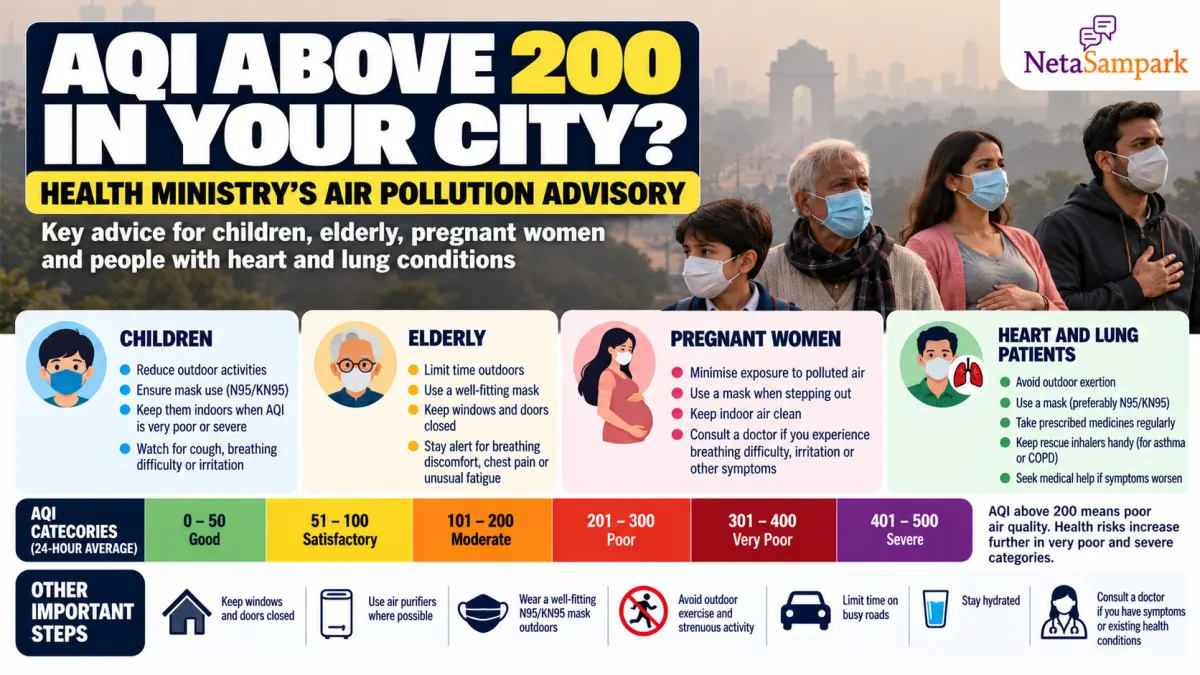
When India's Air Quality Index (AQI) rises above 200, air pollution becomes a health concern that deserves attention—not just for people with existing illnesses, but also for families with young children, older adults and pregnant women.
The Union Health Ministry's air-pollution guidance, issued through the National Centre for Disease Control (NCDC), recommends reducing exposure, avoiding outdoor exertion and taking extra precautions for vulnerable groups as air quality worsens.
The key message: If your city's AQI is above 200, avoid outdoor exercise and strenuous activity. If the AQI rises further, vulnerable people should minimise outdoor exposure and keep activity levels low.
Here is what the advisory says, how to protect your family and when symptoms need medical attention.
1 What does AQI above 200 mean?
India's National AQI system classifies air quality into six categories. The Central Pollution Control Board (CPCB) publishes readings for monitoring stations across the country.
| AQI range | Category | What it means for health |
|---|---|---|
| 0–50 | Good | Minimal health impact |
| 51–100 | Satisfactory | Minor breathing discomfort may occur in sensitive people |
| 101–200 | Moderate | People with asthma, lung disease or heart disease, as well as children and older adults, may experience discomfort |
| 201–300 | Poor | Prolonged exposure may cause breathing discomfort in many people; vulnerable groups may be affected sooner |
| 301–400 | Very Poor | The risk of respiratory illness increases with prolonged exposure |
| 401–500 | Severe | Serious health impacts are possible, including among people with existing heart or lung conditions |
Sources: CPCB National AQI information and Health Ministry/NCDC air-pollution advisory.
A reading of 220 and a reading of 420 are not equivalent. Both call for caution, but the recommended precautions become more restrictive as the AQI increases.
2 What does the Health Ministry advise at different AQI levels?
The Ministry's public-health guidance sets out the following broad precautions.
| AQI category | Advice for the general public | Advice for vulnerable people |
|---|---|---|
| Moderate (101–200) | Reduce prolonged or strenuous outdoor exertion | Avoid prolonged or strenuous outdoor exertion |
| Poor (201–300) | Avoid outdoor physical exertion | Avoid outdoor physical activities |
| Very Poor (301–400) | Avoid outdoor physical activities, particularly during morning and late-evening hours | Remain indoors and keep activity levels low |
| Severe (401–500) | Avoid outdoor physical activities | Remain indoors and keep activity levels low |
These are broad public-health recommendations. Follow any stricter local health advisory, particularly during severe pollution episodes.
3 What should parents do when AQI is above 200?
Children can be more vulnerable to polluted air because their lungs are still developing and they may spend time running, playing or exercising outdoors.
When the AQI enters the Poor category or worse, parents should consider the following steps.
- Avoid outdoor sports and strenuous play. Move physical activity indoors where the air is cleaner.
- Reduce time near busy roads. Vehicle emissions can add to exposure, especially at congested junctions.
- Keep children away from smoke. Avoid cigarette smoke, incense and other indoor pollution sources.
- Watch for symptoms. Persistent coughing, wheezing, unusual breathlessness or eye irritation warrants attention.
- Follow medical advice. Children with asthma or other respiratory conditions should follow their prescribed treatment plan.
For very young children, especially those under five, be particularly cautious during prolonged pollution episodes.
Do not assume that a school or indoor room is automatically pollution-free. Where possible, keep children in a cleaner indoor environment and follow local school and public-health instructions.
4 Precautions for older adults
Older adults may be more susceptible to the effects of air pollution, particularly if they have cardiovascular disease, chronic lung disease or other existing health conditions.
When AQI is above 200:
- Avoid outdoor walks and strenuous exercise.
- Reschedule non-essential outdoor errands when possible.
- Keep prescribed medicines readily available.
- Follow the doctor's advice for existing heart or lung conditions.
- Seek medical advice if breathing discomfort, chest tightness, unusual fatigue or other concerning symptoms develop.
At Very Poor or Severe levels, the Ministry's guidance recommends remaining indoors and keeping activity levels low for vulnerable people.
If you care for an older family member, help arrange essential errands and medical appointments in ways that minimise exposure.
5 What should pregnant women know?
Pregnant women are included among the groups identified as vulnerable in the Health Ministry's air-pollution guidance.
During a pollution episode, it is sensible to:
- Reduce avoidable exposure to polluted outdoor air.
- Avoid outdoor workouts and strenuous physical activity when AQI is Poor or worse.
- Keep indoor air as clean as practical.
- Avoid tobacco smoke and indoor burning.
- Consult an obstetrician or healthcare professional if you have concerns about exposure or develop symptoms.
Pregnancy does not mean that every outdoor exposure will cause harm. The goal is to reduce unnecessary exposure, especially during prolonged periods of poor air quality, and follow individual medical advice.
6 Advice for people with asthma, COPD, heart disease or other chronic conditions
People with asthma, chronic obstructive pulmonary disease (COPD), other lung diseases and cardiovascular conditions should take particular care during high-pollution periods.
The Health Ministry advises people with underlying chronic pulmonary or cardiovascular conditions to avoid exposure as much as possible, avoid strenuous activity, keep prescribed medication readily available and follow their doctor's instructions.
What you should do
- Keep your prescribed medicines available.
- If you use a rescue inhaler, keep it accessible and use it according to your treatment plan.
- Avoid outdoor exercise and strenuous exertion.
- Check local AQI readings before planning outdoor activities.
- If your doctor has advised an action plan for worsening symptoms, follow it.
- Seek prompt medical advice if symptoms worsen.
Do not stop prescribed heart or lung medication because of pollution, and do not change doses without consulting your clinician.
Seek urgent medical attention for severe breathlessness, significant chest pain, fainting, confusion, bluish lips or other signs of a medical emergency. Do not wait for the AQI to improve before seeking help.
7 Should you wear an N95 mask when AQI is above 200?
A well-fitting particulate respirator can reduce exposure to airborne particles, but it does not eliminate all pollution risks.
The Health Ministry's advisory notes that disposable N95 or N99 masks may be useful when used correctly. The fit matters: gaps around the nose and cheeks can allow polluted air to enter.
If you choose to use one:
- Select a genuine, well-fitting N95 or N99 respirator.
- Follow the manufacturer's instructions for wearing and replacement.
- Make sure it covers the nose and mouth securely.
- Do not treat a mask as permission to continue strenuous outdoor exercise in polluted air.
Cloth masks, handkerchiefs and scarves do not provide equivalent protection against fine particulate pollution.
People who have difficulty breathing while wearing a respirator should seek advice from a healthcare professional, especially if they have an existing medical condition.
8 Can an air purifier help?
An appropriately sized air purifier can help reduce indoor particle levels when used and maintained correctly. It is not a substitute for reducing exposure at the source.
If you use one:
- Choose a unit suited to the room size.
- Follow the manufacturer's instructions for placement and filter replacement.
- Keep doors and windows closed when outdoor air is heavily polluted, where practical.
- Avoid air purifiers that deliberately generate ozone, which can harm the respiratory system.
If your home does not have an air purifier, you can still take steps to reduce indoor pollution. Avoid smoking indoors, burning waste or incense, and using other unnecessary combustion sources in enclosed rooms.
Where air conditioning is available, a recirculation setting may help reduce the entry of outdoor air, depending on the system. Ensure that indoor ventilation and other household safety requirements are also considered.
9 Should you cancel your morning walk or outdoor workout?
When AQI is above 200, the Health Ministry's guidance is to avoid outdoor physical exertion. This includes strenuous outdoor workouts and running.
A practical approach is to:
- Check the AQI before leaving home.
- Move exercise indoors during Poor or worse air quality.
- Avoid exercising beside busy roads even when conditions elsewhere are better.
- Recheck conditions before rescheduling outdoor activities.
At Very Poor and Severe levels, vulnerable people should remain indoors and keep activity levels low. Do not rely on visibility alone: air pollution can be harmful even when the air does not look particularly hazy.
10 How to check the AQI in your city
Use official monitoring sources rather than relying only on social-media screenshots.
CPCB All India AQI dashboard: https://app.cpcbccr.com/AQIIndia
How to use it:
- Open the dashboard.
- Find your state, city or nearest monitoring station.
- Check the reported AQI and its category.
- Compare readings from nearby stations if available.
- Recheck later because pollution levels can change throughout the day.
A city-wide figure may not capture every neighbourhood's conditions. Your exposure can vary by location, traffic, weather and nearby pollution sources.
11 Common mistakes to avoid during a pollution episode
- Continuing strenuous exercise outdoors: Shift exercise indoors when AQI is Poor or worse.
- Assuming a cloth mask is enough: A well-fitting N95 or N99 offers better particulate protection.
- Ignoring symptoms: Worsening breathing difficulty or chest symptoms need medical attention.
- Opening windows during every pollution episode: When outdoor air is heavily polluted, closing windows may help reduce entry of polluted air; ventilate appropriately when conditions improve and consider indoor pollution sources.
- Relying on one AQI screenshot all day: Check current official readings and local advisories.
- Stopping prescribed medication: Continue your treatment plan unless your clinician advises otherwise.
Frequently asked questions
Is AQI 200 dangerous?
An AQI of 200 falls at the upper end of the Moderate category in India's AQI scale. The Poor category begins at 201. Even below 201, children, older adults and people with heart or lung disease may experience health effects, so sensitive groups should reduce prolonged or strenuous outdoor exertion.
What should I do if AQI is 250?
AQI 250 falls in the Poor category. Avoid outdoor physical exertion and, if you are in a vulnerable group, avoid outdoor physical activities. Reduce unnecessary exposure and check the local forecast for changes.
What if AQI reaches 350?
AQI 350 is Very Poor. The Ministry's guidance recommends avoiding outdoor physical activity, particularly during morning and late-evening hours. Vulnerable people should remain indoors and keep activity levels low.
Is an N95 mask enough to protect me?
No mask eliminates all exposure. A well-fitting N95 or N99 can reduce inhalation of particles, but staying away from polluted air and avoiding outdoor exertion are also important.
Should I go to hospital if I have a cough during high AQI?
A mild cough can have several causes, but worsening symptoms should not be ignored. Seek medical advice if coughing persists or is accompanied by wheezing or breathing difficulty. Seek urgent care for severe breathlessness, significant chest pain, fainting or other emergency symptoms.
Official sources
- National Centre for Disease Control (NCDC), Ministry of Health and Family Welfare: Public Health Advisory on Air Pollution and Health
- Ministry of Health and Family Welfare: Air-pollution health advisory
- Central Pollution Control Board: All India AQI dashboard
- CPCB National AQI information: AQI categories and health impacts
Final takeaway
When AQI rises above 200, take it seriously: avoid outdoor physical exertion, check official readings and reduce unnecessary exposure. Children, older adults, pregnant women and people with heart or lung conditions need additional care, particularly as air quality enters the Very Poor and Severe categories.
Keep prescribed medicines available, use a well-fitting N95 or N99 if appropriate, keep indoor air as clean as practical, and seek medical help if symptoms worsen. The best protection is to reduce exposure before pollution begins affecting your health.